
Post-Ride Recovery Tips for Cyclists: A Mechanical Approach to Performance Optimization
In short
Discover evidence-based post-ride recovery tips for cyclists that go beyond traditional methods. Learn how advanced mechanical deep-tissue treatment addresses the root cause of cycling-induced tension for lasting performance gains.
Every serious cyclist knows the feeling. You finish a challenging ride—maybe it was a brutal hill climb, a century push, or an intense interval session—and you’re riding that endorphin high. But within 24 to 48 hours, reality sets in. The hip flexors tighten. The lower back seizes. The quads feel like concrete blocks, and your IT bands remind you of every pedal stroke with a dull, persistent ache.
I’ve spent the last decade working with cyclists at every level, from weekend warriors to competitive athletes, and I can tell you with absolute certainty: most riders are approaching recovery completely wrong. They’re treating symptoms instead of causes, applying temporary band-aids to mechanical problems that demand precision engineering solutions.
Understanding the Biomechanical Reality of Cycling Stress
Before we discuss recovery strategies, we need to establish what actually happens to your body during a cycling session. This isn’t about general fatigue or “soreness”—those are surface-level descriptions that miss the mechanical reality underneath.
When you cycle, you’re performing thousands of repetitive hip flexions and extensions, each one creating microscopic trauma and tension accumulation in specific muscle groups. The hip flexors—particularly the iliopsoas complex—work continuously in a shortened position. The quadriceps undergo eccentric loading with every downstroke. The glutes and hamstrings fire asymmetrically depending on your bike fit and pedaling mechanics. Meanwhile, your lower back stabilizers are locked in static contraction for hours.
This creates a cascade of compensatory tension patterns. Your body doesn’t just “get tired”—it builds protective tension layers, fascial adhesions, and trigger point formations that fundamentally alter your biomechanics. Left unaddressed, these patterns compound ride after ride, eventually manifesting as chronic pain, reduced power output, and increased injury risk.
I see this progression constantly. A cyclist comes to me complaining about knee pain, and within minutes of assessment, I’ve identified the actual culprit: a chronically shortened rectus femoris that’s pulling the patella out of optimal tracking. The knee isn’t the problem—it’s the victim of mechanical dysfunction upstream.
Why Traditional Recovery Methods Fall Short
Let me be direct about something the cycling community doesn’t want to hear: most of what you’re doing for recovery is addressing the wrong layer of the problem.
The Hydration and Nutrition Fallacy
Yes, you need adequate hydration and nutrition. That’s non-negotiable. But drinking electrolytes and consuming protein doesn’t release a trigger point in your vastus lateralis. It doesn’t address fascial restrictions in your IT band. These are mechanical problems requiring mechanical solutions.
I worked with a competitive road cyclist last year who had optimized every nutritional variable possible. He was spending hundreds on supplements, timing his macros perfectly, hydrating meticulously. Yet he couldn’t understand why his performance plateaued and his hip pain worsened. Within three sessions of proper mechanical treatment—targeting the exact tissue restrictions limiting his hip extension—his power numbers improved by 8% and the pain completely resolved.
Nutrition supports the system. It doesn’t fix mechanical dysfunction.
The Stretching Misconception
Static stretching has become cycling recovery gospel, and it’s largely ineffective for the type of tension cyclists develop. When you stretch a muscle that contains deep trigger points and fascial adhesions, you’re pulling on tissue that can’t lengthen properly because it’s mechanically restricted at a deeper layer.
Think of it like trying to stretch a rope that has knots tied in it. You’re just creating tension around the knot—not releasing it. Cyclists spend 20 minutes in hip flexor stretches that provide temporary relief because they’ve created a neurological inhibition response, but the underlying mechanical restriction remains completely intact.
The Foam Rolling Limitation
Foam rolling has value for surface-level myofascial release and increasing blood flow. But it’s fundamentally limited by physics. You’re using your body weight against a broad surface—you can’t generate sufficient pressure at the precise angle required to release deep-tissue restrictions without compromising other areas.
I respect foam rolling as a maintenance tool. But when a cyclist tells me they’ve been rolling their IT band for months and still experiencing lateral knee pain, I know immediately that they’re not reaching the actual restriction. They’re working the surface while the problem exists three centimeters deeper in the vastus lateralis and tensor fasciae latae junction.
The Mechanical Deep-Tissue Protocol: Addressing Root Causes
After a decade of treating cyclists and studying body mechanics at both theoretical and applied levels, I’ve developed a protocol that specifically targets the mechanical dysfunctions cycling creates. This isn’t traditional massage—it’s precision mechanical treatment designed to release tension at its anatomical origin.
Why Specialized Equipment Changes Everything
Human hands, no matter how trained, have inherent limitations. Variable pressure based on therapist fatigue. Inability to maintain consistent intensity through thick muscle tissue. Limited penetration depth without causing broad-area trauma.
The specialized mechanical tools I use eliminate these variables entirely. They deliver:
Consistent Penetration Depth: The equipment can work three to five centimeters deep into tissue with precision that hands cannot replicate. When I’m treating the deep hip rotators or the iliopsoas complex—muscles absolutely critical for cycling performance—I need to reach these structures without damaging superficial tissue.
Controllable Intensity Gradation: With cyclists, I’m often working across a spectrum from acute inflammation management to deep structural release. The equipment allows me to adjust intensity in micro-increments, matching exactly what each tissue layer requires at that moment.
Elimination of Human Inconsistency: Every treatment delivers identical quality. You don’t get a less effective session because I’m having an “off day” or my hands are fatigued from previous clients. The mechanical advantage is absolute and reproducible.
The Treatment Targeting Protocol
When I work with a cyclist post-ride, I’m following a specific anatomical hierarchy based on cycling biomechanics:
Primary Hip Complex Release
The hip flexors—iliopsoas, rectus femoris, tensor fasciae latae—are always priority one. These muscles work continuously in shortened positions during cycling, creating persistent tension that affects everything downstream. I work systematically through each structure, releasing trigger points and fascial restrictions that have built up over multiple rides.
Most cyclists have never experienced what full hip extension actually feels like because their hip flexors have been chronically short for years. After proper release, they immediately notice increased power through the downstroke and reduced lower back compensation.
Quadriceps Structural Treatment
The quadriceps aren’t just “sore”—they’re filled with micro-trauma and protective tension. Each of the four quad muscles requires individual attention because they all fire differently through the pedal stroke. The vastus medialis often harbors trigger points that refer to the knee. The rectus femoris, crossing both hip and knee, needs work at multiple attachment points.
I treat these systematically, working from superficial to deep layers, releasing restrictions that compromise force production and create compensatory patterns.
Posterior Chain Integration
The glutes and hamstrings in cyclists are often simultaneously weak and tight—a paradoxical state created by poor activation patterns and compensatory tension. I release the mechanical restrictions first, then the cyclist can actually access these muscles properly during subsequent rides.
Lower Back and Erector Stabilization
The lower back in cyclists is almost universally in protective spasm because it’s compensating for hip mobility restrictions and core weakness. By the time I address this area, I’ve already released the primary contributors upstream, allowing the lower back to actually let go instead of guarding.
Evidence-Based Post-Ride Recovery Protocol
Based on both research and a decade of practical application, here’s the recovery protocol that actually works for cyclists:
| Recovery Phase | Timing Post-Ride | Key Actions | Physiological Purpose |
|---|---|---|---|
| Immediate (0-30 min) | Right after ride | Light active recovery, hydration initiation, quick nutrition | Metabolic waste clearance, glycogen replenishment begins |
| Acute (30 min – 2 hours) | Post-shower/change | Proper nutrition, targeted compression, elevation if needed | Inflammation management, nutrient delivery optimization |
| Mechanical Release (2-24 hours) | Same day or next morning | Deep-tissue mechanical treatment targeting cycling-specific restrictions | Fascial adhesion release, trigger point deactivation, optimal tissue length restoration |
| Active Recovery (24-48 hours) | Following day | Easy movement, mobility work, light cross-training | Blood flow enhancement, neuromuscular pattern maintenance |
| Adaptation (48-72 hours) | Before next hard effort | Assessment of mechanical function, final restriction releases if needed | Ensuring optimal biomechanics for next training stimulus |
The Critical Window: 2-24 Hours Post-Ride
Here’s where most cyclists completely miss the opportunity. The window between 2 and 24 hours post-ride is when mechanical treatment delivers maximum impact. Your tissues are still in acute adaptation phase—they haven’t fully solidified into compensatory patterns yet, but inflammation has begun and restriction formation is underway.
When I treat a cyclist during this window, I’m intercepting the body’s tendency to lay down disorganized tissue and create protective tension. I’m guiding the adaptation process toward optimal length-tension relationships instead of letting it default to protective shortening.
A cyclist I’ve worked with for three years credits this timing for his ability to maintain consistent high-volume training without the chronic achiness that plagued his previous years. We treat within 12 hours of his hard rides, and he’s never experienced the accumulated fatigue and dysfunction that used to force him into rest weeks.
The Mobile Treatment Advantage
One barrier I consistently heard from serious cyclists was the challenge of getting to treatment when they’re already fatigued from a hard ride. The last thing you want after a century is to drive across town to a clinic, wait in a reception area, and then drive home in post-treatment soreness.
I eliminated this barrier entirely by bringing the treatment to the cyclist’s location. I arrive with professional equipment—a specialized treatment bench and all mechanical tools required for comprehensive work. You get clinical-quality treatment in your own space, without the logistical burden that often prevents cyclists from prioritizing proper recovery.
This also allows me to assess your bike setup, watch your movement patterns in your actual environment, and provide contextual guidance that a clinic setting simply doesn’t permit.
Common Cycling-Specific Issues and Mechanical Solutions
The IT Band Syndrome Myth
Every cyclist has heard of IT band syndrome. Most think the IT band itself is the problem. It’s not—it’s biomechanically impossible for the IT band to be the primary pain generator because it’s a fascial structure, not a contractile muscle.
The pain cyclists feel on the lateral knee is referred pain from trigger points in the vastus lateralis and tensor fasciae latae, combined with poor hip stability creating excessive lateral tracking. When I treat these structures properly—releasing the actual contractile tissue restrictions—the “IT band pain” resolves completely.
I’ve never had to directly treat an IT band to resolve IT band syndrome. Never. Because the IT band isn’t the cause.
The Lower Back Pain Cycle
Lower back pain in cyclists is almost always a hip mobility issue manifesting downstream. When your hip flexors are chronically short, your pelvis tilts anteriorly, your lumbar spine compensates into excessive lordosis, and your erector spinae muscles work constantly to stabilize this compromised position.
Treating the lower back directly provides temporary relief. Releasing the hip flexors and restoring proper pelvic positioning eliminates the need for that compensatory tension entirely. The back pain doesn’t return because the mechanical cause has been addressed.
Saddle Discomfort and Pelvic Floor Dysfunction
This is an area most cyclists suffer through unnecessarily. Persistent saddle discomfort isn’t just about chamois choice or saddle fit—often it’s about pelvic floor tension and hip rotator restrictions that create poor pelvic positioning on the saddle.
The deep hip rotators—piriformis, obturator internus, gemelli—when restricted, alter how your sit bones contact the saddle and create referral pain that cyclists misinterpret as simple pressure discomfort. Releasing these structures frequently transforms a cyclist’s relationship with their saddle completely.
The Investment Versus Expense Paradigm
I need to address something directly: many cyclists view recovery treatment as an expense rather than an investment. They’ll spend £5,000 on marginal aerodynamic gains from a new frame, but hesitate to invest in the mechanical optimization of their actual engine—their body.
Let me put this in performance terms. If I told you I could increase your sustainable power output by 5-10% and eliminate the chronic discomfort that limits your training volume, what would that be worth to you? What would that mean for your goals, whether that’s completing your first century comfortably or competing at a higher category?
That’s exactly what proper mechanical treatment delivers. It’s not about feeling relaxed for a day—it’s about optimizing the machine that generates power, removing the restrictions that limit performance, and preventing the accumulated dysfunction that ends cycling careers prematurely.
I’ve worked with cyclists who came to me as a “last resort” before giving up cycling entirely due to chronic pain. After systematic treatment addressing their specific mechanical dysfunctions, they’re riding more than ever, pain-free, often faster than they were in their twenties.
That’s not an expense. That’s an investment in sustained performance and quality of life.
Building a Partnership, Not Providing Sessions
The cyclists who see transformative results aren’t coming for occasional treatments when they’re desperate. They’re engaging in a structured partnership where we systematically optimize their biomechanics over time.
This means:
- Regular assessment of mechanical function and restriction patterns
- Customized treatment protocols based on training load and race schedule
- Progressive release of deep, chronic restrictions that require multiple sessions to fully resolve
- Ongoing adjustment as training demands change throughout the season
- Education about the specific mechanical patterns affecting individual performance
A competitive cyclist I’ve worked with for four years describes our relationship as “essential infrastructure” for his training. We treat every 7-10 days during heavy training blocks, less frequently during base periods. He’s 42 years old and posting power numbers that exceed what he was producing at 35, with zero chronic pain issues.
That’s what dedicated partnership delivers.
Frequently Asked Questions: Post-Ride Recovery for Cyclists
How soon after a ride should I receive mechanical treatment?
The optimal window is 2-24 hours post-ride. This intercepts the acute adaptation phase before compensatory patterns fully solidify, while tissues are still responsive to mechanical input. Same-day evening treatment after a morning ride or next-morning treatment after an evening ride both work excellently.
Can’t I just use a massage gun at home?
Massage guns provide surface-level percussion that increases blood flow and creates temporary muscle relaxation through neurological inhibition. They cannot access deep fascial restrictions, release structural trigger points, or provide the graduated pressure required for true mechanical release. They’re useful for maintenance between proper treatments, but they’re not a substitute for precision mechanical work.
How is this different from sports massage?
Traditional sports massage focuses on general relaxation, circulation enhancement, and broad-area work. My approach uses specialized mechanical equipment to access specific anatomical structures with precision pressure and depth that hands cannot replicate. It’s the difference between general maintenance and structural optimization.
Will the treatment be painful?
You’ll experience intensity—working through deep restrictions requires sufficient pressure to create tissue change. But intensity is not the same as pain. I control the pressure precisely to stay within your tolerance while still achieving mechanical release. Most cyclists describe the sensation as “intense but satisfying” and notice immediate improvement in range of motion and comfort.
How often should cyclists receive treatment?
It depends entirely on training volume and existing mechanical dysfunction. Cyclists training 10+ hours weekly with significant intensity benefit from weekly to bi-weekly treatment during hard training blocks. Recreational cyclists often find every 2-3 weeks optimal. We establish frequency based on your specific mechanical needs and training demands.
What should I do immediately after treatment?
Light movement is beneficial—an easy spin or walk helps integrate the mechanical changes. Avoid hard training for 12-24 hours to allow tissues to adapt to their new length-tension relationships. Hydration is important. Most cyclists feel slightly “different” initially as their nervous system adjusts to improved biomechanics, then notice enhanced performance within 24-48 hours.
Can this help with bike fit issues?
Absolutely. Many perceived “bike fit problems” are actually mechanical restrictions in the rider. When hip flexors are chronically short, no saddle height will feel right. When hip rotators are restricted, no cleat angle will eliminate knee issues. I’ve seen countless cyclists go through multiple expensive bike fits when their actual problem was mechanical dysfunction that proper treatment resolves completely.
Do professional cyclists use this type of treatment?
Professional teams employ various recovery modalities, and mechanical treatment is increasingly recognized as essential. The specific equipment and techniques I use are designed to deliver clinical precision without requiring the infrastructure of team support. You’re accessing professional-grade treatment with none of the logistical barriers.
The Long-Term Performance Trajectory
Here’s what most cyclists don’t realize: your current performance isn’t limited primarily by fitness—it’s limited by mechanical restrictions that prevent you from accessing the fitness you already have.
I consistently see power improvements of 5-15% after systematic mechanical treatment, not because we’ve made anyone fitter, but because we’ve removed the restrictions that were preventing full muscular recruitment and optimal biomechanics.
A masters cyclist I worked with last year provides the perfect example. He’d been training consistently for three years, following structured plans, hitting his intervals. But his FTP had plateaued despite increasing training volume. Within six weeks of systematic treatment—releasing chronic hip flexor restrictions, eliminating compensatory tension patterns, optimizing his posterior chain function—his FTP increased by 35 watts. Same fitness. Different mechanical efficiency.
That’s the difference between treating symptoms and addressing causes.
Taking the Next Step
If you’re serious about cycling performance and longevity in the sport, you need to think about recovery differently. It’s not about passive rest or superficial relaxation—it’s about systematic mechanical optimization that allows your body to adapt properly to training stress.
The cyclists I work with aren’t just recovering faster. They’re building sustainable performance improvements, riding pain-free into their 40s, 50s, and beyond, and fundamentally changing their relationship with their bodies.
This isn’t a luxury service for professional athletes. It’s essential maintenance for anyone who wants to optimize their performance, prevent chronic dysfunction, and keep cycling as a lifelong pursuit rather than something they have to give up due to accumulated mechanical problems.
Your body is the most important piece of equipment you own. Every other upgrade you make to your bike is meaningless if the engine—your biomechanical system—is operating at compromised capacity.
The question isn’t whether you can afford proper mechanical treatment. The question is whether you can afford not to invest in the optimization of your actual performance-limiting factor.
After ten years of this work and a degree in physical education and nutrition, I can tell you with complete confidence: the cyclists who prioritize mechanical optimization outperform, outlast, and enjoy the sport more than those who chase marginal gains everywhere except where it matters most—their own biomechanics.
Recovery isn’t about resting. It’s about optimizing. And optimization requires precision, consistency, and expertise applied to the specific mechanical dysfunctions that cycling creates.
That’s what I provide. That’s what transforms good cyclists into exceptional ones. And that’s what keeps you riding at your best for decades, not just seasons.
Evidence and limits
Massage may help with some symptoms, but benefits and evidence vary by condition. It does not replace medical assessment or treatment. A page update is not evidence of an independent clinical review.
Further reading: Massage therapy: evidence, safety and limitations by US National Center for Complementary and Integrative Health. This is general background reading, not verification of every claim in this article.
How we describe evidence and updates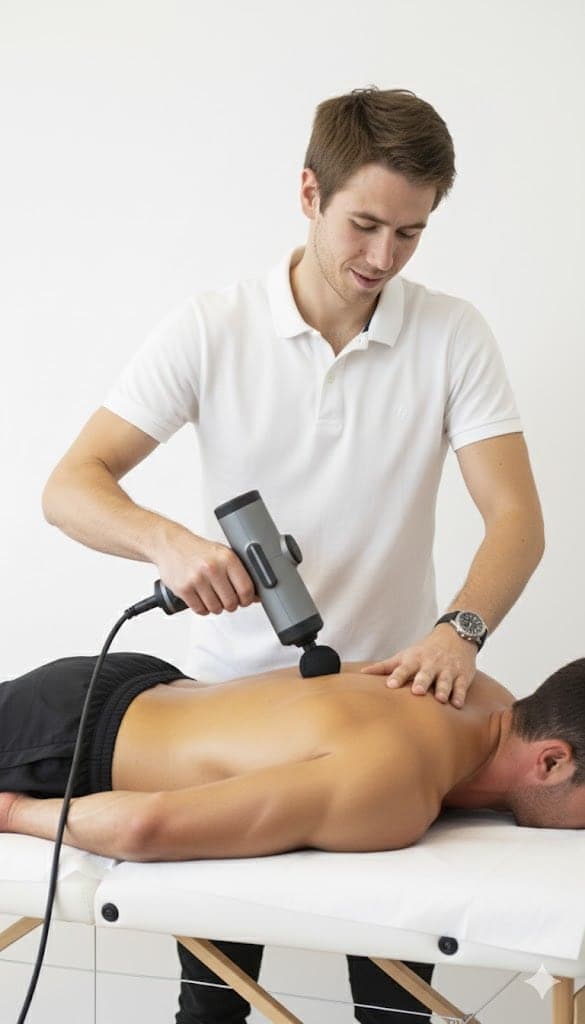
Written by
Chris
Massage therapist, nutrition and exercise physiologist
Norwegian-certified with a Bachelor’s in Physical Education and Nutrition and over ten years of clinical practice, working from a portable table in clients’ homes across the Paphos district.
This article is general information, not a medical diagnosis. If you have severe, worsening or unexplained pain, numbness, weakness, or pain after an accident, see a doctor first.