Body Mechanics Exercises: The Scientific Foundation for Lasting Pain Relief and Performance Enhancement
In short
Discover evidence-based body mechanics exercises that address the root causes of pain and dysfunction. Learn from a decade of clinical experience how proper mechanical training transforms chronic issues into lasting results.
After ten years of working with hundreds of clients—from office workers trapped in chronic pain to elite athletes seeking that final performance edge—I’ve identified a fundamental truth that most practitioners either don’t understand or deliberately ignore: body mechanics exercises aren’t about stretching harder or foam rolling longer. They’re about reprogramming the neuromuscular system to operate as it was designed to function.
The confusion surrounding body mechanics exercises stems from a fitness industry that profits from complexity and recurring dependency. You’ve probably tried the standard prescription: core exercises, stretches, perhaps some yoga poses that promise alignment. Yet the tension returns. The pain persists. The performance plateau remains unbreakable. This isn’t a failure on your part—it’s a fundamental misunderstanding of how mechanical systems in the human body actually function and adapt.
Through my background in Physical Education and Nutrition from Norwegian universities, combined with a decade of clinical specialization in mechanical deep-tissue intervention, I’ve developed a framework that treats body mechanics not as abstract concepts but as concrete, measurable systems that respond to specific mechanical inputs. What follows isn’t theory pulled from textbooks—it’s the distilled methodology I use daily with clients who’ve exhausted conventional options.
Understanding Body Mechanics: Beyond Surface-Level Movement Patterns
Body mechanics represents the intricate relationship between skeletal alignment, muscular tension patterns, fascial restriction, and neurological programming. When I assess a new client, I’m not looking at symptoms. I’m reading a mechanical story written into their tissue—a narrative of compensations, adaptations, and dysfunction layers built over years or decades.
Consider what happens when you sit at a desk for eight hours. Your hip flexors shorten adaptively. Your thoracic spine rounds forward. Your anterior shoulder capsule tightens while posterior stabilizers weaken and lengthen. This isn’t merely “poor posture”—it’s a systematic mechanical reorganization where your body has learned, at a neurological level, that this collapsed position is “normal.” Standard stretching doesn’t address this because the problem isn’t muscle length—it’s nervous system programming combined with deep fascial restriction.
I recall working with a 34-year-old software engineer who’d spent a substantial sum on physical therapy, pilates, and corrective exercise programs over three years. He could perform perfect-looking bird dogs and dead bugs. His hip mobility tests were textbook. Yet every morning, his lower back locked up so severely he needed twenty minutes just to stand upright. The issue wasn’t movement pattern awareness—his nervous system knew exactly what to do. The problem was that layers of fascial adhesion and chronic deep muscle tension prevented those patterns from expressing mechanically. His body physically couldn’t execute what his brain was commanding.
The Three Mechanical Systems That Determine Your Body’s Function
Effective body mechanics exercises must address three interconnected systems simultaneously. Addressing only one creates temporary change at best, and potentially harmful compensation patterns at worst.
The Fascial Network System: Fascia is the continuous three-dimensional web of connective tissue that surrounds and interpenetrates every structure in your body. When restricted through trauma, repetitive strain, or inflammatory processes, it creates mechanical “brakes” that no amount of conscious movement correction can overcome. This is why clients come to me after months of diligent stretching with zero lasting improvement—they’re trying to lengthen structures that are mechanically bound at depths their hands cannot reach.
The Neuromuscular Programming System: Your nervous system controls which muscles activate, in what sequence, with what intensity. Chronic pain and dysfunction rewire these programs. The gluteus maximus that should fire first during hip extension becomes inhibited. The upper trapezius that should stabilize becomes a primary mover. These aren’t conscious choices—they’re deeply ingrained motor patterns maintained by protective mechanisms in your central nervous system.
The Structural Alignment System: Skeletal positioning determines leverage, force distribution, and which tissues bear load during movement. When alignment drifts from optimal parameters through years of compensation, even mechanically sound movement patterns produce problematic loading patterns. Your body learns to function in this compromised state, cementing dysfunction as “normal.”
Why Traditional Body Mechanics Exercises Fail: The Depth Problem
The exercise industry operates under a convenient fiction: that conscious movement alone can reverse years of mechanical adaptation. I’ve watched intelligent, dedicated individuals perform thousands of repetitions of “corrective” exercises with minimal lasting benefit. The reason is mechanical, not motivational.
Human hands, even skilled therapeutic hands, cannot consistently access the depth where chronic mechanical dysfunction lives. The deepest fascial layers, the muscle bellies that harbor decades of protective tension, the myofascial trigger points that maintain pain cycles—these structures exist at depths and densities that manual pressure cannot reliably reach with the consistency required for lasting change.
I spent my first three years in practice using exclusively manual techniques. I was good at it—clients felt better temporarily. But I became frustrated watching the same patterns return within days or weeks. Athletes I worked with showed immediate range of motion improvements that evaporated by their next session. The limitation wasn’t skill or knowledge—it was mechanical reality. Hands have physical constraints that chronic dysfunction exploits.
This realization led me to specialized mechanical intervention tools that deliver what human hands cannot: precision depth control, consistent pressure over extended treatment durations, and the ability to address adhesions at their source rather than their surface manifestations. This isn’t about replacing skill with technology—it’s about amplifying clinical expertise with mechanical capabilities that match the depth and tenacity of chronic dysfunction.
Essential Body Mechanics Exercises: The Foundation Protocol
These exercises form the baseline protocol I prescribe after mechanical intervention has restored functional tissue quality and movement capacity. Attempting them before addressing deep restriction is like trying to renovate a house with a cracked foundation—you’ll work hard, spend resources, and ultimately fail to create lasting change.
Neural Re-education Through Loaded Positioning
These aren’t traditional exercises but neuromuscular reprogramming protocols. The goal isn’t muscular fatigue but nervous system recalibration.
| Exercise Position | Primary Mechanical Target | Execution Protocol | Common Errors |
|---|---|---|---|
| Prone Spinal Extension Hold | Thoracic extensor reprogramming | 10-15 seconds, 6-8 sets, focus on posterior chain activation | Cervical hyperextension, lumbar compression |
| Loaded Hip Hinge Pattern | Posterior hip mechanics restoration | Controlled eccentric, 5-second holds at depth | Knee-dominant pattern, inadequate hip loading |
| Scapular Wall Positioning | Shoulder girdle mechanical reset | 3-minute holds, multiple angles | Rib flare, inadequate scapular depression |
| Anti-rotation Core Stabilization | Deep abdominal wall activation | 8-second contractions, respiratory integration | Breath-holding, superficial muscle dominance |
Movement Pattern Restoration Sequence
After establishing baseline tissue quality and neuromuscular connectivity, these patterns rebuild functional movement competency. Each builds upon the previous—skipping steps guarantees incomplete results.
Phase One: Segmental Spinal Articulation. Most people move their spine as a single rigid unit. This drill reestablishes independent vertebral movement, particularly in the thoracic region where modern life creates the most severe restriction. Lying supine, you slowly articulate each vertebral segment into and out of the floor, spending 15-20 seconds per segment. This isn’t about flexibility—it’s about restoring neurological awareness and control of structures that have been mechanically locked and neurologically forgotten.
A competitive cyclist I worked with couldn’t understand why his power output plateaued despite optimal training and nutrition. His thoracic spine moved as a single 12-vertebra block. When we restored segmental mobility through mechanical intervention and this drill, his power numbers increased 7% within three weeks—not through increased fitness but through improved mechanical efficiency. His body could finally transmit force through structures designed for that purpose rather than compensating through suboptimal patterns.
Phase Two: Integrated Hip-Spine Disassociation. The lumbar spine and hip joint must move independently for proper mechanical function. Years of sitting teach them to move as a linked unit, creating excessive lumbar loading during nearly every movement. This drill reestablishes independent control: lying on your side, you move the hip through its full range while maintaining absolute lumbar neutrality. The difficulty isn’t the movement—it’s the neuromuscular control required to prevent compensatory patterns your nervous system has relied upon for years.
Phase Three: Rotational Capacity Development. Human movement is fundamentally rotational. Walking, throwing, lifting, turning—all require controlled spinal and hip rotation. Yet most body mechanics training obsesses over sagittal plane movements. This creates athletes and individuals who move well forward-and-back but collapse under rotational loads. These drills involve controlled rotation under various loading conditions, from unloaded floor work to standing rotational patterns against resistance. The progressions can take months because you’re not building rotation—you’re removing decades of protective restrictions your body has installed around movements it perceived as threatening.
Advanced Body Mechanics Exercises: Performance and Longevity Integration
Once foundational capacity is restored, these protocols develop resilience and performance capacity that extends beyond basic function into athletic and longevity optimization.
Dynamic Stability Under Variable Loading
Static stability means nothing in real life. You need stability through movement, under changing loads, in unpredictable positions. These exercises create nervous system adaptability that translates into injury resistance and performance capacity.
- Single-leg Proprioceptive Challenge: Standing on one leg sounds simple. Doing it while maintaining optimal hip, knee, and ankle alignment while performing upper body movements that challenge your balance reveals where mechanical weaknesses persist. I watch clients who can squat impressive weights completely lose postural control during this basic human movement pattern. The issue isn’t strength—it’s neuromuscular coordination under destabilizing conditions.
- Loaded Carry Variations: Carrying heavy objects asymmetrically is perhaps the most fundamental human movement pattern. It demands integrated core stability, postural control, and the ability to maintain spinal neutrality under uneven loading. Single-arm farmer’s carries, offset waiter walks, and asymmetrical load carries expose and correct mechanical deficiencies that symmetrical training masks. These aren’t conditioning exercises—they’re assessment tools that reveal compensatory patterns your body has been hiding.
- Reactive Stability Protocols: Your body must respond to unexpected perturbations without thinking. These drills involve controlled destabilization—partner-applied pushes during movement, sudden surface changes, unexpected directional shifts. The nervous system adaptations here are profound. You’re not learning new movements; you’re expanding your body’s ability to maintain mechanical integrity under conditions it hasn’t prepared for.
Velocity-Specific Power Development
Many practitioners avoid explosive movements with clients who have pain histories, believing slow, controlled movement is “safer.” This is mechanically backwards. Life demands power—getting up from chairs, catching yourself from falls, lifting grandchildren. Avoiding power development creates vulnerability.
I had a 58-year-old client referred after two years of conservative physical therapy following a minor back injury. She could perform slow, controlled movements beautifully. But reaching quickly to prevent a falling object caused immediate spasm. Her nervous system had been trained that speed equals danger. We progressively reintroduced velocity-specific training: medicine ball throws, jump training, rapid direction changes. Within eight weeks, she moved with confidence and spontaneity she hadn’t felt in years. The change wasn’t physical conditioning—it was neurological permission to move with the speed life demands.
The Mechanical Deep-Tissue Foundation: Why Exercises Alone Aren’t Enough
Here’s what a decade of clinical experience has taught me: body mechanics exercises are essential, but they’re the second step, not the first. Prescribing exercises to someone with significant fascial restriction and chronic muscular tension is like asking someone to renovate their house while the foundation is crumbling. The effort is genuine, the intention correct, but the mechanical reality prohibits lasting success.
This is why I’ve dedicated my practice exclusively to advanced mechanical deep-tissue intervention. Not because exercises don’t work—they absolutely do, when tissue quality and neurological function allow them to work. But the chronic pain patterns, the movement restrictions, the compensatory patterns that have been building for years or decades exist at tissue depths that conscious exercise cannot address.
The Machine-Assisted Advantage in Body Mechanics Restoration
I use specialized mechanical tools for a simple reason: they deliver results that hands cannot match in consistency, depth, or precision. This isn’t about technology for technology’s sake—it’s about matching the mechanical demands of chronic dysfunction with intervention capabilities that equal those demands.
Depth Capability: Chronic fascial adhesions and muscular tension patterns exist in layers. Surface techniques—whether manual therapy or self-administered tools like foam rollers—address only the most superficial layers. The deeper restrictions remain untouched, continuing to limit movement and maintain dysfunctional patterns. Mechanical intervention reaches the depths where change must occur, consistently and controllably.
Precision Control: Every client’s tissue tolerance is different. Elite athletes may require deep, intense intervention. Someone recovering from chronic pain needs gentler, more gradual progression. Hands tire, pressure varies, consistency suffers. Mechanical intervention allows me to dial in exactly the depth and intensity each tissue area requires, maintaining that precision throughout extended treatment sessions that would be physically impossible using manual techniques alone.
Consistency Across Sessions: I don’t have “off days” where my treatment effectiveness diminishes because I’m fatigued or less focused. Every session delivers identical technical precision. This consistency is crucial for the progressive overload required to remodel chronic tissue dysfunction. Your body doesn’t respond to occasional deep intervention—it responds to consistent, progressive mechanical stimulus that exceeds the threshold required for tissue adaptation.
The Treatment Protocol That Makes Exercises Effective
When clients begin working with me, we don’t start with exercises. We start with comprehensive mechanical intervention that addresses the accumulated restrictions preventing those exercises from producing results. This typically unfolds across three distinct phases:
Phase One: Tissue Quality Restoration (Sessions 1-4). We systematically address the major fascial restrictions and chronic muscular tension patterns throughout your body. This isn’t symptom chasing—we’re treating the mechanical system as an integrated whole. The hip restriction affecting your gait might be contributing to your shoulder pain through compensatory patterns. The thoracic immobility might be the root cause of your recurring neck issues. During this phase, clients often experience dramatic improvements in symptoms they’ve carried for years. This isn’t temporary relief—it’s the removal of mechanical restrictions that have been maintaining those symptoms.
Phase Two: Pattern Correction and Integration (Sessions 5-8). With improved tissue quality, we now address the compensatory movement patterns your nervous system developed around those restrictions. This phase combines continued mechanical intervention focused on specific problematic areas with the introduction of targeted body mechanics exercises. Now those exercises work—because the tissue restrictions that were preventing proper execution have been resolved. Clients often report that movements that previously felt impossible or painful now feel natural and effortless.
Phase Three: Optimization and Maintenance (Ongoing). You’ve achieved the pain relief or performance improvement you sought. Now we shift to maintaining those gains and continuing optimization. This involves less frequent mechanical intervention sessions combined with a customized exercise protocol that keeps your body functioning at this improved level. Many clients continue with monthly or quarterly sessions, not because dysfunction has returned but because they value the continued refinement and optimization of their physical capacity.
Common Body Mechanics Exercise Mistakes That Perpetuate Dysfunction
After watching hundreds of clients attempt to self-correct their mechanical issues before seeking specialized help, I’ve identified the recurring errors that waste time and sometimes worsen problems.
The Stretching Trap
Chronic tightness is rarely a flexibility problem. It’s a stability problem. Your nervous system is maintaining tension as a protective strategy because it perceives mechanical vulnerability somewhere in your system. Aggressively stretching that protective tension without addressing the underlying mechanical instability simply teaches your nervous system to create even more protective tension. I’ve seen this cycle continue for years—people stretching religiously, feeling temporary relief, then finding the tightness returns stronger than before.
A marathon runner came to me after eight months of dedicated hip flexor stretching for chronic tightness. She stretched twice daily, held positions for minutes, used various stretching techniques. The tightness persisted. Within one session of mechanical intervention, we discovered that her hip flexor tightness was a protective response to profound core instability and glute dysfunction. Her body was using hip flexor tension to stabilize a system that lacked proper neuromuscular control. When we addressed the actual mechanical deficiency, the “tightness” resolved without stretching it once.
The Strengthening Misunderstanding
Weakness is often neurological inhibition, not muscular deficiency. Your glutes aren’t weak because they lack strength—they’re inhibited because your nervous system has learned to accomplish hip extension through alternative pathways, typically using your hamstrings and lower back. Performing endless glute bridges doesn’t fix this if the neurological inhibition pattern remains. You simply get stronger at performing glute bridges using your hamstrings and lower back—reinforcing the exact dysfunctional pattern you’re trying to correct.
True correction requires removing the mechanical restrictions that caused the inhibition, then retraining the movement pattern under conditions where the target muscle cannot avoid activation. This demands precision that most self-directed programs cannot provide.
The Symmetry Assumption
Body mechanics exercises are typically prescribed symmetrically—same exercises, same repetitions, same loading for both sides. Yet mechanical dysfunction is almost never symmetrical. Your right hip has different restrictions than your left. Your dominant shoulder has different compensatory patterns than your non-dominant. Treating both sides identically guarantees suboptimal results on at least one side and potentially reinforces asymmetries rather than correcting them.
Effective intervention requires asymmetrical attention. When I assess clients, I’m not looking for symmetry—I’m mapping the specific mechanical limitations and compensatory patterns on each side independently, then designing interventions that address those specific patterns rather than assuming both sides need identical treatment.
Body Mechanics Exercises for Specific Dysfunction Patterns
Different mechanical dysfunction patterns require targeted exercise protocols. These aren’t one-size-fits-all routines but specific interventions for common patterns I encounter clinically.
Anterior Pelvic Tilt and Lower Cross Syndrome
This epidemic pattern—tight hip flexors, weak glutes, overactive lower back, weak deep abdominals—doesn’t respond to the standard prescription of hip flexor stretching and glute bridges. The pattern is maintained by deep fascial restrictions through the psoas and iliacus combined with neurological inhibition of the posterior chain.
The corrective sequence I use post-intervention involves:
- Dead Bug variations with posterior pelvic focus: Not the standard dead bug, but variations that specifically challenge your ability to maintain posterior pelvic tilt against progressively difficult arm and leg positions. This retrains the deep abdominal wall’s ability to control pelvic position—the fundamental deficit in this pattern.
- Glute activation progressions in hip extension: Starting from positions where the glutes cannot avoid firing (prone hip extension with knee bent), progressing to standing patterns where compensation is possible. This systematic progression ensures the nervous system relearns proper sequencing rather than simply getting better at compensating.
- Integrated hip flexor lengthening under load: Not static stretching, but controlled eccentric loading through hip flexion-to-extension patterns that create length while maintaining strength throughout the range. This develops functional range rather than passive flexibility that collapses under load.
Upper Cross Syndrome and Forward Head Posture
The classic pattern of rounded shoulders, forward head position, and thoracic kyphosis creates mechanical stress throughout the cervical spine and shoulder girdle. Standard corrective approaches focus on postural awareness and scapular strengthening exercises. These fail because the restriction isn’t awareness or strength—it’s mechanical.
The thoracic spine has lost extension capability through years of flexed positioning. The anterior shoulder capsule has shortened adaptively. The deep cervical flexors have become inhibited while superficial extensors dominate. Exercises cannot address these mechanical realities until the tissue restrictions are removed through deep mechanical intervention.
Post-intervention, the exercise protocol focuses on:
- Thoracic extension mobility work: Specific segmental extension movements that restore individual vertebral motion rather than global thoracic movement. This requires attention and precision most people cannot self-administer effectively without initial guidance.
- Deep cervical flexor retraining: Precise exercises that isolate the deep cervical flexors without allowing the superficial muscles to dominate. This is technically demanding and requires careful progression.
- Integrated shoulder girdle positioning: Not isolated scapular exercises but functional patterns that require proper shoulder girdle mechanics during real movement. This transfers corrected mechanics into daily function rather than creating exercises you’re good at while real-life patterns remain dysfunctional.
The Investment Perspective: Why Proper Body Mechanics Intervention Delivers Superior Return
I price my services at a level that makes some people uncomfortable initially. I understand that reaction—until you recognize that we’re not discussing an expense but an investment with measurable, lasting returns.
Consider the actual cost of chronic mechanical dysfunction: ongoing pain medication, repeated physical therapy sessions that provide temporary relief, missed work days, reduced performance capacity, the insidious quality-of-life degradation that accompanies persistent discomfort. Add the opportunity cost—the activities you’ve stopped doing, the performance you’ve accepted as “just getting older,” the resignation to progressive decline.
Now consider the return on investment from properly addressing mechanical dysfunction at its source: lasting or near-lasting resolution of chronic pain patterns, restored movement capacity that doesn’t require ongoing intervention, enhanced performance in athletic or professional domains, and perhaps most valuable—restored confidence in your body’s capabilities.
I’ve had clients calculate that three months of working with me cost less than what they’d spent over the previous year on temporary solutions that never addressed root causes. More importantly, those three months provided results that continued benefiting them years later, while the conventional approaches required endless repetition for temporary relief.
The Dedicated Partnership Model
I don’t offer single sessions. This isn’t because I’m trying to extract more money—it’s because mechanical dysfunction developed over years or decades cannot be durably resolved in one treatment. The tissue adaptations, neurological patterns, and compensatory mechanisms that constitute chronic dysfunction require systematic intervention over time.
My approach involves committed partnerships where we work together through a comprehensive protocol designed specifically for your mechanical presentation. I provide the specialized mechanical intervention you cannot accomplish alone. You provide the commitment to the exercise protocols and lifestyle modifications that reinforce and maintain the changes we create.
This partnership structure ensures optimal outcomes. I’m not incentivized to keep you dependent on ongoing treatment—my reputation depends on producing lasting results that reduce or eliminate your need for continued intervention. You’re not shopping for temporary relief—you’re investing in lasting resolution and optimization.
Frequently Asked Questions About Body Mechanics Exercises and Intervention
How do I know if body mechanics exercises alone will help me, or if I need specialized intervention?
If you’ve been consistently performing corrective exercises for 8-12 weeks without significant, lasting improvement, the limitation is almost certainly mechanical restrictions that exercise cannot address. Similarly, if you experience improvements during or immediately after exercising that disappear within hours or days, your body is capable of correct movement but cannot maintain it against underlying restrictions. These scenarios indicate that mechanical intervention should precede exercise prescription.
Why can’t traditional physical therapy or massage provide the same results as your mechanical approach?
Traditional physical therapy typically focuses on symptomatic areas with modalities like heat, electrical stimulation, and standardized exercise protocols. These approaches address symptoms, not causes. Standard massage primarily offers relaxation and temporary tension relief but doesn’t reach the depth or maintain the consistency required to remodel chronic fascial restriction and deep muscular tension. Mechanical intervention with specialized tools delivers precision depth, controlled intensity, and consistent results that manual techniques cannot match.
How long does it take to see lasting results from proper body mechanics intervention?
Most clients experience significant symptomatic improvement within the first 2-4 sessions. However, lasting resolution of chronic patterns typically requires 8-12 sessions over 2-3 months. This timeline allows for systematic tissue remodeling, neurological reprogramming, and pattern correction. Acute issues or athletic optimization may require fewer sessions, while severe chronic dysfunction occasionally needs longer protocols. The key distinction is that we’re creating lasting change, not managing symptoms indefinitely.
Can I do body mechanics exercises at home between professional sessions?
Not only can you, but you must. The exercises I prescribe are specifically designed to reinforce and accelerate the changes we create during intervention sessions. These aren’t generic routines—they’re customized protocols that address your specific mechanical patterns. Compliance with these exercises typically determines the difference between good results and exceptional results. I provide detailed guidance on execution, frequency, and progression to ensure you’re reinforcing correct patterns rather than practicing dysfunction.
What makes your approach different from what I could learn from online programs or books?
Generic information cannot address your specific mechanical presentation. Every body has unique restriction patterns, compensatory mechanisms, and neurological adaptations. Effective intervention requires assessment of your specific dysfunction patterns, mechanical intervention at depths you cannot self-administer, and exercise prescription customized to your presentation. Additionally, most people cannot accurately assess their own movement quality or identify when they’re compensating. Professional guidance ensures you’re executing corrective strategies rather than reinforcing the exact patterns you’re trying to change.
Is this approach appropriate for athletes, or just for pain relief?
High-level athletes are among my most common and successful clients. Athletic performance is fundamentally limited by mechanical efficiency. When your body can transmit force through optimal pathways rather than compensatory patterns, performance improves dramatically—often beyond what additional training or conditioning can provide. I’ve worked with competitive cyclists, CrossFit athletes, recreational runners, and weekend warriors who all achieved performance breakthroughs through improved mechanical function rather than increased training volume.
Do results last, or will I need ongoing treatment indefinitely?
If intervention is performed correctly and you maintain the exercise protocols and lifestyle modifications I prescribe, results are lasting or near-lasting. Some clients choose ongoing monthly or quarterly sessions for continued optimization and to address new stresses their activities create, but this is enhancement, not dependency. The goal is to resolve your mechanical dysfunction so completely that you no longer require intervention to maintain normal, pain-free function. This distinguishes truly corrective intervention from symptom management approaches that require endless repetition.
Why do you travel to clients rather than having them come to a clinic?
Convenience matters for compliance. When people must travel, schedule around clinic hours, and disrupt their day, they’re less likely to maintain the consistent session frequency that optimal results require. By traveling to you with professional equipment, I eliminate those barriers. You receive the same quality intervention you’d get in any clinic setting, but in your environment, on your schedule. This approach demonstrates my commitment to your results—I’m willing to adapt my logistics to optimize your compliance and outcomes.
Evidence and limits
Massage may help with some symptoms, but benefits and evidence vary by condition. It does not replace medical assessment or treatment. A page update is not evidence of an independent clinical review.
Further reading: Massage therapy: evidence, safety and limitations by US National Center for Complementary and Integrative Health. This is general background reading, not verification of every claim in this article.
How we describe evidence and updates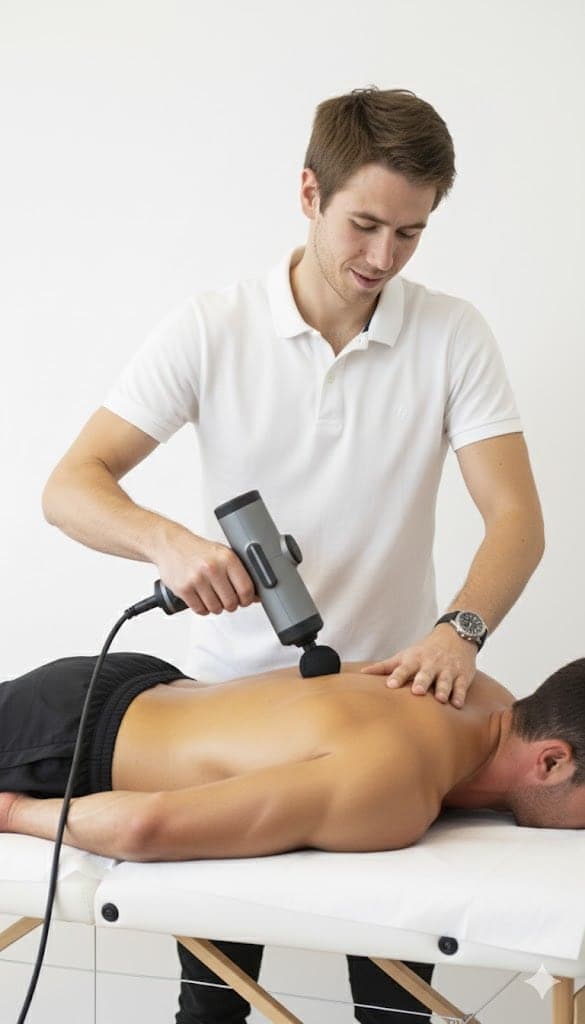
Written by
Chris
Massage therapist, nutrition and exercise physiologist
Norwegian-certified with a Bachelor’s in Physical Education and Nutrition and over ten years of clinical practice, working from a portable table in clients’ homes across the Paphos district.
This article is general information, not a medical diagnosis. If you have severe, worsening or unexplained pain, numbness, weakness, or pain after an accident, see a doctor first.