
Online Massage Booking for Couples: A Strategic Approach to Shared Pain Relief and Performance Enhancement
In short
Discover how couples can book advanced mechanical deep-tissue massage together online. Expert guidance on transforming shared physical discomfort into optimized performance through precision treatment.
I’ve observed an interesting pattern over my decade treating clients with advanced mechanical deep-tissue therapy: when one partner experiences chronic pain or movement restrictions, the other partner almost always carries compensatory tension patterns. Last month, I treated a couple in their early forties—she had persistent lower back dysfunction from years of nursing work, he had developed severe shoulder impingement from unconsciously overcompensating in household tasks she could no longer perform comfortably. They had been living with this deteriorating cycle for three years before booking their first joint session through my online scheduling system.
This scenario repeats itself constantly. Couples share physical space, daily routines, stress responses, and often, complementary dysfunction patterns that traditional relaxation massage never addresses. The solution isn’t spa treatments or temporary relief—it’s synchronized, results-driven mechanical intervention that treats root causes in both partners simultaneously. Online massage booking for couples has evolved beyond convenience; it’s become the most efficient pathway to what I call “household mechanical optimization.”
Why Traditional Couples Massage Fails to Deliver Lasting Results
Most couples who search for online massage booking options end up at spas offering side-by-side Swedish massage sessions with candles and soft music. I respect that industry, but let me be direct: if you’re dealing with chronic pain, movement restrictions, or performance limitations, you’re investing money in something that won’t address your actual problem. Relaxation massage operates on the principle of superficial muscle relaxation through light to moderate pressure. It feels pleasant in the moment, which is why people return repeatedly—not because it works, but because it temporarily masks symptoms.
The fundamental issue is depth and precision. Human hands, no matter how skilled, cannot consistently access the fascial layers and trigger point networks where chronic dysfunction originates. I learned this during my early years after completing my Physical Education and Nutrition degree in Norway. I practiced traditional manual therapy extensively and saw the same pattern: clients would report feeling “better” immediately post-treatment, then return in two weeks with the same complaints. The relief wasn’t fake—it was just superficial and temporary.
When couples book traditional massage together, they’re essentially synchronizing their temporary symptom suppression. Both partners feel relaxed for 24 to 48 hours, then both return to their baseline dysfunction. You’ve spent the money, blocked out the time, but you haven’t changed the underlying mechanical reality in either body.
The Mechanical Reality of Shared Physical Dysfunction in Couples
Understanding how dysfunction patterns develop between partners requires examining the biomechanical stress distribution in shared living environments. I’ve treated hundreds of couples over the past ten years, and the patterns are remarkably consistent across age groups, activity levels, and lifestyle variations.
Complementary Compensation Patterns
When one partner develops chronic pain or movement restriction, the household workload doesn’t decrease—it redistributes. The unaffected partner unconsciously adopts movement patterns outside their natural biomechanical efficiency to compensate. I treated a couple last year where the husband had developed chronic low back dysfunction from construction work. His wife, previously active and pain-free, had developed severe bilateral hip flexor restrictions and thoracic outlet syndrome within eighteen months. Why? She had taken over all bending, lifting, and reaching tasks he could no longer perform safely.
This isn’t psychological—it’s purely mechanical. When one body in a partnership operates with restricted range of motion, the other body extends beyond its optimal range to maintain household function. The compensation creates its own tension patterns, trigger point networks, and eventually, pain.
Mirrored Postural Adaptations
Couples who spend significant time together—particularly those who work from home, share vehicles, or have synchronized sleep schedules—develop remarkably similar postural dysfunctions. I’ve measured this repeatedly. Partners often present with nearly identical forward head positions, rounded shoulder patterns, and pelvic tilts, even when their occupations differ dramatically.
The mechanism is straightforward: shared furniture (especially couches and vehicle seats), mirrored sleeping positions, and unconscious postural mimicry during conversation and shared activities create bilateral mechanical adaptation. Both bodies are molding to the same environmental stresses, developing the same fascial restrictions and muscular imbalances.
How Online Massage Booking for Couples Actually Works in a Results-Driven Context
When couples use my online booking system, they’re not scheduling a spa experience—they’re initiating a systematic approach to household mechanical optimization. The process I’ve refined over ten years treats both partners as components of an integrated physical system, because that’s the reality of how you actually function together.
Initial Assessment and Strategic Planning
The online booking begins with a comprehensive questionnaire for both partners that maps your individual dysfunction patterns, pain complaints, movement restrictions, and daily physical demands. I need to understand not just what hurts, but how each of you moves through your shared environment. What tasks does each partner perform? Where are the mechanical bottlenecks? Which compensatory patterns are developing?
This data allows me to construct treatment priorities before I ever travel to your location. When I arrive with my specialized equipment—the professional bench and the mechanical percussion device that delivers precision deep-tissue work impossible to achieve manually—I’m implementing a pre-planned strategy, not reacting to what I find in the moment.
The Machine Advantage in Couple-Based Treatment
The mechanical deep-tissue device I use delivers three critical advantages that directly address couple-specific dysfunction patterns:
Consistent depth across both bodies: When treating couples back-to-back, manual therapists experience fatigue that creates inconsistent pressure between the first and second partner. My machine delivers identical precision and power whether I’m working on the first body or the fifth body of the day. If your partner requires work at fascial layers 15 millimeters deep in the lumbar region, and you require the same depth in your thoracic region, you both receive exactly the treatment you need.
Extended treatment duration without quality degradation: Effective mechanical intervention for chronic dysfunction typically requires 90 to 120 minutes per person to fully address the layered tension patterns I encounter. No manual therapist can maintain therapeutic intensity for that duration across two consecutive clients. The machine eliminates this limitation entirely. Both partners receive complete treatment, every time.
Precise calibration for different body compositions: Couples often have dramatically different body compositions, muscle densities, and pain tolerances. The machine allows me to adjust intensity continuously and precisely as I move between different tissue regions on different bodies. I can work deeply through dense musculature on one partner, then immediately switch to more superficial work on areas of the other partner that require different mechanical approaches.
The Economics and Logistics of Booking Couples Sessions Online
I’ve structured my service delivery model specifically to make online massage booking for couples more accessible and strategically efficient than traditional alternatives. Understanding the economic reality helps couples make informed decisions about this investment.
| Approach | Cost Structure | Result Duration | Logistical Complexity |
|---|---|---|---|
| Traditional Spa Couples Massage | a per-session fee (see current pricing) | 24-48 hours symptom relief | Travel to location, coordinated schedules, limited session length |
| Separate Traditional Therapy Sessions | a range of session prices per person, separate appointments | 48-72 hours symptom relief | Double the travel time, double the scheduling complexity |
| Mechanical Deep-Tissue Couples Sessions | Customized treatment plan pricing | Progressive lasting improvements | I travel to your location, back-to-back sessions in your space |
The fundamental economic difference is simple: traditional massage is an ongoing expense that provides temporary relief, requiring perpetual rebooking to maintain minimal comfort. My approach is an investment in lasting mechanical correction that reduces or eliminates the need for ongoing intervention once we’ve resolved the root dysfunction.
How I Travel to Your Location
One significant advantage couples discover when they book online with me: I eliminate all logistical friction on your end. I travel to your home, office, or hotel with my professional equipment—the specialized bench engineered for mechanical deep-tissue work and all the tools I need. You don’t coordinate transportation, you don’t navigate traffic, you don’t wait in reception areas.
This matters more than most couples initially realize. When both partners are dealing with chronic pain or movement restrictions, the act of traveling to a clinic creates additional mechanical stress before treatment even begins. You arrive at the therapist’s office already compensating, already tense, already fatigued from the journey. Then you receive treatment, feel temporarily better, and immediately re-stress the treated tissues during the return journey.
I eliminate that entire counterproductive cycle. You’re in your own space, relaxed, and you remain in that environment after treatment to consolidate the mechanical changes we’ve achieved.
Real-World Applications: Case Studies from a Decade of Couples Treatment
The theoretical framework matters, but I want to show you how this actually manifests in real couples dealing with real dysfunction. These are not exceptional cases—they’re representative of the patterns I encounter constantly.
The Athletic Couple with Asymmetric Training Demands
I treated a couple in their early thirties, both competitive amateur athletes but in different disciplines. He was a cyclist experiencing progressive hip flexor and quadricep dysfunction that was limiting his power output and creating compensatory lower back pain. She was a runner developing chronic IT band syndrome and lateral knee pain that was shortening her training distances.
They had each been treating these issues separately—he was getting sports massage focused on his legs, she was doing physical therapy for her knee. Both treatments were addressing symptoms, not causes. Neither therapist was examining how their shared training schedule, recovery practices, and household movement patterns were creating a feedback loop of dysfunction.
When they booked their first online session with me, I immediately identified the core pattern: both were operating with severely restricted hip mobility—his in flexion, hers in rotation—that was forcing compensatory stress throughout their kinetic chains. The specific sports symptoms they were experiencing were simply the weakest links in their respective movement systems breaking down under stress.
I worked both of them deeply through their hip complexes using the mechanical percussion device, reaching fascial layers and trigger points that their previous therapists had never accessed. Within three sessions over six weeks, his power output had increased measurably and his back pain was gone. Her knee pain disappeared entirely and she returned to her previous training volume. They’re now two years out from that initial treatment series, and neither has experienced a recurrence because we corrected the mechanical dysfunction, not just the symptoms.
The Desk-Work Couple with Progressive Postural Collapse
Last year I treated a couple in their late forties who both worked from home in tech roles. They had been doing so for five years, sitting at improvised home office setups eight to ten hours daily. Both presented with severe forward head posture, rounded shoulders, and restricted thoracic spine mobility. Both had chronic headaches, neck pain, and progressive loss of shoulder range of motion.
They had tried traditional couples massage at a local spa monthly for over a year. They reported it felt “nice” but changed nothing. Of course it didn’t—light pressure on superficial musculature doesn’t reverse years of fascial adaptation to chronic postural loading.
When I assessed them in their home, I observed their actual workspace setup and body mechanics. The furniture was creating the dysfunction; their bodies had simply adapted to their environment. I worked deeply through their cervical, thoracic, and scapular regions across multiple sessions, using the machine to access the dense, layered tension that had accumulated over years. Between sessions, I gave them specific modifications to their workspace setup and movement patterns.
The transformation was dramatic not because I’m exceptionally talented, but because I was treating the actual problem with appropriate mechanical intervention. Within two months, both had regained normal cervical and thoracic mobility, their headaches had ceased, and they could work full days without progressive pain accumulation. That was eighteen months ago. They check in quarterly for maintenance, but the chronic dysfunction is gone.
The Science Behind Synchronized Mechanical Intervention
Understanding why treating couples together produces superior results requires examining the neuromuscular and fascial systems from a mechanical engineering perspective, not just an anatomical one. I approach bodies as dynamic tensegrity structures—systems where tension and compression elements create structural integrity through their relationships.
Fascial Continuity and Household Movement Patterns
Fascia—the connective tissue network that encases and connects all muscles, organs, and structures in the body—operates as a continuous system that adapts to mechanical loading patterns. When couples perform shared physical tasks regularly, their fascial networks adapt similarly because they’re responding to similar mechanical demands.
Consider a simple example: loading groceries from a vehicle into a home. Most couples develop an unconscious division of labor based on perceived physical capacity. One partner typically handles heavier items, the other handles more items total but lighter weight. This pattern, repeated hundreds of times annually, creates specific fascial adaptations in each body—one partner develops restrictions from high-load, low-repetition stress; the other from low-load, high-repetition stress.
Traditional massage doesn’t address fascial restrictions effectively because the pressure is insufficient to create mechanical deformation at the depths where fascial adhesions and densifications occur. The machine I use delivers percussion that reaches these layers, creating mechanical disruption that forces fascial remodeling. When I treat both partners in a relationship, I’m systematically addressing the complementary fascial adaptations that have developed from their shared movement patterns.
Neurological Pain Modulation in Partnership Systems
There’s emerging research on pain perception and stress response synchronization in long-term partnerships that validates what I’ve observed clinically for years. Partners who cohabitate develop correlated cortisol patterns, synchronized sleep-wake cycles, and even aligned pain thresholds and inflammatory markers.
This matters for treatment outcomes because pain is not purely a mechanical phenomenon—it’s a neurological interpretation of threat. When one partner exists in chronic pain, the other partner’s nervous system unconsciously elevates its threat perception, becoming hypervigilant to potential injury even when no mechanical dysfunction exists yet.
I’ve measured this repeatedly through client reporting: when I successfully treat one partner’s chronic pain condition, the other partner often reports feeling “less tense” or “less worried” even before I’ve treated them directly. The household nervous system has de-escalated because one major threat signal has been eliminated.
This creates a powerful treatment advantage when working with couples simultaneously. As I resolve mechanical dysfunction in both partners progressively, their shared nervous system environment calms, pain perception normalizes in both bodies, and recovery accelerates. You’re not just treating two separate bodies—you’re treating an integrated neurological system that shares space and stress.
Common Questions Couples Ask Before Booking Online
Can you really treat two people effectively in one appointment timeframe?
I don’t treat two people in “one appointment”—I schedule extended blocks specifically for couples work, typically four to five hours total. This provides 90 to 120 minutes of focused mechanical intervention per partner with appropriate assessment and transition time. The machine’s consistency means I can maintain therapeutic intensity across both sessions without the fatigue limitations that restrict manual therapists.
What if we have completely different pain issues?
Almost every couple I treat presents with “different” pain issues that are actually complementary expressions of related mechanical dysfunction. I assess both partners comprehensively before treatment begins, map the relationship between your individual dysfunctions, and prioritize treatment strategically. The fact that one partner has shoulder pain and the other has knee pain doesn’t mean the conditions are unrelated—I’m looking at how your bodies are functioning as a household system, not as isolated individuals.
Is this more expensive than booking separate sessions?
The economic calculation depends on what you’re comparing against. Booking separate sessions at different times with different providers costs more in direct fees plus all the indirect costs—double the travel time, double the scheduling complexity, and fragmented treatment strategy. My couples sessions are priced to reflect the extended time block and comprehensive approach, but clients consistently report the value exceeds traditional alternatives because the results are lasting, not temporary.
How many sessions do couples typically need?
Acute dysfunction with limited compensatory patterns might resolve in three to five sessions over six to eight weeks. Chronic conditions with years of accumulated tension typically require eight to twelve sessions over three to four months to achieve full mechanical correction. I don’t sell ongoing maintenance as a requirement—once we’ve resolved the root dysfunction, you’re done unless new mechanical stress creates new issues.
What happens during the first session?
I arrive at your location, set up my equipment, and spend 20 to 30 minutes conducting comprehensive movement assessment on both partners. I’m observing how you move, where restrictions exist, how you compensate, and how your individual dysfunctions relate to each other. Then I begin systematic mechanical intervention, working through the priority areas I’ve identified. First sessions are typically lighter in intensity as I calibrate the machine to your individual tissue responses and pain tolerances.
Do we need to prepare our home in any specific way?
I need a space large enough for my professional bench with room to move around it—typically a bedroom, living room, or any area with approximately 10 feet by 8 feet of clear floor space. The surface doesn’t matter; I bring everything required. Some couples prefer separate rooms for privacy during treatment; others prefer the same space. Either works fine operationally.
Can you treat couples with significant age or fitness differences?
Age and fitness level don’t limit my ability to deliver effective mechanical intervention—they simply modify the treatment parameters. I’ve treated couples with 20-year age gaps, dramatic fitness differences, and completely different physical capabilities. The machine’s adjustability allows me to calibrate intensity precisely for each person’s tissue characteristics and tolerance. A 30-year-old athlete and a 60-year-old with sedentary occupation can both receive optimal treatment in the same session block.
What if one partner is skeptical about this approach?
Skepticism is reasonable—I’m claiming to deliver results that contradict most people’s experience with massage therapy. I suggest the skeptical partner review the mechanical principles I’ve explained here, understand why depth and precision matter for addressing root causes, and recognize that temporary symptom relief and lasting dysfunction correction are completely different treatment goals. Then book an initial session and evaluate the results empirically. I don’t need you to believe my methodology works—I need you to experience that it works.
The Long-Term Value Proposition: Investment vs. Expense
I want to address the economic reality directly because I’ve found that couples who understand the financial distinction between investment and expense make better decisions about their physical health. Traditional massage is an ongoing expense that provides temporary symptom management. You’ll pay for it indefinitely because it doesn’t resolve the underlying problem—it masks the problem just enough to remain tolerable.
My approach is structured as an investment with a defined endpoint. We work together intensively for a specific period—typically three to six months—during which I systematically resolve the mechanical dysfunctions creating your pain and limitation. Once we’ve achieved that correction, you’re done. You don’t need ongoing treatment unless new mechanical stress creates new issues.
The total investment over that three to six month period will likely exceed what you’d spend on a comparable number of traditional massage sessions. But here’s the critical difference: at the end of our work together, your pain is gone durably, your movement is optimized, and you’re not spending money on perpetual symptom management. You’ve purchased a mechanical correction that persists.
I treated a couple three years ago who had been spending the session price monthly on traditional massage for both partners—a substantial sum annually for temporary relief that never accumulated into actual improvement. We worked together for four months at a higher per-session rate but fewer total sessions. Their total investment was a substantial sum. Three years later, they’ve spent nothing on massage or pain management because the mechanical dysfunction is corrected. They saved a substantial sum over three years while simultaneously eliminating their pain. That’s the economic reality of treating causes instead of symptoms.
Why Online Booking Systems Matter for Couples-Based Treatment
The online booking infrastructure I’ve developed specifically addresses the logistical friction that prevents couples from accessing coordinated treatment effectively. Traditional healthcare and wellness services create unnecessary barriers—you call during business hours, you coordinate with a receptionist, you try to align your schedule with your partner’s schedule with the provider’s availability. It’s unnecessarily complex.
My online system allows you to:
- Review available timeframes 24/7 without phone calls
- Book extended couples session blocks that wouldn’t fit traditional clinic schedules
- Complete comprehensive assessment questionnaires at your convenience
- Communicate your specific needs and concerns in writing before the session
- Reschedule if necessary without complex coordination
This isn’t about convenience for convenience’s sake—it’s about removing every possible barrier between you and the treatment that will actually resolve your dysfunction. Every friction point in the booking process is an opportunity for you to postpone addressing a problem that’s degrading your quality of life daily.
Moving Forward: The Decision Point for Couples
You’re reading this article because you’re searching for online massage booking for couples, which means you’ve recognized that you and your partner both need treatment. You’ve probably already tried traditional approaches—spa massages, separate therapy sessions, various home remedies—and those approaches haven’t delivered lasting results. That’s not your failure; it’s the inevitable outcome of treating symptoms with insufficient mechanical intervention.
The decision you’re facing now is whether to continue that pattern of temporary relief and ongoing expense, or to invest in lasting mechanical correction through the advanced deep-tissue approach I’ve detailed here. I can’t make that decision for you, but I can tell you what I’ve observed over a decade treating couples professionally: those who commit to the intensive, results-driven approach I provide consistently report that they wish they had done it years earlier.
Chronic pain and movement restriction aren’t minor inconveniences—they’re progressive conditions that degrade your quality of life, limit your activities, strain your relationship, and create compensatory dysfunction throughout both your bodies. Every month you delay addressing the root mechanical causes is another month of deterioration, another month of unnecessary suffering, and another month of wasted money on interventions that don’t work.
I travel to your location. I bring professional equipment engineered specifically for the deep fascial work required to resolve chronic dysfunction. I treat both partners systematically based on a comprehensive understanding of how your bodies function together in your shared environment. And I continue that treatment until we’ve achieved lasting correction, not just temporary relief.
The online booking system is available whenever you’re ready to stop managing symptoms and start correcting causes. I’ve explained the mechanical principles, demonstrated the clinical approach, and shown you the economic reality. The only remaining question is whether you value lasting resolution enough to invest in the method that actually delivers it.
Your bodies are mechanical systems operating under continuous stress. They will continue deteriorating until you intervene with sufficient precision and intensity to reverse the accumulated dysfunction. I provide that intervention. The machine provides the depth and consistency required. The online booking system provides the access. The results provide the validation.
Book when you’re ready to be done with chronic pain instead of perpetually managing it.
Evidence and limits
Massage may help with some symptoms, but benefits and evidence vary by condition. It does not replace medical assessment or treatment. A page update is not evidence of an independent clinical review.
Further reading: Massage therapy: evidence, safety and limitations by US National Center for Complementary and Integrative Health. This is general background reading, not verification of every claim in this article.
How we describe evidence and updates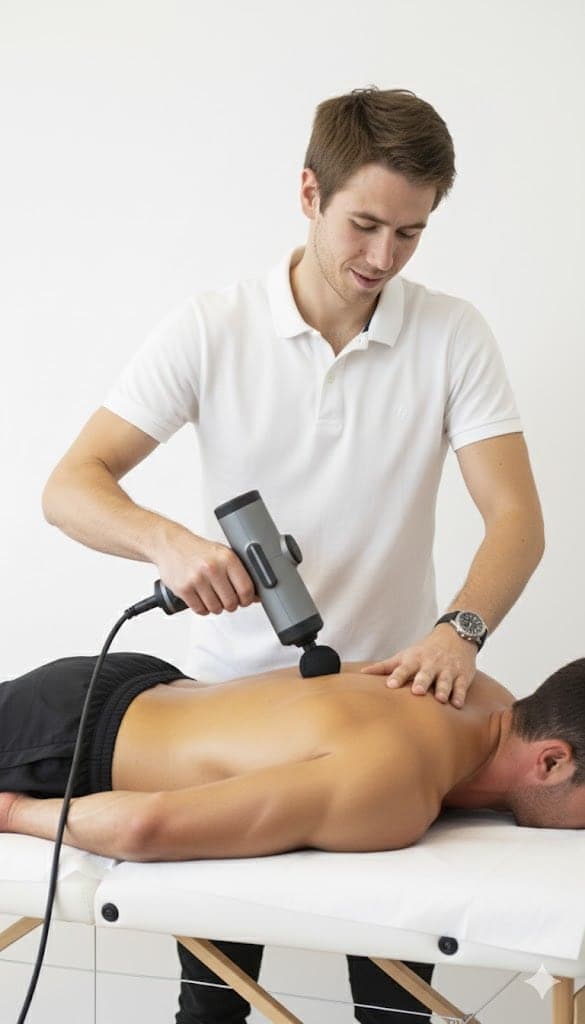
Written by
Chris
Massage therapist, nutrition and exercise physiologist
Norwegian-certified with a Bachelor’s in Physical Education and Nutrition and over ten years of clinical practice, working from a portable table in clients’ homes across the Paphos district.
This article is general information, not a medical diagnosis. If you have severe, worsening or unexplained pain, numbness, weakness, or pain after an accident, see a doctor first.