
Home Visit Massage Tala: Advanced Deep-Tissue Treatment for Lasting Pain Relief
In short
Experience professional mechanical deep-tissue massage in Tala with a specialized practitioner who delivers lasting pain relief through precision treatment at your location.
I’ve spent the last decade studying one thing: why people continue suffering from the same pain patterns year after year despite regular massage treatments. The answer isn’t complicated—most practitioners treat symptoms rather than causes. When you book a home visit massage in Tala with my service, you’re not scheduling another temporary relief session. You’re beginning a systematic approach to lasting resolution of mechanical dysfunction in your body.
My background combines a Bachelor’s degree in Physical Education and Nutrition from Norway with ten years of hands-on experience treating hundreds of clients. I don’t practice relaxation therapy. I specialize exclusively in advanced mechanical deep-tissue work designed to relieves pain at its structural origin. This distinction matters because most people waste years and considerable money on treatments that feel good but change nothing long-term.
Why Traditional Massage Fails to Deliver Lasting Results
Let me share something I observed early in my career. A client came to me after five years of weekly massage sessions at various spas in Tala. She spent over 250,000 baht pursuing relief from chronic shoulder tension and headaches. Every therapist told her she was “holding stress” and needed to “relax more.” The treatments felt pleasant, certainly, but her pain returned within 48 hours every single time.
When I assessed her shoulder mechanics, the problem was immediately clear: severe adhesions in her subscapularis and dysfunction in her scapular stabilizers. These tissues required precise, sustained pressure at specific depths and angles that human hands simply cannot maintain. Within three sessions using my specialized mechanical approach, her headaches disappeared. Six months later, she remains pain-free.
This pattern repeats constantly. Traditional massage operates under a fundamental misunderstanding of pain physiology. Therapists apply general pressure to broad areas, hoping to “release tension.” This approach might temporarily interrupt pain signals, but it doesn’t address the mechanical restrictions causing those signals in the first place.
The Structural Reality of Chronic Pain
Your body develops pain through predictable mechanical processes. Repetitive movement patterns, postural dysfunction, previous injuries, or sustained positions create adhesions between fascial layers. These adhesions restrict normal tissue gliding, alter biomechanics, and create compensatory patterns throughout the kinetic chain. The resulting dysfunction triggers nociceptors—your pain receptors—which send signals to your brain.
Most practitioners respond to these signals with superficial techniques. I treat the adhesions themselves. The difference in outcome is not marginal—it’s categorical.
The Mechanical Advantage: Precision Equipment for Deep-Tissue Work
After years of manual practice, I transitioned entirely to specialized mechanical deep-tissue equipment. This wasn’t a matter of convenience. It was a professional necessity driven by clinical outcomes. The machine I use delivers three critical advantages that human hands cannot replicate:
Precision: The tool maintains exact pressure at specific depths and angles for extended periods. Human hands fatigue, shake, and vary in pressure—these inconsistencies compromise treatment effectiveness. My equipment delivers millimeter-precise contact to targeted tissues, ensuring I reach the exact structures requiring intervention.
Power: Deep adhesions and chronic restrictions require sustained force that exceeds safe manual capacity. I can adjust intensity from gentle surface work to powerfully deep athletic treatment, calibrated precisely to your tissue tolerance and treatment goals. This range allows me to work effectively on everyone from office workers with postural dysfunction to professional athletes requiring performance optimization.
Consistency: Every session delivers identical quality. I don’t have “off days” where my technique varies. The equipment ensures that treatment number ten is exactly as effective as treatment number one. This consistency is essential for progressive tissue remodeling and lasting mechanical changes.
How the Treatment Actually Works
When you receive a home visit massage in Tala from my service, I’m executing a systematic mechanical intervention. Here’s what actually happens during treatment:
I identify specific dysfunctional tissues through movement assessment and palpation. Then I apply sustained, directional pressure to these structures at depths ranging from superficial fascia to deep muscular layers. This pressure creates controlled microtrauma that triggers your body’s remodeling response. Over subsequent days, your tissues reorganize along functional lines of tension rather than dysfunctional adhesion patterns.
This is not massage in the traditional sense. This is mechanical therapy designed to durably alter your tissue architecture.
What Home Visit Massage in Tala Should Actually Accomplish
I travel to your location throughout Tala with professional equipment—a specialized treatment bench and all necessary tools. This isn’t about your convenience alone, though that matters. It’s about creating optimal conditions for effective treatment.
When clients come to clinics, they’re already fatigued from travel. They’re mentally preparing for the journey home. Their nervous systems are partially activated rather than fully receptive. When I come to you, you can move immediately from treatment into complete rest. This maximizes the therapeutic window where your tissues begin their remodeling process.
The Investment Framework
I don’t sell massage sessions. I offer partnerships for lasting mechanical optimization. This distinction determines everything about how we work together.
| Traditional Approach | My Method |
|---|---|
| Symptom relief focus | Cause elimination focus |
| Recurring appointments indefinitely | Structured treatment plan with endpoint |
| Relaxation and temporary comfort | Lasting mechanical changes |
| Generic protocols | Customized biomechanical intervention |
| Passive maintenance | Active optimization |
Most people view massage as an ongoing expense—a pleasant luxury they schedule when pain becomes unbearable. I position treatment as a time-limited investment in lasting resolution. We work intensively for a defined period, eliminate your mechanical dysfunction, then transition to occasional maintenance or optimization work. Many clients complete their initial treatment series and don’t require another session for months or years.
Who Benefits Most from Advanced Deep-Tissue Home Visit Massage in Tala
My practice serves specific populations who’ve already tried conventional approaches without success. I work effectively with:
Chronic pain sufferers who’ve exhausted standard medical options. These clients typically have conditions like persistent lower back dysfunction, chronic neck tension, recurrent headaches, or shoulder impingement that hasn’t responded to physical therapy, chiropractic care, or traditional massage. They need someone who understands pain as a mechanical problem requiring structural solutions.
Athletes and performance-focused individuals who recognize that optimal biomechanics directly improve their capabilities. These clients aren’t injured—they’re seeking marginal gains through improved movement efficiency. We work on mobility restrictions, compensation patterns, and mechanical inefficiencies that limit their performance ceiling.
Professionals with postural dysfunction from sustained work positions. Office workers, drivers, medical professionals—anyone spending hours in fixed positions develops predictable mechanical problems. I address these before they progress to chronic pain conditions.
A Case Study in Mechanical Resolution
A competitive cyclist came to me last year after eighteen months of posterior knee pain that limited his training volume. He’d seen three physiotherapists and received countless sports massages. Everyone treated his hamstrings and calves. His pain temporarily decreased but never resolved.
My assessment revealed the actual problem: severe restrictions in his hip external rotators were altering his pedal stroke mechanics, creating abnormal stress patterns at his knee. The knee pain was purely compensatory. I treated his hip mechanics intensively over four sessions. His knee pain disappeared completely and hasn’t returned through an entire competitive season. He recently set a personal record in a 200-kilometer event.
This outcome wasn’t accidental or fortunate. It was predictable based on proper mechanical assessment and appropriate intervention.
The Science Behind Effective Deep-Tissue Intervention
Let me explain what’s actually happening during effective treatment, because understanding the mechanism helps you recognize whether you’re receiving genuine therapy or just pressure application.
Your fascial system—the connective tissue network throughout your body—responds to mechanical forces according to well-established principles. When tissues experience sustained directional stress, they remodel along those stress lines. This is Wolff’s Law applied to soft tissue. My treatment creates specific mechanical forces that guide your tissues toward functional organization rather than dysfunctional adhesion.
The Remodeling Timeline
Tissue change follows a predictable sequence:
- Immediate mechanical effects (0-24 hours): Direct pressure disrupts adhesions and creates controlled microtrauma. Your tissues become temporarily more pliable.
- Inflammatory response (24-72 hours): Your body initiates healing processes at treated sites. This phase sometimes includes temporary soreness—a necessary component of tissue remodeling.
- Proliferation phase (3-7 days): New collagen fibers form along functional lines rather than random adhesions. This is where lasting change begins.
- Maturation phase (1-3 weeks): New tissue architecture stabilizes. Properly organized fascia maintains improved mobility and function indefinitely.
Understanding this timeline explains why effective treatment requires multiple sessions spaced appropriately. We’re not just “releasing tension” each time—we’re progressively remodeling your tissue architecture toward optimal mechanical function.
Why Location Matters: The Advantages of Home Visit Massage in Tala
I’ve practiced in clinic settings and as a mobile practitioner. The mobile approach delivers superior outcomes for specific reasons related to treatment effectiveness, not just convenience.
Your nervous system state directly influences treatment tolerance and tissue response. When you’re relaxed in your own environment, your parasympathetic nervous system dominates. This state maximizes tissue receptivity and allows me to work deeper more safely. Clinical environments, regardless of their ambiance efforts, trigger subtle stress responses that limit treatment depth.
Additionally, immediate post-treatment rest is critical. The first 2-4 hours after deep-tissue work represent a crucial window where your tissues begin reorganizing. If you spend that time driving home through Tala traffic, you’re partially negating the treatment. When I come to you, you can move directly into complete rest, maximizing therapeutic benefit.
The Professional Standards I Maintain
Mobile practice doesn’t mean compromised equipment or informal treatment. I arrive at your location with:
- Professional-grade hydraulic treatment bench that provides stable support and proper ergonomics
- Specialized mechanical deep-tissue equipment calibrated to precise specifications
- Clinical assessment tools for movement evaluation and treatment planning
- Comprehensive intake documentation for thorough medical history review
My home visit massage service in Tala operates at the same professional standard as any clinical practice, with the added advantage of environmental optimization for treatment effectiveness.
Common Misconceptions About Deep-Tissue Treatment
After ten years of practice, I’ve encountered the same misunderstandings repeatedly. Let me address them directly because they prevent many people from accessing treatment that would genuinely help them.
Misconception: “Deep-tissue massage should be extremely painful.”
This belief causes people to endure unnecessarily brutal treatments while thinking pain equals effectiveness. Reality: Effective deep-tissue work operates at your edge of tolerance—uncomfortable but manageable. Excessive pain triggers protective muscle guarding that prevents tissue release. I work precisely at the depth where your tissues can accept intervention without defensive response.
Misconception: “I need massage regularly forever to manage my pain.”
This assumption keeps people trapped in cycles of dependency. Reality: If treatment is effective, you shouldn’t need indefinite sessions. My goal is always to eliminate your mechanical dysfunction completely, then transition to occasional optimization or maintenance. If you’re seeing the same practitioner weekly for years with unchanged pain patterns, you’re receiving ineffective treatment.
Misconception: “All massage is essentially the same.”
This misunderstanding leads people to choose practitioners based on price or convenience rather than methodology and outcomes. Reality: The difference between relaxation massage and advanced mechanical therapy is as significant as the difference between meditation and surgery. Both have value, but they accomplish entirely different objectives.
How to Evaluate Treatment Effectiveness
You should notice measurable improvements within 3-4 sessions if treatment is working. These improvements include:
- Increased range of motion in previously restricted joints
- Reduced pain intensity or frequency
- Improved movement quality in daily activities
- Decreased compensation patterns
- Better sleep quality due to reduced nocturnal pain
If you’re not experiencing these changes, either the practitioner isn’t identifying the correct mechanical problems or their treatment approach isn’t adequate to create tissue change.
The Customized Treatment Approach for Lasting Results
I don’t offer standardized one-hour sessions with generic protocols. Each client receives an individualized treatment plan developed through comprehensive mechanical assessment.
Our first session involves extensive evaluation. I assess your movement patterns, identify restrictions and compensations, palpate tissue quality throughout relevant kinetic chains, and discuss your complete pain history. This assessment typically reveals mechanical dysfunction patterns you weren’t aware of—compensation chains where your body has redistributed stress to avoid primary restrictions.
Based on this assessment, I develop a structured treatment plan. This plan specifies which tissues require intervention, in what sequence, at what intensity, and with what frequency. We’re executing a systematic protocol designed to progressively resolve your mechanical dysfunction, not randomly “working out tension” each session.
What Treatment Progression Actually Looks Like
Here’s a typical progression for a client with chronic mechanical dysfunction:
Sessions 1-2: Initial assessment and treatment of primary restrictions. We establish your tissue tolerance and begin breaking down major adhesions. You’ll likely experience significant soreness as tissues begin remodeling.
Sessions 3-4: Continued work on primary dysfunctions with progression into secondary compensation patterns. Soreness decreases as tissues adapt to treatment. You begin noticing functional improvements in daily movements.
Sessions 5-6: Treatment of remaining restrictions and optimization of movement patterns. Focus shifts from dysfunction elimination to performance enhancement.
Sessions 7+: Maintenance and optimization work spaced at increasing intervals. Many clients transition to quarterly sessions or as-needed treatment for new issues.
This progression represents a complete treatment cycle, not an indefinite series of identical sessions. The endpoint is your mechanical optimization, not my continued revenue.
Integration with Other Health Approaches
Advanced mechanical therapy doesn’t exist in isolation. I work effectively alongside medical treatment, physical therapy, strength training, and other health interventions.
Many clients come to me while simultaneously receiving physical therapy. The approaches complement each other well: physical therapy typically focuses on motor control, stability, and strengthening, while I address tissue restrictions that prevent those movements from occurring properly. When fascial restrictions limit your range of motion, no amount of strengthening exercises will restore full function. We need to eliminate the mechanical restriction first, then rebuild strength through that newly available range.
The Role of Self-Care and Movement
I provide specific guidance on maintaining treatment gains between sessions. This isn’t generic advice about “staying hydrated” and “stretching regularly.” I give you precise instructions about which movements to emphasize, which positions to avoid, and how to recognize early signs of dysfunction returning.
For some clients, I recommend specific exercises targeting their particular mechanical problems. For others, I suggest avoiding certain movement patterns that reinforce their dysfunction. The guidance is always customized to your individual mechanical profile.
Frequently Asked Questions About Home Visit Massage in Tala
How long does each treatment session take?
Sessions typically run 90 minutes including assessment time. This duration allows me to work thoroughly through relevant tissue structures without rushing. Shorter sessions compromise treatment depth, while longer sessions provide diminishing returns as tissue tolerance decreases.
How many sessions will I need before seeing results?
Most clients notice measurable improvements within three sessions. Complete resolution of chronic mechanical dysfunction typically requires 6-8 sessions spaced over 6-12 weeks, depending on severity and complexity. Acute problems often resolve faster, while long-standing patterns require more extensive remodeling.
Is the treatment painful?
Treatment is intensely uncomfortable rather than painful. I work precisely at your tolerance edge—the depth where tissue release occurs without triggering protective guarding. You maintain complete control over intensity through continuous communication. The sensation is pressure and discomfort, not sharp pain.
What should I do immediately after treatment?
Rest completely for 2-4 hours following your session. Drink adequate water to support tissue remodeling. Avoid intense exercise for 24-48 hours to allow the inflammatory response to proceed optimally. Light movement like walking is beneficial, but don’t stress treated tissues aggressively during the immediate remodeling window.
Do you work with medical conditions or only general pain?
I work with many clients who have medical diagnoses like herniated discs, arthritis, fibromyalgia, or previous injuries. However, I’m not treating the medical condition itself—I’m addressing mechanical dysfunction that contributes to your symptoms. I always recommend maintaining relationships with appropriate medical professionals while we work on your mechanical optimization.
What makes your approach different from spa massage in Tala?
Spa massage prioritizes relaxation and temporary comfort. My practice focuses exclusively on lasting mechanical changes through advanced deep-tissue intervention. Different goals, different methods, categorically different outcomes. Both have value, but they’re fundamentally different services addressing different needs.
How do you ensure hygiene and professionalism during home visits?
I maintain clinical standards regardless of location. All equipment is sanitized between clients. I arrive with fresh linens for each session. My practice follows the same hygiene protocols as any professional clinical setting, with the additional advantage of treating you in your own controlled environment.
What areas of Tala do you serve?
I provide home visit massage throughout Tala and surrounding areas. Travel is included in treatment pricing, ensuring accessibility regardless of your specific location within the service area.
The Long-Term Value Proposition
Let me discuss investment versus expense directly, because this distinction determines whether you’ll actually solve your mechanical problems or continue managing symptoms indefinitely.
Traditional massage operates on a maintenance model. You book regular sessions that provide temporary relief, then schedule another session when pain returns. Over years, you spend substantial amounts—often 50,000-100,000 baht or more—without ever actually eliminating your pain. You’re purchasing temporary symptom management.
My approach operates on a resolution model. We work intensively for a defined period to durably eliminate your mechanical dysfunction. The upfront investment is higher per session because of specialized equipment and advanced expertise, but the total cost over time is dramatically lower because we’re achieving lasting results, not temporary relief.
The Actual Cost of Unresolved Pain
Beyond direct treatment costs, chronic pain carries hidden expenses many people don’t calculate:
- Reduced work productivity and earning capacity
- Decreased quality of life and relationship impact
- Limited participation in activities you value
- Sleep disruption affecting overall health
- Progressive mechanical deterioration requiring increasingly aggressive interventions
- Medications with side effects and long-term health implications
When you frame the decision properly—comparing lasting resolution against years of symptom management plus ongoing quality-of-life costs—the economic analysis strongly favors effective intervention.
Taking the Next Step Toward Mechanical Optimization
If you’ve read this far, you’re likely someone who’s already tried conventional approaches without success. You understand that genuine treatment requires specialized expertise, appropriate methodology, and commitment to systematic intervention rather than quick fixes.
My practice serves clients who are ready to invest in lasting resolution rather than temporary relief. I work with people who understand that effective treatment sometimes involves discomfort but delivers lasting value. I partner with individuals who want to understand their mechanical dysfunction and participate actively in their own optimization.
This is not massage therapy in the traditional sense. This is advanced mechanical intervention designed to durably relieves pain at its structural source and optimize your body’s functional capacity for daily life and performance.
When you book a home visit massage in Tala with my service, you’re beginning a partnership focused on one objective: lasting mechanical optimization that improves your quality of life indefinitely. The approach is systematic, results-oriented, and backed by a decade of experience creating measurable outcomes for hundreds of clients.
Your body’s mechanical function determines your daily experience more than almost any other factor. Poor mechanics create pain, limit performance, and progressively worsen over time. Optimal mechanics relieves pain, enhance capability, and improve consistently with appropriate maintenance.
The choice isn’t between my service and other massage options. The choice is between continuing to manage symptoms indefinitely or investing in lasting mechanical resolution. One approach keeps you dependent on regular treatments. The other makes you functionally independent with optimized biomechanics.
I’ve built my entire practice on a simple premise: if treatment is genuinely effective, clients shouldn’t need indefinite sessions. They should experience measurable improvement rapidly, achieve complete resolution within a reasonable timeframe, and maintain those gains long-term with minimal intervention. That’s the standard I hold myself to, and it’s what you should expect from any practitioner claiming to offer therapeutic treatment rather than simple relaxation.
Evidence and limits
Massage may help with some symptoms, but benefits and evidence vary by condition. It does not replace medical assessment or treatment. A page update is not evidence of an independent clinical review.
Further reading: Massage therapy: evidence, safety and limitations by US National Center for Complementary and Integrative Health. This is general background reading, not verification of every claim in this article.
How we describe evidence and updates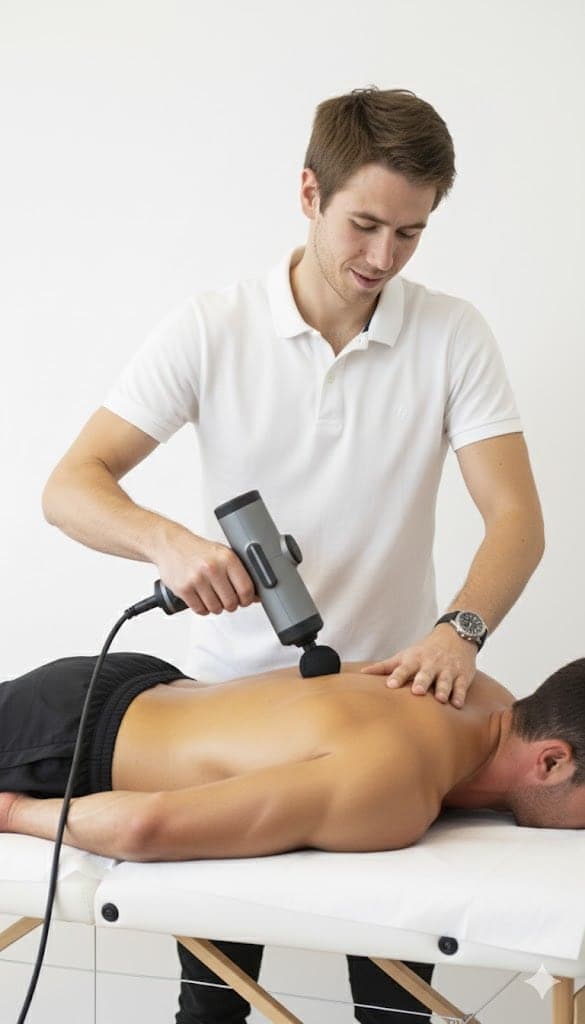
Written by
Chris
Massage therapist, nutrition and exercise physiologist
Norwegian-certified with a Bachelor’s in Physical Education and Nutrition and over ten years of clinical practice, working from a portable table in clients’ homes across the Paphos district.
This article is general information, not a medical diagnosis. If you have severe, worsening or unexplained pain, numbness, weakness, or pain after an accident, see a doctor first.