
Neck pain relief Paphos: mechanical deep-tissue treatment at home
In short
Most persistent neck pain I see in Paphos is mechanical: trigger points and stiff fascia in the upper trapezius, levator scapulae and suboccipitals. Slow, deep, sustained pressure over a few sessions usually restores rotation and eases the ache.
I am Chris, a mobile massage therapist based in Chlorakas, and stiff, aching necks are the single most common reason people book me. Most of them have "tried everything". What I offer is trigger point treatment in Paphos done slowly and deeply, at your home, aimed at the muscles that are actually holding the neck.
This article explains what I think is going on in a persistent neck, what I do about it, what a session feels like, and how to tell whether it is the right kind of help for you.
Why the ache keeps coming back
The neck is a small structure doing a heavy job. Seven vertebrae and a few dozen muscles balance a head that weighs roughly five kilograms, and they do it all day. When the head sits balanced over the shoulders, the muscles work very little. When it drifts forward towards a screen, a steering wheel or a phone, the load on the muscles at the back of the neck climbs sharply, and it stays there for as long as the posture does.
Muscles held under load for hours respond in a predictable way. Fibres in the upper trapezius, levator scapulae and the small suboccipital muscles under the skull tighten into taut bands. Within those bands, tender knots develop — trigger points — that refer pain into the skull, behind the eye or down between the shoulder blades. The fascia around the muscles loses its glide, so layers that should slide over each other start to move as one block. Rotation shortens. Looking over your shoulder to reverse the car becomes a whole-torso movement.
Why do the usual remedies stall? In my experience:
- A relaxation massage works the surface and feels good for a day, but rarely reaches the deeper bands.
- Stretching pulls on the whole chain rather than the one adhered layer, so the knot stays.
- Painkillers quieten the signal without changing the tissue sending it.
- Strengthening is worth doing later, but asking a restricted neck to strengthen first often just irritates it.
None of these are wrong. They are simply aimed at the wrong depth for this particular problem.
What I actually do for neck pain relief Paphos clients ask about
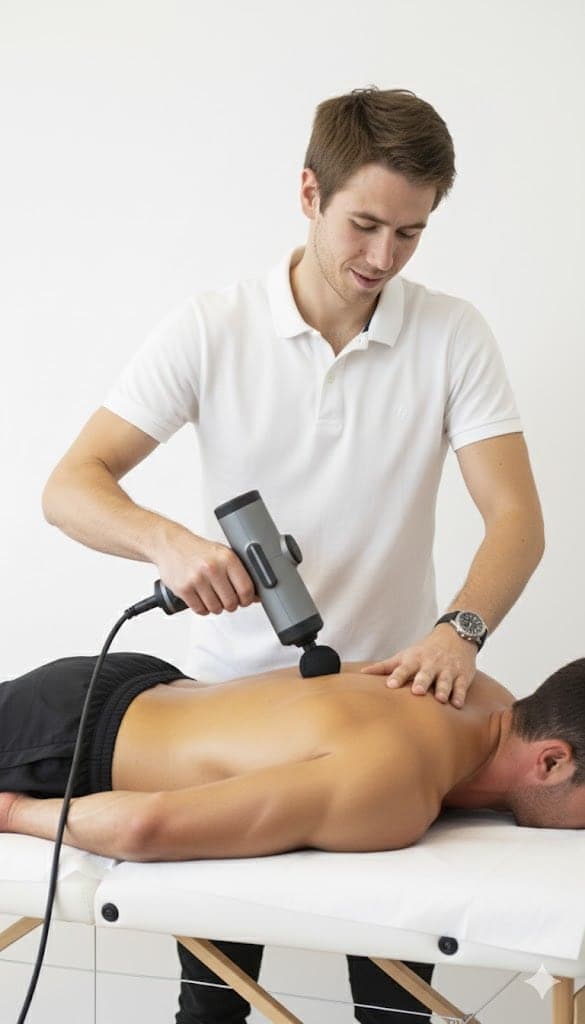
My method is mechanical deep-tissue work: slow, sustained pressure applied precisely to the muscle that is holding, rather than a general rub over the area. I trained in Norway, hold a BSc in Physical Education and Nutrition, and have spent more than ten years narrowing my practice down to this kind of work.
The session begins with a short assessment. I watch how you stand and sit, check rotation, side-bending, flexion and extension, and palpate through each muscle layer to find the taut bands and the exact points that reproduce your pain. That tells me which structures to work and in what order — the pattern is different for someone whose monitor sits to one side than for someone still carrying tension from an old whiplash.
Because I come to you, I also get to see your actual desk, sofa or car seat, which often explains more about the neck than anything I find on the table.
What a session feels like
I will be honest about this: effective deep-tissue work on a stiff neck is not relaxing in the spa sense. When I hold a trigger point in the levator scapulae you will feel a strong, deep ache, often with a referred sensation into the head or shoulder blade. That referral is useful information — it confirms I am on the structure that produces your symptoms.
The intensity should always sit at a level you can breathe through. I check in continuously and back off if your shoulders lift or your breath catches, because a guarded muscle does not release. Most points ease noticeably while I am on them, with a palpable softening under my hands.
Afterwards, expect the following:
| Timeframe | What is typical |
|---|---|
| Straight after | Freer rotation, a heavy or warm feeling in the neck and shoulders |
| The next day or two | Mild soreness, similar to after unfamiliar exercise |
| Days three to five | The soreness settles and the ache is usually quieter than before |
| Following sessions | Each visit starts from a better baseline rather than repeating the same work |
The nervous system has often been receiving pain signals from these muscles for months. Even once the tissue moves better, it takes a little time for the sensitivity to settle, which is why I do not judge a session by how the neck feels in the first hour.
The neck patterns I see most often
Every neck is different, but a handful of presentations account for most of my bookings across Paphos, from Kato Paphos apartments to the villas around Peyia and Tala.
- Bilateral tension-type ache: stiffness across both sides of the neck and upper shoulders, worse by evening, tied to desk work or long drives. This is the pattern that responds most reliably to trigger point work plus a couple of desk changes.
- One-sided pain with restricted rotation: pain on one side and a marked block turning towards it. Usually the sternocleidomastoid, scalenes or levator scapulae on that side are shortened and knotted, often from a monitor, a phone habit or sleeping position.
- Headaches from the base of the skull: a dull pain starting under the occiput, sometimes reaching over the head or behind one eye. The suboccipital muscles are the usual source and they need slow, precise pressure to reach.
- Old whiplash that never quite settled: months or years after a road incident, a neck that still guards and tires quickly. I work more gradually here, but adhered tissue from an old injury usually responds well.
- Active people with a stiff neck: swimmers, cyclists and gym-goers whose neck limits their stroke, their position on the bike or their overhead work. Restoring rotation tends to help performance as much as it helps the pain.
If you recognise yourself in one of these, there is a good chance a few sessions will make a real difference. If your neck does not fit any of them, that is worth mentioning when you book, and I will tell you honestly whether I think I can help.
How many sessions, and what it costs
Pre-book five sessions as a package and receive one additional session free. Long-standing tension usually needs more than one visit, and I will give you a frank estimate after the first session once I have felt the tissue.
Pricing is simple: €90 for 60 minutes and €130 for 90 minutes, and a package of five pre-booked sessions includes one additional free session. Full details are on the pricing page. Neck work sits well within a 60-minute session; if the shoulders and upper back are heavily involved, 90 minutes lets me finish the whole chain without rushing. There is no extra charge for travel within the Paphos district, and if you are out towards Coral Bay or Peyia, I cover Peyia and the coast regularly.
Most people find that three to five sessions, spaced a week or two apart, take a chronic neck from constant to occasional. After that, some come back every month or two, particularly during busy work periods, and many simply return when they feel it building again.
What I can and can't help with
I work with muscular and fascial neck pain: trigger points, postural overload, stiffness after old injuries, and the headaches that come from the neck. I do not treat disc injuries, nerve compression or anything that needs imaging or medication, and I will say so if the assessment points that way. Please see a doctor first if your neck pain followed a recent fall or collision, comes with numbness, weakness or pins and needles in the arm, is accompanied by fever, unexplained weight loss or a severe sudden headache, or is getting steadily worse regardless of position or rest.
Things that make a session more useful:
- Tell me about any medication, recent surgery, osteoporosis or blood-thinning treatment when you book.
- Have a space where the table can stand with room for me to work at the head end.
- Eat lightly beforehand and drink water afterwards.
- Plan for a quiet evening rather than a heavy gym session on the same day.
Frequently asked questions
How quickly will my neck feel better?
Range of movement usually improves during the first session. The ache itself tends to lag behind by a few days while any post-treatment soreness settles and the tissue adjusts. Over a short series of sessions the quiet spells get longer and the flare-ups milder. I would rather set expectations that way than promise a one-visit fix, because the neck usually took months to get like this.
Is deep-tissue neck treatment painful?
It is intense rather than painful in the way an injury is painful. Holding a trigger point produces a deep, spreading ache that often refers into the head or shoulder blade, and it should stay at a level you can breathe through. I adjust the depth constantly and there is no benefit in pushing past what your body will let go of. Say the word and I ease off.
How is this different from a normal massage?
A relaxation massage moves over the whole area at a moderate depth and aims for a general sense of ease. My work is slower and far more specific: I find the exact bands and points that reproduce your symptoms and hold pressure there until they change. Less of the session is pleasant flowing strokes and more of it is precise, sustained work on a small number of structures.
Can you help with headaches that start at the base of my skull?
Often, yes. Headaches that begin under the occiput and spread over the head or behind an eye frequently come from tight suboccipital muscles and the upper trapezius. These respond well to careful sustained pressure. If your headaches are sudden, severe, unlike anything you have had before, or come with visual changes or vomiting, that needs a doctor before it needs me.
Do I need a referral, and how do I book?
No referral is needed. Message me on WhatsApp or call, tell me roughly where you are in the Paphos district and what your neck is doing, and we will find a time. I bring the table and everything else. If anything in your history suggests the problem is not muscular, I will say so and point you towards the right person rather than treat it.
Evidence and limits
Massage may help with some symptoms, but benefits and evidence vary by condition. It does not replace medical assessment or treatment. A page update is not evidence of an independent clinical review.
Further reading: Massage therapy: evidence, safety and limitations by US National Center for Complementary and Integrative Health. This is general background reading, not verification of every claim in this article.
How we describe evidence and updatesWritten by
Chris
Massage therapist, nutrition and exercise physiologist
Norwegian-certified with a Bachelor’s in Physical Education and Nutrition and over ten years of clinical practice, working from a portable table in clients’ homes across the Paphos district.
- Norwegian-certified
- Nutrition & exercise physiologist
- 10+ years clinical practice
- Based in Chlorakas · all of Paphos district
- No call-out fee anywhere in Paphos district
Last updated
This article is general information, not a medical diagnosis. If you have severe, worsening or unexplained pain, numbness, weakness, or pain after an accident, see a doctor first.