
Personalized Massage Paphos Home: Advanced Deep-Tissue Treatment for Lasting Pain Relief
In short
Discover how specialized mechanical deep-tissue massage in your Paphos home addresses the root cause of chronic pain. Expert-led, results-driven treatment designed for lasting improvement.
Most people in Paphos who seek massage therapy make the same mistake: they treat pain as something that needs to be managed, not eliminated. They book an appointment, feel temporary relief, and return weeks later when the discomfort resurfaces. This cycle continues indefinitely because the underlying mechanical dysfunction—the actual source of their pain—remains unaddressed.
I’ve spent a decade studying body mechanics, earning a Bachelor’s degree in Physical Education and Nutrition in Norway, and developing a specialized approach that breaks this pattern. When clients book a personalized massage Paphos home service with me, they’re not purchasing relaxation. They’re investing in a clinical intervention designed to produce lasting results through precise manipulation of deep tissue structures.
The difference between my method and conventional massage isn’t subtle—it’s fundamental. Traditional massage therapists work with their hands, applying pressure that feels beneficial in the moment but lacks the depth, consistency, and precision required to release chronic mechanical dysfunction. My approach uses a specialized machine that delivers what hands simply cannot: controlled, repeatable force that reaches the structural level where pain originates.
Why Mechanical Precision Outperforms Manual Technique in Deep-Tissue Work
During my first year practicing in Paphos, I encountered a 52-year-old construction manager who had spent three years receiving weekly massages for lower back pain. He described each session as pleasant—he felt looser afterward, slept better that night—but the relief never lasted more than two days. His therapist blamed his job, his posture, his stress levels. The real problem was simpler: the treatment wasn’t reaching the tissue depth where his dysfunction existed.
The human hand, regardless of how well-trained, has biomechanical limitations. Even the strongest therapist fatigues after sustained deep pressure. Consistency varies between sessions based on the practitioner’s energy level, hand positioning, and accumulated strain. Most critically, hands cannot maintain the focused, perpendicular force required to release adhesions in deep fascial layers without causing surface tissue trauma.
This is where mechanical intervention becomes not just advantageous but necessary for certain conditions. The specialized tool I use in every personalized massage Paphos home session delivers three capabilities that define professional deep-tissue work:
Depth Beyond Manual Capacity: The machine penetrates to muscular and fascial layers that hands can only compress superficially. When treating chronic thoracic restrictions or deep gluteal dysfunction, this isn’t a matter of preference—it’s a requirement for effective intervention.
Calibrated Force Application: I adjust intensity with precision, moving from diagnostic light pressure to therapeutic deep work in measurable increments. This allows me to identify exactly where tissue restriction begins and apply the specific force needed to release it without overshooting into counterproductive trauma.
Sustainable Consistency: Every stroke delivers identical force across the entire treatment area. There are no “tired hands” in the final 15 minutes of a session. The last pass over your trapezius receives the same effective pressure as the first, ensuring complete treatment of the targeted area.
The Clinical Process: Assessment, Intervention, and Structural Change
When I arrive at your location in Paphos with my professional bench and equipment, we don’t begin with assumptions. I start every personalized massage Paphos home session with a systematic assessment of your movement patterns, tissue quality, and pain presentation. This isn’t conversation-based guesswork—I’m palpating for specific indicators of mechanical dysfunction.
Restricted fascia has distinct characteristics under pressure. Adhesions between muscle layers create predictable movement limitations. Trigger points produce referral patterns that map to specific muscular dysfunctions. My education and experience allow me to identify these markers quickly, building a precise understanding of your body’s actual problems rather than addressing generalized “tightness.”
| Assessment Finding | Indicated Dysfunction | Treatment Approach |
|---|---|---|
| Unilateral shoulder elevation | Upper trapezius hypertonicity with opposite-side weakness | Deep release of hypertonic side, activation protocol for weak side |
| Limited hip internal rotation | Posterior hip capsule restriction and piriformis shortening | Targeted deep work on external rotators, mobility restoration sequence |
| Forward head posture with cervical pain | Anterior neck shortening and posterior chain overload | Suboccipital release, deep work on levator scapulae and upper traps |
| Chronic lower back tension | Quadratus lumborum dysfunction and hip flexor tightness | QL-focused deep tissue work, iliopsoas release, movement correction |
The intervention itself follows a structured progression. I don’t simply “massage the tight areas.” I work through tissue layers systematically, addressing superficial restrictions before progressing to deeper structures. This layered approach prevents defensive muscle guarding and allows each level of tissue to release before the next is engaged.
Why Athletes and Performance-Focused Clients Choose Mechanical Deep-Tissue Treatment
The most physically demanding clients I work with—competitive athletes, CrossFit participants, construction workers, and serious fitness enthusiasts—understand something recreational spa-goers often miss: performance limitation comes from mechanical restriction, not lack of relaxation.
An athlete preparing for competition doesn’t need to feel pampered. She needs her hip flexors released so her stride length increases. She needs her thoracic spine mobility restored so her overhead position improves. She needs her calf tissue compliant enough that her ankle dorsiflexion doesn’t limit her squat depth. These are mechanical problems requiring mechanical solutions.
I worked with a competitive cyclist last season who had plateaued in his time trials. His coaching was excellent, his training volume appropriate, his nutrition dialed in—yet his performance had stagnated. During our first session, I found severe restriction in his psoas and rectus femoris on the dominant leg. His hip flexion was mechanically limited, forcing compensation patterns that reduced power output.
After four weeks of targeted deep-tissue work addressing these restrictions specifically, his functional hip flexion improved by 18 degrees. His power meter showed a 7% increase in sustained output. These weren’t subjective improvements in how he “felt”—they were measurable biomechanical changes that directly translated to performance gains.
The Investment Perspective: Cost Analysis of Chronic Pain Management
When potential clients initially contact me about personalized massage Paphos home services, some hesitate at the cost. They’ve been paying less for their current massage sessions and question whether the investment is justified. This reaction reveals a fundamental misunderstanding of what we’re comparing.
Traditional massage is an expense—you pay for temporary symptom relief that requires indefinite repetition. My approach is an investment that targets lasting structural change, reducing or eliminating the need for ongoing treatment. The economic difference becomes clear when examined over time.
Consider a typical chronic pain sufferer in Paphos who receives weekly massages at €50 per session. Over one year, that’s €2,600 spent on temporary relief that never addresses causation. After five years—not an unusual timeframe for chronic conditions—they’ve spent €13,000 while their underlying problem remains unchanged.
My clients typically require 4-8 sessions to achieve lasting improvement for chronic conditions. Yes, each session costs more because you’re receiving specialized clinical work rather than general relaxation. But when the dysfunction is actually corrected—when your body moves properly and pain doesn’t return—the ongoing expense stops. The total investment for lasting improvement is a fraction of the lifetime cost of symptom management.
Treating Causation vs. Addressing Symptoms: A Clinical Distinction
The massage therapy industry has conditioned clients to expect certain things: dim lighting, soft music, gentle pressure that feels soothing. These elements create a relaxing experience, which has value for stress management. But if you’re dealing with chronic pain, movement restriction, or performance limitation, relaxation isn’t your solution—structural correction is.
I remember a conversation with a new client last year that perfectly illustrated this disconnect. She described her neck pain as “manageable most days, but it never really goes away.” When I asked how long she’d been managing it, she said seven years. Seven years of accommodation, adaptation, and acceptance of dysfunction as normal.
During her assessment, I identified the actual problem within minutes: severe restriction in her scalene muscles creating cervical rotation limitation and referral pain. The dysfunction was completely correctable with proper intervention. She’d spent seven years managing symptoms because no one had treated the mechanical cause.
This is why my approach focuses exclusively on structural work. I’m not providing an experience—I’m executing a clinical intervention designed to restore normal tissue function and movement patterns. The personalized massage Paphos home sessions I conduct are tailored entirely to your specific dysfunction, not to a standardized protocol or relaxation template.
The Precision Factor: How Machine-Assisted Work Enables Diagnostic Accuracy
One advantage of mechanical deep-tissue work that clients rarely consider is diagnostic precision. When I use controlled, consistent force, I can feel exactly where tissue restriction begins, how deep it extends, and how it responds to intervention. This tactile feedback is more accurate than what’s possible with manual pressure because my sensory focus isn’t divided by the physical effort of force generation.
Think of it like diagnostic imaging versus physical examination. Both have value, but one provides clearer, more detailed information. When my hands aren’t straining to generate pressure, they can focus entirely on reading tissue response. I feel the exact moment when fascia begins to release. I detect subtle changes in tissue compliance that indicate I’m reaching the depth where dysfunction exists. I identify compensation patterns in adjacent structures that reveal the full extent of your mechanical problem.
This diagnostic clarity translates directly to treatment effectiveness. I’m not guessing where to work or how much pressure to apply—I’m receiving precise feedback that guides every intervention decision. When treating complex conditions like thoracic outlet syndrome or chronic hip impingement, this level of accuracy often means the difference between improvement and continued dysfunction.
Customized Treatment Plans: The Partnership Model for Lasting Results
I don’t offer single-session solutions because single sessions don’t produce lasting structural change for chronic conditions. Tissue adaptation takes time. Neurological repatterning requires repetition. Sustainable improvement demands a systematic approach that addresses dysfunction progressively while preventing recurrence.
When you commit to a personalized massage Paphos home treatment plan with me, you’re entering a partnership focused on lasting resolution. I develop a specific strategy for your condition based on assessment findings, treatment response, and your functional goals. This isn’t a generic protocol—it’s a customized intervention designed for your body’s unique dysfunction pattern.
The typical progression follows this structure:
- Initial Intensive Phase (Sessions 1-3): Aggressive deep-tissue work targeting primary restrictions, typically scheduled 5-7 days apart to allow tissue recovery while maintaining intervention momentum.
- Structural Correction Phase (Sessions 4-6): Continued deep work combined with movement pattern correction, identifying and addressing compensation patterns that developed around original dysfunction.
- Stabilization Phase (Sessions 7-8): Lighter maintenance work ensuring changes remain stable, teaching self-management techniques for long-term function preservation.
- Optional Maintenance: Monthly or quarterly sessions for clients who want to maintain optimal function, prevent future dysfunction, or continue performance optimization.
This structured approach produces results that single sessions cannot achieve. Tissue needs time to reorganize after deep work. Movement patterns need repetition to become automatic. Your nervous system needs consistent input to accept new ranges of motion as safe and normal. Attempting to achieve these outcomes in one aggressive session is not only ineffective—it’s counterproductive, potentially causing tissue trauma that slows recovery.
The Home Environment Advantage for Clinical Deep-Tissue Work
Delivering personalized massage Paphos home services isn’t just convenient for clients—it creates a superior clinical environment. When you receive treatment in your own space, several factors improve treatment effectiveness.
Your body is genuinely relaxed in familiar surroundings. There’s no pre-treatment stress from commuting through traffic, searching for parking, or adapting to an unfamiliar clinic environment. This baseline relaxation allows your nervous system to accept deeper work without defensive guarding responses.
Post-treatment recovery is optimized when you don’t need to drive home afterward. Deep-tissue work that truly addresses structural dysfunction can produce temporary soreness similar to intensive exercise. Having immediate access to your own shower, comfortable furniture, and rest space allows proper recovery positioning that enhances treatment integration.
I bring everything needed: professional massage bench with proper face cradle positioning, the specialized mechanical tool calibrated specifically for your treatment, and any additional equipment required for your condition. Your only responsibility is providing adequate space—typically just a bedroom or living area with enough room for the bench setup.
Common Conditions Successfully Resolved Through Mechanical Deep-Tissue Intervention
While I work with a wide range of musculoskeletal conditions, certain dysfunctions respond particularly well to the depth and precision my method provides. These are problems where conventional massage often fails because the tissue restriction exists beyond the reach of manual technique.
Chronic Lower Back Pain With No Structural Pathology
When medical imaging shows nothing wrong but pain persists, the problem is usually myofascial. The quadratus lumborum, erector spinae, and deep hip rotators develop restriction patterns that create persistent discomfort. These structures require sustained, deep pressure to release—exactly what mechanical intervention delivers effectively.
I worked with a 38-year-old office worker whose MRI was clean but whose back pain had progressed from occasional to daily over three years. Her problem wasn’t spinal—it was mechanical dysfunction in the QL and multifidus creating constant tension. Six sessions of targeted deep work addressing these specific structures eliminated pain she’d accepted as lasting.
Shoulder Impingement and Rotator Cuff Dysfunction
True structural tears require medical intervention, but most shoulder pain stems from muscular imbalance and fascial restriction creating mechanical impingement. The subscapularis, infraspinatus, and teres minor develop dysfunction patterns that limit glenohumeral mobility and create pain with overhead movement.
Manual work on these structures is challenging because they’re deep, difficult to isolate, and require sustained pressure to release. The mechanical tool accesses these muscles precisely, applying force perpendicular to the fiber direction for optimal release. Combined with proper scapular stabilizer work, this approach resolves impingement that clients often assume requires surgery.
Hip Mobility Restriction Limiting Athletic Performance
Athletes who can’t achieve proper squat depth, runners with limited hip extension, and cyclists with reduced hip flexion often have the same problem: deep hip capsular restriction and external rotator dysfunction. The piriformis, gemelli, and deep hip capsule are nearly impossible to reach effectively with manual pressure.
Mechanical intervention reaches these structures directly, creating mobility improvements that immediately translate to performance gains. I’ve worked with countless athletes who assumed their movement limitations were structural—bone anatomy preventing further range—when the actual problem was soft tissue restriction completely correctable with proper deep-tissue work.
Tension Headaches and Cervical Pain
The suboccipital muscles, upper trapezius, and levator scapulae create most tension headaches and neck pain. These structures become hypertonic from sustained poor posture, stress holding patterns, and computer work positioning. They respond excellently to deep, precise intervention that manual work struggles to deliver consistently.
The suboccipitals particularly benefit from mechanical work because they’re small, deep structures that require focused pressure. Working them manually fatigues therapist hands quickly, limiting treatment effectiveness. The tool I use maintains perfect pressure throughout the entire treatment, ensuring complete release of these pain-generating structures.
Frequently Asked Questions About Personalized Massage Paphos Home Services
How is mechanical deep-tissue work different from what I’ve received before?
Most massage you’ve experienced works within the superficial and intermediate tissue layers—approximately 2-4 centimeters deep at maximum. This feels pleasant and produces temporary relaxation, but chronic dysfunction typically exists in deeper structures: the hip capsule, deep spinal stabilizers, rotator cuff muscles, and fascial planes between muscle groups. My mechanical approach reaches these structures with controlled force that hands cannot sustain, addressing pain at its structural source rather than providing surface-level relief.
Will the treatment be painful?
Deep structural work creates sensation that differs from relaxation massage. You’ll feel significant pressure—what I describe as “intense but productive discomfort” rather than sharp pain. I adjust intensity precisely to your tolerance while ensuring we reach therapeutic depth. Most clients describe the sensation as “hurts good”—challenging during treatment but immediately relieving afterward. If you’ve only experienced gentle, relaxing massage, this will feel more intense. If you’re accustomed to sports massage or have high pain tolerance, you’ll find the depth I can achieve with mechanical assistance far exceeds manual work.
How long does each session take?
Standard sessions run 60-90 minutes depending on the area being treated and condition complexity. Initial assessments typically require the full 90 minutes because I’m conducting a thorough evaluation and treating primary restrictions. Follow-up sessions may be shorter as we target specific structures systematically. Unlike spa massage where duration is arbitrary, my session length is determined by clinical necessity—how much work your condition requires and how much deep tissue intervention your body can integrate productively in one session.
How many sessions will I need to see lasting results?
Chronic conditions that have existed for years require multiple sessions to correct fully. Tissue adaptation takes time, and structural changes must be reinforced before they become lasting. Most clients see significant improvement within 4-6 sessions for conditions like chronic lower back pain, shoulder dysfunction, or hip mobility restriction. Acute problems or simple muscular tension may resolve in 1-3 sessions. During your initial assessment, I’ll provide a specific treatment plan projection based on your condition’s severity and chronicity.
Do you work with acute injuries or only chronic conditions?
I work with both, but my approach differs based on injury timeline. Acute injuries (first 72 hours) require careful intervention focused on reducing inflammation and preventing compensatory dysfunction. Subacute injuries (3 days to 6 weeks) benefit from progressive loading and controlled tissue mobilization. Chronic conditions are where my method shows the most dramatic results because the mechanical dysfunction has been established long enough that conventional massage has proven ineffective. My specialized approach becomes not just beneficial but necessary for resolution.
What happens after treatment? Will I need ongoing sessions?
If we successfully correct your structural dysfunction and you maintain proper movement patterns, you shouldn’t need ongoing treatment to remain pain-free. This distinguishes my approach from traditional massage that requires indefinite weekly sessions. However, many clients choose monthly or quarterly maintenance sessions for performance optimization, prevention of future dysfunction, or managing the mechanical stress of demanding physical activities. Think of these like dental cleanings—not necessary for basic function but valuable for maintaining optimal condition.
Why do you only work in clients’ homes rather than maintaining a clinic?
The home environment provides clinical advantages that outweigh the convenience of a fixed location. Your body is more relaxed in familiar surroundings, allowing deeper work without defensive guarding. Post-treatment recovery is optimized when you can immediately rest without commuting. Additionally, seeing how you move in your daily environment gives me assessment information I wouldn’t observe in a clinic setting. I bring all necessary professional equipment, creating a complete clinical setup in your space.
What should I do to prepare for my first session?
Ensure you have adequate space for the massage bench setup—typically just a bedroom or living area with about 3×2 meters of clear space. Wear or have available loose, comfortable clothing that allows access to treatment areas. Avoid eating a heavy meal within two hours of your session. Have water available for after treatment. Most importantly, come prepared to discuss your condition honestly—when pain started, what makes it worse, what you’ve tried previously, and what your functional goals are. The more information I have, the more precisely I can target intervention.
The Long-Term Health Investment: Beyond Pain Management to Performance Optimization
After a decade of clinical practice, I’ve observed a clear pattern: clients who view my service as health investment rather than pain expense achieve dramatically superior outcomes. They commit to the full treatment protocol rather than stopping after symptom reduction. They implement movement corrections I recommend. They understand that lasting structural change requires partnership, not passive consumption of treatment sessions.
This mindset shift—from seeking relief to pursuing optimization—transforms results. When you’re no longer satisfied with “manageable” pain, when you expect your body to function without limitation, when you understand that chronic dysfunction is correctable rather than inevitable, you engage with treatment differently. You ask better questions. You perform recommended exercises consistently. You recognize subtle improvements rather than waiting for dramatic change.
I worked with a 45-year-old triathlete two years ago who perfectly embodied this investment mindset. She came to me not with injury but with the specific goal of improving performance through enhanced mobility and reduced muscular restriction. Over eight sessions, we systematically addressed limitations in her hip flexors, thoracic spine, and shoulder girdle. She completed every recommended movement protocol. She tracked objective metrics: range of motion measurements, power output, swim stroke count.
The results were quantifiable: 12% increase in hip flexion, 8% improvement in thoracic rotation, 4 minutes off her Olympic-distance time. But more importantly, she understood what we’d accomplished—we hadn’t just “loosened tight muscles,” we’d corrected mechanical dysfunctions that were limiting her body’s capability. That understanding meant she maintained the improvements through proper movement patterns rather than regressing to old dysfunction.
This is what I offer through personalized massage Paphos home services: not temporary relief requiring endless repetition, but structural correction that produces lasting improvement. Not relaxing massage that makes you feel better for a day, but clinical intervention that makes you function better indefinitely.
Your Next Step: Initial Assessment and Treatment Planning
If you’ve been managing chronic pain rather than resolving it, if conventional massage hasn’t produced lasting results, if you understand the difference between symptom relief and structural correction, then my approach may be exactly what your body requires.
Your first session begins with comprehensive assessment—I need to understand your dysfunction completely before intervening. We’ll discuss your history, conduct movement analysis, and perform detailed palpation of relevant structures. Then we’ll begin treatment targeting the primary restrictions I’ve identified. You’ll leave with a clear explanation of what’s actually wrong, why previous treatments haven’t worked, and what our plan is to produce lasting improvement.
I travel throughout Paphos with all professional equipment needed for complete clinical deep-tissue intervention. Your investment covers not just the session itself but my decade of specialized education and experience in body mechanics, the advanced tools that enable results impossible with manual technique, and a systematic approach to structural correction rather than symptom management.
This is how you resolve chronic pain durably. This is how you optimize your body’s mechanical function for performance and longevity. This is what personalized massage Paphos home treatment means when delivered by someone who understands body mechanics at the clinical level and has both the education and equipment to produce measurable, lasting change.
Your body is mechanically designed to function without pain. If it’s not doing that currently, there’s a correctable reason. I find that reason, I address it systematically, and I help you maintain the correction durably. That’s not a marketing promise—it’s a clinical outcome I’ve produced consistently for ten years across hundreds of clients with conditions ranging from chronic back pain to athletic performance limitation.
The question isn’t whether your dysfunction can be corrected. The question is whether you’re ready to invest in lasting resolution rather than continuing to manage symptoms indefinitely.
Evidence and limits
Massage may help with some symptoms, but benefits and evidence vary by condition. It does not replace medical assessment or treatment. A page update is not evidence of an independent clinical review.
Further reading: Massage therapy: evidence, safety and limitations by US National Center for Complementary and Integrative Health. This is general background reading, not verification of every claim in this article.
How we describe evidence and updates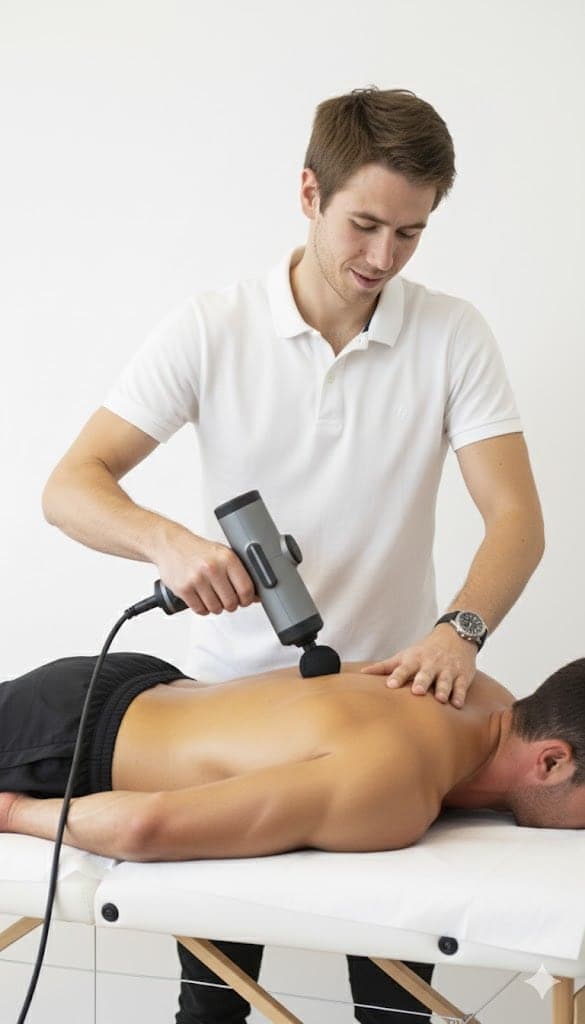
Written by
Chris
Massage therapist, nutrition and exercise physiologist
Norwegian-certified with a Bachelor’s in Physical Education and Nutrition and over ten years of clinical practice, working from a portable table in clients’ homes across the Paphos district.
This article is general information, not a medical diagnosis. If you have severe, worsening or unexplained pain, numbness, weakness, or pain after an accident, see a doctor first.