In-home massage Paphos: deep-tissue therapy at your own address
In short
My in-home massage Paphos service means I bring the table and the mechanical deep-tissue kit to your villa, apartment or hotel room, assess how you move, and treat the cause of the tension rather than the symptom.
I have been doing this work for over ten years, and most of it happens in other people's homes. My in-home massage Paphos service is simple: I bring the table, the towels and the mechanical deep-tissue device to your address anywhere in Paphos district, and the session is built around your body rather than a menu.
Many people find this article by searching for spa treatments at home. I want to be honest about what I do and do not offer, because the difference matters when you are choosing who to let through the door with a massage table.
Why an in-home massage Paphos session is not a spa treatment
A spa treatment is designed to be pleasant. Warm oil, soft music, a set sequence of strokes, and you leave feeling calm for an evening. There is nothing wrong with that, and if that is what you want, I am not the right person to call.
What I do is closer to clinical bodywork delivered in a domestic setting. I am Norwegian-certified with a BSc in Physical Education and Nutrition, and my specialism is mechanical deep-tissue therapy. The goal is a measurable change in how a muscle group behaves — more range, less guarding, less of the ache that returns every evening — not a nice hour.
The distinction shows up in three ways:
- Assessment comes first. I watch you stand, reach and rotate before I touch anything, so I know which structures are shortened and which are compensating.
- Pressure is chosen for the tissue, not for comfort. Deep enough to reach the layer that is holding, no deeper than you can breathe through.
- The session follows the problem. Lower-back pain usually pulls in the hip flexors and thoracolumbar fascia; neck tension usually involves the upper trapezius, levator scapulae and scalenes. I treat the chain, not the spot you point at.
- The setting is your home. Same equipment, same standards, but you rest afterwards instead of driving.
If you were expecting candles, this is your cue to book a spa instead. If you were expecting someone to actually find the thing that hurts, read on.
What actually happens when I arrive
I work from Chlorakas, just north of Paphos town, so anywhere in Paphos district is a short drive. I arrive a few minutes before the booked time with a folding table, fresh linen, oil and the device. I need roughly two by three metres of floor space, ideally near a plug socket, and a room where you can be undisturbed for the hour.
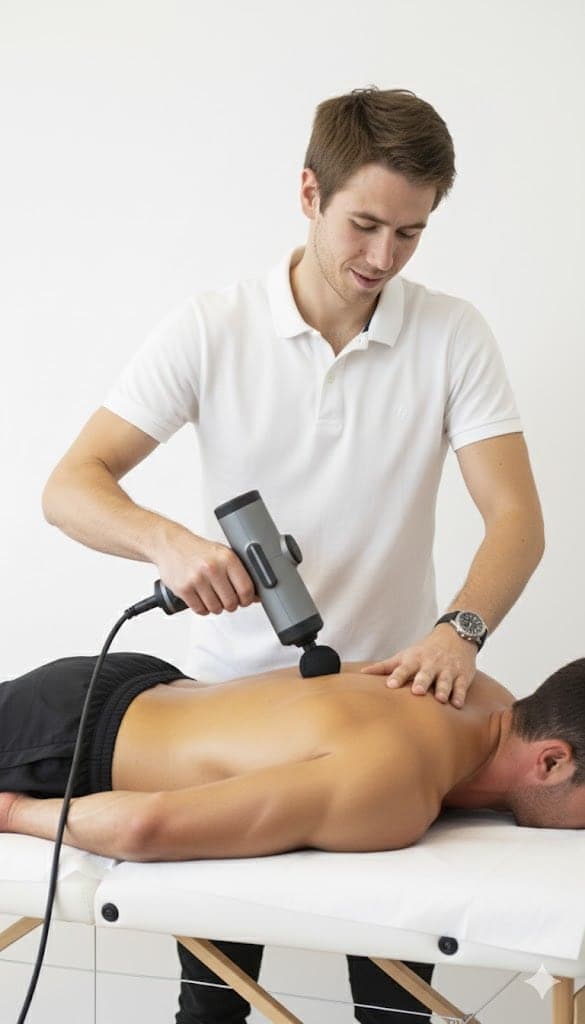
The first ten to fifteen minutes are assessment. I ask what brought you to book, when it started, what makes it worse and what you have already tried. Then I look at a handful of simple movements and palpate the areas involved. Dense, cable-like tissue tells me one thing; a granular, crunchy texture tells me another; localised heat tells me to go carefully.
Only after that do I decide the plan for the session. Here is what a first appointment normally looks like:
| Stage | Roughly how long | What I am doing |
|---|---|---|
| Conversation and movement check | 10–15 min | Finding the primary restriction and the compensations around it |
| Warm-up pressure | 5–10 min | Preparing the tissue and calibrating depth to your tolerance |
| Focused deep-tissue work | 35–55 min | Sustained mechanical pressure through the structures that are holding |
| Debrief | 5 min | What I found, what to expect for 24 hours, whether a follow-up makes sense |
You are covered by towels throughout and only the area being worked is exposed. You set the room temperature and whether there is music. Afterwards, drink water, keep moving gently, and expect a mild, worked-out ache the next morning that fades within a day or two.
The mechanical approach and why I use it
The device I use is not a percussion gun and it is not vibration. It applies controlled, sustained compression that I can hold at an exact depth for as long as a muscle belly needs. Hands are excellent for reading tissue and I still use them constantly, but hands fatigue after a few minutes of genuinely deep work and the pressure drifts. The machine does not drift.
The sensation is different from a flowing oil massage. It is focused, intense and, most people say, satisfying — the "good pain" feeling of something releasing. It is not painful in the sense of injury. If you cannot breathe steadily through it, I have gone too deep, and I will ease off. Nobody gets points for enduring.
The presentation I see most often across Paphos is a desk-and-driving pattern: shortened hip flexors, rounded upper back, tight chest and an overworked neck. On the coast and in the villas around Coral Bay it is often the opposite — people who are active, playing golf or swimming daily, with a stubborn shoulder or hip that no amount of stretching has shifted. Both respond well to sustained deep pressure precisely because the tissue involved sits below the reach of superficial work.
Who this suits and who it does not
I am direct about fit, because a wasted session is a wasted €90. Deep-tissue work suits people who have a specific complaint or a specific goal. Chronic muscular tension, restricted range, recurring aches from work posture, sports recovery and performance maintenance are all in scope. If you would like a treatment aimed squarely at those things, my therapeutic massage page describes it in more detail.
What I can help with is muscular and fascial tension, restricted movement and the recovery side of training; what I cannot help with is anything that needs a diagnosis, so see a doctor first if you have unexplained or worsening pain, numbness or weakness, pain after a fall or accident, fever, sudden swelling, or a history of clotting problems, and come to me once you have been cleared. I do not treat within 72 hours of an acute injury and I will not work over active inflammation or infection.
I am one practitioner, not a clinic. That means you get the same person every time, who remembers what your left hip did last month. It also means my diary is finite, so booking a few days ahead by WhatsApp or phone is sensible, particularly in the summer months.
How sessions build over time
A single session moves things — you will feel it standing up off the table. Whether that change holds depends on how long the pattern took to form. Something that arrived last week after a long flight often settles quickly. Something built over years of desk work usually needs a short series, and then occasional maintenance.
The way I structure it:
- Early sessions: reduce the acute holding, establish how much depth your tissue tolerates, identify the primary pattern.
- Middle sessions: as the main restriction lets go, secondary compensations show themselves; this is where the work often gets deeper and more specific.
- Maintenance: spacing out to every four to eight weeks depending on your load, keeping the gains rather than rebuilding them.
Pre-book five sessions as a package and receive one additional session free. A package of five pre-booked sessions includes one additional free session, which is my way of rewarding people who keep the momentum going, and current rates — €90 for 60 minutes, €130 for 90 minutes — are on the pricing page. Ninety minutes is worth considering for a first visit if you have more than one area to address, because the assessment takes the same time regardless of session length.
Between sessions, the most useful thing you can do is move: walk, swim, do the two or three specific stretches I show you. Sitting still for a week and hoping the next appointment does the work is the pattern I would most like to talk you out of.
Frequently asked questions
Is an in-home massage in Paphos really the same quality as a clinic visit?
Yes, and in some ways better. I bring the same professional table, the same equipment and the same assessment process I would use anywhere. What changes is that you are in familiar surroundings, you control the temperature and noise, and you can rest immediately afterwards rather than getting into a hot car. Deep work integrates better when the nervous system is not immediately asked to drive.
Which parts of Paphos do you cover?
All of Paphos town and the surrounding district: Kato Paphos and the harbour area, Universal, Anavargos, Konia, Geroskipou, Chlorakas, Emba, Kissonerga, Tala, Tsada, Pegeia and Coral Bay. I am based in Chlorakas, so most addresses are within twenty minutes. If you are staying in a hotel or holiday villa, that is fine — I have set up in a great many of them.
How much space do I need at home?
Roughly two by three metres of clear floor, enough for the table with room for me to move around it. A living room, a bedroom with the bed pushed aside, or a shaded terrace all work. A nearby plug socket helps for the device. I bring everything else, including linen. You do not need to prepare anything except a quiet room and a glass of water for afterwards.
Does deep-tissue work hurt?
It is intense but should never feel like injury. I calibrate depth to what you can breathe through and I check in as we go. Most people describe it as a satisfying, releasing pressure rather than pain. Some soreness the following day is common, similar to after a hard workout, and it fades. If anything feels sharp, electric or wrong during the session, tell me and I stop immediately.
How often should I book?
That depends on what we are treating. A recent, simple complaint may need one or two visits. A long-standing pattern usually does best with a few sessions closer together, then spacing out to maintenance every four to eight weeks. I will give you an honest view after the first assessment, and I would rather tell you that you do not need to come back than book you in for the sake of it.
Is there a mobile massage therapist near me in Paphos?
Yes. I am based in Chlorakas, just north of Paphos town, and I travel to homes, apartments and hotels across the district. Message me on WhatsApp or call with your area, what you would like help with, and a couple of times that suit you, and I will confirm a slot. Weekday mornings and early evenings are the busiest, so a few days' notice helps.
Evidence and limits
Massage may help with some symptoms, but benefits and evidence vary by condition. It does not replace medical assessment or treatment. A page update is not evidence of an independent clinical review.
Further reading: Massage therapy: evidence, safety and limitations by US National Center for Complementary and Integrative Health. This is general background reading, not verification of every claim in this article.
How we describe evidence and updatesWritten by
Chris
Massage therapist, nutrition and exercise physiologist
Norwegian-certified with a Bachelor’s in Physical Education and Nutrition and over ten years of clinical practice, working from a portable table in clients’ homes across the Paphos district.
- Norwegian-certified
- Nutrition & exercise physiologist
- 10+ years clinical practice
- Based in Chlorakas · all of Paphos district
- No call-out fee anywhere in Paphos district
Last updated
This article is general information, not a medical diagnosis. If you have severe, worsening or unexplained pain, numbness, weakness, or pain after an accident, see a doctor first.