Therapeutic massage at home Paphos: mechanical deep tissue for pain
In short
Therapeutic massage at home Paphos means I bring the table and a mechanical deep-tissue method to you, work slowly on the tissue that is actually restricted, and give you a plain plan for the next weeks.
I have spent ten years working on one question: why chronic muscle pain returns after treatment, and what has to happen in the tissue for it to stop returning. This article explains what I do when I come to your home for therapeutic massage in Paphos, how it differs from a relaxing massage, and who it suits.
Therapeutic massage at home Paphos is a service I run alone, from Chlorakas, across the whole district. I bring a folding treatment table, clean linen and the equipment I use for mechanical deep-tissue work. You do not need to prepare anything except a room with space for a table.
What therapeutic massage means in my practice
The word "therapeutic" is used loosely. In my practice it means treatment aimed at a specific problem, with a plan, rather than a general full-body session for pleasure. I trained in Norway, hold a BSc in Physical Education and Nutrition, and I specialise in mechanical deep-tissue work. That background shapes what a session looks like.
- I start with questions and a short movement check, not with oil on the table.
- I work mostly on the region that is causing the problem, plus the areas that feed into it.
- Pressure is slow and sustained rather than fast and superficial.
- I explain what I find in plain language and what I think it means.
- You leave with a small amount of homework, usually one or two movements.
If you want an hour of gentle, unstructured relaxation, I can do that too, but that is a different booking and a different article. This one is about pain.
How mechanical deep-tissue work differs from ordinary massage
Most massage is manual and rhythmic. Hands glide over the muscle, warm it, and the tissue softens for a day or two. That is pleasant and it has a place. It does not do much for a restriction that has been sitting deep in the hip or under the shoulder blade for two years.
The mechanical method I use is different in three ways.
| Aspect | Conventional manual massage | Mechanical deep-tissue work |
|---|---|---|
| Pressure | Varies with the therapist's fatigue and angle | Sustained, controlled and consistent |
| Depth | Mainly superficial and mid-layer muscle | Reaches deeper layers without bruising the surface |
| Pace | Rhythmic strokes | Slow holds on a specific spot, then reassessment |
| Aim | General relaxation | A measurable change in movement or pain |
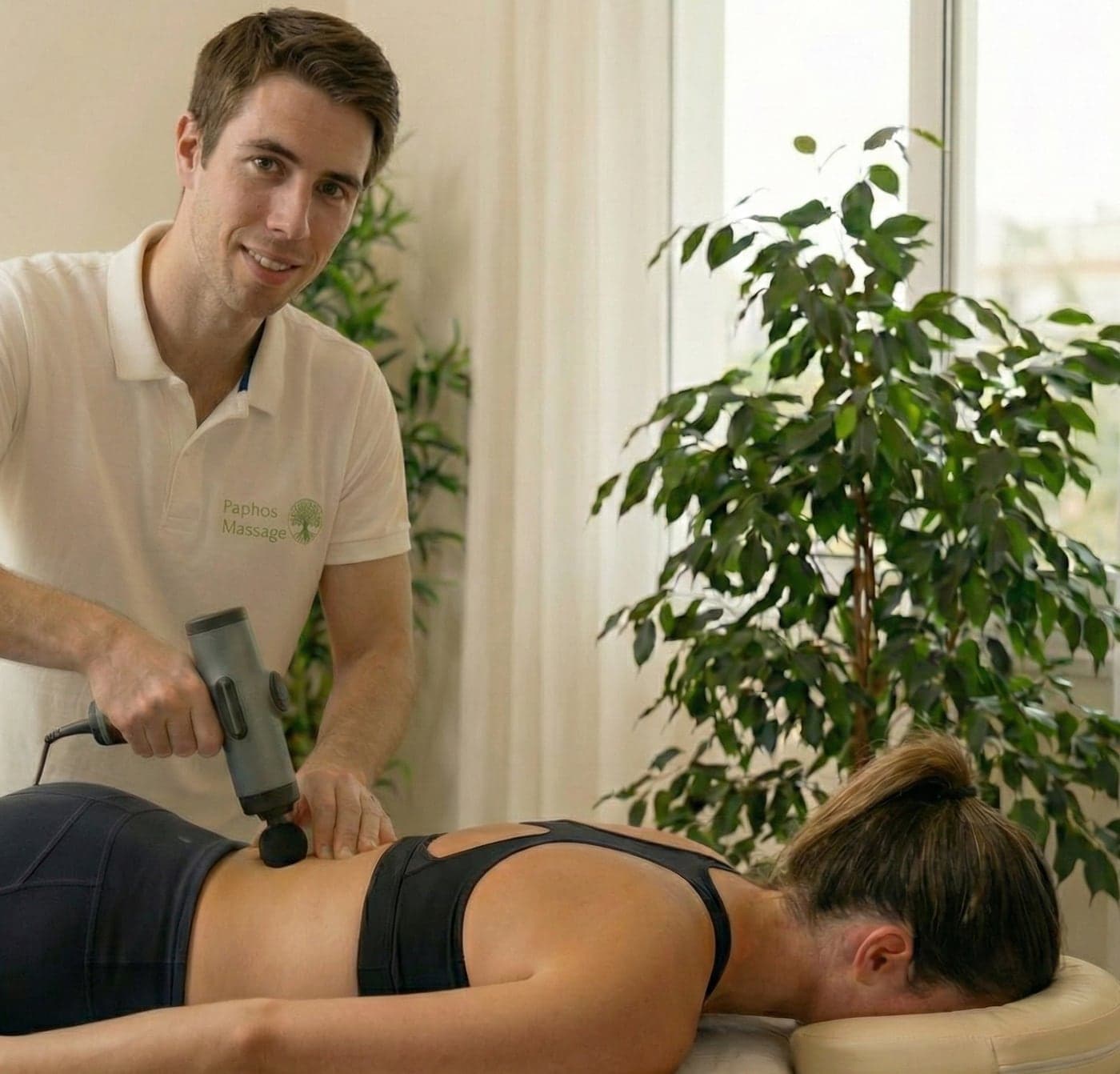
The important word is sustained. Tight fascia and trigger points respond to pressure held for a period, not to pressure that skims across them. Holding that pressure by hand for a minute at a time, session after session, is tiring and inconsistent. The tool takes that variability out. My job is to decide where, how deep and for how long, and to watch how you and the tissue respond.
What I actually treat, and what I see most often in Paphos
I treat soft-tissue problems: muscle, tendon and fascia. The presentations I see most often when I visit homes around Paphos are fairly consistent.
- Lower back pain with tight hip flexors from long hours sitting, driving, or working at a screen.
- Neck and shoulder tension with headaches that start at the base of the skull.
- Deep buttock pain that runs into the back of the leg, often from a tight piriformis rather than a disc.
- Calf, Achilles and heel pain in people who walk the coastal path daily or have taken up running in retirement.
- Shoulder stiffness after months of gardening, swimming or padel.
There is a local pattern too. Paphos has a warm climate that allows year-round activity, so overuse builds up without the enforced winter rest people had in northern Europe. Many of the people I treat moved here from colder countries with an old back or shoulder problem already in place, and the move is a good moment to deal with it properly.
I do not offer relaxation-only visits under this service, and I do not treat conditions that need a doctor. If you are unsure which category you fall into, describe the problem on WhatsApp and I will tell you honestly whether I am the right person.
Why therapeutic massage at home Paphos works better for chronic pain
I chose to work as a mobile therapist for practical reasons, and over the years I have come to think it is also better clinically for people in pain.
- You do not drive twenty minutes on a sore back and then sit in a waiting room. You start relaxed.
- After treatment you can lie down, walk in your garden or have a shower instead of getting into a car while the tissue is still adjusting.
- I see the chair, the desk, the sofa and the bed that are part of the problem, and I can suggest changes on the spot.
- People with limited mobility, or who are recovering from surgery and are cleared for massage, can be treated without a difficult journey.
- Sessions can be booked in the evening after work, when tension is usually at its peak.
The one thing I ask is a room where I can set up a table roughly two metres long with room to walk around it. A living room or a large bedroom is fine. Some clients in villas prefer a shaded terrace in the cooler months, which works well. If you are comparing what I offer with a clinic session, look at the sports massage in Paphos page too; the two services overlap for active people, and I will tell you which fits.
How a course of treatment is structured
One session can make a real difference, but a problem that has been there for years usually needs a short course. I try to be direct about this at the start rather than let people book one visit and hope.
- First visit: history, movement check, and treatment of the main region. I tell you what I found and what I think a sensible plan is.
- Second and third visits, usually a week apart: deeper work on the primary restriction, and the areas compensating for it.
- Reassessment: we compare movement and pain with the first visit and decide whether to continue, spread sessions out, or stop.
- Maintenance, if you want it: a session every few weeks for people whose work or sport keeps loading the same tissue.
Sessions are 60 minutes at €90 or 90 minutes at €130, and a package of five pre-booked sessions includes one additional free session. The 90-minute option suits a first visit or anyone with more than one region to treat. Full details are on the pricing page.
What I can and cannot help with
I can help with muscle tension, trigger points, restricted fascia, stiffness after overuse, and the deep, dull, movement-related pain that comes with all of these. I cannot help with, and will not treat, anything that looks like it needs a diagnosis first. See a doctor first if you have pain that came on suddenly with no obvious cause, pain that wakes you at night, numbness or weakness in a limb, fever, unexplained weight loss, a recent fall or accident, or a history of cancer, clotting problems or osteoporosis in the area concerned.
- I will ask about medication, surgery and current diagnoses before I start.
- If something does not fit a soft-tissue picture, I will say so and suggest who to see.
- Deep work is adjusted, not forced, around anything sensitive.
- If you are under a physiotherapist or doctor, I am happy to work alongside their plan.
I make no promise of a fixed outcome. What I can promise is that I will work carefully, tell you what I find, and not string you along with sessions that are not helping.
Frequently asked questions
Is deep mechanical work painful?
It is intense at times, but it should never be sharp or make you brace. I work at the level where the tissue is under pressure but you can still breathe steadily and talk. Most people describe it as a strong, satisfying ache that eases within the hold. If anything feels wrong, say so and I change depth or position immediately. Guarding against pain undoes the work, so I have no interest in pushing past it.
How many sessions will I need?
I cannot say precisely before I have seen you. A recent strain often settles in a few visits; a problem that has built up over years usually needs a short course of weekly sessions and then a reassessment. I would rather tell you honestly after the first visit than quote a number now. If you are not seeing a change after three or four sessions, we stop and rethink rather than continue out of habit.
What do you bring, and what do I need to provide?
I bring a folding treatment table, fresh linen, oil, the mechanical equipment and anything else the session needs. You provide a room with enough floor space for the table and a metre or so around it, and somewhere I can wash my hands. Loose clothing is helpful for the movement check. I set up and pack away myself; the whole visit takes about fifteen minutes longer than the treatment time.
Do you treat athletes and active people as well as chronic pain?
Yes. Runners, cyclists, swimmers and padel players make up a good share of my week, and the method is the same: find the restriction, work it under sustained load, retest. The aim shifts from reducing pain to improving range and recovery. If you are training for an event, tell me the date and I will avoid heavy work in the days immediately before it.
Which areas around Paphos do you cover?
I am based in Chlorakas and cover the whole Paphos district: the town itself, Kato Paphos, Chlorakas, Emba, Tala, Peyia, Coral Bay, Kissonerga, Geroskipou, Konia, Mesa Chorio and the villages towards Polis. There is no travel charge inside the district. If you are further out, ask on WhatsApp and I will tell you whether it is practical.
How do I book therapeutic massage at home?
Send a WhatsApp message or call. Tell me roughly what the problem is, where you are and which days suit. I confirm a time, and on the day I arrive with everything needed. Payment is by cash or bank transfer after the session. There is no form to fill in and no deposit; if you need to cancel, a few hours' notice is appreciated so I can offer the slot to someone else.
Evidence and limits
Massage may help with some symptoms, but benefits and evidence vary by condition. It does not replace medical assessment or treatment. A page update is not evidence of an independent clinical review.
Further reading: Massage therapy: evidence, safety and limitations by US National Center for Complementary and Integrative Health. This is general background reading, not verification of every claim in this article.
How we describe evidence and updates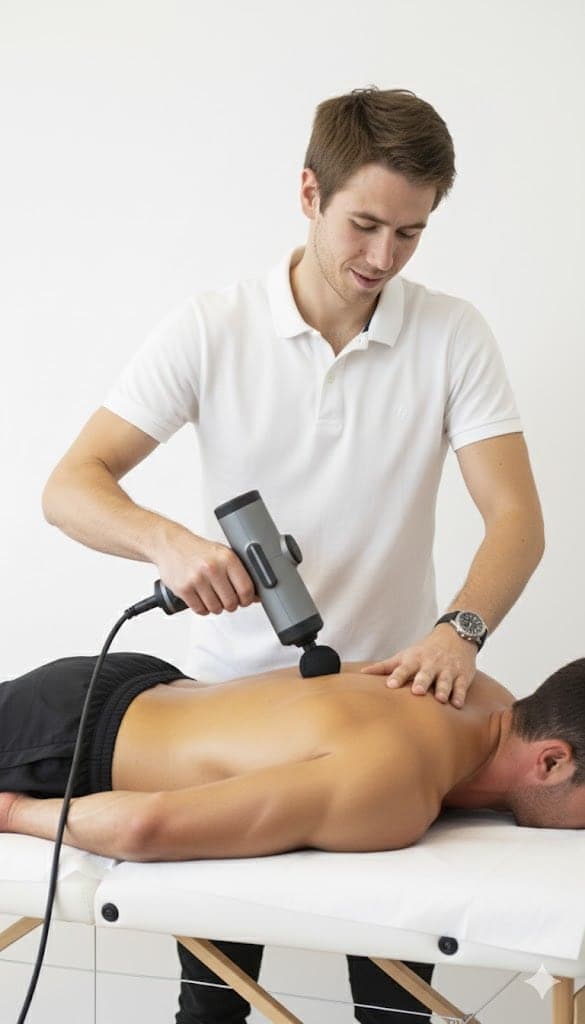
Written by
Chris
Massage therapist, nutrition and exercise physiologist
Norwegian-certified with a Bachelor’s in Physical Education and Nutrition and over ten years of clinical practice, working from a portable table in clients’ homes across the Paphos district.
- Norwegian-certified
- Nutrition & exercise physiologist
- 10+ years clinical practice
- Based in Chlorakas · all of Paphos district
- No call-out fee anywhere in Paphos district
Last updated
This article is general information, not a medical diagnosis. If you have severe, worsening or unexplained pain, numbness, weakness, or pain after an accident, see a doctor first.