
How often should athletes get a massage: a working schedule
In short
Most athletes in training do well with a sports massage every 7 to 14 days, closer together at first and further apart once the tissue settles. Training load, race dates and old injuries decide where in that range you sit.
I get asked this in almost every first session with a runner or cyclist. My honest answer is that how often should athletes get a massage depends on load, not habit, and the range for most people is every 7 to 14 days. I deliver sports massage in Paphos at your home, so the interval is easy to hold.
The short answer, and why it is a range
If you train seriously most weeks of the year, an interval of 7 to 14 days keeps the muscles I work on — calves, hamstrings, glutes, hip flexors, the thoracic back — from stiffening into a pattern that starts to change how you move. Shorter intervals suit the first weeks of a new block or a body that arrives with a lot of accumulated tightness. Longer intervals suit steady, moderate training and a body that holds its gains between visits.
I would rather give you a range than a single number, because a single number is nearly always wrong for someone. The variables that matter are covered in the next section, but the honest headline is this:
- Every 7 to 10 days during heavy blocks or when starting out with a lot of tension.
- Every 10 to 14 days for steady in-season training with no active complaint.
- Every 3 to 4 weeks in the off-season or for recreational athletes who train three or four times a week.
- Never closer than about five days between deep sessions, because tissue needs time to adapt.
What decides your frequency
I look at four things before suggesting an interval. None of them requires a lab. They are the same questions I ask on the sofa in Peyia or Tala before the first session, and they are the reason I keep saying "how often should athletes get a massage" is a question about you rather than about massage.
| Factor | Points towards shorter intervals | Points towards longer intervals |
|---|---|---|
| Weekly training hours | 12 hours or more, or a sudden jump | Under 8 hours, steady for months |
| Sport pattern | Rotational or asymmetric loading (tennis, golf, padel) | Symmetrical endurance work at moderate volume |
| Injury history | Old injuries with compensations still present | Clean history, movement looks even |
| Recovery basics | Poor sleep, high life stress, age over 40 | Sleeping well, eating enough, recovering fast |
Training volume is the biggest lever. Someone building for a marathon at 15 hours a week accumulates stiffness faster than someone maintaining base fitness at five, even if they are the same age and the same build. Sport pattern comes next: rotational sports load one side more than the other and I tend to see asymmetry return quicker, so those athletes often want the shorter end of the range during their season.
Injury history matters more than people expect. An athlete who arrives with an old ankle sprain or a hip that has been "a bit tight for years" usually needs closer sessions at the start, because we are undoing a compensation as well as clearing training stiffness. Once that pattern is quieter, the interval can open up.
A three-phase schedule I use with most athletes
Rather than a fixed weekly booking that runs indefinitely, I plan in phases. The point of good deep-tissue work is that the tissue should hold better between visits as we go, which means the interval should lengthen. If it never lengthens, either the training load is rising faster than we can keep up with, or the work is not reaching the right layer.
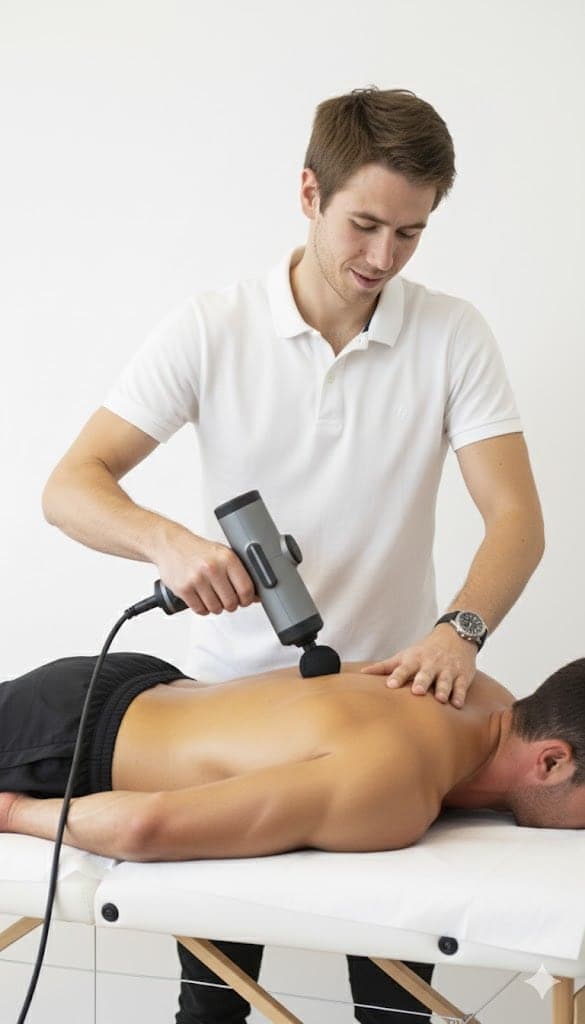
I use a mechanical deep-tissue device alongside my hands. The reason that matters for scheduling is consistency: the pressure I can deliver through the glutes and hamstrings at minute seventy is the same as at minute five, so each visit builds on the last rather than repeating it. That is what lets the interval open up over time.
The pattern I see most often in Paphos is an athlete who has been booking a massage "when I can fit it in" — perhaps once a month, perhaps less — and then wondering why the same calf keeps flaring. Moving that person to a proper correction phase, then letting the gap widen, is nearly always more useful than any single heroic session. Because I come to you, the logistical reason for skipping a visit disappears, which is a bigger part of holding an interval than most people admit.
Timing around competition
Frequency is only half of it. When the session lands relative to a race or match matters just as much, and getting it wrong can cost you more than skipping it would have.
The mistake I see most is a deep session two days before a long race. It feels productive at the time and then the legs feel flat on the start line. The other mistake is doing nothing at all in the fortnight before an event and arriving with the stiffness of a full build sitting in the hips. Between those two lies the sensible middle: keep the interval, drop the intensity as the date approaches.
Signs the interval is wrong
You do not need to guess. Your body tells you whether the gap between sessions is right, and I adjust it every visit rather than sticking to whatever we agreed at the start.
- Too far apart: the same restrictions are back in full by the next session; a hard block leaves you feeling heavy for days; a new niggle appears in a place you were compensating with.
- Too close together: you are still tender from the previous visit; the tissue feels reactive rather than looser; training feels worse the day after, not better.
- About right: you arrive with a little to work on but not the whole list; range of motion holds most of the way to the next visit; recovery between hard sessions feels shorter.
I keep simple markers between visits — where the tightness is, how far a hip or ankle moves, what you noticed in training — rather than relying on whether you "feel better" walking out the door. Feeling better is easy to produce for an hour. Holding it for ten days is the goal, and it is what tells me whether we can lengthen the gap.
What frequent massage can and cannot do
Regular sports massage is good at keeping training stiffness from turning into a movement problem, at making hard blocks recoverable, and at picking up an asymmetry before it becomes a complaint. It is not a substitute for sleep, for eating enough, or for sensible load progression, and no interval will fix a training plan that keeps jumping volume by a third.
I can help with tight, aching or restricted muscle that is clearly linked to training; I cannot help with, and will not work through, sharp pain, swelling, numbness or a suspected tear or stress fracture — see a doctor first if any of those are present, or if pain woke you at night or came on without any change in load. Once it is clear the problem is muscular, the interval conversation starts again.
- Book through WhatsApp or a phone call and tell me what you are training for and when.
- Sessions are 60 minutes at €90 or 90 minutes at €130, and a package of five pre-booked sessions includes one additional free session — see pricing.
- Runners and cyclists in the hills north of town, and anywhere else in the district, are covered by my Paphos service area.
Frequently asked questions
Can an athlete get a massage too often?
Yes. Deep work every two or three days does not give the tissue time to adapt, and it can leave muscle feeling reactive rather than looser. During a correction phase I rarely go closer than five days between deep sessions, and for most athletes the sweet spot is seven to ten days. Lighter flush work can be more frequent, but that is a different session.
Should the interval change through the training year?
It should. Base building usually needs the least, every three to four weeks. Peak blocks push it towards seven to ten days. Taper is about intensity rather than frequency, keeping the interval but making the work lighter. Off-season is a good time for a short correction phase if there is anything lingering. I plan the interval off your training calendar rather than the other way round.
How quickly will I notice a difference?
Range of motion and general tension usually shift the same day. The change that matters — a hip or calf that stops coming back tight between visits — takes a few weeks of consistent sessions, and how many depends on how long the pattern has been there. Most athletes notice training feels easier before they can point to exactly what changed in the muscle.
Is it better to have shorter sessions more often or longer sessions less often?
For a body carrying a lot of accumulated stiffness, a longer 90-minute session every ten to fourteen days usually does more than a rushed hour every week, because there is time to work through the whole chain. For maintaining an athlete who is already moving well, 60 minutes at a longer interval is plenty. I suggest the length based on what is actually there.
Should I have the session before or after a hard training day?
Deep work belongs at least 24 to 48 hours after a hard session, and not within a couple of days before a key one. A lighter session before quality training can improve how you move, but that is a different intensity. In practice I book around your weekly structure — a rest day or an easy day is nearly always the right slot for the deeper work.
What if I cannot keep to the recommended interval?
Progress slows and gets less predictable, because we end up clearing the same stiffness rather than building on the last visit. That said, a good session every three weeks still beats a shallow one every week. If life or budget limits the frequency, tell me and I will plan the intensity of each visit around a realistic gap rather than an ideal one.
Evidence and limits
Massage may help with some symptoms, but benefits and evidence vary by condition. It does not replace medical assessment or treatment. A page update is not evidence of an independent clinical review.
Further reading: Massage therapy: evidence, safety and limitations by US National Center for Complementary and Integrative Health. This is general background reading, not verification of every claim in this article.
How we describe evidence and updatesWritten by
Chris
Massage therapist, nutrition and exercise physiologist
Norwegian-certified with a Bachelor’s in Physical Education and Nutrition and over ten years of clinical practice, working from a portable table in clients’ homes across the Paphos district.
- Norwegian-certified
- Nutrition & exercise physiologist
- 10+ years clinical practice
- Based in Chlorakas · all of Paphos district
- No call-out fee anywhere in Paphos district
Last updated
This article is general information, not a medical diagnosis. If you have severe, worsening or unexplained pain, numbness, weakness, or pain after an accident, see a doctor first.