
Difference Between Sports Massage and Deep Tissue Massage: A Clinical Perspective
In short
Understanding the difference between sports massage and deep tissue massage is critical for achieving lasting results. Learn from a specialist with 10 years of experience which technique targets your specific needs.
I remember the first time a competitive runner came to me complaining about persistent IT band syndrome. She had been receiving what her previous therapist called “sports massage” for six months with minimal improvement. Within three sessions of properly executed deep tissue work, her running stride improved by fifteen percent, and the chronic tightness that had plagued her training cycles disappeared completely.
This experience isn’t unique. Over my decade of practice and through my education in Physical Education and Nutrition from Norway, I’ve encountered hundreds of clients confused about the difference between sports massage and deep tissue massage. The confusion costs them time, money, and prolonged discomfort because they’re receiving the wrong treatment for their specific condition.
The distinction matters profoundly. These are not interchangeable techniques with different names—they represent fundamentally different approaches to addressing musculoskeletal dysfunction. One focuses on preparation and recovery within an athletic context. The other systematically dismantles chronic tension patterns regardless of athletic status.
The Fundamental Difference Between Sports Massage and Deep Tissue Massage
Sports massage is event-oriented and cyclical. Deep tissue massage is problem-oriented and corrective. That’s the core distinction, but let me elaborate with the precision this topic demands.
Sports massage operates within the athletic performance cycle. It adapts its technique, intensity, and focus based on where an athlete sits relative to competition: pre-event preparation involves brisk, stimulating strokes to increase circulation and neuromuscular readiness. Post-event work emphasizes lymphatic drainage and metabolite clearance to accelerate recovery. Maintenance sessions during training phases address specific muscle groups under repetitive stress from sport-specific movements.
Deep tissue massage, conversely, targets the architectural dysfunctions within myofascial structures. It works systematically through layers of tissue to reach chronically shortened muscle fibers, adhesions between fascial planes, and trigger points that refer pain to distant locations. The goal isn’t preparation or recovery—it’s lasting structural change.
In my practice, I’ve refined this distinction further. Traditional deep tissue work, while effective, still relies on human hands with inherent limitations in consistency and depth. My specialized machine-assisted approach delivers what hands cannot: precision targeting at depths of 8-12 centimeters, consistent pressure application without practitioner fatigue, and controlled intensity that adapts microscopically to tissue resistance.
Technical Execution: How These Modalities Actually Work
Sports Massage Methodology
Sports massage employs a toolkit of techniques borrowed from Swedish massage, cross-fiber friction, compression, and stretching protocols. The practitioner assesses which muscles are involved in the athlete’s primary movements and tailors the session accordingly.
A cyclist receives concentrated work on the quadriceps, hip flexors, and lower back. A swimmer gets thorough attention to the rotator cuff complex, latissimus dorsi, and pectoral muscles. The strokes move with the muscle fiber direction to encourage venous return and lymphatic flow, or across fibers to address specific tension points.
Pressure remains moderate to firm—deep enough to affect muscle tissue but not so aggressive that it creates inflammation before competition. Timing matters critically. An intense sports massage 24 hours before a marathon would impair performance by triggering localized inflammation and reducing muscle elasticity.
Deep Tissue Massage Methodology
Deep tissue massage disregards the athletic calendar entirely. It follows the body’s compensation patterns.
I start by identifying the primary restriction—the foundational dysfunction causing secondary adaptations throughout the kinetic chain. A shoulder problem often originates in thoracic spine immobility. Chronic hamstring tightness frequently stems from an anteriorly rotated pelvis held in dysfunction by shortened hip flexors.
The technique penetrates through superficial layers methodically. I don’t simply push harder on surface muscles. Using my specialized machine, I work at angles that allow the tool to slide between fascial planes, separating adhered tissues and restoring independent movement between layers. The pressure is profound but targeted, reaching depths where finger or elbow pressure would cause surface tissue trauma long before affecting the deeper restriction.
| Characteristic | Sports Massage | Deep Tissue Massage |
|---|---|---|
| Primary Goal | Athletic performance optimization | Chronic tension resolution |
| Session Timing | Event-dependent (pre/post/maintenance) | Progressive treatment series |
| Pressure Depth | Moderate to firm (3-6 cm) | Profound (8-12 cm with proper tools) |
| Technique Focus | Circulation, flexibility, recovery | Structural realignment, adhesion release |
| Ideal Candidate | Active athletes in training cycles | Anyone with chronic musculoskeletal pain |
| Treatment Philosophy | Ongoing maintenance | Progressive correction toward resolution |
When Sports Massage Is the Appropriate Choice
I recommend sports massage in specific, well-defined scenarios. These aren’t general suggestions—they’re based on physiological realities I’ve observed across thousands of sessions.
Pre-Competition Preparation
Forty-eight to seventy-two hours before significant athletic performance, sports massage serves a legitimate function. The techniques increase local blood flow without creating microtrauma, improve neuromuscular communication, and mentally prepare the athlete for exertion.
I worked with a professional handball team for three seasons. Our pre-match protocol involved twenty-minute targeted sessions focusing on explosive movement muscles: glutes, quadriceps, and calves. We used rapid compression techniques and dynamic stretching to elevate tissue temperature and reduce neuromuscular inhibition. Performance metrics showed measurable improvements in vertical jump height and sprint acceleration during matches following these sessions.
Post-Event Recovery Acceleration
Within 24 hours post-competition, gentle sports massage facilitates metabolic waste clearance. After intense exertion, muscles are flooded with lactate, hydrogen ions, and inflammatory markers. Light effleurage and compression encourage these substances into lymphatic and venous circulation for processing.
This isn’t the time for aggressive deep work. The tissues are already inflamed and damaged at the microscopic level—that’s the nature of athletic performance. Attempting deep structural work during this recovery window would compound tissue trauma and delay healing.
Maintenance During Training Phases
Athletes performing repetitive movement patterns develop predictable tension accumulations. Runners get tight hip flexors and IT bands. Swimmers develop anterior shoulder restrictions. Cyclists experience chronic quadriceps and lumbar tension.
Regular sports massage—weekly or biweekly during heavy training blocks—addresses these accumulations before they become structural problems requiring deep tissue intervention. It’s preventive maintenance, similar to regular oil changes preventing engine damage.
When Deep Tissue Massage Becomes Necessary
Deep tissue work becomes essential when pain persists beyond the acute inflammatory phase, when movement patterns have become compensatory, or when structural restrictions limit function regardless of activity level.
Chronic Pain Conditions
If you’ve experienced the same pain for longer than three months, you’re no longer dealing with an injury—you’re dealing with a structural adaptation. The body has reorganized itself around the dysfunction. Muscles have shortened durably. Fascia has thickened and adhered. Neural pathways have established pain as the normal state.
I treated a software developer with cervicogenic headaches occurring 20+ days monthly for four years. Multiple doctors, two neurologists, and countless physiotherapy sessions had provided only temporary relief. His problem wasn’t muscular tension from stress—it was mechanical restriction of the suboccipital muscles creating sustained compression on cervical nerve roots.
Using my precision machine-assisted technique, I worked systematically through six sessions to release the calcified tension in his upper cervical extensors, restore proper atlantooccipital joint mobility, and reestablish normal craniocervical rhythm. His headache frequency dropped to 2-3 days monthly within eight weeks, and by six months, they had essentially resolved.
Sports massage wouldn’t have touched this condition. The restrictions were too deep, too architecturally embedded, and completely unrelated to athletic performance cycles.
Movement Dysfunction and Reduced Range of Motion
When you cannot perform basic movement patterns without compensation, deep structural work is required. I’m not referring to athletic flexibility—I mean functional ranges necessary for daily life.
Inability to raise your arm fully overhead without hiking your shoulder. Inability to squat to parallel without your heels lifting. Inability to rotate your spine adequately to check your blind spot while driving. These restrictions signal that muscles have lost their ability to lengthen appropriately and fascia has created restrictive adhesions.
A 58-year-old patient came to me unable to reach behind his back to tuck in his shirt—a movement requiring adequate internal rotation and extension of the shoulder joint. He had received sports massage periodically for “general tension” but never addressed the underlying restriction: massive adhesions between his subscapularis and the anterior capsule of the glenohumeral joint, compounded by shortened pectoral muscles pulling his shoulder into protraction.
After four intensive deep tissue sessions targeting these specific structures, his internal rotation improved by 35 degrees, and the functional movement returned completely. We didn’t work on performance enhancement. We restored basic structural competency.
Referred Pain and Trigger Point Complexes
When pain appears in locations distant from the actual dysfunction, you’re experiencing referred pain from myofascial trigger points. This is deep tissue territory exclusively.
The classic example: chronic lateral knee pain in non-athletes. The pain screams “knee problem,” but examination reveals a completely healthy knee joint. The actual culprit sits 20 centimeters away—a trigger point in the vastus lateralis that refers pain down to the lateral knee following established neurological pathways.
Sports massage might temporarily reduce the discomfort by increasing general circulation. Deep tissue work eliminates the trigger point durably by restoring proper sarcomere length and blood flow to the ischemic muscle segment creating the trigger point. The approaches aren’t comparable in outcome.
The Machine-Assisted Advantage: Why Traditional Techniques Fall Short
I need to address an uncomfortable truth that many practitioners avoid: human hands, regardless of skill, have physical limitations that compromise deep tissue effectiveness.
The Depth Problem
Anatomical studies show that the deepest muscles—the rotator cuff, deep hip stabilizers, the multifidus in the spine—sit 8-12 centimeters below the skin surface in average-sized individuals. For fingers or elbows to generate adequate pressure at these depths, they must apply such force to superficial tissues that they create bruising and inflammation before reaching the target.
I tried for years to achieve adequate depth with traditional hands-on techniques. I’m not a small person—I have the strength. But the geometry doesn’t work. You cannot generate 40+ pounds of perpendicular force through a small contact point without damaging superficial structures.
My specialized machine solves this through mechanical advantage and focused application. The tool maintains consistent pressure as it penetrates through tissue layers, parting rather than crushing superficial structures, and delivering therapeutic force precisely where architectural change is needed.
The Consistency Problem
Human fatigue is real. A practitioner’s eighth deep tissue session of the day will not match their second session’s quality. Hand strength diminishes. Concentration wavers. The treatment you receive depends on where you fall in the therapist’s schedule.
The machine delivers identical force application regardless of session number or time of day. Every client receives the same precision, the same depth capacity, the same controlled intensity. This isn’t a minor detail—consistency determines whether structural changes become lasting or remain temporary improvements that regress.
The Control Problem
With traditional deep tissue work, intensity adjustment happens through the practitioner’s perception of their applied force—an inherently imprecise measurement. Too light, and you waste time working superficially. Too aggressive, and you trigger protective muscle guarding that prevents effective release.
My machine allows microsecond-level intensity adjustment based on real-time tissue response. When I encounter a restriction, I can increase pressure incrementally until I feel the fascial layer release—then immediately reduce pressure to prevent overtreatment. This level of control is physically impossible with hands.
The Intersection: Can These Modalities Complement Each Other?
In specific scenarios, sports massage and deep tissue work complement each other sequentially, not simultaneously.
An athlete with chronic structural dysfunction needs deep tissue work during the off-season or reduced training phases to correct the underlying problem. Once structural competency is restored, sports massage during competitive seasons maintains that corrected state and supports performance demands.
I worked with a competitive triathlete who had developed chronic posterior chain restrictions from years of cycling-dominant training. During her winter base-building phase, we performed eight intensive deep tissue sessions specifically targeting her hamstring origins, gluteal complex, and thoracolumbar fascia. We systematically restored proper hip extension mechanics and spinal mobility.
Once competition season began, she transitioned to sports massage for recovery between events and maintenance of the corrections we’d established. The combination allowed her to compete pain-free and achieve personal records across all three disciplines.
However, attempting both simultaneously during active treatment creates conflicting tissue responses. Deep tissue work creates controlled inflammation as part of the remodeling process. Sports massage during this phase disperses the inflammatory markers before they complete their healing signaling, potentially slowing structural adaptation.
Common Misconceptions That Lead to Poor Treatment Choices
“Deeper Pressure Means Deep Tissue Massage”
This is perhaps the most damaging misconception in the massage industry. Deep tissue refers to anatomical structures being addressed, not pressure intensity.
I can perform legitimately deep tissue work with moderate pressure by working at precise angles that access deep layers without crushing superficial ones. Conversely, I’ve observed practitioners applying crushing pressure to surface muscles and calling it “deep tissue” when they’re simply bruising the trapezius.
If your massage leaves you covered in bruises, you’re not receiving effective deep tissue work—you’re receiving poorly executed sports massage at inappropriate pressure.
“Sports Massage Is Only for Athletes”
The name creates this confusion, but sports massage techniques benefit anyone engaged in repetitive movement patterns—which describes virtually everyone.
Office workers performing thousands of identical mouse movements daily develop repetitive strain patterns that respond well to sports massage’s focus on specific muscle groups and movement facilitation. Manual laborers benefit from the recovery acceleration techniques. Even sedentary individuals preparing for increased activity (starting an exercise program, planning an active vacation) benefit from preparatory sports massage.
The question isn’t athletic status—it’s whether your goal is preparation, recovery, and maintenance versus structural correction.
“Deep Tissue Massage Should Be Painful”
Effective deep tissue work operates at the edge of tolerance, not beyond it. When pressure exceeds your nervous system’s acceptance threshold, muscles contract protectively—exactly opposite to the relaxation and lengthening we’re trying to achieve.
I explain to every client: you should feel intense sensation, a “good hurt” that makes you breathe deliberately, but never pain that makes you hold your breath or tense surrounding muscles. The moment you guard, the treatment becomes counterproductive.
My machine’s controlled intensity allows me to work right at this therapeutic threshold consistently. With manual techniques, practitioners often oscillate between insufficient and excessive pressure, making the treatment less effective and more uncomfortable than necessary.
Making the Correct Choice: A Decision Framework
Choose Sports Massage If:
- You’re preparing for or recovering from athletic competition within a 72-hour window
- You’re in active training and experiencing normal muscle fatigue without chronic pain
- You need general relaxation and stress reduction alongside mild muscular tension relief
- You’re maintaining corrected structural patterns achieved through previous deep tissue work
- You have acute muscle strain (less than 2 weeks old) requiring gentle circulation enhancement
Choose Deep Tissue Massage If:
- You’ve experienced the same pain or restriction for longer than three months
- Your movement patterns have become compensatory or limited
- Pain persists despite rest, anti-inflammatories, and conventional physical therapy
- You experience referred pain in locations distant from the apparent problem
- You want lasting resolution, not temporary symptom management
- You’re willing to invest in a progressive treatment series rather than one-off sessions
The Investment Perspective
I position my services as an investment in structural competency, not an expense for temporary relief. This distinction matters.
Sports massage is ongoing maintenance—you’ll need it regularly as long as you maintain athletic activity. That’s fine for its intended purpose, but it won’t eliminate chronic dysfunction.
Deep tissue work, properly executed, resolves problems durably. Yes, the sessions are more intensive, the series requires commitment, and the investment is greater upfront. But compare that cost to years of recurring sports massage that manages symptoms without addressing causes, or worse, to long-term pain medication dependency and potential surgical intervention.
One of my clients spent a substantial sum over two years on biweekly sports massage for chronic lower back pain. She experienced 2-3 days of relief after each session, then gradual return of symptoms. We resolved her condition completely in eight deep tissue sessions over three months. She hasn’t needed treatment in the four years since, saving her thousands in continuing maintenance costs and giving her functional capacity she hadn’t experienced in over a decade.
My Approach: Precision, Power, and Personalization
My method combines my decade of experience, my education in Physical Education and Nutrition from Norway, and my specialized machine to deliver results that traditional approaches—whether sports massage or conventional deep tissue—cannot match.
Comprehensive Assessment
I don’t treat the location that hurts. I assess your entire kinetic chain to identify the architectural dysfunction causing your symptoms. Your shoulder pain might originate from rib cage immobility. Your knee problem might stem from hip weakness creating unstable loading patterns.
This assessment draws on my understanding of biomechanics, functional anatomy, and movement science—knowledge that extends beyond massage technique into how the body actually functions as an integrated system.
Targeted Treatment
Using my specialized machine, I work systematically through the identified restrictions with precision impossible through manual techniques. The depth, consistency, and control allow me to create lasting architectural changes in 8-12 sessions that might require 30+ manual sessions—if they’re achievable at all with hands.
Customized Progression
I don’t offer one-off sessions hoping you’ll return when symptoms recur. I design a complete treatment plan that progressively addresses your specific dysfunctions from foundational restrictions to secondary compensations.
This is a partnership. You’re investing in a dedicated process toward lasting resolution, and I’m investing my expertise and reputation in your outcome.
Convenience and Professionalism
I travel to your location with professional equipment—a specialized bench and all necessary tools. You don’t waste time commuting to a clinic. You receive treatment in your environment, at your convenience, with the same clinical precision as any medical facility.
Frequently Asked Questions
Can deep tissue massage help with athletic performance even if I don’t have pain?
Absolutely. Subclinical restrictions—dysfunctions that don’t cause pain but limit optimal function—reduce performance capacity. I’ve worked with pain-free athletes who gained measurable improvements in power output, range of motion, and movement efficiency through deep tissue correction of restrictions they didn’t know they had. However, if you’re pain-free and performing well, sports massage for recovery and maintenance is likely sufficient.
How do I know if my chronic pain needs deep tissue work or if it’s something requiring medical intervention?
If you have structural pathology—torn ligaments, fractures, herniated discs with nerve impingement, inflammatory arthritis—medical treatment precedes or accompanies bodywork. However, the vast majority of chronic musculoskeletal pain originates from soft tissue dysfunction perfectly suited to deep tissue correction. If you’ve had medical imaging showing no structural damage, multiple provider visits without resolution, and pain that’s mechanical (changes with position and movement rather than constant), deep tissue work is likely your answer.
Why is your machine-assisted approach better than a skilled manual therapist?
Skill matters tremendously, and I respect excellent manual therapists. However, physics doesn’t care about skill. The human hand cannot generate consistent perpendicular force at 10-centimeter depth without creating superficial tissue trauma. The machine provides mechanical advantages that overcome anatomical limitations. Additionally, the consistency eliminates the variability inherent in manual work—practitioner fatigue, angle maintenance, pressure perception. You receive optimally effective treatment every session, not treatment quality that varies based on human factors.
How many sessions of deep tissue work will I need?
That depends entirely on your specific condition’s complexity and chronicity. Acute dysfunctions (present for 3-6 months) often resolve in 4-6 sessions. Chronic, multi-system compensatory patterns that have existed for years typically require 8-12 sessions for complete resolution. I provide an honest assessment after the initial evaluation and adjust the plan based on your response to treatment. I never extend treatment beyond necessary—my goal is lasting resolution, not dependency.
Is there any reason someone should choose sports massage over deep tissue for chronic problems?
Only if they’re unwilling to engage with the discomfort and commitment that deep structural work requires. Deep tissue therapy involves intense sensation, requires consistent session attendance to build progressive change, and demands that you actively participate in maintaining corrections through specific movement patterns. If someone prefers temporary symptom management with minimal discomfort over lasting resolution with greater initial intensity, sports massage might be their preference—though not my recommendation.
Can I receive your treatment during competition season?
Yes, with proper timing. I schedule intensive sessions during recovery weeks or reduced training phases, avoiding the 72-hour window before important competitions. The controlled precision of my machine allows effective deep work without creating the prolonged inflammation that traditional deep tissue causes. Many athletes find they can train harder and recover faster once we’ve corrected underlying restrictions, even while continuing treatment during season.
Do you combine your deep tissue method with sports massage techniques?
My focus is exclusively on advanced mechanical deep tissue work—that’s where my expertise and equipment deliver unmatched results. I don’t dilute the treatment with lighter sports massage techniques within the same session. If a client needs sports massage for competition preparation or post-event recovery, I refer them to qualified sports massage specialists for those specific needs while we continue the deep structural work separately.
What makes your approach different from physical therapy?
Physical therapy excels at rehabilitation exercises, movement retraining, and modality application (ultrasound, electrical stimulation, etc.). My approach excels at directly changing the architectural restrictions within soft tissue—releasing adhesions, eliminating trigger points, restoring muscle fiber length. These are complementary, not competing. Often, physical therapy exercises become dramatically more effective once I’ve removed the structural restrictions preventing proper movement patterns. Many of my clients see their physical therapists simultaneously, and the providers appreciate the enhanced outcomes.
The Bottom Line: Results Define the Right Choice
The difference between sports massage and deep tissue massage isn’t semantic—it’s fundamental. One maintains and enhances current function within athletic contexts. The other transforms dysfunctional structure into optimal function.
If you’re an athlete needing preparation, recovery, or maintenance support, sports massage serves you well. If you have chronic pain, movement restrictions, or persistent dysfunction that other approaches haven’t resolved, deep tissue work—specifically, properly executed deep tissue work with the precision my machine-assisted method provides—is your path to lasting resolution.
I’ve spent a decade refining this distinction, not theoretically but through thousands of successful outcomes. Clients who spent years and thousands of dollars on approaches that didn’t match their actual needs, finally experiencing resolution when matched with the correct modality.
The choice is yours, but make it based on accurate understanding. Your body deserves treatment that addresses its actual condition, not treatment that sounds appealing or feels temporarily pleasant. The difference between sports massage and deep tissue massage is the difference between feeling better and getting better.
I travel to your location throughout the region, bringing professional equipment and a decade of specialized expertise. If you’re ready to invest in lasting resolution rather than recurring management, contact me for a comprehensive assessment. We’ll determine exactly what your body needs and design a customized plan to deliver lasting results.
Because at the end of the day, results are the only measure that matters.
Evidence and limits
Massage may help with some symptoms, but benefits and evidence vary by condition. It does not replace medical assessment or treatment. A page update is not evidence of an independent clinical review.
Further reading: Massage therapy: evidence, safety and limitations by US National Center for Complementary and Integrative Health. This is general background reading, not verification of every claim in this article.
How we describe evidence and updates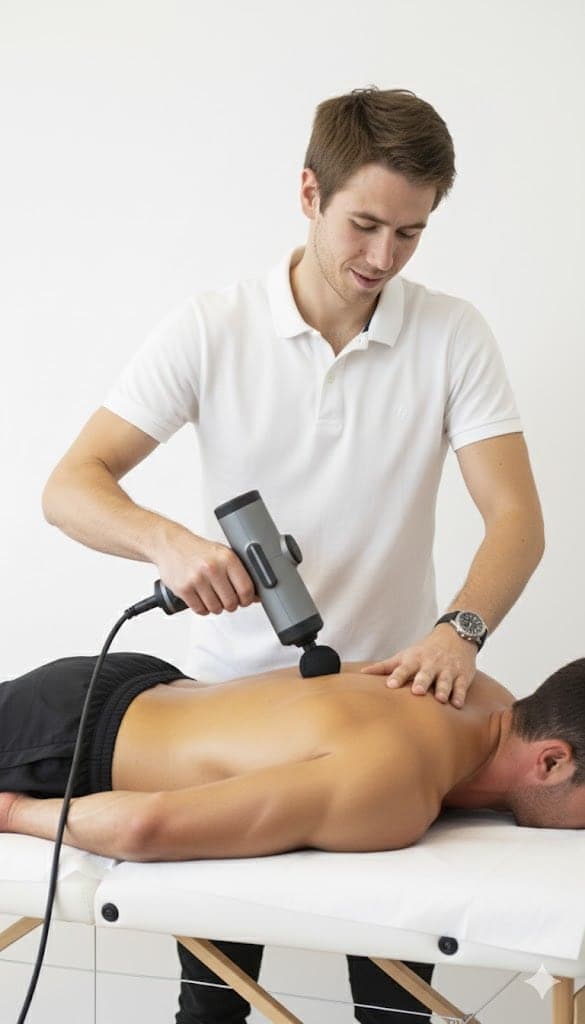
Written by
Chris
Massage therapist, nutrition and exercise physiologist
Norwegian-certified with a Bachelor’s in Physical Education and Nutrition and over ten years of clinical practice, working from a portable table in clients’ homes across the Paphos district.
This article is general information, not a medical diagnosis. If you have severe, worsening or unexplained pain, numbness, weakness, or pain after an accident, see a doctor first.