
Shoulder pain specialist Paphos: how to choose the right help
In short
A good shoulder pain specialist in Paphos looks at how the whole shoulder girdle moves, explains why it hurts, works session by session and knows when to send you to a doctor. Here is how I would judge one.
Choosing who to trust with a sore shoulder is harder than it should be, and I say that as one of the options. This is my honest guide to picking a shoulder pain specialist Paphos residents can rely on, whether that is me, a physiotherapist, or a doctor. It comes from a decade of injury rehab in Paphos.
Why most shoulder pain keeps coming back
The shoulder is not really one joint. It is a ball-and-socket joint sitting on a shoulder blade that glides over the ribcage, hung from the collarbone, and driven by muscles that reach up into the neck and down into the mid-back. When people say "my shoulder hurts", the pain is often the last link in that chain to complain, not the first.
The presentation I see most often in Paphos is a shoulder that has been treated as an isolated part. The sore spot gets rubbed, heated, or stretched, it eases for a few days, and then the same stiff mid-back and the same rounded posture load it up again. Nothing was wrong with the treatment as such; it just addressed the place that hurt rather than the reason it hurt.
None of these are exotic. They are just easy to miss if the assessment stops at "where does it hurt" and "how far can you lift it".
What a shoulder pain specialist Paphos should actually do
Whatever the letters after someone's name, there is a minimum I would expect from anyone calling themselves a shoulder pain specialist in Paphos. Most of it happens in the first twenty minutes and costs nothing beyond attention.
First, a proper conversation. When did it start, what makes it worse, what do you do all day, have you had it before, does anything wake you at night. The answers narrow the picture more than any test does. Then a look at how you move, not just how far: raising the arm, reaching behind the back, turning the head, and what the shoulder blade does while all that happens.
Second, hands on the tissue. Feeling for the difference between a muscle that is tight because it is overworked and one that is guarding because something underneath is irritated. This is where experience shows, and it is the part I lean on most.
Third, a plain explanation. If a practitioner cannot tell you in ordinary words why your shoulder hurts and what the plan is, they may not know. That is not a criticism of the person; it is a reason to keep looking.
| What to expect | Why it matters |
|---|---|
| A history and movement check before any treatment | Treatment without assessment is guesswork |
| Attention to the neck, upper back, and shoulder blade | The shoulder rarely fails on its own |
| A clear explanation you understand | You need to know what you are paying for |
| Session-by-session booking | You should be free to stop if it is not helping |
| A referral when something is beyond their scope | Some shoulders need imaging or a doctor, not massage |
Red flags I would walk away from
I have heard enough second-hand stories over the years to have a short list of things that make me uneasy on your behalf. None of them prove a practitioner is bad, but each is a reason to ask more questions.
- Promises about timelines before anyone has examined you. Nobody can honestly say how many sessions a shoulder will need from a phone call.
- Packages you have to pay for up front. A practitioner who is confident in their work does not need you locked in for ten sessions.
- Treatment that is entirely passive. If every visit is heat, a machine, and a lie-down with no change to how you move or what you do between sessions, the shoulder has no reason to behave differently afterwards.
- No interest in the rest of you. If the neck and upper back never get a look, the most common cause of shoulder pain is being skipped.
- Explanations that stay vague. "Improving circulation" and "releasing tension" are not diagnoses.
The other side of the coin matters too. A therapist who says "I do not think this is one for me, see your GP" is showing you exactly the judgement you want. Shoulders that hurt at rest and at night for no obvious reason, that came on after a fall, or that arrive with numbness, weakness, or a visible deformity are not massage cases first. See a doctor, and come back to soft-tissue work if and when it makes sense.
Questions worth asking before you book
Ten minutes on WhatsApp or the phone will tell you most of what you need. These are the questions I would want answered if I were the one with the sore shoulder, and I am happy to be asked them myself.
Listen for how comfortable the person is with uncertainty. Good practitioners hedge, because shoulders are genuinely variable. "It sounds like the shoulder blade is not moving well, but I would want to feel it before I say more" is a better answer than a confident label given down the phone.
Ask about price plainly. Mine is €90 for 60 minutes and €130 for 90 minutes, and a package of five pre-booked sessions includes one additional free session; the full detail is on the pricing page. Anyone who is cagey about cost, or who steers you towards a package before they have met you, has told you something.
How I work with shoulders at your home
I am a one-man mobile practice, based in Chlorakas and covering the Paphos district, and I trained in Norway with a BSc in Physical Education and Nutrition before specialising in mechanical deep-tissue work. That background shapes how I approach a shoulder: I think about it as a movement problem with a tissue component, not the other way round.
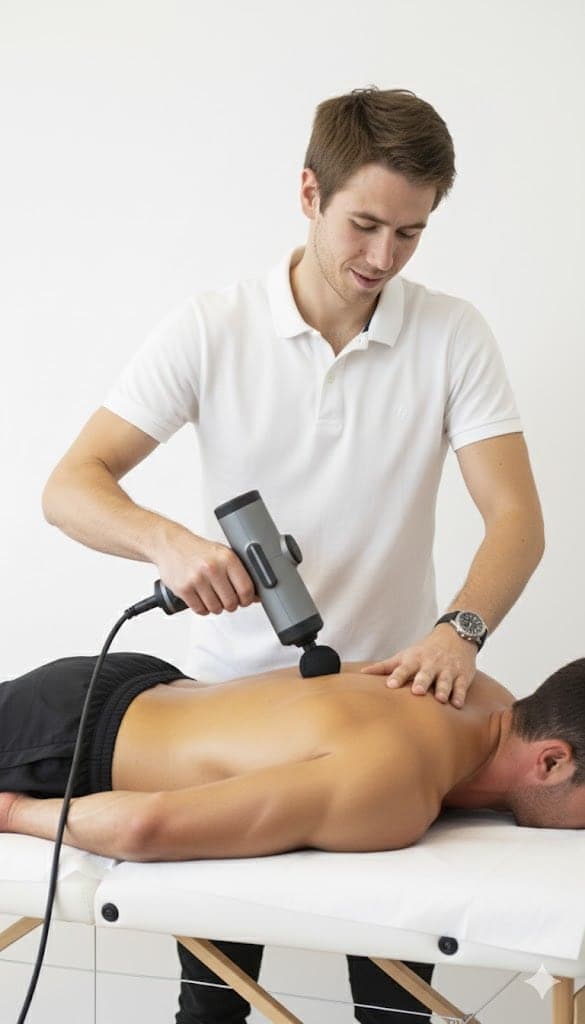
A first session at your home in Paphos starts with the conversation and movement check described above. Then I work through the tissue in a sensible order. Usually that means the upper back and the muscles between the shoulder blades first, then the muscles that hitch the shoulder up, the chest, and finally the rotator cuff and the muscles round the joint itself. Deep-tissue work here is slow and specific rather than forceful; the aim is to change how the shoulder blade sits and slides, not to bruise the sore bit.
Between sessions I give you two or three things to do that are chosen for your pattern, not a generic sheet. Usually one mobility drill for the upper back, one for the shoulder blade, and one habit to change at the desk or in the car. The people whose shoulders improve fastest are almost always the ones who do these.
Working in your home has a practical advantage for shoulders in particular. I can see the desk, the car seat, the sofa, and the pillow, and most of the aggravating habits are found in one of those. Adjusting a screen height or a headrest is sometimes worth more than another session.
To be clear about scope: I can help with shoulders that are stiff, overloaded, guarding, or recovering from an injury that has already been checked, and I cannot help with fractures, dislocations, suspected tears with weakness, frozen shoulders in their acute painful phase, or pain that has no mechanical pattern. See a doctor first if the shoulder hurts constantly at rest, followed a fall or a sudden pop, or comes with numbness, tingling down the arm, fever, or unexplained weight loss. If you are dealing with a shoulder that is stiff rather than injured, my deep-tissue massage in Paphos page describes the more general version of the same work.
Frequently asked questions
Do I need to see a doctor before booking shoulder massage?
Not always. If the pain is clearly related to how you use the shoulder, is worse with certain movements and better with rest, and there was no fall or sudden injury, soft-tissue work is a reasonable first step. If it hurts at rest and at night, followed trauma, or comes with numbness or weakness, see a doctor first and bring what they say to the first session.
How many sessions does shoulder pain usually take?
I do not give a number before I have examined the shoulder, and I would be wary of anyone who does. What I can say is that we agree at each visit whether the next one is worth it, a package is optional, and if a shoulder is not changing over a handful of sessions I will say so and suggest who to see instead.
Is deep-tissue massage safe for a painful shoulder?
Yes, when it is applied with judgement. Deep-tissue does not mean heavy pressure on the sore spot; most of the useful work happens in the upper back, neck, and chest, and the shoulder itself is treated more carefully. I will always adjust depth to what your tissue tolerates, and an irritated tendon is worked around rather than through.
Can you treat a frozen shoulder?
It depends on the stage. In the early, very painful phase, massage tends to irritate more than it helps and a doctor should be guiding things. Once the shoulder is stiff rather than fiercely painful, working on the surrounding muscles and the upper back can make the remaining movement more comfortable and support whatever exercise programme you have been given.
What should I do between sessions to help my shoulder?
Do the two or three things I give you, which are chosen for your pattern rather than copied from a sheet. Change the desk, car seat, or pillow if I have pointed at one of them. Keep moving the arm gently through the range that does not hurt, and avoid the temptation to rest it completely, which usually leaves it stiffer.
Do you travel across Paphos for shoulder work?
Yes. I am based in Chlorakas and cover Paphos town, Kato Paphos, Tala, Peyia, Coral Bay, Emba, Kissonerga, and the surrounding villages. Sessions are at your home or accommodation, I bring the table and everything else, and booking is by WhatsApp or phone. Sixty minutes is €90 and ninety is €130, with one additional free session when you pre-book five sessions as a package.
Evidence and limits
Massage may help with some symptoms, but benefits and evidence vary by condition. It does not replace medical assessment or treatment. A page update is not evidence of an independent clinical review.
Further reading: Massage therapy: evidence, safety and limitations by US National Center for Complementary and Integrative Health. This is general background reading, not verification of every claim in this article.
How we describe evidence and updatesWritten by
Chris
Massage therapist, nutrition and exercise physiologist
Norwegian-certified with a Bachelor’s in Physical Education and Nutrition and over ten years of clinical practice, working from a portable table in clients’ homes across the Paphos district.
- Norwegian-certified
- Nutrition & exercise physiologist
- 10+ years clinical practice
- Based in Chlorakas · all of Paphos district
- No call-out fee anywhere in Paphos district
Last updated
This article is general information, not a medical diagnosis. If you have severe, worsening or unexplained pain, numbness, weakness, or pain after an accident, see a doctor first.