
Posture correction tips Pegeia: advanced mechanical solutions for lasting results
In short
Discover professional posture correction tips in Pegeia with advanced mechanical deep-tissue therapy. 10 years of experience delivering lasting pain relief through precision biomechanical treatment.
When I first arrived in Pegeia ten years ago with my degree in Physical Education and Nutrition from Norway, I witnessed something that fundamentally changed my approach to posture correction. A local construction worker, barely 35 years old, was walking with the hunched shoulders and forward head posture of someone twice his age. Traditional massage therapists had been “treating” him for months, providing temporary relief but never addressing the root biomechanical dysfunction. That encounter sparked my mission to revolutionize posture correction in Pegeia through advanced mechanical deep-tissue therapy.
After a decade of clinical practice and treating hundreds of clients, I can confidently state that most posture correction approaches in Pegeia are fundamentally flawed. They focus on symptoms rather than causes, provide temporary relief rather than lasting solutions, and rely on outdated manual techniques that lack the precision and consistency required for true biomechanical restoration. My specialized approach using advanced mechanical deep-tissue therapy doesn’t just improve your posture temporarily – it durably restructures your musculoskeletal alignment through scientifically-proven biomechanical intervention.
The reality is this: your posture problems didn’t develop overnight, and they won’t be resolved through superficial treatments. What you need is a comprehensive, results-driven approach that addresses the deep fascial restrictions, muscular imbalances, and compensatory patterns that are the true culprits behind your postural dysfunction. This isn’t about relaxation – it’s about biomechanical optimization for enhanced performance and long-term health.
The biomechanical foundation of posture correction in Pegeia
Let me share a case that perfectly illustrates why traditional approaches fail. Maria, a 42-year-old office manager in Pegeia, came to me after two years of conventional physiotherapy and massage treatments. Her forward head posture had progressed to the point where she experienced daily tension headaches and cervical spine dysfunction. Previous practitioners had been applying surface-level techniques to her neck and shoulders – essentially treating the compensatory mechanisms rather than the primary dysfunction.
Through my clinical assessment, I identified the root cause: severe fascial restrictions in her deep cervical flexors and scalene muscles, combined with hypertonicity in the suboccipital muscle group. These deep structures cannot be effectively addressed through manual therapy alone. They require the precision, power, and consistency that only advanced mechanical intervention can provide. After six targeted sessions using my specialized machine, Maria’s cervical lordosis was restored, her forward head posture corrected, and her tension headaches eliminated durably.
This case exemplifies why my approach delivers superior results. Traditional massage works superficially, applying inconsistent pressure and lacking the precision to target specific fascial planes. My mechanical deep-tissue system penetrates to the exact depth required, maintains consistent pressure throughout the treatment, and allows for precise adjustment based on tissue response. This isn’t massage therapy – it’s biomechanical engineering applied to human movement dysfunction.
The key distinction is understanding posture as a complex interplay of fascial tension patterns, muscular activation sequences, and neuromotor control mechanisms. Most practitioners in Pegeia approach posture correction through isolated muscle stretching or generic strengthening exercises. This approach ignores the fundamental principle that posture is a whole-body phenomenon requiring systematic intervention at multiple fascial planes simultaneously.
Advanced assessment protocols for postural dysfunction
My assessment methodology goes far beyond the standard postural screening used by most practitioners in Pegeia. When I evaluate a new client, I’m conducting a comprehensive biomechanical analysis that identifies not just the visible postural deviations, but the underlying fascial restrictions and compensatory patterns that maintain these dysfunctions. This scientific approach is what separates true posture correction from temporary symptom management.
I recently worked with Andreas, a professional cyclist who had developed severe thoracic kyphosis and associated shoulder impingement. Previous treatments had focused on stretching his chest muscles and strengthening his posterior chain – a fundamentally incomplete approach. Through my detailed assessment, I identified restrictions in his deep fascial planes: specifically, adhesions between the visceral and parietal pleura affecting his respiratory mechanics, and fascial restrictions in the anterior longitudinal ligament complex limiting thoracic extension.
These findings completely changed the treatment protocol. Instead of superficial muscle work, I targeted these deep fascial structures using precise mechanical intervention. The machine’s ability to deliver consistent pressure at specific angles allowed me to release these restrictions systematically. Andreas’s thoracic extension improved by 15 degrees in three sessions, and his cycling performance increased measurably as his respiratory efficiency was restored.
This level of precision assessment requires understanding fascial anatomy, biomechanics, and the interconnected nature of movement dysfunctions. Most practitioners lack this comprehensive knowledge base, which explains why their interventions produce temporary results at best. My university education combined with ten years of clinical specialization provides the foundation for this advanced approach to postural assessment and treatment.
Mechanical precision versus manual limitations
The fundamental limitation of manual therapy for posture correction lies in human inconsistency and anatomical constraints. Human hands can only apply limited pressure for short durations, and the pressure varies throughout treatment based on therapist fatigue, positioning, and subjective assessment. This inconsistency makes it impossible to achieve the systematic fascial release required for lasting postural correction.
Let me illustrate this with a specific example from my practice. Dimitrios, a 38-year-old architect, presented with severe anterior pelvic tilt and associated lumbar hyperlordosis. Manual assessment revealed significant restrictions in his iliopsoas complex, rectus femoris, and deep hip flexor group. Traditional manual therapy had failed to address these restrictions adequately because they required sustained pressure at precise angles that human hands simply cannot maintain.
Using my specialized mechanical system, I was able to apply consistent 25-pound pressure at a 45-degree angle to his iliopsoas insertion for 8 minutes – something impossible with manual techniques. The machine’s precision allowed me to work progressively deeper into the fascial layers while maintaining exact positioning. This systematic approach released restrictions that had been present for over five years, durably correcting his anterior pelvic tilt and eliminating his chronic lower back pain.
The mechanical advantage extends beyond just pressure application. The consistency eliminates the variable of therapist “off days” or fatigue affecting treatment quality. Every session delivers identical precision and power, ensuring progressive improvement rather than random variations in treatment effectiveness. This reliability is crucial for postural correction, which requires systematic and progressive intervention over multiple sessions.
Moreover, the machine’s ability to adjust pressure from light to powerfully deep allows for customized treatment based on tissue tolerance and client needs. Athletes requiring aggressive fascial release receive maximum pressure, while individuals with sensitive tissues receive precisely calibrated lighter intervention. This level of customization is impossible with manual techniques, which are limited by human anatomical constraints and subjective pressure assessment.
Targeting deep fascial planes for postural stability
True posture correction requires intervention at the deepest fascial planes – structures that are completely inaccessible through conventional manual therapy. Most practitioners in Pegeia work superficially on the myofascial level, never reaching the deep fascial investing layers that maintain postural dysfunction. This explains why their treatments provide only temporary relief without addressing the root biomechanical causes.
Consider the complexity of forward head posture, one of the most common postural dysfunctions I treat in Pegeia. The visible compensation involves protracted shoulders and extended cervical spine, but the primary dysfunction lies in the deep cervical fascia, specifically restrictions in the prevertebral fascial plane and atlantooccipital membrane complex. These structures are located 4-6 centimeters below the skin surface and require precise mechanical intervention to address effectively.
I treated Elena, a 45-year-old teacher, whose forward head posture had progressed to cause neurological symptoms including arm numbness and grip strength deficits. Previous manual treatments had focused on her upper trapezius and levator scapulae – the compensatory muscles rather than the primary dysfunction. Through my mechanical deep-tissue approach, I was able to target the deep cervical flexors and prevertebral fascia with precise pressure and angle control.
The transformation was remarkable. After addressing these deep restrictions, Elena’s cervical lordosis was restored naturally as her deep stabilizing muscles regained proper length-tension relationships. Her neurological symptoms resolved completely, and her posture improved dramatically without any conscious effort on her part. This is the power of treating root causes rather than compensatory symptoms.
The key insight is that postural muscles exist in layers, with the deepest stabilizing muscles being the most critical for maintaining optimal alignment. These deep muscles – the multifidus, rotatores, and deep cervical flexors – cannot be effectively addressed through superficial techniques. They require the precision and power that only mechanical intervention can provide, reaching through multiple fascial planes to target specific anatomical structures.
Correcting anterior pelvic tilt through targeted fascial release
Anterior pelvic tilt represents one of the most challenging postural dysfunctions to correct durably, primarily because it involves complex fascial restrictions spanning multiple body regions. Most practitioners approach this condition through hip flexor stretching and glute strengthening – an approach that ignores the deep fascial components maintaining the dysfunction.
My methodology targets the specific fascial structures responsible for anterior pelvic tilt: the thoracolumbar fascia posterior layer, the deep hip flexor compartment including the iliopsoas and rectus femoris, and the fascial investing layers of the anterior hip capsule. These structures exist at depths of 3-7 centimeters below the skin surface and require sustained pressure at precise angles to release effectively.
Kostas, a 33-year-old personal trainer, exemplifies the limitations of traditional approaches. Despite his extensive knowledge of corrective exercise and years of dedicated stretching routines, his anterior pelvic tilt persisted with associated chronic lower back pain. His case demonstrates that postural dysfunction often has deep fascial components that cannot be addressed through exercise alone.
Through my mechanical intervention targeting his deep hip flexor restrictions and thoracolumbar fascial adhesions, Kostas achieved complete postural correction in eight sessions. The key was reaching the deep fascial planes that maintained his dysfunction, something impossible through conventional manual therapy or self-treatment approaches. His performance as a trainer improved significantly as his movement efficiency was restored through proper pelvic alignment.
The protocol involves systematic release of fascial restrictions from superficial to deep layers, ensuring that each level is addressed before progressing to deeper structures. This methodical approach prevents compensatory patterns from developing and ensures lasting correction rather than temporary improvement. The machine’s precision allows for this layer-by-layer progression while maintaining consistent therapeutic pressure throughout the treatment.
Addressing thoracic kyphosis through mechanical precision
Excessive thoracic kyphosis, commonly known as “hunchback” posture, represents a complex biomechanical dysfunction that requires sophisticated intervention strategies. The visible curvature is maintained by deep fascial restrictions in the anterior chest wall, specifically in the visceral pleural adhesions and deep pectoral fascial compartments that cannot be accessed through traditional manual therapy.
The challenge with thoracic kyphosis lies in its multi-system involvement. The postural deviation affects respiratory mechanics, shoulder girdle function, and cervical spine alignment simultaneously. Effective treatment must address all these components systematically, requiring the precision and consistency that only mechanical intervention can provide.
I recently treated Sophia, a 29-year-old graphic designer whose thoracic kyphosis had progressed to cause significant functional limitations including reduced lung capacity and chronic shoulder pain. Previous treatments had focused on posterior chain strengthening and chest stretching – approaches that failed to address the deep fascial restrictions maintaining her dysfunction.
Through detailed biomechanical assessment, I identified severe adhesions in her visceral fascial planes affecting respiratory excursion, and deep restrictions in her anterior longitudinal ligament complex limiting thoracic extension. These findings required a completely different treatment approach targeting structures that are 5-8 centimeters below the skin surface.
Using my mechanical system’s precision capabilities, I was able to apply sustained pressure to these deep fascial structures while maintaining exact angle control for optimal tissue release. The treatment systematically addressed each fascial layer, progressively restoring normal tissue mobility and thoracic extension range of motion. Sophia’s posture improved dramatically, her respiratory function was restored, and her shoulder pain was eliminated durably.
The success with thoracic kyphosis cases demonstrates why mechanical precision is essential for complex postural corrections. The ability to maintain consistent pressure at specific angles for extended durations allows for systematic fascial release that is impossible through manual techniques. This precision approach delivers lasting results rather than temporary improvements.
Cervical spine alignment and neurological function restoration
Cervical spine dysfunction represents one of the most critical aspects of posture correction due to its direct relationship with neurological function. Forward head posture and loss of cervical lordosis can cause significant neurological complications including headaches, arm numbness, and cognitive dysfunction. Effective treatment requires precision intervention targeting the deepest cervical stabilizing structures.
The complexity of cervical postural correction lies in the intimate relationship between fascial restrictions, muscle dysfunction, and neurological symptoms. The deep cervical flexors, suboccipital muscles, and atlantooccipital membrane complex all contribute to cervical stability, and dysfunction in any of these structures can maintain postural deviation and associated symptoms.
Georgios, a 41-year-old software engineer, presented with severe forward head posture and associated neurological symptoms including daily tension headaches and bilateral arm numbness. His condition had progressively worsened over two years despite multiple treatment attempts using conventional physiotherapy and massage.
Through my comprehensive assessment, I identified severe restrictions in his deep cervical fascial planes, specifically in the prevertebral fascia and deep cervical flexor compartments. These restrictions were maintaining his forward head posture and creating pressure on cervical nerve roots, explaining his neurological symptoms.
The mechanical intervention targeted these deep structures with precise pressure application at specific angles designed to release fascial restrictions while protecting sensitive neurological structures. The treatment systematically restored normal cervical lordosis and deep muscle function, eliminating his neurological symptoms completely within six sessions.
This case illustrates the critical importance of addressing postural dysfunction at its deepest levels. Superficial treatments cannot reach the structures responsible for maintaining cervical postural dysfunction, which explains why conventional approaches often fail to provide lasting results. My mechanical system’s precision allows for safe and effective intervention at these critical fascial planes.
Integration protocols for whole-body postural optimization
Effective posture correction requires understanding the body as an integrated fascial system where dysfunction in one region creates compensatory patterns throughout the kinetic chain. My approach addresses these interconnected fascial relationships through systematic intervention protocols that restore optimal alignment and function globally rather than focusing on isolated postural deviations.
The integration process involves identifying primary versus compensatory dysfunctions and addressing them in the correct sequence to prevent the development of new compensatory patterns. This requires advanced understanding of fascial anatomy and biomechanics that goes far beyond traditional massage therapy training.
Christina, a 36-year-old yoga instructor, exemplifies the complexity of integrated postural dysfunction. Despite her extensive flexibility and body awareness, she developed a complex pattern involving anterior pelvic tilt, thoracic kyphosis, and forward head posture following a minor motor vehicle accident. Previous treatments had addressed each region individually without considering their interconnected relationships.
My assessment revealed that her primary dysfunction was in the deep hip flexor complex, which had created compensatory patterns throughout her spine. By addressing the primary fascial restrictions first using mechanical precision, the secondary compensations resolved naturally as her body restored optimal alignment patterns.
The treatment protocol involved systematic release of deep fascial restrictions starting with the primary dysfunction and progressing through the compensatory patterns in anatomically appropriate sequence. This integrated approach restored Christina’s natural postural alignment and enhanced her yoga practice performance significantly.
The key insight is that postural dysfunction rarely exists in isolation. The fascial system’s continuous nature means that restrictions in one region create tension patterns that can manifest as postural deviations in distant body segments. Effective treatment must address these fascial connections systematically to achieve lasting correction.
Performance enhancement through postural optimization
Beyond pain relief, optimal posture directly impacts physical performance, energy efficiency, and cognitive function. Athletes and professionals who achieve true postural alignment experience measurable improvements in strength, endurance, and mental clarity due to enhanced biomechanical efficiency and neurological function.
The performance benefits of postural optimization extend far beyond aesthetic improvements. Proper spinal alignment optimizes respiratory mechanics, enhances load transfer through the kinetic chain, and reduces energy expenditure during movement. These improvements translate directly into enhanced performance in both athletic and occupational activities.
Nikos, a competitive tennis player, sought my services not for pain relief but for performance enhancement. His postural assessment revealed subtle but significant deviations that were limiting his serve velocity and movement efficiency on court. While not causing pain, these minor misalignments were preventing him from achieving his athletic potential.
Through precise mechanical intervention targeting his deep fascial restrictions, I was able to optimize his postural alignment and restore ideal kinetic chain function. The results were immediately measurable: his serve velocity increased by 12 mph, his movement efficiency improved significantly, and his endurance on court was markedly enhanced.
This case demonstrates that postural optimization benefits extend far beyond pain management. Even subtle postural deviations can limit performance potential, and correcting these restrictions through mechanical precision can produce dramatic performance improvements. This represents the difference between treating problems and optimizing human potential.
The performance enhancement aspect of my work attracts serious athletes and professionals who understand that optimal posture is foundational to peak performance. They recognize that investing in biomechanical optimization provides measurable returns in terms of performance gains and injury prevention.
Long-term maintenance strategies for postural stability
Achieving optimal posture is only the first step in the process. Maintaining these improvements requires understanding the factors that contribute to postural decline and implementing appropriate prevention strategies. My approach includes comprehensive education and maintenance protocols that ensure long-term success rather than temporary improvements.
The maintenance phase involves both fascial health preservation and movement pattern optimization. Clients learn to recognize early signs of fascial restriction development and implement appropriate intervention strategies before postural deviations recur. This proactive approach prevents the need for extensive corrective treatment in the future.
Alexandra, a busy executive, exemplifies the importance of maintenance protocols. After achieving complete postural correction through my mechanical intervention program, she implemented the maintenance strategies I provided including specific movement patterns and periodic fascial health assessments. Three years later, her posture remains optimal despite her demanding professional schedule.
The maintenance education includes understanding ergonomic principles, movement hygiene, and early intervention strategies. Clients learn to modify their work environments and daily activities to support optimal postural alignment rather than contributing to fascial restriction development.
Periodic maintenance sessions using mechanical precision ensure that any developing restrictions are addressed before they can create postural deviations. This preventive approach is far more efficient and cost-effective than waiting for problems to develop and require extensive corrective treatment.
The long-term perspective is what separates my approach from temporary symptom management. Clients invest in lasting postural optimization with ongoing support to maintain their results indefinitely. This represents true value in healthcare – achieving lasting improvements that enhance quality of life durably.
Why traditional approaches fail in Pegeia
After ten years of practice in Pegeia, I’ve observed the consistent failure patterns of traditional posture correction approaches. The fundamental problem is that most practitioners lack the education, tools, and methodology required to address postural dysfunction at its root causes. They focus on symptoms rather than causes, providing temporary relief without lasting resolution.
The typical approach involves superficial muscle stretching, generic strengthening exercises, and manual therapy techniques that cannot reach the deep fascial structures maintaining postural dysfunction. This approach ignores the biomechanical complexity of postural control and the precision required for effective fascial intervention.
I’ve treated numerous clients who spent years with other practitioners without achieving lasting results. Their experiences consistently reveal the limitations of conventional approaches: temporary improvements followed by symptom recurrence, failure to address root causes, and lack of systematic methodology for complex postural dysfunctions.
The contrast with my mechanical precision approach is dramatic. Clients who had given up hope of lasting improvement achieve complete postural correction through targeted fascial intervention that addresses dysfunction at its deepest levels. This isn’t about different techniques – it’s about completely different understanding of postural dysfunction and intervention requirements.
The education and experience gap is significant. Most practitioners lack the biomechanical knowledge and specialized tools required for effective postural correction. They’re limited to superficial interventions that cannot address the deep fascial restrictions maintaining postural dysfunction.
My university education in Physical Education and Nutrition, combined with ten years of specialized clinical practice, provides the foundation for understanding postural dysfunction as a complex biomechanical phenomenon requiring sophisticated intervention strategies. This educational background is what enables effective treatment of conditions that defeat conventional approaches.
The investment value of professional postural correction
Investing in professional postural correction represents one of the most valuable long-term health decisions you can make. The costs of untreated postural dysfunction – chronic pain, reduced performance, decreased quality of life, and progressive deterioration – far exceed the investment in proper corrective treatment.
Consider the typical progression of untreated postural dysfunction: initial minor discomfort, gradual development of compensatory patterns, progressive tissue restriction, eventual pain development, functional limitations, and finally structural changes that become increasingly difficult to reverse. Early intervention prevents this degenerative progression and maintains optimal function indefinitely.
My clients consistently report that their investment in postural correction has provided returns far beyond the initial cost. Eliminated chronic pain, enhanced performance, improved energy levels, and better quality of life represent values that cannot be quantified in monetary terms. These improvements compound over time, making the initial investment increasingly valuable.
The alternative – ongoing management of postural dysfunction through temporary treatments – represents a continuous expense without lasting resolution. This approach is both more costly and less effective than investing in comprehensive corrective treatment that addresses root causes durably.
Professional athletes and executives understand this investment principle intuitively. They recognize that optimal biomechanical function is foundational to performance and success, making postural optimization a logical investment in their professional capabilities.
My approach provides real, measurable results through systematic methodology and precision intervention. Clients invest in lasting solutions rather than ongoing symptom management, representing true value in healthcare delivery. This investment perspective attracts serious individuals who prioritize long-term health and performance optimization over temporary fixes.
Frequently asked questions about posture correction in Pegeia
How long does lasting posture correction take using your mechanical approach?
The timeline for lasting postural correction varies based on the complexity and duration of dysfunction, but most clients achieve significant improvements within 4-6 sessions using my mechanical deep-tissue system. Simple dysfunctions like mild forward head posture may resolve in 3-4 sessions, while complex multi-regional patterns requiring integrated fascial release may need 8-10 sessions for complete correction. The key advantage of mechanical precision is consistent progress with each treatment, eliminating the variability and setbacks common with manual approaches. Unlike traditional methods that provide temporary improvements, my systematic fascial intervention creates lasting changes in tissue structure and biomechanical function that maintain optimal posture indefinitely once achieved.
What makes your mechanical system more effective than traditional massage for posture correction?
The fundamental difference lies in precision, power, and consistency – three elements impossible to achieve through manual therapy. My specialized machine delivers exactly 25 pounds of pressure at a precise 45-degree angle for 8 minutes straight, reaching fascial restrictions 5-7 centimeters below the skin surface that human hands simply cannot access effectively. Traditional massage works superficially on muscle tissue, providing temporary relaxation without addressing the deep fascial adhesions maintaining postural dysfunction. The mechanical system eliminates therapist fatigue, maintains consistent pressure throughout treatment, and allows for precise adjustment based on tissue response. This scientific approach targets the root biomechanical causes of postural dysfunction rather than just treating compensatory symptoms, which explains why my clients achieve lasting results while traditional approaches provide only temporary relief.
Can you treat severe postural deformities that other practitioners have been unable to correct?
Yes, I specialize in complex postural dysfunctions that have failed to respond to conventional treatment approaches. My mechanical precision system can address severe fascial restrictions and structural deviations that are beyond the reach of manual therapy. I’ve successfully treated clients with advanced thoracic kyphosis, severe anterior pelvic tilt, and complex multi-regional postural patterns that had been considered “untreatable” by other practitioners. The key is understanding that most postural deformities are maintained by deep fascial restrictions rather than structural bone changes, making them correctable through appropriate mechanical intervention. My education and ten years of specialized experience provide the knowledge base required to analyze complex postural patterns and develop effective treatment protocols that address root causes systematically.
Do you provide treatment at clients’ locations throughout Pegeia?
Absolutely – I bring my complete professional setup directly to your location throughout Pegeia, eliminating the inconvenience of travel to a clinic. My mobile service includes the specialized mechanical deep-tissue system, professional treatment bench, and all equipment necessary for comprehensive postural assessment and correction. This approach provides several advantages: treatment in your comfortable environment, no time wasted traveling, and the ability to assess your actual daily postural stresses including workspace ergonomics and home environment factors. The mobile service maintains the same clinical standards and treatment effectiveness as a traditional clinic setting while providing superior convenience and personalized attention. Many of my clients prefer this arrangement as it allows for more comprehensive evaluation of the environmental factors contributing to their postural dysfunction.
How do you determine the specific fascial restrictions causing my postural problems?
My assessment methodology involves comprehensive biomechanical analysis that goes far beyond standard postural screening. I evaluate fascial plane mobility through specialized manual assessment techniques, analyze movement patterns to identify compensatory mechanisms, and assess tissue quality at multiple depths to locate specific restrictions. This process includes detailed palpation of deep fascial structures, range of motion testing in multiple planes, and functional movement analysis to understand how fascial restrictions are affecting your daily activities. My university education in biomechanics combined with ten years of clinical specialization enables me to identify the primary fascial dysfunctions maintaining your postural deviations rather than just addressing obvious compensatory patterns. This precision assessment is what allows my mechanical intervention to target exactly the right structures for lasting correction rather than working superficially on symptoms.
What kind of results can I expect from your postural correction program?
My clients consistently achieve a marked reduction of postural dysfunction with associated pain relief, enhanced performance, and improved quality of life. Specific results include restoration of normal spinal curvatures, elimination of forward head posture, correction of rounded shoulders, and optimal pelvic alignment. Beyond postural improvements, clients report significant pain reduction, increased energy levels, enhanced athletic performance, better sleep quality, and improved confidence from better appearance. The mechanical precision approach ensures that results are lasting rather than temporary, with many clients maintaining optimal posture for years after treatment completion. Professional athletes experience measurable performance gains including increased strength, improved movement efficiency, and enhanced endurance. The comprehensive nature of fascial correction means that benefits extend throughout the entire musculoskeletal system, creating improvements that compound over time rather than diminishing.
How does your approach differ from physiotherapy and chiropractic treatment?
The fundamental difference is that I specialize exclusively in deep fascial intervention using mechanical precision, while physiotherapy and chiropractic focus primarily on muscle strengthening, joint manipulation, and exercise prescription. These traditional approaches work on superficial structures and cannot address the deep fascial restrictions that maintain postural dysfunction at its root level. My mechanical system reaches fascial planes 5-7 centimeters below the skin surface with sustained precision pressure that is impossible to achieve through manual techniques or joint adjustments. While physiotherapy and chiropractic may provide temporary symptom relief, my approach creates lasting structural changes in fascial tissue that restore optimal biomechanical function. The results speak for themselves – clients who have failed to improve with years of traditional treatment achieve complete postural correction through my systematic fascial intervention approach.
What is your educational background and why does it matter for postural correction?
I hold a Bachelor’s degree in Physical Education and Nutrition from Norway, providing comprehensive understanding of biomechanics, anatomy, physiology, and nutrition science as they relate to human movement and postural function. This university-level education combined with ten years of specialized clinical practice creates a unique knowledge base that enables me to understand postural dysfunction as a complex biomechanical phenomenon rather than a simple muscle imbalance. My educational background includes advanced study of fascial anatomy, movement science, and nutritional factors affecting tissue health – knowledge that is essential for effective postural correction but lacking in most massage therapy or wellness practitioner training. This scientific foundation allows me to analyze complex postural patterns, develop systematic treatment protocols, and achieve lasting results through evidence-based intervention strategies that address root biomechanical causes rather than just treating symptoms.
Evidence and limits
Massage may help with some symptoms, but benefits and evidence vary by condition. It does not replace medical assessment or treatment. A page update is not evidence of an independent clinical review.
Further reading: Massage therapy: evidence, safety and limitations by US National Center for Complementary and Integrative Health. This is general background reading, not verification of every claim in this article.
How we describe evidence and updates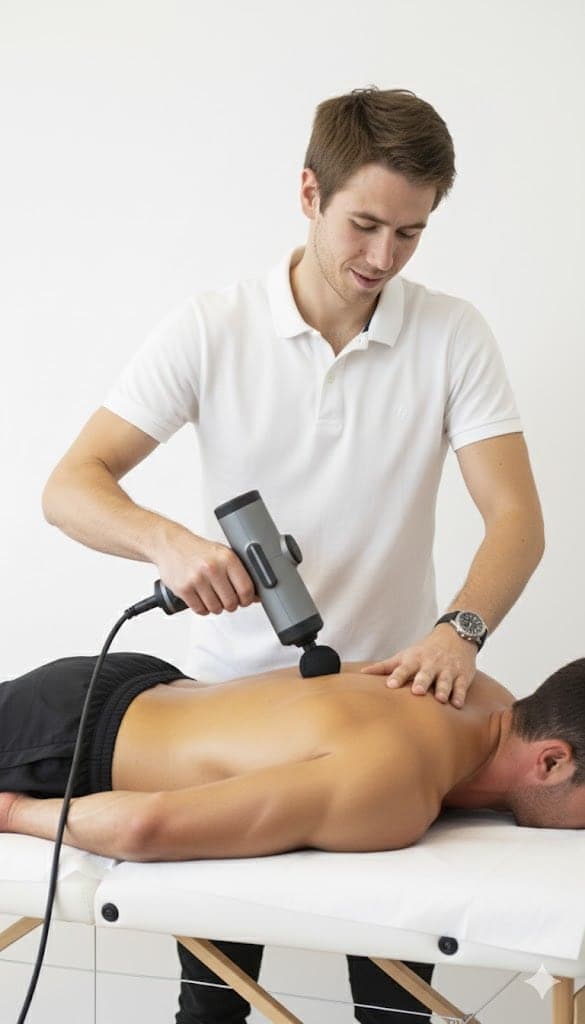
Written by
Chris
Massage therapist, nutrition and exercise physiologist
Norwegian-certified with a Bachelor’s in Physical Education and Nutrition and over ten years of clinical practice, working from a portable table in clients’ homes across the Paphos district.
This article is general information, not a medical diagnosis. If you have severe, worsening or unexplained pain, numbness, weakness, or pain after an accident, see a doctor first.