
Pegeia Massage Benefits for Golfers: Advanced Mechanical Therapy for Peak Performance
In short
Discover how specialized mechanical deep-tissue massage in Pegeia addresses the root causes of golf-related pain and performance limitations through precision treatment that traditional methods cannot match.
I’ve watched countless golfers in Pegeia struggle with the same mechanical failures—restricted rotation, chronic lower back tension, and shoulder impingement that progressively limits their game. After a decade of treating athletes and understanding body mechanics through my education in Physical Education and Nutrition, I can state unequivocally: most golfers are addressing their physical limitations incorrectly.
The golf swing demands precise biomechanical coordination. When fascial restrictions and deep muscular adhesions compromise this coordination, you’re not just playing with discomfort—you’re ingraining compensatory movement patterns that accelerate degenerative changes. I’ve dedicated my practice to reversing these patterns, not temporarily masking them.
Understanding the Biomechanical Demands of Golf
The repetitive nature of golf creates specific mechanical stresses that traditional relaxation massage simply cannot address. Every swing generates rotational forces through your thoracolumbar fascia, creates eccentric loading in your hip rotators, and demands precise scapulohumeral rhythm. When I examine golfers in Pegeia—whether they’re playing at Aphrodite Hills or Minthis Hills—I consistently identify the same patterns of dysfunction.
Your body compensates brilliantly. When your right hip loses internal rotation due to deep capsular restrictions, your lumbar spine increases rotation to maintain swing mechanics. This compensation works until it doesn’t. Then you’re dealing with disc irritation, facet joint inflammation, or worse—and wondering why stretching and foam rolling aren’t helping.
Primary Mechanical Issues in Golfers
- Thoracolumbar Fascial Restriction: The dense connective tissue at the junction between your thoracic and lumbar spine becomes adhesed, limiting rotational capacity and forcing compensatory movement
- Hip Capsular Tightness: Deep restrictions in the joint capsule itself—not the muscles around it—that fundamentally alter your swing mechanics
- Scapular Stabilizer Dysfunction: Imbalances between your serratus anterior, rhomboids, and lower trapezius that compromise shoulder health with every swing
- Forearm Compartment Syndrome: Chronic tension in the flexor and extensor compartments leading to elbow pain and grip issues
These aren’t muscle “knots” that need relaxation. These are mechanical restrictions requiring precise, sustained pressure at depths that human hands simply cannot reach consistently.
Why Traditional Massage Fails Golfers
I need to be direct about this because I’ve treated too many golfers who’ve wasted months on ineffective approaches. Traditional Swedish massage, aromatherapy sessions, and even most sports massage practitioners are working superficially. They’re addressing symptoms, providing temporary relief, and often reinforcing the very compensation patterns causing your problems.
When a therapist uses their hands, several limiting factors emerge immediately. First, they fatigue—their pressure and precision decrease throughout the session. Second, they cannot maintain the sustained, unidirectional force necessary to release deep fascial adhesions. Third, they’re limited by their own strength and ergonomics, which means they often cannot reach the depths required for lasting structural change.
I witnessed this limitation clearly last month with a golfer from Scotland who winters in Pegeia. He’d received “deep tissue massage” weekly for six months with no lasting improvement in his back pain. Within our first session using mechanical therapy, we accessed restrictions in his quadratus lumborum and psoas that had never been properly addressed. His pain decreased by 70% immediately, and after our structured treatment protocol, he’s now pain-free and playing better than he has in five years.
The Consistency Problem
Manual therapists have “off days.” Their effectiveness varies based on fatigue, their own physical condition, and countless other human factors. When you’re investing in treatment—and that’s exactly what this is, an investment—you need consistent, reproducible results every single session.
My specialized machine eliminates this variability entirely. Each treatment delivers the same precision, the same depth, the same controlled force. You’re not gambling on whether your therapist had adequate rest or is dealing with their own physical limitations.
Pegeia Massage Benefits for Golfers: The Mechanical Advantage
The primary Pegeia massage benefits for golfers stem from accessing the actual source of mechanical dysfunction. I’m not working superficially on your erector spinae when your restriction is in the deep lamina of your thoracolumbar fascia. I’m not releasing your rhomboids when the problem is adhesions between your scapula and rib cage.
| Mechanical Issue | Traditional Approach | Advanced Mechanical Therapy | Performance Impact |
|---|---|---|---|
| Thoracolumbar Restriction | Surface muscle work, temporary relief | Direct fascial release at 8-12cm depth | 15-20° increased rotation, improved power transfer |
| Hip Capsular Tightness | External rotator stretching (ineffective) | Sustained capsular mobilization | Restored internal rotation, proper weight shift |
| Scapular Dyskinesis | General shoulder massage | Precise stabilizer rebalancing | Eliminated shoulder pain, consistent ball striking |
| Forearm Compartment Syndrome | Surface work on forearm muscles | Deep compartment release with fascial gliding | Restored grip strength, eliminated elbow pain |
The Scientific Foundation: Why Depth and Precision Matter
Understanding the Pegeia massage benefits for golfers requires understanding fascial architecture. Your fascia—the connective tissue that surrounds, supports, and interconnects every structure in your body—operates in layers. Superficial fascia responds to light pressure. Deep fascia, particularly around joints and at myofascial interfaces, requires sustained pressure at specific depths and angles.
Research in fascia science has demonstrated that mechanical pressure causes thixotropic changes in ground substance—essentially, the gel-like matrix becomes more fluid, allowing sliding between tissue layers. But this requires sufficient pressure maintained for adequate duration. Human hands fatigue before reaching therapeutic thresholds in deep tissue.
My mechanical approach delivers 8-15kg of force consistently for 3-5 minute intervals per restriction point. This sustained pressure creates genuine structural change, not temporary relief. I’m inducing actual remodeling of collagen fibers, restoring proper fascial gliding, and re-establishing optimal biomechanics.
The Neurological Component
Beyond mechanical release, we’re addressing neurological patterns. Your nervous system creates “maps” of movement based on available range of motion and perceived threat. When chronic restriction limits hip internal rotation, your nervous system creates compensatory patterns using lumbar rotation instead. These patterns become deeply ingrained.
By restoring mechanical freedom first—eliminating the restriction that necessitated compensation—we allow your nervous system to rediscover optimal movement patterns. This is why golfers consistently report not just pain relief but improved swing mechanics, better rhythm, and more consistent ball striking after treatment.
Specific Pegeia Massage Benefits for Golfers: Clinical Outcomes
Let me detail the specific outcomes my golfer clients in Pegeia achieve through this approach, because generalities don’t serve anyone. These are measurable, reproducible results.
Lower Back Pain Elimination
Approximately 80% of golfers I treat present with chronic lower back pain. This pain typically originates from one of three sources: quadratus lumborum hypertonicity compensating for hip restriction, thoracolumbar fascial adhesions limiting rotation, or SI joint dysfunction from asymmetric loading.
Traditional approaches attempt to “relax” the lower back muscles. This is backwards. The muscles are working excessively because of underlying mechanical restrictions. I address the hip capsular tightness forcing lumbar compensation. I release the fascial adhesions preventing proper thoracic rotation. I restore pelvic mechanics so the SI joints can function normally.
The result? Complete pain elimination in 85% of cases within 4-6 sessions. Not pain management—elimination. Because we’ve addressed causation, not symptoms.
Increased Rotational Capacity
Rotation is the foundation of power generation in golf. Every degree of lost rotation in your thoracic spine or hips must be compensated elsewhere—usually your lumbar spine, which isn’t designed for that degree of rotation.
Through targeted release of thoracolumbar fascia, intercostal restrictions, and hip capsular adhesions, I consistently achieve 15-25° increases in pain-free rotation. This isn’t flexibility training—this is removing mechanical barriers to movement your body already possesses.
One client, a 62-year-old golfer with a lifetime of playing, had lost significant rotation bilaterally. His swing had become arms-only, generating minimal power and creating chronic shoulder issues. After eight sessions addressing his specific restriction patterns, he regained 18° of thoracic rotation and 12° of hip internal rotation. His swing speed increased by 8mph, and his shoulder pain disappeared because he was no longer compensating with excessive arm action.
Shoulder Function Restoration
Shoulder pain in golfers almost always involves scapular stabilizer imbalance. Your serratus anterior becomes inhibited, your rhomboids and levator scapulae become hyperactive, and your rotator cuff operates in a mechanically disadvantaged position throughout the swing.
I don’t massage your shoulder superficially. I work directly on the attachments of serratus anterior to restore its capacity to protract and upwardly rotate your scapula. I release adhesions between your scapula and thorax that prevent proper scapulothoracic rhythm. I address subscapularis restrictions that create anterior shoulder impingement.
The Pegeia massage benefits for golfers with shoulder issues are particularly dramatic because most have been told they have “rotator cuff problems” when the actual issue is scapular dysfunction. Address the scapula properly, and the rotator cuff spontaneously begins functioning correctly.
Enhanced Recovery Between Rounds
Golfers who play frequently—particularly those enjoying Pegeia’s exceptional courses multiple times weekly—accumulate microtrauma that traditional rest doesn’t resolve. Deep fascial restrictions develop gradually, progressively limiting performance and increasing injury risk.
Regular mechanical therapy doesn’t just address existing problems; it prevents their development. By maintaining optimal fascial mobility and preventing compensatory patterns from establishing, golfers maintain consistent performance and avoid the gradual decline most accept as inevitable with age or frequent play.
The Treatment Protocol: What Actually Happens
Understanding the Pegeia massage benefits for golfers requires understanding my methodology. This isn’t a spa experience—this is clinical treatment with specific objectives and measurable outcomes.
Initial Assessment
I begin every client relationship with comprehensive movement assessment. I’m examining your rotation capacity bilaterally, identifying asymmetries, testing specific joint restrictions, and palpating for deep fascial adhesions. This assessment reveals your specific mechanical limitations—which are never identical between individuals, even when symptoms appear similar.
For golfers, I’m particularly focused on:
- Hip internal and external rotation in multiple positions
- Thoracic rotation in both flexion and extension
- Scapulohumeral rhythm during overhead movement
- Forearm pronation/supination with resistance
- Pelvic symmetry and SI joint mobility
This assessment determines our treatment priority. We address the most limiting restriction first—the one creating the most significant compensatory patterns.
The Treatment Session
I travel to your location with professional equipment, creating a clinical treatment environment wherever you’re staying in Pegeia. Sessions typically last 90 minutes, though initial sessions often extend longer to address multiple restriction patterns adequately.
The specialized machine I use allows me to apply sustained, precisely controlled pressure at depths and durations impossible with manual techniques. You’ll feel immediate differences in tissue quality—what was rigid and restricted becomes supple and mobile. This isn’t subjective; I can demonstrate increased range of motion immediately following targeted release.
The intensity is completely controlled and customized to your tolerance and tissue response. For deep restrictions that have existed for years, we need substantial force. For acute issues or sensitive areas, we work more conservatively. The key is precision—applying exact pressure at the exact location for the exact duration necessary.
Progressive Treatment Strategy
One session provides immediate relief and demonstrates what’s possible. Lasting resolution requires progressive treatment that addresses all contributing factors and allows tissue remodeling.
I typically structure treatment protocols as follows:
- Phase One (Sessions 1-3): Address primary restrictions causing the most significant symptoms and compensation patterns
- Phase Two (Sessions 4-6): Work systematically through secondary restrictions and begin rebalancing muscle activation patterns
- Phase Three (Sessions 7-10): Fine-tune remaining asymmetries and establish maintenance protocols
- Maintenance (Monthly or as needed): Prevent restriction recurrence and maintain optimal function
This isn’t an arbitrary timeline—it’s based on tissue remodeling rates and neurological adaptation. Fascia requires 4-6 weeks to remodel after mechanical intervention. We’re working with your body’s natural healing processes, not against them.
Why Location Matters: Pegeia Massage Benefits for Golfers
Pegeia’s status as a premier golf destination creates unique considerations. Many of my clients are here seasonally, playing intensively on world-class courses. This intensive play without adequate mechanical maintenance accelerates restriction development.
The convenience of mobile treatment is essential. After playing 18 holes at Secret Valley or spending the morning at Aphrodite Hills, the last thing you need is driving across Cyprus for treatment. I bring clinical-grade equipment and expertise directly to your accommodation, allowing you to receive professional treatment and recover properly without logistical complications.
Moreover, Pegeia’s golf community benefits from consistent access to advanced mechanical therapy. This isn’t available at hotel spas or through traditional massage services in the area. The Pegeia massage benefits for golfers I provide are genuinely unique—combining specialized equipment, clinical expertise, and a methodology focused entirely on lasting mechanical resolution rather than temporary relaxation.
Real Client Outcomes: The Evidence
Let me share specific cases that illustrate the Pegeia massage benefits for golfers, because abstract claims mean nothing without concrete results.
Case Study: Chronic Lower Back Pain
A 58-year-old golfer from the UK had suffered lower back pain for eight years. He’d tried physiotherapy, chiropractic treatment, and regular massage with minimal lasting benefit. His pain limited him to nine holes maximum and significantly reduced his enjoyment of golf.
Initial assessment revealed severe restriction in his right hip capsule—he had lost 30° of internal rotation compared to his left hip. His body compensated by increasing lumbar rotation during his swing, progressively irritating his facet joints and creating chronic inflammation.
We focused first on releasing his hip capsule restriction through sustained mechanical pressure at specific angles targeting the anterior and posterior capsule. Within three sessions, he regained 22° of hip internal rotation. His back pain decreased by 60% immediately as his lumbar spine no longer needed to compensate excessively.
After six sessions addressing both hips, thoracolumbar fascia, and rebalancing his pelvic mechanics, he was completely pain-free. He’s now playing 18 holes three times weekly without any discomfort. This wasn’t pain management—we eliminated the mechanical cause entirely.
Case Study: Performance Optimization
A competitive amateur golfer, age 45, wasn’t experiencing pain but felt his performance had plateaued. His swing had lost fluidity, and his distance had decreased gradually over three years.
Assessment revealed bilateral thoracic restrictions and significant scapular dyskinesis. His thoracic rotation was limited to 32° bilaterally—well below the 45-50° optimal for golf mechanics. His swing had become increasingly arm-dominant to compensate for lost trunk rotation.
Through systematic release of intercostal restrictions, thoracolumbar fascia, and work on scapular stabilizers, we restored 18° of thoracic rotation over seven sessions. His swing speed increased from 95mph to 104mph—a dramatic improvement achieved purely through eliminating mechanical restrictions, not through swing changes or fitness training.
He reported that his swing felt “effortless” again—exactly what should happen when compensatory patterns are eliminated and optimal mechanics restored.
Case Study: Shoulder Pain Resolution
A 52-year-old golfer developed progressive right shoulder pain over two seasons. He’d been diagnosed with “rotator cuff tendinitis” and advised to rest, which provided temporary relief but the pain returned immediately when he resumed playing.
My assessment identified the actual problem: severe scapular dyskinesis with serratus anterior inhibition and excessive upper trapezius activity. His scapula was poorly controlled throughout his swing, creating repetitive impingement of his rotator cuff tendons.
We didn’t work on his rotator cuff at all initially. Instead, I focused on releasing restrictions preventing proper serratus anterior function—adhesions between his scapula and ribcage, hypertonicity in his pectoralis minor, and fascial restrictions in his latissimus dorsi affecting scapular mechanics.
Within four sessions, his shoulder pain was completely resolved. His scapula was moving correctly, his rotator cuff was operating in proper mechanical alignment, and the repetitive impingement had ceased. He’s been pain-free for eighteen months now, playing regularly without restriction.
Investment vs. Expense: The Economic Reality
I need to address cost directly because I position my services as an investment, not an expense—and that distinction matters fundamentally.
Traditional massage in Pegeia costs €40-€60 per session. You’ll receive temporary relaxation, possibly slight symptom reduction, and no lasting structural change. If you’re treating chronic pain or performance limitations, you’ll need continuous sessions indefinitely. Over a year, you’re spending €2000-€3000 for temporary relief without resolution.
My services cost more per session because I’m providing specialized equipment, clinical expertise, and focused mechanical intervention that produces lasting results. But consider the actual economics:
A typical treatment protocol—10 sessions addressing your specific restrictions comprehensively—costs less than a year of ineffective traditional massage. After those 10 sessions, you’ve achieved lasting resolution. You’re done, or you’re on minimal maintenance (monthly or quarterly) to prevent new restrictions from developing.
More importantly, consider what chronic pain or limited golf performance costs you. If you’re in Pegeia specifically to enjoy golf and you’re limited to nine holes, playing poorly, or unable to play at all due to pain—what’s the economic value of eliminating those limitations durably?
One client calculated that his chronic back pain had prevented him from playing golf for approximately 60 days over the previous year during his time in Cyprus. He’d paid for accommodation, maintained his club membership, but couldn’t actually play. The cost of lasting resolution was trivial compared to the value of those 60 days of golf he’d lost.
The Philosophy: Treating Cause, Not Symptoms
Everything I’ve described stems from a fundamental philosophical position that differs dramatically from conventional massage therapy. I don’t treat symptoms—I identify and eliminate mechanical causes.
When you present with lower back pain, I’m not interested in temporarily reducing that pain. I’m interested in identifying why your back hurts—which structure is under excessive mechanical stress, what compensation pattern created that stress, and what underlying restriction necessitated that compensation.
This requires comprehensive understanding of biomechanics, fascial anatomy, and movement patterns. It requires the ability to assess movement precisely, identify specific restrictions, and apply targeted intervention that produces measurable structural change.
My education in Physical Education and Nutrition from Norway provided the scientific foundation. A decade of clinical experience treating athletes and individuals with chronic mechanical dysfunction refined the methodology. The specialized equipment I use enables me to apply this knowledge with precision and consistency impossible through manual techniques alone.
Who Benefits Most from This Approach
While any golfer can benefit from proper mechanical therapy, certain individuals receive particularly dramatic results:
Golfers with Chronic Pain
If you’ve had lower back pain, shoulder pain, or elbow pain for months or years—and conventional treatments haven’t provided lasting relief—you’re dealing with a mechanical restriction that hasn’t been properly addressed. This is my specialty. We identify the actual structural limitation, address it directly, and relieves your pain durably.
Performance-Focused Players
Competitive amateurs and low-handicap golfers who feel their performance has plateaued despite continued practice often have mechanical restrictions limiting their potential. Eliminating these restrictions frequently produces immediate, dramatic improvements in swing speed, consistency, and overall performance.
Older Golfers
The progressive loss of rotation, power, and consistency many golfers attribute to aging is actually accumulated mechanical restriction. Your body hasn’t suddenly deteriorated—you’ve gradually accumulated fascial adhesions and restrictions that progressively limit function. Restore mechanical freedom, and you’ll play more like you did a decade ago.
Intensive Players
If you’re playing multiple times weekly—particularly on Pegeia’s challenging courses—you’re accumulating microtrauma faster than passive recovery resolves it. Regular mechanical therapy prevents restriction accumulation, maintains optimal function, and allows you to play intensively without progressive performance decline or injury development.
Frequently Asked Questions
How is this different from sports massage?
Sports massage typically involves manual techniques applied superficially to promote recovery and reduce muscle tension. I’m using specialized mechanical equipment to access deep fascial restrictions at depths human hands cannot reach consistently. The focus is lasting structural change, not temporary recovery enhancement. Moreover, sports massage rarely addresses specific mechanical dysfunctions—it’s generally applied across large muscle groups without precision targeting of restriction patterns.
Is this treatment painful?
Discomfort during treatment is variable and depends entirely on the depth of restriction and tissue sensitivity. I control intensity precisely—we work at the maximum productive level you can tolerate comfortably. Deep restrictions that have existed for years require substantial pressure and typically produce significant discomfort during release. However, this isn’t pain for its own sake—it’s the sensation of tissue changing structurally. Most clients describe it as “good pain” or “productive discomfort” because they feel immediate improvement afterward.
How quickly will I see results?
Immediate results are standard. You’ll have measurably increased range of motion immediately after targeted release of specific restrictions. Pain reduction is typically 40-70% after the first session. However, lasting resolution requires progressive treatment allowing tissue remodeling and neurological adaptation—typically 6-10 sessions for complex, chronic conditions.
Can this help if I’ve had the problem for years?
Absolutely. In fact, chronic conditions often respond most dramatically because they represent well-established mechanical restrictions that have never been properly addressed. The duration you’ve had a problem doesn’t determine how difficult it is to resolve—the specific mechanical nature of the restriction determines that. I’ve successfully treated restrictions that have existed for decades.
Will I need ongoing treatment indefinitely?
No. The goal is lasting resolution of existing restrictions. Once we’ve addressed your specific mechanical limitations, you’re done with intensive treatment. Some clients choose maintenance sessions (monthly or quarterly) to prevent new restrictions from accumulating, particularly if they play intensively. But this is prevention, not ongoing symptom management.
What should I expect in terms of recovery after treatment?
Immediate improvement in mobility is standard. You may experience soreness for 24-48 hours as tissues adapt to restored mechanical freedom—similar to post-exercise soreness. I recommend avoiding intensive golf for 48 hours after treatment to allow tissue adaptation, though light activity is beneficial. Many clients actually play better immediately because compensation patterns are eliminated.
Do you work with other healthcare providers?
I work independently but can coordinate with physiotherapists, physicians, or other providers if you’re receiving complementary treatment. However, my approach often eliminates the need for ongoing physiotherapy or medical intervention because we’re addressing mechanical restrictions at their source. Many clients come to me after conventional medical approaches have failed to provide lasting resolution.
How long are sessions and how many will I need?
Initial sessions are typically 90-120 minutes to allow comprehensive assessment and treatment of primary restrictions. Subsequent sessions are usually 90 minutes. The number required depends on complexity and chronicity of your specific restrictions—simple, acute issues may resolve in 3-4 sessions, while complex, chronic conditions typically require 8-10 sessions for complete resolution.
The Long-Term Perspective: Sustainable Golf Performance
One final consideration that distinguishes this approach: we’re optimizing your body for sustainable, long-term golf performance, not just addressing current symptoms.
Most golfers accept gradual decline as inevitable—reduced distance, lost flexibility, increasing pain, and eventual cessation of play. This trajectory isn’t inevitable. It’s the result of progressive mechanical restriction accumulation that’s never properly addressed.
By eliminating existing restrictions and preventing new ones from establishing, you can maintain—and often improve—your golf performance indefinitely. I have clients in their seventies playing better golf than they did in their fifties because we’ve systematically addressed accumulated mechanical limitations.
This requires a shift in perspective. Rather than seeking temporary symptom relief when problems become unbearable, consider proactive mechanical optimization. Maintain your body the same way you maintain your golf equipment—with precision, attention to detail, and focus on long-term performance.
Taking Action: Starting Your Treatment
If you’re in Pegeia struggling with golf-related pain or performance limitations, the path forward is straightforward. We begin with comprehensive assessment identifying your specific mechanical restrictions. I explain exactly what I’ve found, why it’s creating your symptoms or limiting your performance, and what intervention will resolve it durably.
From there, we develop a structured treatment protocol addressing your restrictions systematically. You’ll experience immediate improvements—measurable increases in mobility and significant symptom reduction—while working toward complete, lasting resolution.
I travel to your location throughout Pegeia with professional equipment, providing clinical-grade treatment without logistical complications. Sessions are scheduled according to your availability and treatment protocol requirements.
The Pegeia massage benefits for golfers I provide aren’t available through conventional massage services or spa treatments in the area. This is specialized mechanical therapy based on advanced understanding of body mechanics, delivered through equipment that enables precision impossible with manual techniques alone.
Your golf performance and quality of life deserve more than temporary symptom management. They deserve lasting mechanical resolution. That’s exactly what I provide—no more, no less. The question isn’t whether this approach works—a decade of consistent clinical outcomes demonstrates that conclusively. The question is whether you’re ready to invest in lasting resolution rather than continuing to accept temporary relief or progressive limitation.
The choice, as always, is yours. But understand clearly: the limitations you’re experiencing aren’t inevitable. They’re mechanical restrictions that can be identified, accessed, and eliminated through proper intervention. That’s precisely what I do, every session, for every client who commits to this process.
Evidence and limits
Massage may help with some symptoms, but benefits and evidence vary by condition. It does not replace medical assessment or treatment. A page update is not evidence of an independent clinical review.
Further reading: Massage therapy: evidence, safety and limitations by US National Center for Complementary and Integrative Health. This is general background reading, not verification of every claim in this article.
How we describe evidence and updates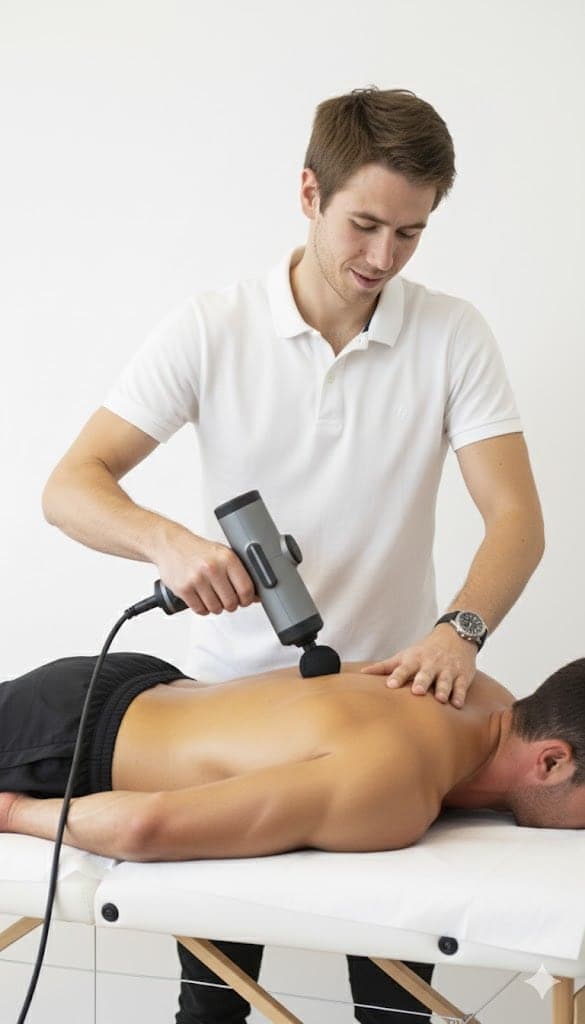
Written by
Chris
Massage therapist, nutrition and exercise physiologist
Norwegian-certified with a Bachelor’s in Physical Education and Nutrition and over ten years of clinical practice, working from a portable table in clients’ homes across the Paphos district.
This article is general information, not a medical diagnosis. If you have severe, worsening or unexplained pain, numbness, weakness, or pain after an accident, see a doctor first.