
Massage Therapy for Stress Relief Chloraka: A Scientific Approach to Lasting Results
In short
Discover advanced massage therapy for stress relief in Chloraka. With 10 years of experience and specialized mechanical deep-tissue techniques, I deliver lasting stress reduction through precision treatment that addresses root causes.
Stress doesn’t just live in your mind—it manifests physically in your body as chronic tension, restricted fascia, and compensatory movement patterns that compound over time. After a decade of treating clients throughout Cyprus, I’ve observed a critical pattern: most people experiencing stress-related symptoms in Chloraka are treating the surface while ignoring the mechanical dysfunction underneath. They book a relaxing massage, feel temporary relief, and return weeks later with the same tension patterns firmly re-established.
My approach to massage therapy for stress relief in Chloraka differs fundamentally from conventional methods. With a Bachelor’s degree in Physical Education and Nutrition from Norway and 10 years of specialized practice, I treat stress as a biomechanical problem that requires precise, deep intervention—not merely a psychological state requiring relaxation. The chronic neck tension you’re experiencing isn’t just from “being stressed.” It’s from forward head posture creating sustained muscular contraction that your nervous system has normalized. The lower back pain isn’t purely emotional—it’s from compromised hip mobility forcing lumbar compensation that becomes habitual.
I’ve developed a methodology that combines advanced mechanical deep-tissue techniques with scientific understanding of how stress embeds itself into your musculoskeletal system. This isn’t about creating a peaceful environment with candles and soft music. This is clinical intervention designed to durably alter the physical structures that perpetuate your stress response.
Why Traditional Massage Therapy Fails to Provide Lasting Stress Relief
The massage industry in Chloraka—and globally—operates on a flawed premise: that stress relief comes from superficial relaxation. I’ve seen countless clients who’ve spent thousands of euros on weekly Swedish massage sessions, aromatherapy treatments, and spa experiences, only to discover their stress symptoms return within days. This isn’t because those therapists lack skill. It’s because they’re treating symptoms while the underlying mechanical dysfunction remains completely untouched.
Let me explain what happens physiologically when stress becomes chronic. Your body enters a sustained sympathetic nervous system state, maintaining elevated cortisol and adrenaline. This biochemical environment causes muscular tissues to remain in partial contraction. Over weeks and months, this creates fascial adhesions—essentially, your connective tissue begins binding to itself and to surrounding structures. These adhesions restrict movement, compress nerve pathways, and create trigger points that refer pain to distant areas.
A standard relaxation massage applies light to moderate pressure to the superficial muscle layers. This feels pleasant, temporarily increases circulation, and may reduce cortisol levels for several hours. But it doesn’t address the deep fascial restrictions that have formed. Within 48 to 72 hours, those restrictions pull your body back into its dysfunctional patterns, and the stress symptoms return completely.
The Depth Problem: Why Hands Aren’t Enough
I spent my first three years as a massage therapist using exclusively manual techniques. I was well-trained, physically strong, and genuinely believed I could deliver adequate depth with my hands, forearms, and elbows. Then I treated a professional athlete preparing for competition—a cyclist with chronic IT band syndrome that was limiting his power output and creating compensatory knee pain.
After our first session using traditional deep-tissue methods, he reported 30% improvement. Significant, but temporary. I worked deeper in subsequent sessions, applying maximum pressure I could sustain. We reached perhaps 50% improvement, but I recognized I was approaching my physical limits while still not accessing the deepest fascial layers where his restriction originated.
This was my turning point. I researched mechanical assistance devices used in clinical settings and invested in specialized equipment that would extend my capabilities beyond what human force could achieve. The difference was immediate and undeniable. With precise mechanical pressure, I could work three to four centimeters deeper into tissue, sustaining consistent force that would be impossible to maintain manually for the duration required.
That cyclist achieved complete resolution of his IT band syndrome. More importantly, his performance metrics improved measurably—increased power output, reduced recovery time, and elimination of compensatory patterns. This wasn’t temporary stress relief. This was lasting structural change.
My Specialized Method for Stress Relief: Precision, Power, and Consistency
My massage therapy for stress relief in Chloraka utilizes a specialized mechanical deep-tissue system that I’ve refined over seven years. This isn’t a percussion massager you can purchase online. This is clinical-grade equipment that allows me to deliver therapeutic intervention at depths and consistency impossible through manual techniques.
Precision: Targeting the Root Cause
When I assess a client experiencing stress-related symptoms, I’m not looking at where they report discomfort. I’m analyzing their entire kinetic chain to identify the primary dysfunction creating cascading compensation patterns. Stress-related tension typically originates from specific mechanical restrictions—most commonly in the thoracic spine, suboccipital muscles, hip flexors, or plantar fascia.
For instance, I recently treated a financial consultant working in Chloraka who reported debilitating stress headaches, jaw tension, and difficulty sleeping. Surface-level observation would suggest neck and shoulder work. My biomechanical assessment revealed the actual problem: bilateral psoas hypertonicity creating anterior pelvic tilt, which forced thoracic extension compensation, which elevated and protracted her shoulders, which compressed the suboccipital triangle and created her headaches.
Traditional massage would have addressed her neck symptoms directly. My method treated her psoas dysfunction first. After three sessions targeting the root cause, her headaches resolved completely because we eliminated the mechanical dysfunction driving the entire compensatory chain.
Power: Accessing Restricted Layers
The mechanical system I use delivers controlled force ranging from light superficial work to powerfully deep intervention suitable for athletic conditioning. This adjustability is crucial because effective treatment requires matching depth to tissue resistance and client tolerance.
I begin each session with assessment work—applying graduated pressure while monitoring tissue response. This tells me exactly where restrictions exist and how much force will be required to release them. For most stress-related patterns in Chloraka residents, I’m working at depths between 3 to 5 centimeters—well beyond what manual pressure can sustain effectively.
The machine allows me to maintain this therapeutic depth for extended periods—sometimes 15 to 20 minutes on a single restricted area. This sustained deep pressure achieves what’s called “creep”—the gradual elongation of collagenous tissue under constant load. This is the mechanism that creates lasting change in fascial restrictions. Brief manual pressure, regardless of intensity, simply cannot achieve this biomechanical effect.
Consistency: Eliminating the Variable
Every manual therapist has off days. You’re tired, you’ve already treated four clients, your hands are fatigued—these variables directly impact treatment quality. When you’re paying for professional therapeutic intervention, this inconsistency is unacceptable.
Mechanical assistance eliminates this variable completely. The tool delivers identical force and precision whether it’s my first client at 9 AM or my sixth at 7 PM. Every treatment session meets the same standard of depth, duration, and effectiveness. This consistency is particularly critical for the structured treatment plans I develop for clients requiring multiple sessions to achieve lasting results.
Understanding Stress as a Biomechanical Dysfunction
My approach to massage therapy for stress relief in Chloraka is founded on understanding stress not as an abstract psychological state, but as concrete physical dysfunction. This perspective comes from my educational background in Physical Education and Nutrition combined with a decade of clinical observation.
| Stress Symptom | Biomechanical Root Cause | Treatment Target |
|---|---|---|
| Tension headaches | Suboccipital compression from forward head posture | Cervical extensors, upper trapezius, scalenes |
| Jaw tension/TMJ pain | Masseter hypertonicity from stress-induced clenching | Masseter, temporalis, pterygoid muscles |
| Chest tightness/breathing restriction | Pectoralis minor shortening limiting rib expansion | Pectoralis minor, intercostals, anterior serratus |
| Lower back pain | Psoas hypertonicity creating lumbar compression | Iliopsoas, quadratus lumborum, erector spinae |
| Sleep disruption | Systemic fascial tension preventing parasympathetic activation | Full-body fascial release focusing on posterior chain |
This table illustrates what I assess in every initial consultation. When you describe your stress symptoms, I’m simultaneously mapping the mechanical dysfunctions most likely creating those symptoms. This diagnostic approach allows me to develop treatment protocols that address causation rather than chasing symptoms.
The Stress-Tension-Dysfunction Cycle
Let me describe a pattern I’ve observed in dozens of Chloraka clients, particularly those in high-pressure professional environments. The cycle begins with psychological stress—work deadlines, financial pressure, relationship challenges. This activates your sympathetic nervous system, which triggers muscular bracing patterns as an evolutionary protective response.
Initially, this bracing is temporary. You finish the stressful task, your nervous system downregulates, and your muscles release. However, when stress becomes chronic, this cycle never completes. Your muscles remain in partial contraction continuously. After several weeks, your nervous system recalibrates, treating this heightened tension as the new baseline. Your brain no longer even recognizes this dysfunction as abnormal.
Simultaneously, sustained contraction compresses blood flow, reducing oxygen delivery and metabolic waste removal. This creates trigger points—hypersensitive nodules that refer pain in predictable patterns. A trigger point in your upper trapezius creates headache pain. In your gluteus medius, it creates hip and lower back pain. These referral patterns make diagnosis complex because the pain location isn’t where the dysfunction exists.
As weeks become months, fascial adhesions form. Your connective tissue literally begins binding to itself, creating restrictions that limit movement and pull your skeletal structure into misalignment. This misalignment creates compensatory patterns—your body recruits inappropriate muscles to perform basic movements because the correct muscles are restricted or inhibited.
This is why traditional relaxation massage fails. It briefly interrupts the cycle but doesn’t break it. The fascial adhesions remain, the trigger points reactivate, the compensatory patterns continue, and within days you’re experiencing identical symptoms.
My Treatment Protocol for Lasting Stress Relief
When I work with clients seeking massage therapy for stress relief in Chloraka, I structure treatment as a progressive protocol, not isolated sessions. This methodology reflects my understanding that lasting results require systematic intervention over time, not sporadic treatments whenever symptoms become unbearable.
Phase One: Comprehensive Assessment
Our first session is as much diagnostic as therapeutic. I spend 15 to 20 minutes conducting biomechanical assessment before beginning hands-on work. This includes:
- Postural analysis identifying misalignments and compensatory patterns
- Range of motion testing revealing restricted joints and fascial limitations
- Palpation assessment locating trigger points, adhesions, and hypertonicity
- Movement pattern observation exposing recruitment dysfunction
- Client history regarding injury, surgery, and chronic symptoms
This assessment provides the roadmap for treatment. I identify the primary dysfunction driving your stress-related symptoms and the secondary compensations that have developed around it. From this analysis, I develop a customized treatment plan specifying which structures require intervention, in what sequence, and over how many sessions.
Phase Two: Deep Fascial Release
The core of my treatment involves systematic deep-tissue work targeting the identified restrictions. Using my specialized mechanical system, I work through tissue layers progressively—beginning superficially to prepare tissue, then advancing to therapeutic depth where actual change occurs.
I’m not performing broad, generalized massage over large areas. I’m delivering focused, sustained pressure to specific restricted structures, maintaining therapeutic force for sufficient duration to achieve fascial release. A typical session focuses on two to four primary areas, working each thoroughly rather than superficially addressing many areas.
For stress-related patterns, I typically prioritize posterior neck and upper back work first. The suboccipital muscles, upper trapezius, and levator scapulae complex nearly always harbor significant restriction in clients experiencing stress symptoms. Releasing these structures immediately reduces tension headaches, improves cervical mobility, and begins interrupting the stress-tension cycle.
Phase Three: Progressive Treatment and Maintenance
Lasting stress relief requires multiple sessions because fascial restrictions develop over months or years. A single treatment, regardless of quality, cannot reverse this accumulated dysfunction. I typically structure initial treatment as four to six sessions over three to five weeks, allowing tissue adaptation time between appointments.
As we progress through treatment, I’m continuously reassessing and adjusting the protocol. Some restrictions release more readily than expected, revealing underlying dysfunctions that require attention. Others prove more resistant, necessitating additional focused work. This adaptability distinguishes my approach from generic treatment templates.
After completing the initial protocol, many clients transition to maintenance scheduling—typically monthly sessions designed to prevent restriction recurrence and address new dysfunctions before they become problematic. This proactive approach maintains the improvements we’ve achieved and prevents return to previous patterns.
Case Studies: Real Results from Chloraka Clients
The Entrepreneur: From Constant Tension to Complete Function
I began working with a 43-year-old business owner operating a restaurant in Chloraka. He’d experienced chronic upper back and neck tension for six years, with progressively worsening headaches that were affecting his ability to manage his business effectively. He’d tried conventional massage, chiropractic adjustment, and even pharmaceutical intervention with muscle relaxants. Nothing provided more than temporary relief.
My initial assessment revealed severe restriction in his cervical erector spinae and scalene muscles, creating compression on the cervical nerve roots. Additionally, his pectoralis minor was severely shortened, protractinghis shoulders and forcing constant compensatory tension in his posterior chain. This mechanical dysfunction was the root cause of his symptoms—not stress itself, but the physical manifestations stress had created.
We implemented a six-session protocol focusing first on releasing his pectoralis minor and anterior shoulder capsule, then progressively addressing his cervical and upper thoracic restrictions. By session three, his headache frequency had reduced by approximately 70%. After completing the full protocol, he reported a marked reduction of daily tension and headaches occurring only occasionally under extreme circumstances—perhaps once monthly versus his previous three to four times weekly.
More significantly, he reported subjective improvements in stress tolerance. He described feeling more capable of handling business challenges without experiencing immediate physical tension response. This wasn’t psychological—we’d literally altered his nervous system’s habitual response pattern by removing the mechanical dysfunction that perpetuated it.
The Office Professional: Breaking the Sleep-Stress Cycle
A 38-year-old woman working in administrative management contacted me specifically for massage therapy for stress relief in Chloraka. Her primary complaint was severely disrupted sleep—waking three to five times nightly, unable to achieve deep restorative sleep, consequently feeling exhausted and increasingly stressed during her workday.
This case exemplifies why biomechanical assessment is crucial. Her sleep disruption wasn’t primarily neurological or psychological—it was mechanical. My assessment revealed significant restriction throughout her posterior chain, particularly in her thoracolumbar fascia and quadratus lumborum. These restrictions were preventing her body from achieving the parasympathetic state necessary for deep sleep. Her nervous system was literally stuck in partial sympathetic activation.
Treatment focused on comprehensive posterior chain release—working systematically from her plantar fascia through her posterior leg, gluteals, lumbar region, and thoracic spine. This full-chain approach was necessary because restrictions in one area were creating compensatory tension throughout the entire system.
Her sleep improvement was dramatic and rapid. After just two sessions, she reported sleeping through the night for the first time in months. By session four, she was consistently achieving seven to eight hours of uninterrupted sleep. Her daytime stress symptoms—irritability, difficulty concentrating, tension headaches—resolved secondarily as her sleep normalized.
Why Location-Based Massage Therapy in Chloraka Offers Unique Advantages
I’ve deliberately chosen to provide mobile massage therapy services throughout Chloraka rather than operating from a fixed clinic. This decision reflects my understanding of how environmental factors impact treatment effectiveness and client compliance.
When you travel to a clinic for treatment, you’re immediately introducing stress variables. You’re navigating traffic, managing scheduling pressure, potentially feeling rushed. You arrive at the appointment already in a heightened stress state—the opposite condition ideal for therapeutic intervention.
By traveling to your location, I eliminate these variables completely. You receive treatment in your own environment, where you’re comfortable and relaxed. After our session, you don’t need to drive anywhere. You can rest immediately, allowing the therapeutic effects to integrate without interruption. This environmental consideration significantly enhances treatment outcomes.
Additionally, mobile service removes compliance barriers. One of the primary reasons people fail to complete treatment protocols is inconvenience. When scheduling requires significant time commitment beyond the actual session, adherence drops dramatically. By bringing professional treatment directly to your home or office, I make consistent treatment achievable even for those with demanding schedules.
I arrive with everything necessary—a professional treatment bench meeting clinical standards, specialized mechanical equipment, and all materials required for effective therapy. You provide only space and time. This comprehensive mobile service ensures treatment quality matches or exceeds what you’d receive in a fixed clinic setting.
Investment in Long-Term Health: The Economics of Effective Treatment
I position my massage therapy for stress relief in Chloraka as an investment in functional improvement, not an expense for temporary relief. This distinction is critical for understanding value.
Consider the typical approach: weekly relaxation massage at €50-70 per session. Over a year, this represents €2,600-3,640 invested in temporary symptom management. You feel better for days after each session, then gradually return to baseline tension. You’re essentially renting relief rather than purchasing lasting improvement.
My structured treatment protocol typically involves four to six initial sessions at premium pricing reflecting specialized expertise and equipment. This represents a higher upfront investment, but it’s purchasing lasting structural change. After completing the protocol, most clients require only monthly maintenance sessions, dramatically reducing long-term costs while maintaining improvements.
Calculating the True Cost of Unresolved Stress
Beyond direct treatment costs, consider the broader economic impact of unresolved stress-related dysfunction:
- Reduced Productivity: Chronic stress, pain, and fatigue directly impair cognitive function and work performance. For professionals, this represents significant lost earning potential.
- Medical Expenses: Untreated stress-related symptoms often escalate into conditions requiring medical intervention—hypertension, chronic pain syndromes, anxiety disorders. These generate substantial healthcare costs.
- Pharmaceutical Dependence: Many people manage stress symptoms with ongoing medication—anti-anxiety drugs, sleep aids, pain relievers. These represent continuous costs plus potential side effects requiring additional management.
- Quality of Life: While difficult to quantify economically, the value of feeling genuinely good—sleeping well, moving without pain, maintaining emotional stability—is immeasurable.
When evaluated comprehensively, investing in effective treatment that produces lasting results is economically superior to indefinitely managing symptoms with temporary solutions.
The Physiology of Lasting Stress Relief
To understand why my approach delivers lasting results, you need to understand the physiological mechanisms we’re targeting. This isn’t abstract theory—this is concrete biomechanical science.
Fascial Plasticity and Remodeling
Your fascia—the connective tissue network surrounding and interpenetrating all structures in your body—exhibits a property called plasticity. Under sustained mechanical load, fascial tissue gradually elongates and remodels. This is the same principle used in orthodontics to move teeth or in physical therapy to increase joint mobility.
When I apply sustained deep pressure to restricted fascia, I’m deliberately inducing this plastic deformation. The tissue gradually releases, adhesions break down, and the structure remodels into a more functional configuration. This change is lasting, assuming the mechanical factors that created the original restriction are addressed.
Traditional massage lacks the sustained depth necessary to induce fascial remodeling. Light to moderate pressure may improve circulation and provide temporary comfort, but it doesn’t achieve the mechanical load required for plastic deformation. This is why results don’t last—the tissue structure hasn’t actually changed.
Neural Reprogramming and Movement Patterns
Your nervous system learns and habituates movement patterns through repetition. When mechanical restrictions force compensatory movement, these compensations become neurologically programmed. Your brain begins treating dysfunctional movement as normal, actively recruiting incorrect muscle patterns even after restrictions are released.
Effective treatment must address both the mechanical restriction and the neural programming. By releasing restrictions and then having you perform corrective movement, I’m deliberately reprogramming your nervous system. We’re teaching your brain that functional movement is now available and should become the new default pattern.
This neural component is why I emphasize active client participation between sessions. I provide specific movement recommendations designed to reinforce the mechanical changes we’ve achieved. This home component accelerates progress and improves permanence of results.
Frequently Asked Questions About Massage Therapy for Stress Relief
How is your approach different from regular massage therapy available in Chloraka?
The fundamental difference is depth, precision, and methodology. Traditional massage focuses on relaxation through superficial to moderate pressure applied broadly across muscle groups. My approach uses specialized mechanical equipment to deliver sustained deep pressure to specific restricted structures, creating lasting fascial release rather than temporary relaxation. I treat the biomechanical dysfunction causing your stress symptoms, not just the symptoms themselves.
Will the deep-tissue work be painful?
Therapeutic deep-tissue work operates at the edge of discomfort—what I describe to clients as “productive discomfort.” You’ll feel significant pressure and potentially some tenderness in restricted areas, but this should never cross into sharp or intolerable pain. The mechanical system I use allows precise control, adjusting intensity to remain within your tolerance while achieving necessary therapeutic depth. Most clients describe the sensation as intense but satisfying, with immediate relief as restrictions release.
How many sessions will I need to see lasting results?
This depends entirely on how long your dysfunction has existed and how severe the restrictions are. Most stress-related patterns respond to four to six initial sessions scheduled over three to five weeks. Some clients experience significant improvement after just two sessions, while complex cases with years of accumulated dysfunction may require eight to ten sessions. After the initial protocol, monthly maintenance typically maintains improvements indefinitely.
Can massage therapy really provide lasting stress relief, or will symptoms return?
If we’re treating symptoms superficially, they will absolutely return. That’s the limitation of traditional relaxation massage. My approach targets the root mechanical dysfunction creating your stress response. When we durably alter fascial restrictions, eliminate trigger points, and restore functional movement patterns, the symptoms don’t return because we’ve eliminated their cause. You may experience new stress, but your body won’t respond with the same dysfunctional patterns we’ve resolved.
Do you work with athletes, or only people experiencing stress-related issues?
I work with anyone seeking to optimize their biomechanical function—from office professionals with stress-related tension to competitive athletes pursuing performance enhancement. The methodology is identical: identify mechanical dysfunction, release restrictions, restore optimal movement patterns. The specific dysfunctions differ, but the treatment principles remain consistent. Many athletes experience performance limitations from accumulated mechanical restrictions they don’t even recognize as problems.
Why do you travel to clients rather than having them come to a clinic?
Environmental factors significantly impact treatment effectiveness. When clients travel to a clinic, they arrive already stressed from traffic, time pressure, and unfamiliar environments. By providing mobile service, I eliminate these variables. You receive treatment in your comfortable environment and can rest immediately afterward, dramatically improving outcomes. Additionally, mobile service removes compliance barriers, making it easier for busy professionals to complete full treatment protocols.
What should I expect during and after my first session?
Your initial session begins with comprehensive biomechanical assessment—postural analysis, movement evaluation, and palpation to identify primary dysfunctions. This takes 15-20 minutes before hands-on treatment begins. During treatment, you’ll experience sustained deep pressure to specific restricted areas. Most clients report immediate improvement in mobility and reduction in tension. Post-session, you may feel some muscle soreness similar to post-workout tenderness, typically resolving within 24-48 hours. Hydration is important for optimal tissue recovery.
Can massage therapy help with stress-related sleep problems?
Absolutely, and this is one of the most dramatic improvements clients report. Sleep disruption from stress is often mechanical—fascial restrictions preventing your nervous system from downregulating into parasympathetic state necessary for deep sleep. By releasing these restrictions, particularly throughout the posterior chain, we remove the physical barrier preventing restful sleep. Most clients report significant sleep improvement within two to three sessions.
Taking Action: Beginning Your Journey to Lasting Stress Relief
If you’ve read this far, you understand that effective massage therapy for stress relief in Chloraka requires a fundamentally different approach than what’s conventionally available. You’re not looking for temporary relaxation—you’re seeking lasting resolution of the mechanical dysfunctions creating your stress-related symptoms.
I work with clients who value expertise and are committed to achieving real results. This isn’t quick-fix therapy. This is systematic intervention producing lasting structural change. If you’re ready to invest in long-term functional improvement rather than repeatedly purchasing temporary relief, I invite you to schedule an initial assessment.
During our first session, I’ll conduct comprehensive biomechanical evaluation to identify exactly what mechanical dysfunctions are creating your symptoms. I’ll explain precisely what I’ve found, why it’s creating the problems you’re experiencing, and what treatment protocol will resolve it. You’ll experience firsthand the difference between superficial relaxation massage and deep therapeutic intervention targeting root causes.
I bring everything necessary directly to your location in Chloraka—professional equipment, specialized tools, and a decade of clinical expertise. You provide only space and commitment to following through on the treatment plan we develop together.
The alternative is continuing your current approach—managing symptoms indefinitely, spending money on treatments that provide temporary relief, and gradually accommodating increasing dysfunction as normal. After 10 years treating clients throughout Cyprus, I can tell you with certainty: unresolved mechanical dysfunction doesn’t improve spontaneously. It accumulates, compensates, and progressively limits your quality of life.
Lasting stress relief through advanced massage therapy in Chloraka is available. The question is whether you’re ready to commit to the systematic approach necessary to achieve it. If you are, I’m prepared to guide you through that process with the expertise, equipment, and methodology that produce results traditional massage cannot deliver.
Your body has adapted to dysfunction, treating chronic tension and pain as normal. Together, we’ll restore the functional capacity you’ve lost, eliminate the mechanical patterns perpetuating your stress response, and establish sustainable practices maintaining those improvements durably. This is the partnership I offer—not occasional symptomatic relief, but fundamental transformation of how your body functions under stress.
Evidence and limits
Massage may help with some symptoms, but benefits and evidence vary by condition. It does not replace medical assessment or treatment. A page update is not evidence of an independent clinical review.
Further reading: Massage therapy: evidence, safety and limitations by US National Center for Complementary and Integrative Health. This is general background reading, not verification of every claim in this article.
How we describe evidence and updates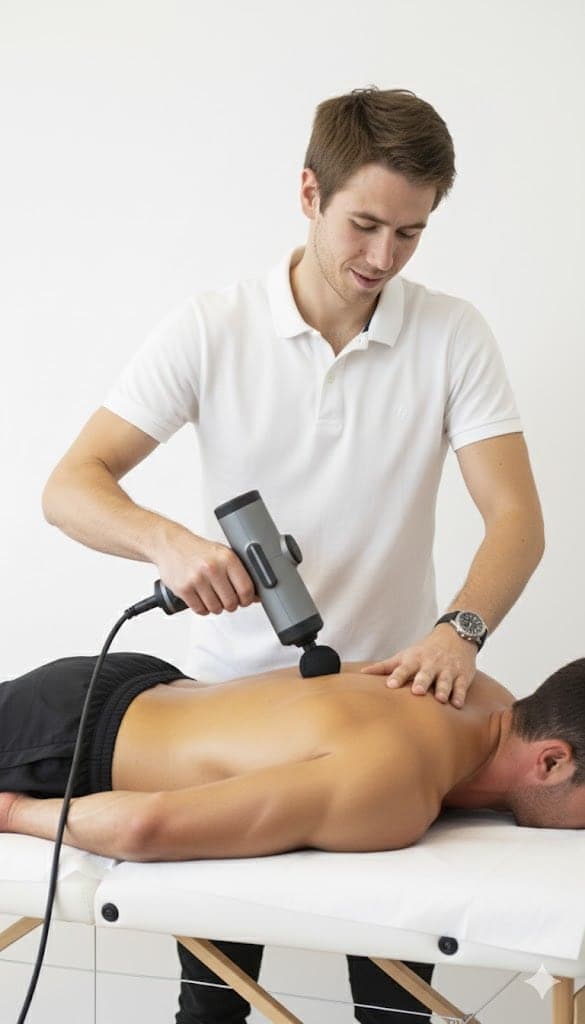
Written by
Chris
Massage therapist, nutrition and exercise physiologist
Norwegian-certified with a Bachelor’s in Physical Education and Nutrition and over ten years of clinical practice, working from a portable table in clients’ homes across the Paphos district.
This article is general information, not a medical diagnosis. If you have severe, worsening or unexplained pain, numbness, weakness, or pain after an accident, see a doctor first.