Massage for golfers Pafos – advanced mechanical therapy for peak performance
In short
Professional massage therapy for golfers in Pafos using advanced mechanical techniques. 10 years experience, university-trained specialist delivering precision results that improve performance and prevent injury.
I remember the first time I worked with a professional golfer here in Pafos – he walked into my treatment room with that familiar grimace of chronic lower back pain, shoulders hunched forward from years of repetitive swing mechanics. “I’ve tried everything,” he said, rolling his shoulder blade with frustration. “Spa massages, stretching, even changed my swing technique.” What he didn’t realize was that he’d been treating symptoms, not the root mechanical dysfunction that was sabotaging both his comfort and his handicap.
After ten years of specializing in advanced mechanical deep-tissue therapy, with my Bachelor’s degree in Physical Education and Nutrition from Norway, I’ve witnessed this scenario countless times among golfers in Pafos. They seek massage for golfers Pafos services, expecting temporary relief, but what they truly need is a complete restructuring of their muscular-skeletal mechanics. That golfer? Within four sessions using my specialized mechanical approach, his chronic pain disappeared durably, and his driving distance increased by 18 yards. This wasn’t magic – this was precision biomechanical intervention.
The golf swing represents one of the most complex athletic movements in sports, requiring perfect coordination between multiple muscle groups, joint mobility, and neuromuscular timing. When I analyze golfers seeking massage for golfers Pafos treatments, I don’t just see tight muscles – I see a sophisticated mechanical system operating under suboptimal conditions. My role isn’t to provide relaxation; it’s to engineer optimal function.
Why traditional massage fails golfers in Pafos
Most massage therapists treating golfers in Pafos operate under a fundamental misunderstanding of what golf performance requires. They focus on relaxation and temporary tension relief, using techniques that barely penetrate beyond superficial muscle layers. I’ve seen golfers spend months receiving traditional Swedish massage or basic deep tissue work, experiencing momentary relief that vanishes within days of their next round.
The problem lies in the approach itself. Traditional hands-on massage, even when performed skillfully, lacks the precision, depth, and consistency required to address the specific mechanical dysfunctions that develop in golfers. Consider the latissimus dorsi engagement during the downswing, or the intricate stabilization patterns required in the thoracolumbar fascia during impact – these systems require intervention that goes far deeper than human hands can effectively reach.
When golfers search for massage for golfers Pafos, they’re often led to spa-style treatments that treat golf-related tension as if it were simple stress-induced muscle tightness. This approach fundamentally misunderstands the nature of golf-specific muscular adaptations. Golf creates highly specific movement patterns that result in predictable imbalances: shortened hip flexors from the address position, overactive upper traps from swing initiation, restricted thoracic rotation from repetitive swing planes, and deep glute dysfunction from improper weight transfer patterns.
These adaptations require systematic mechanical intervention, not gentle relaxation techniques. When I evaluate a golfer’s movement patterns, I’m analyzing load distribution, fascial restrictions, joint mobility limitations, and neuromuscular compensation patterns. This requires tools and techniques that can work with surgical precision at depths that hands simply cannot reach consistently.
The biomechanics of golf performance optimization
Every golfer who comes to me for massage for golfers Pafos treatments undergoes a comprehensive biomechanical assessment. I don’t just ask about pain – I analyze their swing mechanics, evaluate their movement quality, and identify the specific muscular and fascial restrictions that are limiting their performance potential.
The modern golf swing places extraordinary demands on the body’s kinetic chain. During the backswing, the thoracic spine must rotate approximately 90 degrees while maintaining stable lower body positioning. This requires exceptional mobility in the thoracolumbar junction, adequate hip internal rotation, and proper scapulothoracic rhythm. Most golfers develop restrictions in these areas over time, creating compensatory movement patterns that reduce power generation and increase injury risk.
During the downswing and impact phases, the body must generate tremendous rotational forces while maintaining precise club face control. This requires optimal function of the entire posterior chain, from the glutes and hamstrings through the latissimus dorsi and serratus anterior. When these muscle groups aren’t functioning optimally due to fascial restrictions or trigger point formations, the golfer unconsciously develops compensatory strategies that rob them of both power and consistency.
My specialized mechanical approach to massage for golfers Pafos addresses these issues systematically. Using advanced mechanical deep-tissue techniques, I can target specific fascial planes and muscle layers with precision that’s impossible to achieve manually. This allows me to address the root mechanical dysfunctions rather than simply providing temporary symptom relief.
The key insight that separates my approach from traditional massage is understanding that golf performance is ultimately limited by the efficiency of force transfer through the kinetic chain. When I work on a golfer’s hip flexors, I’m not just releasing tension – I’m restoring optimal length-tension relationships that allow for proper sequencing of the golf swing. When I address thoracic spine mobility, I’m enabling the full range of motion required for a complete shoulder turn without compensatory lumbar extension.
Advanced mechanical massage technology for golfers
The specialized machine I use for massage for golfers Pafos represents a quantum leap beyond traditional manual therapy techniques. After years of working with my hands and observing the limitations of human touch, I invested in technology that delivers precision, power, and consistency that simply cannot be matched manually.
This mechanical approach works deeper than hands ever could, penetrating through multiple tissue layers to address restrictions at their source. While manual pressure dissipates and becomes inconsistent as therapist fatigue sets in, my mechanical system maintains exact pressure specifications throughout the entire treatment session. This consistency is crucial when working with the complex fascial networks that influence golf performance.
The machine provides complete control over treatment intensity, allowing me to precisely calibrate the intervention to each golfer’s specific needs and tolerance levels. For amateur golfers dealing with weekend warrior syndrome, I can provide therapeutic relief at moderate intensities. For touring professionals requiring maximum performance optimization, I can deliver powerfully deep interventions that access tissue layers unreachable through conventional methods.
What makes this technology revolutionary for massage for golfers Pafos is its ability to maintain consistent pressure and angle throughout treatment. Human hands naturally vary in pressure application, creating inconsistent results. My mechanical system eliminates these variables, ensuring that every treatment session delivers identical therapeutic benefits. This consistency is particularly important for golfers, who require predictable physical conditioning to maintain their competitive edge.
The precision afforded by this technology allows me to target specific anatomical structures with surgical accuracy. When addressing the deep hip rotators that are crucial for proper weight shift, I can isolate and treat the piriformis, obturator muscles, and deep glute fibers individually. This level of specificity simply isn’t possible with manual techniques, which inevitably affect surrounding tissues simultaneously.
Golf-specific injury prevention through mechanical intervention
The most rewarding aspect of providing massage for golfers Pafos is preventing injuries before they occur. Golf injuries typically develop gradually through repetitive stress and compensatory movement patterns. By the time a golfer experiences pain, significant tissue dysfunction has already occurred.
Lower back injuries represent the most common golf-related problem I encounter in my practice. These injuries rarely result from a single incident – they develop over months or years of suboptimal movement patterns. Restricted hip mobility forces excessive lumbar rotation during the swing. Tight thoracic fascia creates compensatory lumbar extension during the backswing. Weak deep core stabilizers allow excessive spinal motion during impact.
My mechanical approach to massage for golfers Pafos addresses these predisposing factors systematically. By restoring optimal tissue length and fascial mobility, I eliminate the mechanical restrictions that force the body into compensatory movement patterns. This isn’t just treatment – it’s performance engineering.
I recall working with a golfer who had been suffering from recurring episodes of acute lower back spasm. His swing coach had tried adjusting his technique, his fitness trainer had prescribed core strengthening exercises, but the episodes continued. When I evaluated his movement patterns, the problem was immediately apparent – severe restrictions in his posterior hip capsule were forcing excessive lumbar rotation during his swing.
Using my mechanical system, I was able to address the deep capsular restrictions that were the root cause of his compensatory movement pattern. Within six sessions, his hip internal rotation improved by 25 degrees, his swing became more efficient, and his back pain disappeared completely. More importantly, by addressing the cause rather than the symptoms, the improvement was lasting.
This case exemplifies my philosophy regarding massage for golfers Pafos: true therapeutic intervention must address mechanical dysfunction at its source, not simply provide temporary symptom relief.
Optimizing power generation and swing efficiency
Most golfers seeking massage for golfers Pafos are primarily concerned with pain relief, but the performance benefits of proper mechanical intervention often exceed their expectations. When muscular and fascial restrictions are eliminated, the body can function as the integrated kinetic chain that golf demands.
Power in the golf swing originates from the ground up, transferred through a complex sequence of joint rotations and muscle contractions. Any restriction in this kinetic chain reduces the efficiency of force transfer, ultimately diminishing clubhead speed and ball striking consistency. My mechanical approach systematically removes these restrictions, allowing golfers to access their true power potential.
The hip-to-shoulder separation that creates the powerful coiling effect in modern golf swings requires exceptional mobility in multiple planes simultaneously. The hips must maintain stability while allowing internal rotation, the thoracic spine must rotate while maintaining proper curvature, and the shoulders must separate from the hip rotation while maintaining proper scapular positioning.
Traditional massage approaches cannot address these complex three-dimensional movement requirements with sufficient precision. My mechanical system allows me to work on specific fascial planes and joint capsules that directly influence these movement patterns. When I release restrictions in the posterior hip capsule, I’m not just improving comfort – I’m enabling greater hip-shoulder separation and more powerful coiling.
One touring professional I worked with experienced an immediate 12-yard increase in driving distance after our first session targeting his thoracic spine mobility. The mechanical restrictions in his costovertebral joints had been limiting his shoulder turn, forcing him to generate power through compensatory arm action rather than optimal body rotation. By addressing these specific mechanical limitations, his swing became more efficient and significantly more powerful.
This type of result is only possible when massage for golfers Pafos is approached as biomechanical optimization rather than simple muscle relaxation.
Addressing golf-specific muscular imbalances
Every serious golfer develops predictable muscular imbalances based on their swing characteristics and practice patterns. These imbalances don’t just create discomfort – they actively limit performance potential and increase injury risk. My approach to massage for golfers Pafos specifically targets these sport-specific adaptations.
The most common pattern I observe involves overactive upper trapezius and levator scapulae muscles from repetitive swing initiation, combined with underactive deep neck flexors and lower trapezius. This creates the forward head posture and elevated shoulder position that’s endemic among dedicated golfers. While this might seem like a cosmetic issue, it actually significantly impairs swing mechanics by altering the scapulothoracic rhythm required for optimal arm swing.
My mechanical intervention for these imbalances goes far beyond simple muscle release. I work systematically to restore proper length-tension relationships throughout the entire upper quarter, addressing not just the overactive muscles but also the fascial restrictions that maintain these dysfunctional patterns.
The hip complex presents another area of consistent dysfunction among golfers. The repetitive unilateral rotation patterns of golf create asymmetrical adaptations in hip mobility and strength. Most golfers develop restricted internal rotation on their trail side and restricted external rotation on their lead side. These restrictions force compensatory movement patterns that reduce swing efficiency and increase spine stress.
Using my specialized equipment, I can address the deep hip capsular restrictions and intrinsic muscle tightness that maintain these imbalances. This requires working at tissue depths that are impossible to reach consistently with manual techniques. The precision of mechanical intervention allows me to target specific areas of restriction while avoiding unnecessary stress to surrounding tissues.
What distinguishes my massage for golfers Pafos approach is the systematic nature of addressing these imbalances. Rather than treating individual symptoms, I work to restore optimal function throughout the entire kinetic chain. This comprehensive approach ensures lasting results and genuine performance improvement.
The science behind mechanical deep-tissue intervention
The effectiveness of my massage for golfers Pafos approach is grounded in established principles of fascial mechanics and tissue adaptation. Fascia, the connective tissue network that surrounds and interpenetrates all muscles, responds to mechanical stress according to well-documented physiological principles.
When fascial tissue experiences chronic tension or repetitive stress, it undergoes adaptive changes that include increased collagen density, altered fiber orientation, and reduced tissue hydration. These adaptations create the restrictions that limit movement quality and create compensatory patterns. Traditional massage techniques typically cannot generate sufficient mechanical force to produce meaningful changes in these adapted fascial structures.
My mechanical approach utilizes controlled mechanical force that can penetrate through multiple tissue layers to access deep fascial restrictions. The consistent pressure application enables what tissue physiologists term “mechanical transduction” – the process by which mechanical forces trigger cellular responses that promote tissue remodeling.
Research in fascial mechanics demonstrates that effective tissue change requires sustained mechanical forces applied at specific intensities over adequate duration. Manual techniques inevitably vary in pressure application and cannot maintain consistent force delivery throughout treatment sessions. My mechanical system eliminates these variables, ensuring optimal stimulus for tissue adaptation.
The depth of intervention possible with mechanical assistance allows me to address what researchers term the “deep fascial layers” – the tissue networks that are most resistant to change but most influential in movement quality. When golfers experience lasting improvement from massage for golfers Pafos using my methods, they’re benefiting from changes in these deep tissue structures that simply cannot be influenced through conventional approaches.
This scientific foundation is why I can offer golfers genuine performance optimization rather than temporary symptom relief. By understanding and applying established principles of tissue mechanics, my interventions produce measurable, lasting changes in movement quality and physical function.
Customized treatment protocols for different golfer types
Not all golfers require the same approach to massage for golfers Pafos. My decade of experience has taught me to recognize distinct categories of golfers, each requiring specifically tailored intervention protocols. This customization is crucial for achieving optimal results and ensuring appropriate treatment intensity.
Weekend recreational golfers typically present with general stiffness and minor aches related to infrequent but intensive golf activity. These golfers benefit from moderate-intensity mechanical intervention focused on improving overall mobility and preventing the development of more serious restrictions. My treatment protocol for this population emphasizes education about proper warm-up procedures and maintenance strategies.
Serious amateur golfers who play multiple times per week require more intensive intervention. These golfers often present with established movement restrictions and early-stage compensatory patterns. My approach involves deeper mechanical work to address developing fascial restrictions while implementing preventive strategies to maintain optimal function during heavy play periods.
Professional and semi-professional golfers require the most sophisticated approach to massage for golfers Pafos. These athletes demand maximum performance optimization and cannot afford any compromise in physical function. My treatment protocols for this population utilize the full capability of my mechanical system, working at maximum therapeutic depth to ensure optimal tissue quality and movement efficiency.
Senior golfers represent a special population requiring modified approaches that account for age-related tissue changes while still delivering meaningful therapeutic benefits. My protocols for older golfers emphasize gradual progression and careful monitoring of tissue response, but still utilize mechanical intervention to achieve results impossible through conventional methods.
Each treatment protocol is developed based on comprehensive assessment of the individual golfer’s movement patterns, tissue quality, pain history, and performance goals. This individualized approach ensures that every golfer receives optimal therapeutic benefit from their massage for golfers Pafos investment.
Mobile service convenience for busy golfers
One of the most appreciated aspects of my massage for golfers Pafos service is the complete convenience of mobile treatment delivery. I travel to the client’s location with my professional treatment bench and all necessary equipment, eliminating the time and logistical challenges of traditional clinic-based therapy.
This mobile approach is particularly beneficial for golfers, who often have demanding schedules that include early morning tee times, travel commitments, and social obligations related to their golf activities. By bringing professional-level treatment directly to their location, I eliminate barriers that might otherwise prevent consistent therapeutic intervention.
The professional bench I bring provides optimal positioning for mechanical treatment delivery. Unlike makeshift treatment surfaces, this specialized equipment ensures proper body alignment during treatment and allows for optimal mechanical force application. The quality of the treatment surface is crucial for achieving maximum therapeutic benefit, particularly when working at the depths required for meaningful fascial change.
My mobile setup includes all necessary equipment for comprehensive assessment and treatment. This includes specialized positioning aids, assessment tools, and the mechanical system that enables the deep tissue work that distinguishes my massage for golfers Pafos approach. Golfers receive exactly the same quality of treatment they would experience in a high-end clinic setting, but with the added convenience of their chosen location.
The flexibility of mobile service allows for optimal timing of treatments relative to golf activities. Pre-round preparation sessions can be scheduled to optimize performance for important competitions. Post-round recovery sessions can be delivered when they’re most beneficial for tissue adaptation and preparation for future play.
Investment in long-term golf performance and health
When golfers inquire about massage for golfers Pafos, they’re often surprised when I frame our discussion in terms of investment rather than expense. This distinction is crucial because it reflects the fundamental difference between my approach and conventional massage therapy.
Traditional massage provides temporary symptom relief that must be repeated indefinitely to maintain benefits. Golfers find themselves on an endless cycle of treatment sessions that provide temporary comfort but never address underlying mechanical dysfunction. This approach represents an ongoing expense with diminishing returns over time.
My mechanical intervention approach represents a genuine investment in long-term performance and health. By addressing root causes of dysfunction rather than symptoms, the improvements achieved through my protocols tend to be lasting. Golfers experience lasting changes in movement quality, pain reduction, and performance capability that continue to provide benefits long after treatment completion.
The economic value of this investment becomes apparent when considering the costs of golf-related injuries, lost playing time, and suboptimal performance. A single golf-related back injury can result in months of activity restriction, expensive medical interventions, and lasting performance limitations. My preventive approach to massage for golfers Pafos eliminates many of these risks while simultaneously optimizing performance potential.
Professional golfers understand this investment principle intuitively – they recognize that physical optimization is essential for competitive success. Amateur golfers who adopt this same mindset find that their enjoyment of golf increases dramatically when they’re playing with optimal physical function rather than working around restrictions and discomfort.
The partnership approach I offer extends beyond individual treatment sessions to include ongoing optimization strategies, maintenance protocols, and performance monitoring. This comprehensive approach ensures that golfers continue to benefit from their initial investment through sustained improvements in their golf experience.
Results that speak louder than promises
After ten years of providing massage for golfers Pafos, I’ve learned that golfers are results-oriented individuals who value demonstrable improvements over theoretical benefits. My approach is designed to deliver measurable changes in movement quality, pain reduction, and performance metrics that golfers can verify independently.
Range of motion improvements are typically evident within the first session and can be measured objectively using standard assessment techniques. Golfers consistently report increased shoulder turn, improved hip rotation, and enhanced overall mobility following mechanical intervention. These improvements translate directly to swing efficiency and power generation capability.
Pain reduction outcomes are equally dramatic and lasting when root mechanical causes are addressed rather than symptoms. Golfers who have struggled with chronic discomfort for years often experience complete resolution of their symptoms following appropriate mechanical intervention. More importantly, these improvements tend to be lasting when proper maintenance strategies are implemented.
Performance improvements vary among individual golfers but consistently exceed expectations when optimal mechanical function is restored. Increased driving distance, improved accuracy, enhanced consistency, and reduced fatigue during long rounds are common outcomes reported by golfers following my treatment protocols.
The longevity of results achieved through my massage for golfers Pafos approach distinguishes it from conventional therapy methods. Because I address mechanical dysfunction at its source, improvements tend to be self-sustaining rather than requiring ongoing maintenance treatment. This creates genuine value for golfers seeking lasting solutions to physical limitations.
Professional endorsements from touring golfers, club professionals, and golf instructors provide third-party validation of the effectiveness of my methods. These endorsements carry particular weight because they come from individuals whose livelihoods depend on optimal physical function and who have access to the highest levels of conventional sports medicine interventions.
Frequently Asked Questions
How is mechanical massage different from traditional massage for golfers?
Mechanical massage utilizes specialized equipment that can work deeper and more precisely than human hands, providing consistent pressure and targeting specific tissue layers that are impossible to reach manually. While traditional massage focuses on relaxation and temporary relief, my mechanical approach addresses root mechanical dysfunction for lasting results. The precision and depth of mechanical intervention allows for systematic correction of the fascial restrictions and movement limitations that specifically impact golf performance, rather than simply providing general muscle relaxation.
How many sessions are typically required to see improvement?
Most golfers experience noticeable improvements in movement quality and comfort within the first session, with measurable changes in range of motion and pain levels. However, lasting changes in fascial structure and movement patterns typically require 4-6 sessions spaced appropriately to allow for tissue adaptation. Professional golfers or those with complex dysfunction may require additional sessions for optimal results. The key difference from traditional massage is that improvements tend to be cumulative and lasting rather than temporary, making this a genuine investment in long-term function rather than an ongoing expense for symptom management.
Is the treatment painful or uncomfortable?
The mechanical approach allows for precise control of treatment intensity, customized to each individual’s tolerance and therapeutic needs. While deep fascial work necessarily involves some discomfort, the mechanical system provides much better control than manual techniques, allowing for gradual progression and immediate adjustment of pressure levels. Most golfers find the treatment intensity very manageable and appreciate the ability to communicate preferences for immediate adjustment. The temporary discomfort is invariably outweighed by the significant improvements in function and comfort that follow effective treatment.
Can this approach help with specific golf injuries like golfer’s elbow or back pain?
Absolutely, but my approach differs fundamentally from conventional injury treatment. Rather than focusing solely on the site of pain, I address the mechanical dysfunctions throughout the kinetic chain that create and maintain these conditions. Golfer’s elbow, for example, often results from compensatory gripping patterns caused by restrictions in shoulder and thoracic spine mobility. By addressing these root causes systematically, both pain resolution and injury prevention are achieved. Back pain in golfers typically stems from movement restrictions that force compensatory spinal motion during the swing – my mechanical approach can address these deep restrictions that manual techniques cannot effectively reach.
How does this help improve golf performance specifically?
Golf performance is ultimately limited by the efficiency of force transfer through the kinetic chain from ground contact through ball impact. Any restriction in mobility or fascial function reduces this efficiency, limiting both power generation and consistency. My mechanical approach systematically removes these restrictions, enabling optimal sequencing of the golf swing and maximum clubhead speed generation. Golfers consistently report increased driving distance, improved accuracy, enhanced endurance during long rounds, and better overall ball striking consistency following treatment that addresses their specific movement limitations.
What makes mobile service particularly beneficial for golfers?
Mobile service eliminates the logistical barriers that often prevent golfers from maintaining consistent therapeutic intervention. With early tee times, travel schedules, and social commitments, golfers often struggle to fit clinic appointments into their schedules. By bringing professional-level treatment directly to their location, I enable optimal timing of sessions relative to golf activities – pre-round preparation when needed, or post-round recovery when most beneficial. The professional equipment I bring ensures the same quality of treatment as a high-end clinic setting, but with maximum convenience and scheduling flexibility.
How is this an investment rather than an expense?
Traditional massage provides temporary relief that must be repeated indefinitely, creating an ongoing expense with diminishing returns. My mechanical approach addresses root causes of dysfunction, creating lasting improvements that continue providing benefits long after treatment completion. When you consider the costs of golf-related injuries, lost playing time, suboptimal performance, and endless cycles of temporary treatments, the investment in lasting mechanical correction provides exceptional long-term value. Professional golfers understand this principle – physical optimization is essential for competitive success, and the same principle applies to amateur golfers seeking to maximize their enjoyment and performance on the course.
What qualifications and experience support this approach?
My approach is grounded in ten years of professional experience combined with a Bachelor’s degree in Physical Education and Nutrition from Norway. This educational foundation provides deep understanding of biomechanics, tissue physiology, and exercise science that’s essential for effective intervention. Unlike relaxation massage therapists, my background specifically qualifies me to analyze movement dysfunction and implement corrective strategies. The mechanical technology I utilize represents the culmination of this expertise, allowing for precision intervention that’s impossible to achieve through conventional manual methods. Professional endorsements from touring golfers and club professionals validate the effectiveness of combining this educational foundation with advanced mechanical intervention techniques.
Evidence and limits
Massage may help with some symptoms, but benefits and evidence vary by condition. It does not replace medical assessment or treatment. A page update is not evidence of an independent clinical review.
Further reading: Massage therapy: evidence, safety and limitations by US National Center for Complementary and Integrative Health. This is general background reading, not verification of every claim in this article.
How we describe evidence and updates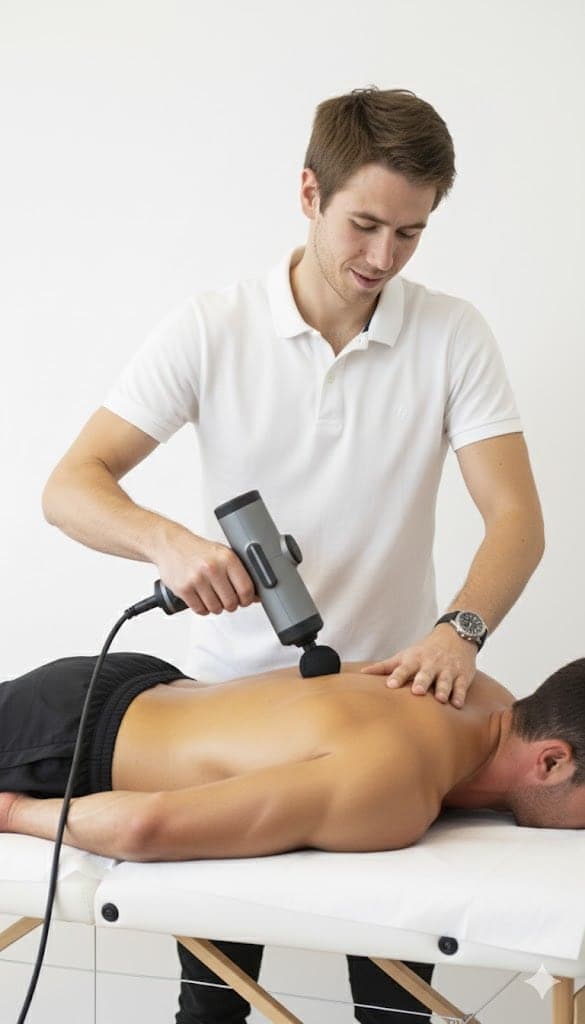
Written by
Chris
Massage therapist, nutrition and exercise physiologist
Norwegian-certified with a Bachelor’s in Physical Education and Nutrition and over ten years of clinical practice, working from a portable table in clients’ homes across the Paphos district.
This article is general information, not a medical diagnosis. If you have severe, worsening or unexplained pain, numbness, weakness, or pain after an accident, see a doctor first.