
Effective Massage Techniques: A Decade of Results-Driven Mechanical Deep-Tissue Therapy
In short
Discover effective massage techniques that deliver consistent, lasting results through precision mechanical deep-tissue therapy. Learn how advanced body mechanics expertise creates lasting pain relief.
After ten years of treating chronic pain patterns and movement dysfunction, I’ve learned something most people don’t realize: the most effective massage techniques aren’t about pressure alone—they’re about precision, repeatability, and understanding the biomechanics of how your body actually stores tension. When a client tells me they’ve been getting massages for years but still wake up with the same shoulder pain, I know exactly what’s happened. They’ve been treated for symptoms, not causes. And that’s where most traditional approaches fundamentally fail.
My background in Physical Education and Nutrition gave me the scientific framework to understand body mechanics at a structural level. But it was years of clinical practice that taught me the uncomfortable truth: human hands, no matter how skilled, have inherent limitations. They fatigue. They vary in pressure. They cannot consistently reach the depth required to release fascial adhesions in the deep muscle layers where chronic tension actually lives. This realization led me to develop a method that combines my expertise in body mechanics with advanced mechanical deep-tissue technology—a approach that delivers what traditional massage simply cannot: lasting, measurable results.
Why Traditional Massage Techniques Fail to Deliver Consistent Results
Let me be direct about something the massage industry doesn’t want to acknowledge. Most massage therapy operates on a fundamentally flawed model. Clients come in, receive treatment that feels good in the moment, and return two weeks later with the same complaints. This cycle repeats endlessly because the approach treats surface-level symptoms rather than addressing the mechanical dysfunction creating the pain in the first place.
The human hand can generate approximately 30-50 pounds of sustained pressure before fatigue sets in. This might sound substantial, but chronic myofascial restriction in the deeper muscle layers—the quadratus lumborum, the deep rotators of the hip, the subscapularis—requires significantly more force to achieve actual tissue release. When a therapist attempts to go deeper using traditional techniques, three things happen: their precision decreases, their endurance fails, and the treatment becomes inconsistent.
I saw this pattern repeatedly during my early years in practice. A client would report dramatic improvement after a session where I was fresh and energized, then lesser results when I treated them at the end of a long day. This inconsistency troubled me deeply. How could I claim to be treating the root cause of dysfunction when my own physiological limitations compromised the treatment quality?
The Biomechanics of Chronic Tension
Understanding effective massage techniques requires understanding how your body actually creates and maintains chronic tension patterns. This isn’t about “knots” or “toxins”—those are oversimplified explanations that don’t reflect the actual pathophysiology. What we’re dealing with is myofascial adhesion, trigger point formation, and compensatory movement patterns that reinforce themselves over time.
When you maintain poor posture at a desk for eight hours daily, specific muscle groups remain in a shortened, contracted state. The fascia—the connective tissue surrounding and interpenetrating the muscle—begins to lay down additional collagen fibers in this shortened position. Over weeks and months, these tissues literally remodel themselves to this dysfunctional position. Your nervous system adapts, accepting this as the new normal. The muscle bellies develop trigger points: hyperirritable spots within taut bands of skeletal muscle that refer pain to distant locations.
This is why superficial relaxation massage provides only temporary relief. You’re asking tissues that have been structurally remodeled over months or years to release with light, pleasant pressure. It’s mechanically impossible. Effective massage techniques must reach the depth where these adhesions exist, apply sufficient force to mechanically disrupt the dysfunctional tissue patterns, and do so with enough precision to avoid creating defensive guarding responses.
The Machine-Assisted Approach: Precision, Power, and Consistency
Five years into my practice, I made the decision that would define my entire approach moving forward. I invested in specialized mechanical deep-tissue equipment and spent eighteen months developing protocols that combined my understanding of body mechanics with the unique capabilities this technology offered. The results were immediately, undeniably superior to anything I had achieved with traditional techniques.
The machine I use delivers force through a precise, computer-controlled mechanism. This isn’t percussion therapy or vibration—those are entirely different modalities with different applications. This is controlled, sustained, penetrating pressure that can be adjusted from light therapeutic touch to forces exceeding 100 pounds per square inch, all while maintaining millimeter-level precision. More importantly, it never fatigues, never has an “off day,” and delivers identical treatment parameters from the first client of the day to the last.
Deeper Than Hands: Accessing Structural Layers
When I work on a client’s thoracolumbar fascia—the dense connective tissue of the lower back—I can reach depths that would be physically impossible with manual techniques. The mechanical advantage allows me to compress tissue layers progressively, working through the superficial fascia, the erector spinae muscle group, into the deep multifidus and rotator muscles adjacent to the spine itself. This is where chronic low back pain actually originates in most cases.
I remember treating a competitive cyclist who had been dealing with bilateral lower back pain for three years. He’d tried everything: traditional massage, chiropractic, physical therapy, even cortisone injections. His MRI showed no structural damage—just “muscle strain.” When I assessed him, I found massive fascial restriction in his quadratus lumborum and deep hip rotators, a predictable pattern from the flexed cycling position maintained for hours during training.
Using manual techniques, I could barely reach these tissues. With the mechanical approach, I was able to apply sustained pressure directly to the restriction sites, holding for 90-120 seconds while the tissues underwent viscoelastic deformation—the actual mechanical process by which fascia releases. After four sessions over six weeks, his pain was completely resolved. More importantly, it hasn’t returned in the two years since, because we treated the actual mechanical dysfunction, not just the pain signal.
Complete Control: Individualized Force Application
Effective massage techniques must be precisely calibrated to the individual client’s tissue tolerance, pain threshold, and therapeutic goals. This is where the control offered by mechanical systems becomes invaluable. I can adjust pressure in real-time during a session, responding to the client’s feedback and the tissue’s response without the variability introduced by my own fatigue or strength limitations.
For an executive dealing with chronic tension headaches from forward head posture, I use moderate pressure on the suboccipital muscles and upper trapezius—enough to release fascial restriction but calibrated to avoid creating defensive tension. For an elite athlete preparing for competition, I can apply significantly deeper pressure to achieve rapid recovery and performance optimization. The same precision, the same consistency, just different parameters based on the clinical requirement.
| Treatment Variable | Traditional Manual Technique | Mechanical Deep-Tissue Method |
|---|---|---|
| Maximum Sustained Pressure | 30-50 lbs (decreases with fatigue) | 100+ lbs (consistent throughout session) |
| Precision Consistency | Variable (depends on therapist condition) | Millimeter-level precision maintained |
| Deep Tissue Penetration | Limited by hand anatomy and strength | Reaches structural layers impossible manually |
| Treatment Repeatability | Varies session to session | Identical parameters every treatment |
| Therapist Fatigue Factor | Significant (affects quality) | Eliminated (consistent quality) |
| Force Adjustment Range | Limited by physical capability | Complete spectrum from light to maximum |
Results-Oriented Protocol Design: Treating Causes, Not Symptoms
The most effective massage techniques in the world are worthless without proper assessment and protocol design. This is where my education in body mechanics and decade of clinical experience become critical. When a new client contacts me, I don’t just ask where they hurt—I investigate the entire kinetic chain to identify the actual mechanical dysfunction creating their symptoms.
Someone with chronic shoulder pain often has no actual shoulder pathology. Instead, I typically find thoracic spine immobility, scapular dyskinesis from weak serratus anterior, and compensatory overactivity in the upper trapezius and levator scapulae. The shoulder pain is just the symptom—the place where mechanical stress accumulates because the movement pattern is fundamentally dysfunctional. Treat the shoulder alone, and you’ll provide temporary relief but no lasting change.
The Assessment Phase: Identifying Mechanical Dysfunction
Every new client undergoes a comprehensive biomechanical assessment before we begin treatment. I evaluate posture, movement patterns, range of motion limitations, and tissue quality through palpation. This isn’t a quick examination—it’s a systematic evaluation that identifies exactly where mechanical dysfunction exists and how different restrictions relate to each other.
I had a client last year, a software developer, who complained of wrist pain she attributed to typing. Her doctor had diagnosed carpal tunnel syndrome and suggested surgery. When I assessed her, yes, there was tension in her forearm flexors, but the primary dysfunction was in her cervical spine and scalene muscles. Her forward head posture created chronic tension in the neck muscles, which restricted nerve mobility through the thoracic outlet, which manifested as hand and wrist symptoms—a classic example of double crush syndrome that would never be resolved by addressing the wrist alone.
After treating her cervical dysfunction, restoring proper scapular mechanics, and then addressing the forearm tissues, her symptoms resolved completely in six weeks. She never needed surgery because we identified and treated the actual mechanical cause rather than chasing the symptom.
Progressive Treatment Protocols
Effective massage techniques must be applied within a structured, progressive protocol that respects tissue adaptation timelines. You cannot resolve chronic dysfunction in a single session, regardless of technique quality. Fascia remodels over weeks. Nervous system patterns take time to reset. Movement patterns require conscious practice to change.
My typical protocol involves an initial intensive phase: sessions every 7-10 days for 4-6 weeks. During this period, we’re achieving mechanical release of primary restrictions, reducing trigger point activity, and beginning to restore normal movement patterns. The mechanical deep-tissue work provides the force necessary to disrupt dysfunctional tissue, while the consistent treatment frequency prevents the patterns from re-establishing between sessions.
After the intensive phase, we transition to a maintenance protocol: sessions every 3-4 weeks. At this point, we’re not treating chronic dysfunction anymore—we’re preventing its recurrence and optimizing performance. This is the partnership model I work within. I’m not providing spa services or one-off relaxation sessions. I’m partnering with clients who are serious about durably resolving mechanical dysfunction and optimizing their body’s capability.
Advanced Techniques for Specific Dysfunction Patterns
Different mechanical dysfunctions require different technical approaches. After ten years, I’ve developed specialized protocols for the most common patterns I encounter. These aren’t generic massage routines—they’re biomechanically-informed treatment sequences designed to address specific pathomechanics.
Thoracic Outlet Syndrome and Cervical Dysfunction
Forward head posture and rounded shoulders—the default position of modern life—creates predictable dysfunction patterns. The scalene muscles become chronically shortened and hypertonic, compressing the neurovascular bundle that travels to the arm. The pectoralis minor follows the same pattern. Meanwhile, the deep cervical flexors weaken, the lower trapezius becomes inhibited, and the entire shoulder girdle loses its proper mechanical relationship to the thorax.
My protocol for this pattern involves systematic release of the scalenes using precise, sustained pressure on each of the three muscle bellies. This requires careful anatomical knowledge—the brachial plexus and subclavian artery run directly through this area. Traditional massage approaches this region cautiously or avoids it entirely. With mechanical precision and proper positioning, I can achieve complete release of these critical tissues safely and effectively.
Following scalene release, I address the pectoralis minor, which requires getting underneath the pectoralis major to reach the attachment sites on ribs 3-5. Then we work systematically through the subscapularis—the internal rotator of the shoulder that’s virtually inaccessible with traditional techniques but can be reached by positioning the arm in specific angles and using the mechanical advantage to work along the anterior surface of the scapula.
Lumbar-Pelvic Dysfunction and Hip Mechanics
Lower back pain affects approximately 80% of adults at some point in their lives. The vast majority of cases involve no structural pathology—no disc herniation, no fracture, no stenosis. Just mechanical dysfunction in the posterior chain muscles and fascial restrictions that alter movement patterns and create pain.
The key tissues in chronic lower back pain are rarely the ones that hurt. Yes, the erector spinae are often painful and tense, but they’re usually responding to dysfunction elsewhere. The primary culprits are typically the quadratus lumborum, the psoas major, the deep hip rotators (especially piriformis), and the thoracolumbar fascia itself.
I treated a construction worker last year who had been dealing with debilitating low back pain for five years. He’d been told he had degenerative disc disease and should consider spinal fusion surgery. When I assessed him, his hip extension was severely limited bilaterally, his psoas was massively restricted, and his entire lumbar spine was essentially locked in flexion from compensatory patterns.
We spent six weeks systematically releasing his hip flexors, restoring mobility to his thoracolumbar fascia, and retraining proper hip hinge mechanics. The mechanical deep-tissue work allowed us to reach the psoas effectively—a muscle that’s notoriously difficult to access manually because it’s deep in the abdominal cavity, behind the intestines and major blood vessels. By the eighth session, his pain was reduced by 80%. By the twelfth, it was gone completely, and he was moving better than he had in a decade.
Athletic Performance Optimization
Effective massage techniques for athletes differ significantly from treatment protocols for chronic pain. The goals are different: we’re not addressing dysfunction but rather optimizing function, reducing recovery time, and preventing injury by maintaining ideal tissue quality and movement mechanics.
Athletes require deeper, more aggressive treatment than most clinical populations. Their tissue tolerance is higher, their recovery capacity is greater, and the performance demands justify more intensive protocols. I work with several competitive athletes, and our sessions are fundamentally different from chronic pain treatment sessions.
For a runner, I focus on the entire lower kinetic chain: deep work through the plantar fascia, the posterior compartment of the lower leg, the hamstring complex, the glute med and glute max, and the thoracolumbar fascia. The mechanical approach allows me to achieve tissue release that would be impossible manually while maintaining the precision necessary to avoid creating soreness that would interfere with training.
The consistency factor becomes especially important for athletes. Their training schedules are precise, their peak performance windows are narrow, and they cannot afford variable treatment quality. Knowing that every session delivers identical technical parameters provides the reliability they need to integrate bodywork into their periodized training plans.
The Science Behind Mechanical Deep-Tissue Effectiveness
Understanding why mechanical deep-tissue techniques work requires understanding the actual physiological mechanisms by which chronic tension releases and tissue remodels. This isn’t mystical energy work or vague “toxin release.” These are documented biomechanical and neurophysiological processes that have been studied extensively in sports medicine and rehabilitation literature.
Viscoelastic Deformation and Fascial Release
Fascia exhibits viscoelastic properties, meaning its behavior under load depends on both the magnitude of force applied and the duration of application. When you apply sustained pressure to restricted fascial tissue, you induce a process called creep—gradual elongation under constant load. This is why sustained pressure techniques are more effective than brief, repetitive techniques for releasing deep fascial restrictions.
The mechanical advantage of tool-assisted techniques allows me to apply sustained pressure at therapeutic levels for 90-120 seconds—the minimum duration required to achieve true viscoelastic deformation. Manual techniques cannot maintain this pressure duration at sufficient depth without therapist fatigue compromising the treatment. This is simple physics: the mechanical system doesn’t fatigue, doesn’t experience discomfort from sustained awkward positions, and can maintain precise force vectors that would be anatomically impossible for human hands.
Trigger Point Deactivation Mechanisms
Trigger points—those hyperirritable spots within taut bands of muscle that refer pain to distant locations—form through a complex process involving sustained sarcomere contraction, local hypoxia, and sensitization of muscle nociceptors. Effective trigger point treatment requires sufficient pressure to mechanically disrupt the taut band while simultaneously inducing a local twitch response that releases the sustained contraction.
The precision offered by mechanical techniques allows me to target trigger points with millimeter accuracy, applying pressure directly perpendicular to the muscle fiber orientation at the exact location of maximum tenderness. This level of precision is extremely difficult to achieve manually, especially in deep muscle layers or anatomically complex regions like the rotator cuff or deep hip rotators.
When treating a trigger point, I gradually increase pressure until the client reports an 8 out of 10 intensity—uncomfortable but tolerable. We maintain this pressure for 60-90 seconds. Initially, the pain remains constant or even intensifies slightly. Then, typically between 45-75 seconds, there’s a sudden release—the pain drops dramatically, the tissue softens palpably, and the taut band disappears. This is trigger point deactivation, and it’s one of the most satisfying moments in clinical practice because both the client and I can feel the mechanical change occurring in real-time.
Neuroplastic Adaptation and Movement Pattern Reset
Perhaps the most important aspect of effective massage techniques is their effect on the nervous system. Chronic pain and dysfunction aren’t just tissue problems—they’re nervous system problems. Your brain creates a neural representation of your body called the cortical homunculus, and this representation adapts based on input. When you maintain dysfunctional movement patterns for months or years, your nervous system literally rewires itself around that dysfunction.
Mechanical deep-tissue work provides intense sensory input that forces neuroplastic adaptation. We’re not just changing tissue—we’re changing the neural representation of that tissue. When I release a chronically restricted muscle, the sudden increase in sensory input from mechanoreceptors in that region updates the brain’s body map. This is why clients often report that a body region “feels different” after treatment—not just less painful, but actually different in their perception and control of that area.
This neuroplastic effect is cumulative and progressive. Each treatment session reinforces new movement patterns and updates the neural representation. This is why protocol consistency matters so much—we’re not just providing temporary mechanical change but driving lasting neuroplastic adaptation that supports long-term functional improvement.
Why Clients Choose to Invest in Advanced Mechanical Treatment
I’m going to be direct about something that most practitioners avoid discussing: this approach is more expensive than traditional massage. It requires specialized equipment, extensive education in biomechanics and anatomy, and a treatment model focused on lasting results rather than temporary relaxation. Some people see the price and walk away. The clients I work with understand they’re not paying for a massage—they’re investing in resolving problems that have compromised their quality of life for years.
The True Cost of Chronic Pain
When someone has lived with chronic back pain for five years, they’ve paid a cost that far exceeds any treatment fee. They’ve missed workouts, avoided activities with their children, slept poorly, experienced reduced productivity at work, and gradually accepted a lower quality of life as their “new normal.” The financial cost of ongoing pain management—whether chiropractor visits, pain medications, or productivity loss—accumulates to thousands of dollars annually.
I had a client who calculated he’d spent over a substantial sum in three years on various treatments for his chronic shoulder dysfunction: physical therapy, chiropractic, massage, injections, and multiple specialist consultations. Nothing provided lasting improvement. After three months working with me using advanced mechanical deep-tissue protocols, his dysfunction was resolved. The total investment was less than what he’d spent in the previous six months chasing temporary relief.
This is the conversation I have with prospective clients: you can continue the cycle of temporary relief and ongoing expense, or you can invest in treatment designed to durably resolve the mechanical dysfunction creating your symptoms. One approach is an endless expense. The other is a finite investment with lasting returns.
Convenience and Professional Service Delivery
I travel to the client’s location with professional equipment—a specialized treatment bench and all necessary tools. This isn’t just about convenience, though that matters. It’s about removing every barrier to consistent treatment. When clients have to travel to a clinic, schedule conflicts arise, traffic delays happen, and treatment consistency suffers. When I come to them, we eliminate these variables.
This service model also allows me to control the treatment environment completely. I’m not working in a shared space with ambient noise, scheduling pressure, and other clients waiting. Each session receives my complete attention in an environment conducive to focused work. The quality of service delivery matches the quality of the technical approach.
Common Questions About Advanced Mechanical Deep-Tissue Techniques
How is mechanical deep-tissue different from percussion therapy devices?
This is the most common confusion I encounter. Percussion therapy devices deliver rapid, repetitive impacts to the tissue surface. They’re useful for certain applications—primarily pre-workout muscle activation and light recovery work. They do not reach deep fascial layers, cannot apply sustained pressure, and do not achieve the mechanical tissue changes required for treating chronic dysfunction. The mechanical deep-tissue approach I use involves sustained, controlled pressure application that progressively compresses tissue layers to reach structural depth. Completely different modalities with completely different mechanisms of action.
Is deep tissue work painful?
Discomfort and pain are different phenomena. Effective deep-tissue work operates in what I call the therapeutic discomfort zone—typically 6-8 out of 10 on a subjective intensity scale. This is uncomfortable but tolerable, and clients report the discomfort feels “productive”—they can sense that something beneficial is happening. If we cross into actual pain territory—sharp, burning, or causing defensive tensing—we’ve exceeded therapeutic parameters and risk creating protective guarding that undermines treatment effectiveness. The precision control offered by mechanical techniques allows us to work right at the optimal intensity threshold without overshooting into counterproductive pain levels.
How quickly will I see results?
This depends entirely on the chronicity and complexity of your dysfunction. Someone with acute muscle strain from overtraining might experience 80% improvement in one or two sessions. Someone with five years of chronic low back pain involving multiple compensatory patterns will require 6-8 weeks of systematic treatment. I provide realistic timelines during the initial assessment based on what I find biomechanically. What I can guarantee is that if we’re going to achieve improvement, you’ll notice measurable change within the first three sessions. If dysfunction has mechanical origins, mechanical treatment produces mechanical change that’s immediately apparent.
Can this technique treat injuries or just chronic pain?
The mechanical approach is highly effective for accelerating recovery from soft tissue injuries—muscle strains, tendon issues, fascial restrictions following trauma. The key is timing: during the acute inflammatory phase immediately following injury, aggressive deep work is contraindicated. Once we’re past acute inflammation (typically 72-96 hours post-injury), mechanical deep-tissue techniques can dramatically accelerate the remodeling phase by promoting proper collagen alignment, reducing scar tissue formation, and maintaining tissue mobility during healing. Athletes, in particular, benefit significantly from this approach during rehabilitation.
Why don’t more massage therapists use this approach?
Several reasons, and I’ll be honest about them. First, the equipment investment is substantial—tens of thousands of dollars for professional-grade mechanical systems. Second, this approach requires significant education in anatomy, biomechanics, and pathophysiology beyond standard massage therapy training. Third, it demands a fundamentally different business model: focused on results and long-term client relationships rather than high volume and ongoing appointments. Many therapists are excellent at what they do within the traditional relaxation and wellness paradigm. This is simply a different paradigm entirely, focused on clinical outcomes for mechanical dysfunction.
How do I know if this approach is right for me?
If you’ve been dealing with chronic pain or movement dysfunction that hasn’t responded adequately to other treatments, if you’re an athlete looking to optimize performance and recovery, or if you understand that investing in resolving problems durably is more valuable than managing symptoms indefinitely—then this approach is likely appropriate. Conversely, if you’re primarily seeking relaxation massage, general stress relief, or aren’t ready to commit to a structured treatment protocol, traditional massage services would better meet your needs. I’m explicit about this because matching expectations to service delivery is critical for client satisfaction.
What should I expect during a first session?
The initial session is always longer than subsequent treatments because it includes comprehensive assessment. We’ll discuss your history, current symptoms, and functional goals in detail. I’ll evaluate your posture, movement patterns, and range of motion, then palpate tissues to identify restriction patterns and trigger points. Based on this assessment, I’ll explain exactly what mechanical dysfunction I’ve found, how it relates to your symptoms, and what treatment protocol I recommend. Then we begin the first treatment session, which allows you to experience the technique and intensity level. You’ll leave with clear understanding of what we’re treating, why, and what timeline to expect for results.
Is there any recovery time needed after treatment?
Most clients experience some tissue soreness for 24-48 hours following deep-tissue work, similar to post-workout muscle soreness. This is normal and indicates we’ve created mechanical change in the tissue. I recommend light movement and hydration during this period but no restrictions on normal activities. Athletes can typically return to training the day after treatment, though I often recommend reducing intensity slightly for 24 hours if we’ve done particularly aggressive work on primary movement muscles. The soreness is temporary and mild compared to the dysfunction we’re treating.
The Partnership Model: Long-Term Results Through Dedicated Collaboration
I don’t offer single-session appointments or gift certificate massages. This isn’t that kind of service. What I provide is a dedicated partnership with clients who are serious about durably resolving mechanical dysfunction. This model requires commitment from both sides: I commit to providing consistent, results-driven treatment based on my decade of experience and advanced technical capabilities. Clients commit to following the recommended protocol, communicating openly about their response to treatment, and actively participating in their own recovery through any movement or postural modifications I recommend.
This partnership approach produces results that casual, episodic treatment cannot achieve. When we work together consistently over 6-12 weeks, we’re not just treating tissues—we’re fundamentally changing movement patterns, neuroplastic adaptations, and the mechanical functioning of your body. This is how lasting resolution happens, not through random occasional sessions but through systematic, progressive protocol implementation.
Conclusion: Choosing Effective Techniques That Actually Work
After ten years of clinical practice, thousands of treatment hours, and continuous refinement of protocols, I’ve built an approach that consistently delivers what clients actually want: lasting resolution of dysfunction, not temporary symptom relief. The mechanical deep-tissue method I’ve developed combines my education in body mechanics with technology that overcomes the inherent limitations of traditional manual techniques.
Effective massage techniques must be deep enough to reach structural tissues, precise enough to target specific dysfunction, powerful enough to create mechanical change, and consistent enough to produce reliable results. They must be applied within biomechanically-informed protocols that treat causes rather than symptoms. And they must be delivered by a practitioner who understands that this is clinical work focused on measurable outcomes, not wellness services focused on temporary relaxation.
If you’re ready to stop managing symptoms and start resolving dysfunction durably, if you understand the difference between an expense and an investment, and if you’re willing to commit to a structured treatment partnership—then this approach will deliver results you’ve likely given up expecting were possible. Your body is a mechanical system. When that system develops dysfunction, it requires mechanical treatment applied with precision, power, and consistency. That’s what I provide, and that’s why it works when other approaches have failed.
Evidence and limits
Massage may help with some symptoms, but benefits and evidence vary by condition. It does not replace medical assessment or treatment. A page update is not evidence of an independent clinical review.
Further reading: Massage therapy: evidence, safety and limitations by US National Center for Complementary and Integrative Health. This is general background reading, not verification of every claim in this article.
How we describe evidence and updates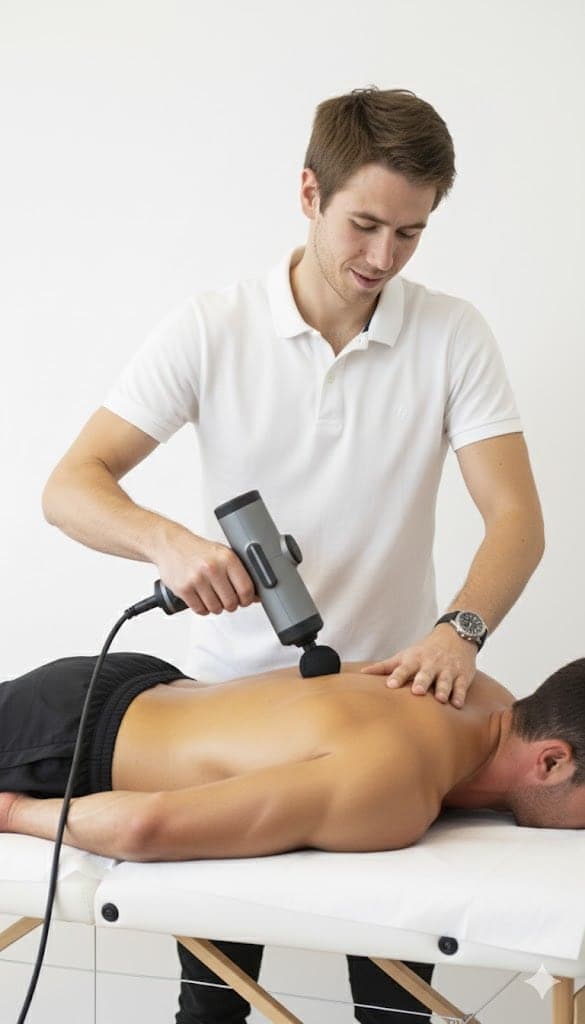
Written by
Chris
Massage therapist, nutrition and exercise physiologist
Norwegian-certified with a Bachelor’s in Physical Education and Nutrition and over ten years of clinical practice, working from a portable table in clients’ homes across the Paphos district.
This article is general information, not a medical diagnosis. If you have severe, worsening or unexplained pain, numbness, weakness, or pain after an accident, see a doctor first.