Couples massage at home Paphos: two treatments, one visit
In short
A couples massage at home Paphos is two back-to-back deep-tissue treatments at your villa or apartment, one partner at a time, each with its own assessment and pressure. €90 for 60 minutes or €130 for 90 minutes per person.
I get asked for a couples massage at home in Paphos most weeks, usually by two people who want the same evening treated together without leaving the villa. I do offer it, as part of my hotel and villa massage service, but the way I run it differs from what most people picture, so I want to explain it plainly.
The short version is this: I am one therapist, so a couples massage at home Paphos means two full, individual treatments back-to-back in the same visit. One of you is on the table while the other rests, and then you swap. There is no second therapist and no side-by-side tables. What you gain is that each of you gets a proper assessment and a treatment set to your own body rather than a diluted, synchronised routine.
What a couples massage at home Paphos visit actually looks like
I drive out from Chlorakas with a folding treatment table, linens, oil and my mechanical deep-tissue tools, and set up in whichever room you prefer. Most couples choose a bedroom or a shaded terrace in the evening. Setup takes about ten minutes, and packing up about the same.
Then the two treatments run in sequence:
- A brief conversation with each of you about what hurts, what you do all day and anything I should avoid.
- The first treatment, 60 or 90 minutes, at the pressure and depth that suits that person.
- A short break while I change linens and the second person gets on the table.
- The second treatment, again 60 or 90 minutes, planned separately.
- A few minutes at the end for practical advice, if you want it.
You can each choose a different length. One of you might want the full 90 minutes on a stubborn lower back while the other is happy with 60 minutes of neck and shoulders. That flexibility is one of the reasons I prefer this format over trying to run two identical sessions in parallel.
Why I treat one partner at a time
The honest reason is that I work alone, and I would rather be transparent about that than pretend otherwise. But after ten years of doing it this way, I have come to think the sequential format is genuinely better for most couples, and not just a limitation I make the best of.
Some couples ask whether the partner who is waiting can watch. They can, if the person on the table is comfortable with it. It is quite common for the second partner to point out during their own treatment that they noticed how tight the first one was in the same spot, and that shared understanding is useful when I explain what I have found.
What is actually happening in the tissue
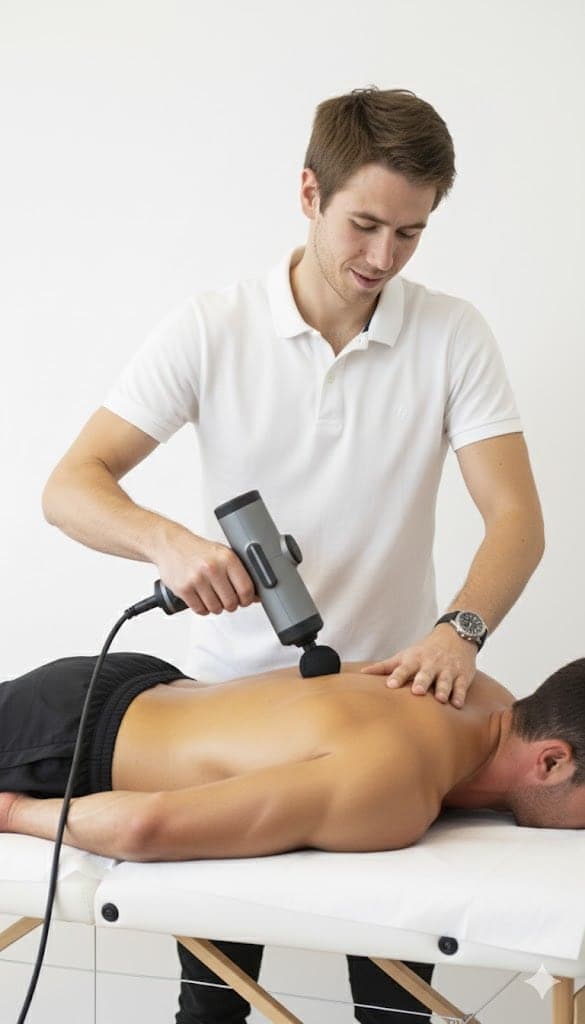
I am a mechanical deep-tissue specialist. That means I am less interested in a general rub-down and more interested in finding the specific bands of muscle and fascia that have shortened, thickened or stopped gliding over each other, and then loading them slowly and firmly enough that they let go. My background is a Norwegian certification and a BSc in Physical Education and Nutrition, so I tend to think about the body in terms of movement chains rather than isolated sore spots.
In practice the work sits between three ideas:
| What I find | What it usually feels like to you | What I do about it |
|---|---|---|
| A shortened muscle held under constant low-level tension | A dull ache that is worse after sitting or driving | Slow, sustained pressure along the fibre until the guarding eases |
| Fascia that has stopped sliding between muscle layers | Stiffness that improves once you warm up | Broad, deep strokes across the grain of the tissue |
| A local trigger point referring pain elsewhere | Pain in one place, tenderness in another | Direct, held pressure on the point, then work along its referral line |
The sensation is firm and sometimes uncomfortable, but it should never be a fight. I ask for feedback constantly, and I would rather work slightly under your threshold for longer than push past it and have you brace against me. Some soreness the next day is normal and usually settles within a day or two, similar to the feeling after an unfamiliar workout.
The patterns I see most often in couples
Two people who share a house, a car, a bed and often a training schedule tend to accumulate related problems. It is not mysterious. They sit in the same sofa, sleep on the same mattress and drive the same routes. The presentation I see most often across the Paphos district falls into a few recognisable groups.
None of these are diagnoses. They are simply the starting points I expect, and the first conversation on the day sorts out which of them, if any, applies to each of you.
How the visit runs from arrival to packing up
If you have never had a therapist come to the house, the logistics are the part most people wonder about. Here is what to expect.
- Booking. Message me on WhatsApp or call. Tell me the area, the date and time you would like, and that it is for two people. I will confirm and give you an arrival window.
- Space. A room where a two-metre table fits with room for me to walk around it. Bedrooms and living rooms are usually fine. Terraces work well in the evening once the sun is off them.
- Arrival and setup. Around ten minutes. I bring everything, including linens and oil, so you do not need to prepare anything except a clear patch of floor.
- The two treatments. As described above, in sequence, each planned separately.
- Payment. Card, cash or bank transfer at the end of the visit.
The pricing is per person and the same as for any single visit: €90 for 60 minutes and €130 for 90 minutes. Pre-book five sessions as a package and get one additional session free. Contact me to arrange a package for two people. Full details are on the pricing page. Because the whole visit is a single trip for me, there is no travel supplement for the second person anywhere in the Paphos district.
Between visits and what I can and can't help with
The treatment does the heavy lifting on the day, but what happens between visits decides how long it holds. I keep advice short and specific to what I found on the table, rather than handing out a generic sheet of stretches.
- Drink water afterwards and go easy on alcohol that evening; deep work leaves tissue a little inflamed and it settles faster if you are hydrated.
- If I have worked on hips and lower back, avoid a long drive or a long sit immediately after if you can.
- A short walk the next morning does more good than a full rest day.
- If you train together, treat the day after as an easy day rather than a test of whether the treatment worked.
To be clear about scope: I can help with tight, sore, restricted muscle and the movement problems that come with it, and I regularly work alongside what a physiotherapist or doctor is doing. I cannot treat injuries that need imaging, joint or nerve problems that need a medical opinion, or anything you have not had looked at that is getting worse. See a doctor first if you have unexplained swelling, numbness or weakness in a limb, pain that wakes you at night and does not ease with position, a recent fall or trauma, or a fever alongside the pain. If you tell me about any of that when you book, I will say honestly whether a visit makes sense yet.
If it is mainly one of you with a persistent problem and the other simply wants a good treatment, my therapeutic massage page explains how I approach the more clinical end of the work.
Frequently asked questions
Can you treat both of us at the same time?
No. I am one therapist, so a couples booking is two full treatments back-to-back in the same visit. One partner is on the table while the other rests, and then you swap. Each treatment is planned and priced individually, at €90 for 60 minutes or €130 for 90 minutes, and you can each choose a different length if you want to.
How long should we set aside for the whole visit?
Allow the two treatment lengths added together plus about half an hour for setup, changeover and packing up. Two 60-minute treatments therefore take a little over two and a half hours from my arrival, and two 90-minute treatments a little over three and a half. Evenings are the most popular slot for couples, particularly on villa terraces once the sun has gone.
Do we need to provide anything?
Only a clear space for the table and a room you are both comfortable in. I bring the folding table, fresh linens for each of you, oil and my equipment. A towel and a glass of water each afterwards is a nice touch but not required. If you are staying in a rented villa or hotel, it is worth checking that a therapist visiting the room is fine with the host, which it almost always is.
Is deep-tissue work suitable for both of us if one of us prefers something gentler?
Yes, and this is one of the advantages of treating you one at a time. Depth and pressure are set per person, not per booking. One of you can have firm, targeted work on a specific problem while the other has a broader, lighter treatment. Tell me during the first few minutes of your own treatment what feels right and I will adjust as we go.
Do you travel across the whole Paphos district for two people?
Yes. I am based in Chlorakas and cover the town, the coast from Coral Bay round to Kissonerga, the villages up towards Peyia and Tala, and eastwards through Geroskipou and Mandria. A couples visit is a single trip for me, so there is no extra travel charge for the second person. When you message me, just include the area or the villa name and I will confirm the arrival window.
Evidence and limits
Massage may help with some symptoms, but benefits and evidence vary by condition. It does not replace medical assessment or treatment. A page update is not evidence of an independent clinical review.
Further reading: Massage therapy: evidence, safety and limitations by US National Center for Complementary and Integrative Health. This is general background reading, not verification of every claim in this article.
How we describe evidence and updatesWritten by
Chris
Massage therapist, nutrition and exercise physiologist
Norwegian-certified with a Bachelor’s in Physical Education and Nutrition and over ten years of clinical practice, working from a portable table in clients’ homes across the Paphos district.
- Norwegian-certified
- Nutrition & exercise physiologist
- 10+ years clinical practice
- Based in Chlorakas · all of Paphos district
- No call-out fee anywhere in Paphos district
Last updated
This article is general information, not a medical diagnosis. If you have severe, worsening or unexplained pain, numbness, weakness, or pain after an accident, see a doctor first.