Massage therapist Chlorakas: what to look for in a home visit
In short
I am a Norwegian-certified massage therapist based in Chlorakas, working from your home rather than a clinic. Mechanical deep-tissue for stubborn back, neck and shoulder tension, €90 for 60 minutes, booked by WhatsApp or phone.
I am Chris, a massage therapist in Chlorakas, and I treat people in their own homes rather than in a clinic. If you are searching for a massage therapist Chlorakas can actually rely on for stubborn back, neck or shoulder tension, this article explains how I work, what the treatment involves, and how to tell whether it suits you.
Why I work from Chlorakas rather than a clinic
I live in Chlorakas, just north of Paphos town, so the village and its surroundings are the shortest drives I make. Working mobile was a deliberate choice. Deep-tissue work goes better when the person is at ease, and most people are more at ease in their own home than on a clinic table with a waiting room outside the door.
There is a practical side too. After a proper deep-tissue session most people want to lie down, drink water and do very little, and being ten steps from your own sofa is better for that than a drive home. I bring the table, linens and equipment, set up in whatever room has the space, and clear away afterwards.
What actually causes the pain I see most often here
The presentation I meet most often in Chlorakas is a mixture of two things: long hours sitting, and long hours in the sun. Retired residents garden, walk the dogs and swim, then sit for the evening. Working residents drive to Paphos, sit at a desk, and drive back. Either way, the neck, upper back and lower back end up doing the same small range of movement for hours, and the deeper stabilising muscles slowly shorten and stiffen.
The soreness people describe is rarely a single injured spot. More often it is a band of tissue that has become dense and unresponsive over months, with a few tender points inside it that refer pain elsewhere. The lower back aches after standing at the sink; the shoulder catches when reaching into a high cupboard; the neck feels wooden first thing in the morning. None of it is dramatic and none of it goes away on its own.
| What people report | What I usually find | Where the work goes |
|---|---|---|
| Lower back ache after standing or gardening | Tight hip flexors and lumbar erectors, weak glutes | Hips, lower back, upper thighs |
| Shoulder catching or a dull ache under the blade | Overactive upper trapezius and levator, tight pecs | Upper back, chest, side of the neck |
| Morning neck stiffness, headaches at the base of the skull | Dense suboccipitals and upper trapezius | Neck, base of the skull, upper shoulders |
| Tired legs, calf tightness on hills and stairs | Shortened calves and hamstrings, tight plantar fascia | Calves, hamstrings, feet |
This is where I differ from a general relaxation massage. Broad, gentle strokes feel pleasant but they do not reach the tissue that is actually causing the problem, so the relief tends to last a day or two and then fades. Reaching that tissue takes sustained, specific pressure, and that is what mechanical deep-tissue is for.
How mechanical deep-tissue differs from a standard massage
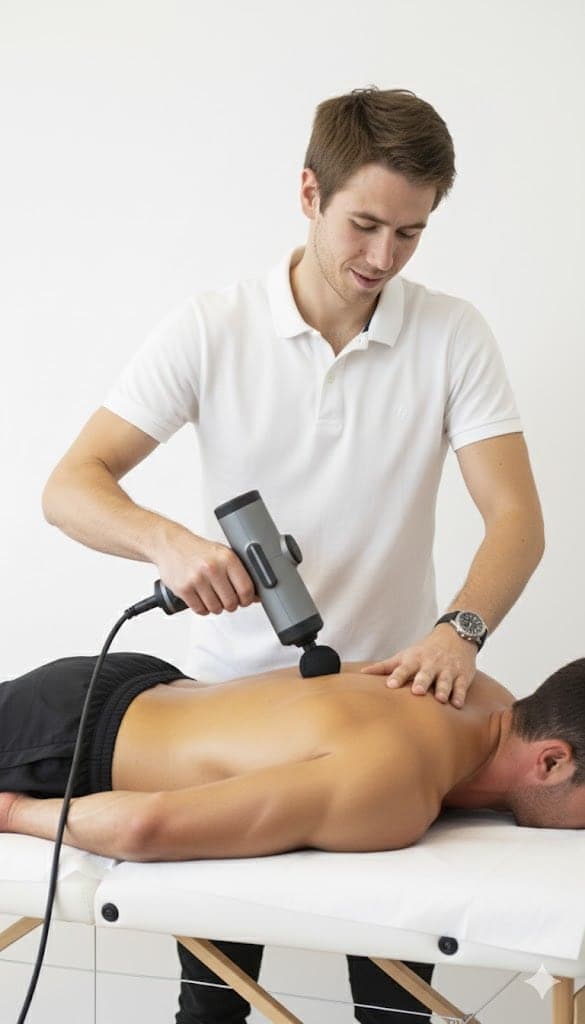
I want to be honest about what mechanical deep-tissue is and is not. It is not a magic device and it does not replace what my hands do. It is a way of applying deep, even, sustained pressure to a specific line of tissue without the pressure fading as the therapist tires. I use my hands to find the tissue and to judge how it is responding, and I use the equipment to hold the depth and pace that dense tissue needs to soften.
The reason this matters is simple physiology. Chronically shortened muscle does not release from a quick pass. It needs pressure held long enough for the nervous system to stop guarding and for the fibres to lengthen. With hands alone, holding that depth for a full session on the lower back or the hips is exhausting, and the pressure drifts. Mechanical assistance keeps it steady, so I can spend the session on precision rather than on effort.
- Slow, sustained pressure along the muscle fibre, not fast strokes across it
- Depth adjusted continuously to what the tissue will accept, never forced
- Focus on the two or three areas that are actually driving the problem
- Firm but tolerable: you should be able to breathe normally throughout
- Some next-day soreness is common, similar to the day after a hard workout
If you would like more on the method itself, the mechanical deep-tissue page goes into it in detail. What I would say here is that people who have had a lot of general massage and found it pleasant but short-lived are usually the ones who notice the biggest difference.
What a home visit in Chlorakas looks like
The session starts before I touch you. I ask what hurts, when it started, what makes it better or worse, and what you do with your body during a normal week. I look at how you stand and move through a few simple ranges. Then I palpate the area, which is really just an educated search for the tissue that is dense, tender or restricted. That assessment tells me where the session goes; the plan is not the same for everyone with a sore back.
The treatment itself is unhurried. On a 60-minute visit I usually work one region properly and check one connected region. On a 90-minute visit there is time for two full regions, which suits people whose neck and lower back are both bothering them, or anyone with a long history of tension who wants the whole posterior chain addressed in one go.
Afterwards I usually give one or two things to do at home: a stretch, a change to how you sit, sometimes just a reminder to move every 40 minutes. I keep these small and specific because long exercise programmes rarely get followed.
How many sessions, how often, and what it costs
Pre-book five sessions as a package and receive one additional session free. What I can tell you is the pattern I see: for tension that has been building for months, a short run of sessions spaced a week or so apart tends to make more difference than occasional visits, because each session builds on the tissue change of the last. Once things have settled, most people either stop or come back on an ad hoc basis when something flares. There is no dependency built into the way I work.
| Duration | Price | Best for |
|---|---|---|
| 60 minutes | €90 | One region worked properly, plus a check of a connected area |
| 90 minutes | €130 | Two regions, or a full-back and neck session for long-standing tension |
| Package deal | 1 additional session free | Pre-book 5 sessions |
Those are the only two prices. There is no extra charge for travel within Chlorakas or the neighbouring villages, and the full breakdown, including how the package deal works, is on the pricing page.
Choosing a massage therapist in Chlorakas
There are good therapists in and around Paphos and I am not going to claim to be the only choice. What I would suggest is that you ask a few plain questions before booking anyone for a specific problem, rather than a general treat.
- Do they assess before they treat, or does everyone get the same routine?
- Can they explain in plain language why your shoulder or back is doing what it does?
- Are they honest about what massage can and cannot fix?
- Do they work deep enough to reach the tissue that matters, and slowly enough that you can tolerate it?
- Do they tell you when to see someone else?
On that last point: what I can help with is muscular tension and the aches, stiffness and restricted movement that come with it. What I cannot help with is anything structural, inflammatory or neurological, and I will say so if I suspect it. See a doctor first if your pain followed a fall or accident, if it wakes you at night, if you have numbness, weakness or pins and needles down an arm or leg, if you have unexplained weight loss or fever alongside it, or if it is simply getting worse rather than better. Once anything serious has been ruled out, massage is often a sensible part of the recovery, and I am happy to work alongside a physiotherapist's plan.
If you are further along the coast, I cover Pegeia, Coral Bay and the surrounding villages as well; the district coverage page has the details.
Frequently asked questions
Is there a mobile massage therapist near me in Chlorakas?
Yes. I am based in Chlorakas itself, so the village, Emba, Kissonerga and Lemba are the shortest trips I make and I can usually fit a visit within a day or two. I bring a professional table and everything else needed, set up in a spare room or living room, and clear away afterwards. There is no travel charge within Chlorakas or the neighbouring villages, and booking is by WhatsApp or phone.
How is your treatment different from a normal deep-tissue massage?
The difference is in how the pressure is delivered. A standard deep-tissue session relies on hands, elbows and forearms, and the depth inevitably varies as the therapist tires. I use mechanical assistance to hold slow, even, sustained pressure along the tissue that is actually causing the problem, while my hands find the areas and judge how they respond. The result is deeper, more consistent work without it becoming brutal.
Does mechanical deep-tissue hurt?
It is firm and you will feel it, but it should never be pain you have to brace against. The pressure is adjusted continuously to what the tissue accepts, and if you tell me it is too much I ease off immediately. Some soreness the next day is common, similar to the day after a hard workout, and it usually settles within a day or two. Drinking water and gentle movement help.
How many sessions will I need?
I cannot give an honest number without seeing you, and I am wary of anyone who can. The pattern I see is that recent tension often eases noticeably after one or two sessions, while tension that has built up over months responds better to a short run of visits about a week apart. After that most people stop or return only when something flares. Pre-book five sessions as a package and receive one additional session free.
What do I need to have ready at home?
Very little. A room with space for a treatment table roughly two metres long, a power socket nearby, and somewhere I can wash my hands. I bring the table, linens, oil and equipment. It helps to wear something you can undress from easily, to have had water beforehand, and to keep the hour after the session free so you can rest rather than rush out.
Can you help with a specific injury or a diagnosed condition?
Sometimes, but not always, and I will tell you which. Muscular tension, stiffness and the aches that go with poor posture or overuse are what I treat well. Structural, inflammatory or nerve-related problems need a doctor's assessment first. If you have already been diagnosed and are under a physiotherapist or doctor, I am happy to work within their plan, and I will say plainly if I think massage is not the right tool for what you have.
Evidence and limits
Massage may help with some symptoms, but benefits and evidence vary by condition. It does not replace medical assessment or treatment. A page update is not evidence of an independent clinical review.
Further reading: Massage therapy: evidence, safety and limitations by US National Center for Complementary and Integrative Health. This is general background reading, not verification of every claim in this article.
How we describe evidence and updatesWritten by
Chris
Massage therapist, nutrition and exercise physiologist
Norwegian-certified with a Bachelor’s in Physical Education and Nutrition and over ten years of clinical practice, working from a portable table in clients’ homes across the Paphos district.
- Norwegian-certified
- Nutrition & exercise physiologist
- 10+ years clinical practice
- Based in Chlorakas · all of Paphos district
- No call-out fee anywhere in Paphos district
Last updated
This article is general information, not a medical diagnosis. If you have severe, worsening or unexplained pain, numbness, weakness, or pain after an accident, see a doctor first.