Massage for athletes Paphos: recovery work that actually holds
In short
Massage for athletes Paphos means deep, specific work on the tissue that is limiting your training — hips, calves, shoulders — done at your home or villa, timed around your sessions, with pressure you can actually tolerate.
I have spent over ten years working on athletes' bodies, and most of the sports massage in Paphos I hear about is pleasant, general and gone by the next hard session. This article explains how I approach recovery work for runners, cyclists, swimmers and gym athletes, what to expect from a session, and how to time it.
Massage for athletes Paphos, done properly, is not a relaxing hour. It is targeted, mechanical, sometimes uncomfortable work on the specific structures that are limiting your training. I bring the table and the equipment to your home, villa or training base anywhere in the Paphos district, so you can rest straight afterwards instead of driving.
Why athletes in Paphos often get the wrong massage
The pattern I see most often is a runner or cyclist who has been having regular massage for months and still carries the same tight calf, the same grumbling lower back, the same shoulder that will not open on the serve. The sessions were not bad. They were simply general: light to medium pressure over the whole body, nothing held for long, nothing followed to its origin.
There are three reasons general massage tends to fall short for people who train hard.
- Depth: the muscles that matter most for athletes — deep hip rotators, soleus, the psoas, the subscapularis — sit under other layers, and a light full-body routine rarely reaches them.
- Duration: a restriction usually needs sustained pressure for a minute or more before it starts to change. Gliding strokes move on too quickly.
- Direction: fibres and fascia run in specific lines. Working across them at random feels nice but does not follow the actual restriction.
None of this is a criticism of gentle massage. It has its place, and I offer it. It is just a different tool from the one most athletes actually need.
What massage for athletes Paphos looks like in practice
I am a mechanical deep-tissue specialist. Alongside my hands and forearms I use a mechanical device that lets me hold consistent, controlled pressure at a set depth and angle for as long as a tissue needs, without my own fatigue changing the quality of the work halfway through a 90-minute session. It is not a percussion gun. It is slow, directional compression that I steer.
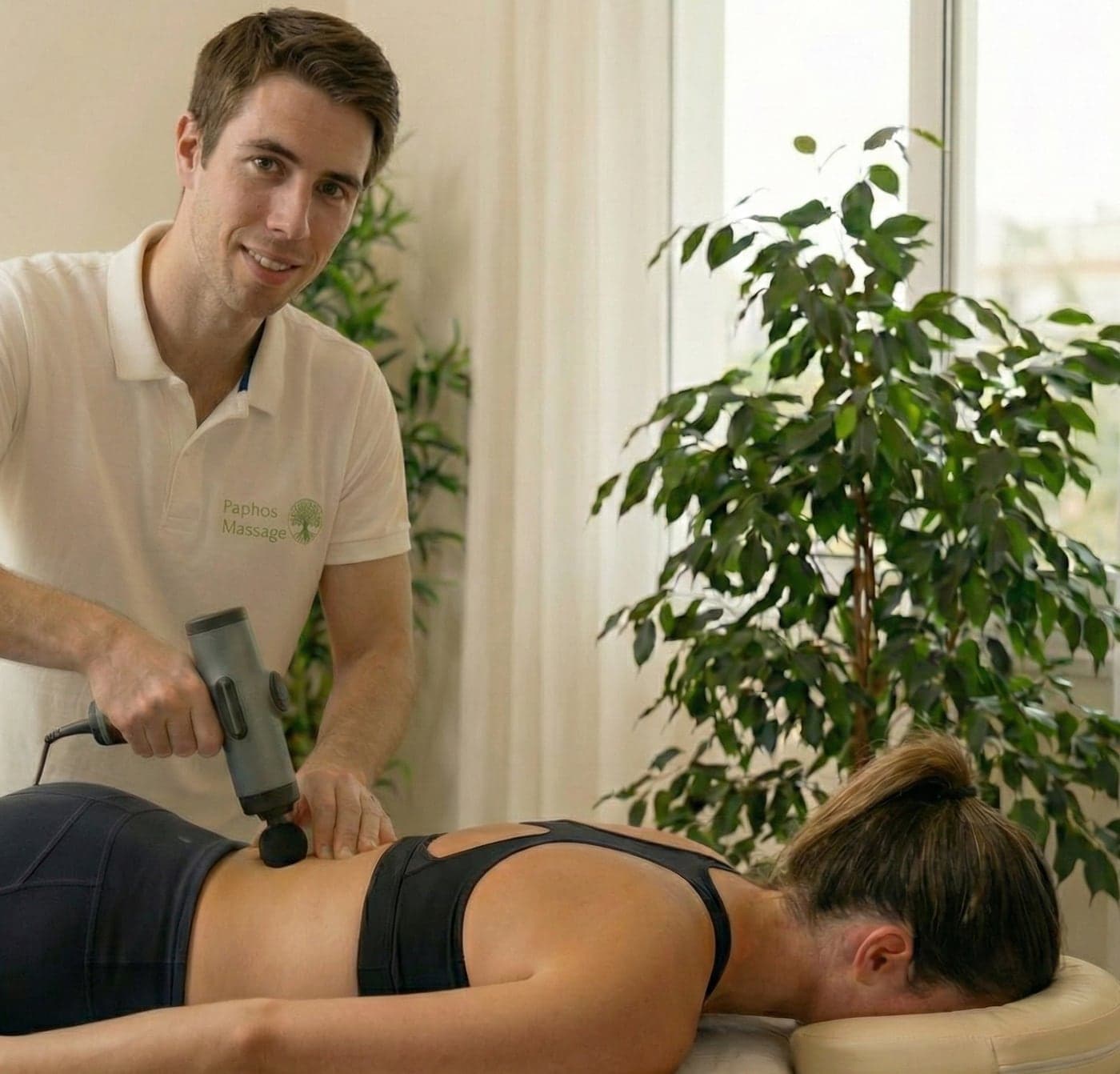
The practical differences you will notice compared with a standard sports massage are these.
| Aspect | General sports massage | How I work with athletes |
|---|---|---|
| Pressure | Medium, spread across the body | Deep and specific, mostly on two to four areas |
| Time per structure | Seconds | Often one to three minutes of sustained pressure |
| Consistency | Varies with the therapist's fatigue | Held steady by the device |
| Aim | Feel looser today | Change how the tissue moves in training |
The sensation is intense but it should always stay within what I call productive discomfort: strong, dull, with a sense of something giving. Sharp, radiating or breath-holding pain means I have gone too far, and I want you to tell me straight away. You control the ceiling in every session.
Most athletes feel a clear change in range on the table — a hip that swings further, a calf that lets the ankle bend more. Some of that settles back over the following days, which is normal. What tends to hold is the change that comes from a few sessions spaced a week or so apart, combined with you keeping the area moving.
How I assess before I treat
I do not start working on the spot that hurts. Pain is usually the last thing to show up and it is often downstream of the actual problem. A sore knee in a runner is more often a hip and lateral thigh issue; a cyclist's back pain is very commonly a hip-flexor issue expressed through the lumbar spine.
From that I choose two to four areas for the session and work through them in order, following the chain rather than the symptom. For running problems that usually means foot, calf, hamstring, glute and hip flexor in some sequence. For swimmers and racket players it is the front of the shoulder, the subscapularis, the lats and the mid-back. I explain what I am doing and why as I go, because the more you understand the map, the better you can help me between sessions.
I keep short notes after each session — which structures, how deep, how the tissue responded — so the next one builds on it rather than starting again.
Timing the work around your training
Where deep work sits in your week matters as much as the work itself. Done at the wrong time it can leave you heavy-legged for a key session.
If you are working with a coach or physiotherapist, I fit around their plan. My role is not to replace them but to do the deep tissue work that sits alongside strength training and load management. Most athletes I see settle into a rhythm of a few closer sessions to shift a specific problem, then something roughly monthly through the season to keep on top of things.
Sessions are €90 for 60 minutes and €130 for 90 minutes; the 90 is the one I recommend for athletes because it gives enough time to assess and still work three or four areas properly. Details are on the pricing page, and a package of five pre-booked sessions includes one additional free session. If your legs are your only concern, a focused deep tissue massage hour is usually enough.
What I can and can't help with
I can help with muscle and fascial tightness that is limiting range or nagging during training: tight calves and Achilles tension, hamstring and glute stiffness, hip-flexor and lower-back tightness in cyclists, shoulder and mid-back restriction in swimmers and racket players, and general recovery between hard blocks. I cannot fix a structural injury with massage, and I will say so if that is what I find. See a doctor first if you have sudden sharp pain from a specific moment, swelling or bruising, numbness or pins and needles, night pain, or pain that is getting worse despite rest.
- Good fit: chronic tightness, uneven range, recovery between sessions, a problem that improves with movement
- Ask a doctor first: acute injuries, unexplained swelling, nerve symptoms, anything you would not train through
- Grey area: I will do a light assessment and tell you honestly whether it is worth booking
I would rather you spend your money once, in the right place, than have a good massage for the wrong problem.
Frequently asked questions
How often should an athlete have a sports massage?
It depends on load and on what you are trying to change. For a specific restriction I usually suggest three or four sessions about a week apart, then reassess. For general maintenance through a training season, something roughly monthly is enough for most people. If you are ramping up for an event, a session in the middle of a big block and one 48 to 72 hours before race day works well.
Is deep tissue work safe the day before a race?
Deep, specific work is not a good idea the day before. It can leave the tissue feeling heavy or a little sore for 24 to 48 hours, which is the last thing you want on the start line. If you want something before an event, book it three days out, or ask me for a light flush the day before and I will keep the pressure well below anything that would leave a mark.
Do you only work with serious competitors?
No. Most of the athletes I see in Paphos are people who train hard for their own reasons — parkrunners, club cyclists, masters swimmers, gym regulars, people preparing for a first half marathon. What matters is not your level but that you are training regularly and want the tightness dealt with rather than papered over.
Will it hurt?
It is uncomfortable rather than painful, and you set the limit. I work at what I call productive discomfort — strong, dull pressure that you can breathe through and that eases as the tissue gives. If it becomes sharp or you find yourself bracing against it, that is too much and I want to know straight away. Some areas will feel tender for a day afterwards; that is normal and passes.
Do you travel to villas and hotels around Paphos for athletes?
Yes. I am based in Chlorakas, just north of Paphos town, and I bring the table and equipment to your home, villa or accommodation anywhere in the Paphos district, including Coral Bay, Peyia, Tala and Kato Paphos. Athletes on training camps often book a couple of sessions across their stay. Booking is by WhatsApp or phone.
How is your device different from a massage gun?
A massage gun taps rapidly at the surface and mainly works by dulling the nervous system for a while, which is fine for a quick loosen-up. What I use is slow, sustained, directional pressure that I steer along the line of the restriction and hold at a set depth. It reaches deeper structures and stays there long enough for the tissue to change, which a gun is not designed to do.
Evidence and limits
Massage may help with some symptoms, but benefits and evidence vary by condition. It does not replace medical assessment or treatment. A page update is not evidence of an independent clinical review.
Further reading: Massage therapy: evidence, safety and limitations by US National Center for Complementary and Integrative Health. This is general background reading, not verification of every claim in this article.
How we describe evidence and updates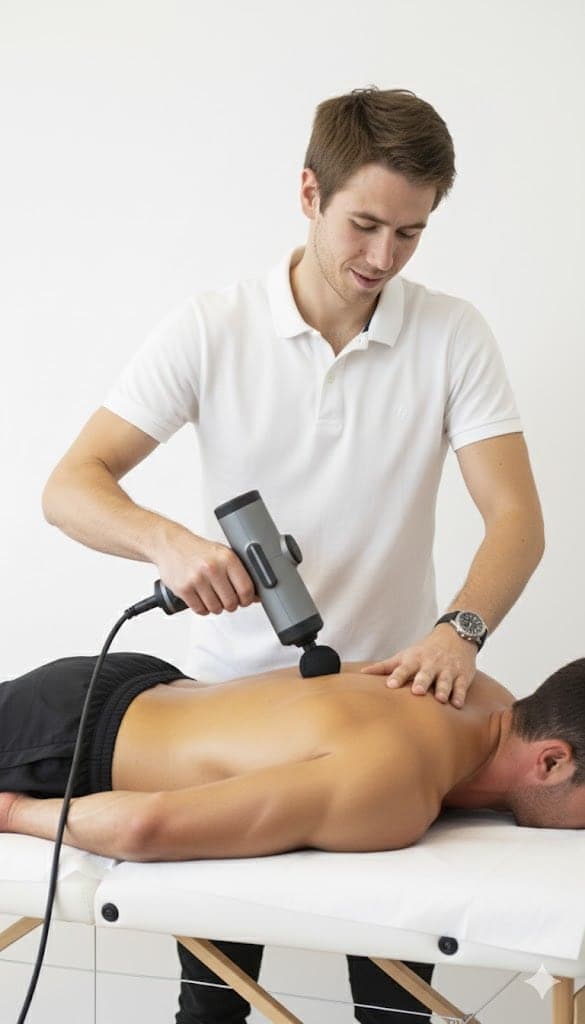
Written by
Chris
Massage therapist, nutrition and exercise physiologist
Norwegian-certified with a Bachelor’s in Physical Education and Nutrition and over ten years of clinical practice, working from a portable table in clients’ homes across the Paphos district.
- Norwegian-certified
- Nutrition & exercise physiologist
- 10+ years clinical practice
- Based in Chlorakas · all of Paphos district
- No call-out fee anywhere in Paphos district
Last updated
This article is general information, not a medical diagnosis. If you have severe, worsening or unexplained pain, numbness, weakness, or pain after an accident, see a doctor first.