Sports massage Paphos: mechanical deep-tissue work for athletes
In short
Sports massage Paphos: mechanical deep-tissue treatment for athletes, delivered at your home or accommodation. It targets the tissue restrictions behind recurring niggles, supports recovery between hard sessions and fits around your training week.
I am Chris, and most of my athletic clients find me by searching for sports massage in Paphos after a niggle has stopped responding to rest and foam rolling. I bring the table and my mechanical deep-tissue equipment to your home or training base, and I treat the tissue that is actually limiting you, not just the muscle that hurts.
Why sports massage for athletes is a different job
A relaxation massage aims to leave you calm. Sports massage aims to leave you able to train tomorrow, and that changes almost everything about how I work. Athletes carry higher training volumes, denser tissue and very specific movement demands, and the treatment has to respect all three.
The presentation I see most often among Paphos athletes is not an acute injury. It is a chronic tightness that keeps returning in the same place: the lateral thigh in runners, the upper back and shoulder in swimmers, the hip flexors and low back in cyclists, the forearms and traps in climbers and gym athletes. The sore spot is usually the end of a chain, not the start of it.
Because I work alone and travel to you, I also see how you actually live and train. Where your bike is set up, how you sit at your desk between sessions, what the stairs to your apartment look like after a long run. That context tells me more than a clinic form does.
How I work: sports massage Paphos, mechanical and mobile
My background is a Norwegian massage certification and a BSc in Physical Education and Nutrition, and I have been doing this for over ten years. Over that time I have moved almost entirely to mechanical deep-tissue work: percussive and pressure tools that let me reach deep tissue with control and stay at a consistent depth for as long as the tissue needs, without my hands tiring or my pressure drifting.
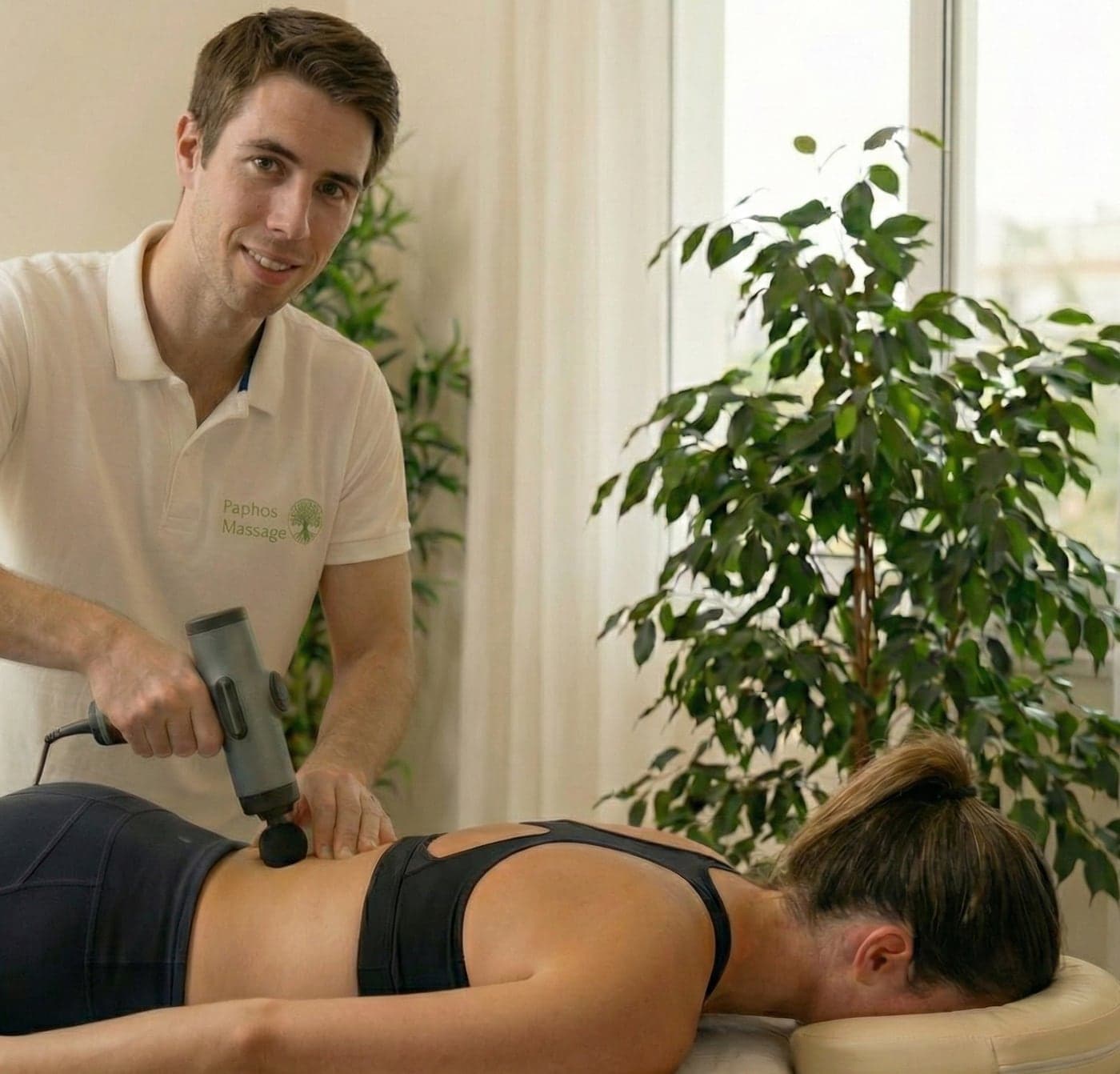
Hands are still involved. I use them to assess, to find the layer that is stuck, to feel how the tissue responds. But when it comes to sustained work into a dense iliotibial band, a locked-up thoracic spine or a fibrous calf, the tools do the job more evenly than fingers and thumbs can, and you feel the difference the next morning.
A typical session runs like this:
| Stage | What happens | Approximate time |
|---|---|---|
| Assessment | Movement screen, palpation, a short conversation about training | 5–10 min |
| Warm-up work | Broad manual strokes to raise tissue temperature | 5–10 min |
| Mechanical deep-tissue | Sustained, targeted work on the restricted areas | 30–60 min |
| Reset | Lighter finishing work and simple homework | 5–10 min |
Sessions are €90 for 60 minutes and €130 for 90 minutes, and a package of five pre-booked sessions includes one additional free session. The 90-minute option suits athletes with more than one problem area or anyone in a heavy training block. You can find full details on the pricing page, and I cover the whole Paphos district, including the villages around Chlorakas, Peyia and Tala. Booking is by WhatsApp or phone.
What is actually happening in overtrained tissue
Repetitive load does something quite specific to muscle and fascia. Fibres shorten and thicken along the lines they are used most, the connective tissue between muscle layers loses its glide, and small areas develop into tender, dense bands that fire off pain when pressed. None of this is damage in the injury sense. It is adaptation that has gone slightly too far in one direction.
The body then does what it always does: it routes around the problem. A restricted hip flexor changes stride length, so the hamstring on the other side does more work, so the low back tightens to stabilise. By the time you feel the back, the hip has been the issue for weeks.
Mechanical deep-tissue work addresses this by restoring glide between the layers and reducing the density of those bands. Pressure that is deep, slow and sustained gives the tissue time to respond rather than guard. It is not always comfortable, but it should never be a fight, and I adjust to what your tissue and your training schedule can tolerate that day.
Timing treatment around your training week
The most common mistake I see is booking a heavy deep-tissue session the day before a race or a key long run. Deep work changes how tissue feels and fires for a day or two, and you do not want to be learning that on the start line.
My general guidance for the Paphos athletes I work with:
- Pre-event (24–48 hours before): light, brisk work only, no deep pressure, mainly to feel loose and settled
- Post-event (24–72 hours after): moderate work to help the legs or shoulders recover, deeper as soreness allows
- Base and build phases: this is where the real deep-tissue work belongs, usually every one to two weeks
- Rest weeks: an ideal time for a longer 90-minute session on accumulated restrictions
- Off-season: less frequent, more thorough, with time to work on the imbalances that competition hides
Because I come to you, the timing tends to work better than it would with a clinic. A session at your villa in the evening after an easy day costs you no travel and no disruption. Many of my regulars book a slot the same evening each week and let the content of the session change with the training plan.
Frequency depends on volume and how your body is coping. Someone building for a marathon or a triathlon in the Cyprus heat generally benefits from more regular work than someone maintaining fitness through the summer. I will always tell you if I think you are booking more than you need.
Sport by sport: where the load lands
Every sport has its own pattern, and it is worth knowing which one you are likely bringing to the table.
| Sport | Where I usually find restriction | What we work on |
|---|---|---|
| Distance running | Lateral thigh, calves, hip flexors, glutes | Stride efficiency, calf and IT band density |
| Cycling | Hip flexors, low back, quads, upper traps | Hip opening, thoracic mobility, quad density |
| Swimming | Lats, pecs, upper back, neck | Shoulder glide, thoracic rotation |
| Triathlon | All of the above, usually one side worse | Balancing left and right, recovery capacity |
| Gym and strength | Forearms, traps, glutes, low back | Grip and shoulder tissue, hip mechanics |
| Racket and rotation sports | Obliques, forearms, shoulder, hips | Rotational chain, one-sided overload |
Paphos has a good mix of all of these. The coast road brings cyclists, the sea brings open-water swimmers, and the hills above town bring trail runners. Visiting athletes on training camps in Coral Bay and Peyia are also a large part of my winter work, and I am happy to treat at hotels and rented villas.
If you also spend long hours at a desk between sessions, that changes the picture. Desk posture stacks upper-back and hip restrictions on top of the training load, and I often combine sports work with elements of my mechanical deep tissue massage approach for the neck, shoulders and thoracic spine.
What I can and cannot help with
I can help with training-related tightness, recurring muscle pain, restricted range of motion, recovery between hard sessions and the imbalances that build up over a season. I cannot treat acute injuries, and I will not work through sharp pain, swelling or anything that feels structurally wrong. See a doctor first if you have sudden severe pain, a joint that is swollen, hot or unstable, numbness or pins and needles that persist, or pain that woke you at night for no clear reason. Once you have been cleared, I am glad to help with the return.
- Bring your recent training log or a rough sense of your weekly volume
- Tell me about any injuries in the past year, even the ones that seem unrelated
- Have somewhere reasonably quiet where I can set the table up
- Drink water and avoid a big meal in the hour before we start
I bring everything else.
Frequently asked questions
How soon before a race should I have a sports massage?
Deep work should be finished at least 48 to 72 hours before a race, and preferably longer if you are not used to it. Within the last two days, I only recommend light, brisk work to help you feel loose. If you are new to me and racing soon, the safest option is to book your first proper session for the days after the event.
Does sports massage in Paphos hurt?
Deep-tissue work on athletic tissue is often uncomfortable in the sense of a strong, working pressure, but it should never feel like a fight or make you tense up. I check in constantly and adjust depth to what your tissue accepts. Some soreness the next day is normal after a first session and usually settles within a day or two.
Can I train on the same day as a session?
Light training is fine, and an easy spin or jog beforehand can actually help by warming the tissue. I would avoid a hard interval session or heavy lifting in the hours after deep work, because the tissue is temporarily more relaxed and you want to give it time to settle. Most of my regulars book on an easy or rest day.
Do you treat visiting athletes on training camps?
Yes. A good part of my winter and spring work is with cyclists, triathletes and runners staying in Coral Bay, Peyia, Kato Paphos and the villages around Chlorakas. I travel to hotels and rented villas across the Paphos district and can usually fit sessions around your camp schedule with a few days' notice.
How often should an athlete book?
During a build phase, every one to two weeks is a reasonable rhythm for most people. In rest weeks a longer 90-minute session on accumulated restrictions is often more useful. In the off-season, less frequent but more thorough work makes sense. I will always say if I think a lighter schedule would serve you just as well.
Is there a mobile massage therapist near me in Paphos?
Yes. I am based in Chlorakas, just north of Paphos town, and I cover the whole district: Kato Paphos, Universal, Tala, Peyia, Coral Bay, Emba, Kissonerga and beyond. There is no clinic to travel to. Book by WhatsApp or phone, tell me where you are and when you train, and I will bring the table and equipment to you.
Evidence and limits
Massage may help with some symptoms, but benefits and evidence vary by condition. It does not replace medical assessment or treatment. A page update is not evidence of an independent clinical review.
Further reading: Massage therapy: evidence, safety and limitations by US National Center for Complementary and Integrative Health. This is general background reading, not verification of every claim in this article.
How we describe evidence and updates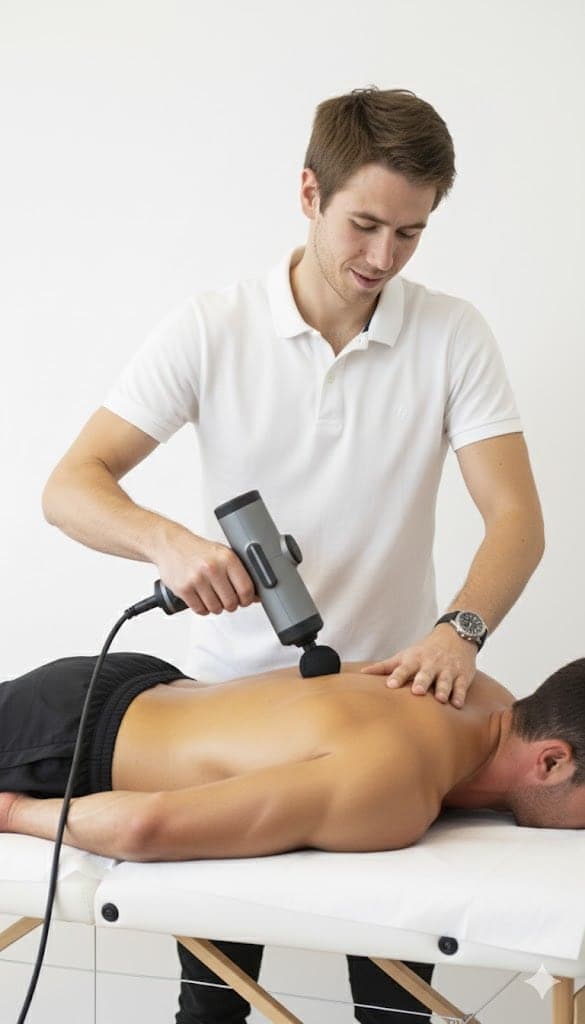
Written by
Chris
Massage therapist, nutrition and exercise physiologist
Norwegian-certified with a Bachelor’s in Physical Education and Nutrition and over ten years of clinical practice, working from a portable table in clients’ homes across the Paphos district.
- Norwegian-certified
- Nutrition & exercise physiologist
- 10+ years clinical practice
- Based in Chlorakas · all of Paphos district
- No call-out fee anywhere in Paphos district
Last updated
This article is general information, not a medical diagnosis. If you have severe, worsening or unexplained pain, numbness, weakness, or pain after an accident, see a doctor first.