Massage for golfers Paphos: deep-tissue work for the golfing body
In short
Massage for golfers Paphos means mechanical deep-tissue work on the hips, thoracic spine, shoulders and forearms that a repeated golf swing tightens. I bring the table to your villa or hotel anywhere in the district.
I am Chris, a mobile massage therapist based in Chlorakas, and I offer massage for golfers in Paphos at your villa, hotel or apartment. Most golfers I treat arrive at the table with the same handful of restrictions. This article explains what those are and how I work on them.
What the golf swing does to a body
The golf swing is an asymmetrical rotation repeated hundreds of times a week once you count the range and the short-game practice. It is not violent, but it is one-sided and relentless, and the body adapts by stiffening in predictable places. Massage for golfers Paphos, as I practise it, is aimed at those places rather than at general relaxation.
The pattern I see most often in Paphos golfers looks like this:
- Reduced hip internal rotation on the lead side, which the lower back then compensates for
- A stiff thoracic spine that shortens the backswing and steals length from the follow-through
- Tight hip flexors that disturb weight transfer and tilt the pelvis forward
- Overworked forearm flexors and a grippy lead hand, often labelled golfer's elbow
- A trail shoulder that has lost some rotation and sits slightly forward
None of these feel like much on their own. Together they are the reason a swing coach keeps correcting the same fault. The body cannot do what it is being asked to do, and no amount of instruction changes that until the tissue moves again.
I hold a BSc in Physical Education and Nutrition, I am Norwegian-certified, and I have spent more than ten years working mechanically on deep tissue. That background is why I approach a golfer's body as a chain rather than as a sore spot.
What I look for before I start
Every session begins with a short assessment. I ask where it hurts, but I am more interested in what does not move. In practice this takes about five minutes at the start of the appointment, and it tells me where the hour is best spent.
| Region | What I check | Why it matters for the swing |
|---|---|---|
| Hips | Internal rotation each side, flexor length, glute tone | Weight transfer, lower-back load, power from the ground |
| Thoracic spine | Segmental rotation, rib-cage movement | Backswing length, follow-through, clubhead speed |
| Shoulders | Range, scapular position, rotator-cuff balance | Swing plane, arm structure at impact |
| Forearms and wrists | Flexor tone, grip tension, wrist mobility | Elbow load, club-face control |
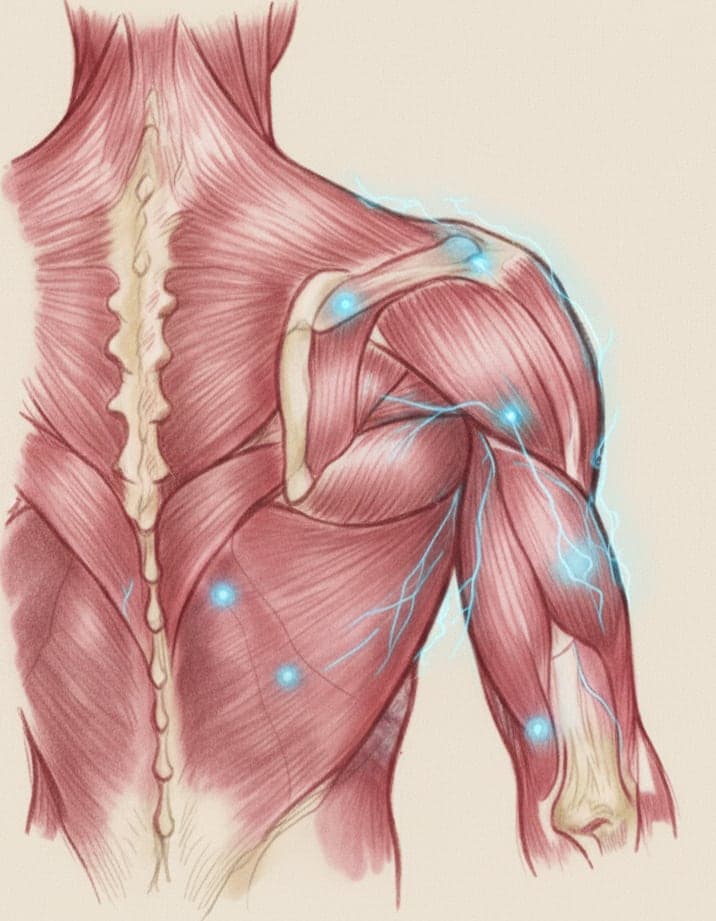
The findings decide the order of work. A golfer with a locked lead hip and a sore lower back gets hip and glute work first, not lumbar work. A golfer with a rigid mid-back and a tired trail shoulder gets thoracic and rib-cage work before I go anywhere near the shoulder itself. Treating the sore spot alone is the mistake I am trying to avoid.
How the treatment works
I work mechanically, which means sustained, precisely angled pressure into the deep layers of muscle and fascia rather than fast kneading of the surface. For golfers this matters because the muscles that drive rotation sit deep: the obliques, psoas, quadratus lumborum, the deep spinal rotators, subscapularis and infraspinatus. Surface work relaxes the layer above them and leaves the restriction where it was.
Deep work is strong. It should feel like pressure that is doing something, not like sharp pain, and I keep it at a level you can breathe through. If a golfer tenses against me, we have gone past the useful point and I ease off. The tissue responds to pressure it can accept, not pressure it is fighting.
The frequency depends on where you start. A visiting golfer here for a week usually wants one longer session early in the trip and, if the schedule allows, a shorter one before flying home. Residents who play two or three times a week tend to settle into a session every three or four weeks once the initial stiffness has been worked through. The 90-minute session suits the first appointment because it leaves room for the assessment and the whole chain; the 60-minute session is enough for maintenance once I know your body. Prices are on the pricing page.
How massage for golfers Paphos fits around your golf
I come to you with a professional folding table, linen and everything I need. For golfers this is not just convenience. After deep hip and thoracic work the last thing the body needs is a drive back across town, and treatment in your own space lets you go straight from the table to a shower and a rest.
Timing relative to play matters:
- After a round or a range session is the best time for deep work; the tissue is warm and the day's tension is fresh
- The day before a competitive round I keep the work lighter and stay away from anything that leaves you feeling loose in a way you are not used to
- Give yourself a night's sleep after a strong session before your next round
- Drink water and walk a little afterwards; there is no need to stretch aggressively
- If you are here on a golf holiday, book the first session early in the week rather than the last day
I cover the whole Paphos district: Chlorakas and Kissonerga where the courses are closest, Coral Bay, Tala, Pegeia, Kato Paphos and the hotels along the coast, Geroskipou and the villages inland. Golfers staying in Kato Paphos and Coral Bay make up most of the visiting bookings, and I have a page on mobile massage in Coral Bay if that is where you are.
Common complaints I see in golfers
The four presentations below account for most of the golfers who book me. I describe them as patterns because that is what they are; individual bodies vary and I adjust to what I find.
Lower back that tightens after nine or twelve holes. The back is very rarely the source. Most often the lead hip does not rotate enough, so the lumbar spine over-rotates on every downswing to make up the difference. I work the hip flexors, glutes and deep hip rotators first, then the thoracolumbar fascia and quadratus lumborum, and the back settles because it is no longer doing the hip's job.
Loss of distance without any obvious pain. This is usually a rigid mid-back and a shortened posterior chain. When the thoracic spine will not coil, the arms take over and speed drops. Thoracic, rib-cage and lat work is the core of the session, with hip work to restore the ground-up sequence.
Shoulder that aches during or after play. In golfers this is often the trail shoulder, and it is often compensating for a stiff thoracic spine and a scapula that does not glide. I treat the mid-back and serratus first, then the rotator cuff, rather than pressing into the sore front of the shoulder and hoping.
Golfer's elbow. Medial elbow pain in a golfer usually comes from grip tension and forearm flexors that never switch off, sometimes because the body is not rotating and the arms are overworking. I release the forearm flexors and wrist, then look upstream at shoulder and thoracic rotation so the arms have less to do.
Broadly:
| Complaint | Where I work first | Where I usually finish |
|---|---|---|
| Lower-back tightness | Hip flexors, glutes, hip rotators | Thoracolumbar fascia, QL |
| Loss of distance | Thoracic spine, ribs, lats | Hips and posterior chain |
| Shoulder ache | Thoracic spine, serratus, scapula | Rotator cuff |
| Golfer's elbow | Forearm flexors, wrist | Shoulder and thoracic rotation |
If your main issue is elbow or forearm rather than the swing as a whole, my sports massage in Paphos page describes the general sports work in more detail.
What I can and can't help with
I can help with the muscular and fascial restrictions that build up from playing golf: stiff hips, a locked mid-back, tired shoulders, tight forearms, and the lower-back and elbow complaints that usually follow from them. I cannot help with structural or medical problems, and I do not diagnose. See a doctor first if you have back pain with numbness, tingling or weakness in a leg, pain that wakes you at night or does not change with position, a recent fall or acute injury, unexplained swelling, or any pain that started suddenly and severely rather than building up over rounds.
Frequently asked questions
Is massage for golfers different from a normal sports massage?
The technique is the same mechanical deep-tissue work, but the map is different. In a golfer I spend most of the session on the rotational chain: hips, thoracic spine, shoulder girdle and forearms, in the order the assessment suggests. A general sports massage might spread the time more evenly. The aim is that the body can rotate the way your swing asks it to.
Should I book before or after a round?
After, whenever possible. The tissue is warm and the restrictions are obvious, and you have the evening to recover. Before a round I keep the work lighter and shorter so you do not feel unfamiliar on the first tee. If you are on a golf holiday, the ideal is a longer session early in the week and a shorter one later.
Will deep-tissue work make me sore for my next round?
Some heaviness the next morning is common after strong work, similar to the feeling after a hard gym session, and it usually settles within a day. That is why I suggest sleeping on it before you play. If you have a competitive round the following day, tell me and I will keep the pressure moderate and avoid leaving you feeling loose in an unfamiliar way.
Do you travel to villas near the golf courses?
Yes. I am based in Chlorakas, so the courses north and west of Paphos are a short drive, and I cover the whole district including Coral Bay, Tala, Pegeia, Kato Paphos, Geroskipou and the inland villages. I bring a professional table and linen. Bookings are by WhatsApp or phone, and a 60-minute session is €90, a 90-minute session €130.
How often should a regular golfer have this done?
Most residents who play two or three times a week end up on a session every three to four weeks once the initial stiffness has been worked through, with the first appointment as a 90-minute session and maintenance at 60 minutes. Players in a busy competitive period sometimes book more often. I would rather see you at a sensible interval than sell you a course of sessions you do not need.
Can this help if my back has been tight for years?
Often, yes, though I cannot promise a particular result. Long-standing tightness in golfers is usually a compensation pattern the body has settled into, and patterns can be worked on at any age. If the tightness comes with numbness, night pain or leg symptoms, see a doctor first; if it is the familiar stiff-after-twelve-holes back, that is the presentation I treat most often.
Evidence and limits
Massage may help with some symptoms, but benefits and evidence vary by condition. It does not replace medical assessment or treatment. A page update is not evidence of an independent clinical review.
Further reading: Massage therapy: evidence, safety and limitations by US National Center for Complementary and Integrative Health. This is general background reading, not verification of every claim in this article.
How we describe evidence and updates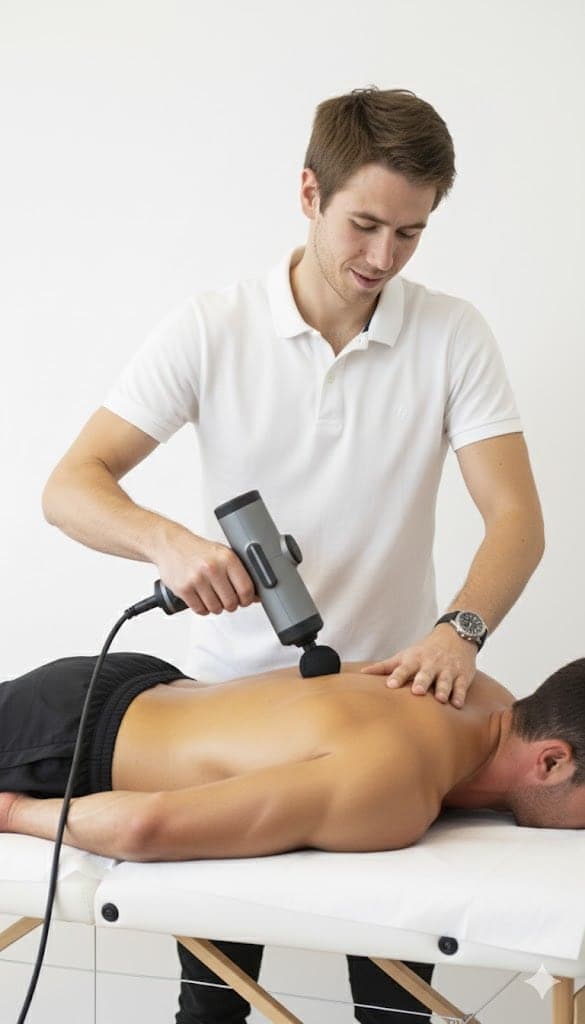
Written by
Chris
Massage therapist, nutrition and exercise physiologist
Norwegian-certified with a Bachelor’s in Physical Education and Nutrition and over ten years of clinical practice, working from a portable table in clients’ homes across the Paphos district.
- Norwegian-certified
- Nutrition & exercise physiologist
- 10+ years clinical practice
- Based in Chlorakas · all of Paphos district
- No call-out fee anywhere in Paphos district
Last updated
This article is general information, not a medical diagnosis. If you have severe, worsening or unexplained pain, numbness, weakness, or pain after an accident, see a doctor first.