Sports injury massage Paphos: a mechanical approach to recovery
In short
Sports injury massage in Paphos means treating the tissue that keeps overloading, not just the spot that hurts. I assess the whole chain, work deep and precisely, and come to your home with a proper table.
I have spent over ten years watching athletes repeat the same pattern: get injured, rest until the pain fades, return too soon, and get injured again. My work in injury rehab in Paphos is built around breaking that loop by treating the mechanical cause rather than the sore spot.
Sports injury massage Paphos runners, cyclists, swimmers and tennis players ask me for is not a relaxing hour. It is assessment first, then deep and precise remedial work on the tissue that is actually overloading, delivered at your home or villa anywhere in the Paphos district. This article explains how I think about sports injuries, what I look for, and what a course of treatment realistically involves.
Why the injury site is rarely the whole problem
An injury is usually the last link in a chain that has been quietly failing for months. The body works as one mechanical system. Restrict ankle mobility and the knee tracks differently. That knee shifts load into the hip, which tightens to protect itself. A stiff hip pushes movement into the lower back. Eventually something gives, often a long way from the original restriction.
That is why massage that only kneads the painful area gives short relief and nothing more. The tension that caused the overload is still there. Fascia, the connective tissue wrapping every muscle, spreads load across many structures during sport. When it becomes stuck through overuse or compensation, load concentrates at one point and that point starts to complain.
The presentations I see most often in Paphos follow predictable lines:
- Knee pain in runners that traces back to a stiff hip or a weak, inhibited inner quadriceps
- Shoulder pain in swimmers and tennis players that starts with a rigid upper back
- Plantar heel pain in hikers and runners linked to a tight calf and limited hip extension
- Athletic low back pain driven by hips that will not extend, forcing the spine to do the work
- Achilles complaints where the tendon has stuck to its sheath after repeated irritation
None of these are exotic. They are simply what happens when a specific sport loads a body with a specific restriction, week after week, in the Paphos heat.
What sports injury massage Paphos athletes get from me
My background is a BSc in Physical Education and Nutrition, Norwegian certification, and more than a decade specialising in mechanical deep-tissue work. That shapes the treatment in three ways.
Depth does not mean brutality. Power in this context means enough sustained force to change stiff tissue, adjusted constantly to your response. Good sports injury work is uncomfortable in a productive, localised way; it should not leave you bruised or guarded. I would rather do slightly less and have you relaxed enough that the tissue lets me in.
Injuries I see most often in the Paphos district
Every body is different, but the same handful of complaints turn up repeatedly around Paphos, Coral Bay, Tala and Geroskipou. Here is how I approach them.
| Complaint | Where the load usually comes from | Where I focus |
|---|---|---|
| Runner's knee (patellofemoral pain) | Poor kneecap tracking from a tight lateral thigh and inhibited inner quad | Lateral retinaculum, IT band and TFL, hip rotators, quad tone |
| Rotator cuff irritation | Poor shoulder-blade movement and a stiff mid-back | Posterior shoulder capsule, scapular stabilisers, thoracic spine |
| Plantar heel pain | Excess pronation caused by limited hip extension and tight calves | Plantar fascia, deep calf compartment, hamstrings, hip flexors |
| Achilles tendinopathy | Tendon adhesions and a calf complex that no longer absorbs shock | Tendon-sheath glide, gastrocnemius and soleus, ankle mobility |
| Athletic low back pain | Hips that will not extend, so the lumbar spine moves too much | Hip capsule, psoas, thoracolumbar fascia |
Runner's knee
The kneecap stops gliding cleanly in its groove, usually because the outer structures are pulling it sideways and the inner quadriceps has gone quiet. Strengthening alone often fails because that inner muscle is inhibited by trigger points and stuck fascia rather than merely weak. I release the lateral retinaculum and IT band properly, then work the hip and posterior chain so the compensation stops.
Shoulders in swimmers and racket players
Shoulder function depends on the shoulder blade moving well, and the shoulder blade depends on a mobile upper back. Treating the cuff tendon alone misses this. I work from the thoracic spine outward, freeing the posterior capsule and the muscles that position the scapula, so the tendon stops being pinched with every stroke or serve.
Plantar fascia and Achilles
The plantar fascia is usually the victim, not the cause. When the hip cannot extend, the foot rolls in further with every stride and the fascia takes the strain. I work the fascia itself, then the calf, hamstrings and hip flexors in turn. Achilles work is similar, with particular attention to restoring glide between tendon and sheath.
How a session actually runs
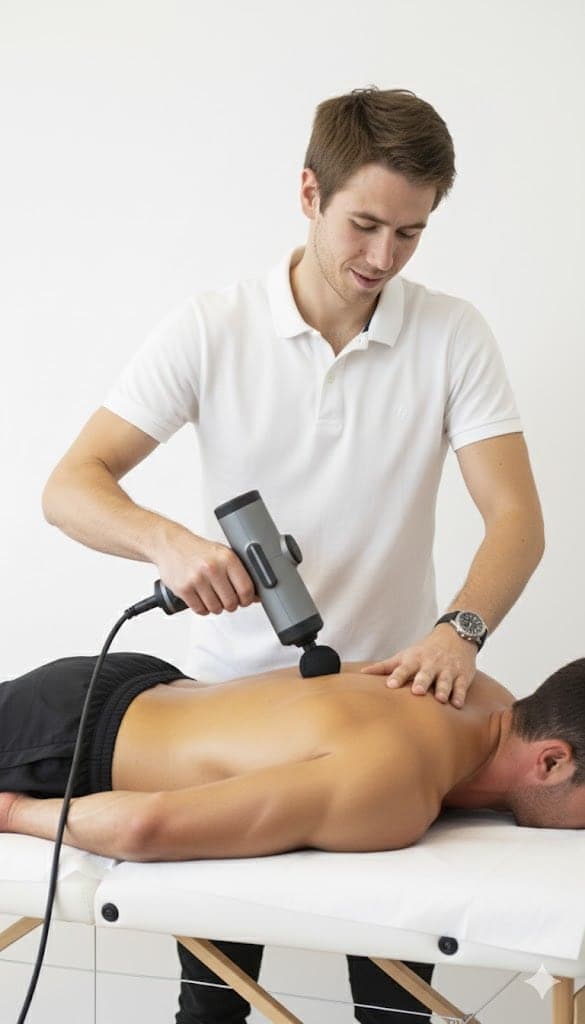
I travel to you with a professional table and everything needed for deep work. Treating you at home saves you driving while sore, and it lets me watch you move in a normal setting rather than a clinic where people unconsciously tidy up their gait.
The first visit starts with movement. I watch you walk, squat, balance on one leg and, where practical, mimic your sport. I am looking for asymmetry: a hip that rotates less than its partner, a pelvis that drifts during a single-leg squat, shoulders that hitch when the arms go overhead. Then I palpate along the relevant chain, checking tissue density, trigger points and how the joints move passively compared with actively. Athletes are regularly surprised by tender areas they had never noticed; chronic restriction tends to sit below awareness until it is challenged.
Only then do I treat. The order is usually the deeper structural restrictions first, followed by the muscles that have been compensating. I finish by rechecking the movement that provoked the pain so we both know whether something has changed.
Recovery pace and getting back to training
Pain easing is welcome but it is not the same as tissue that has recovered. I try to be honest about this because the temptation to return to full training in the first fortnight is where most re-injuries happen.
A realistic course looks like this:
- Early sessions. Reduce irritation and begin releasing the main restrictions, at moderate depth. Sessions are closer together at this stage.
- Middle phase. Deeper, more precise work on the stuck fascia and adhesions once the tissue is calmer. This is where the lasting change happens.
- Return to load. Sessions spread out, and training builds gradually while I check that the compensation has not crept back.
I do not promise fixed timelines. Progression is guided by how the tissue responds and whether graduated training stays comfortable. Where I can, I give you two or three specific mobility drills for the restriction we found, not a generic stretching list. Once the injury has settled, many athletes keep a maintenance session every four to six weeks so emerging tightness is caught early; treatment costs and the package deal are on the pricing page, and if you want more general athletic upkeep alongside rehab, sports massage in Paphos covers that.
I can help with muscular and fascial restriction, overuse tendon irritation and the compensations around a healed injury; I cannot treat fractures, ligament ruptures, acute swelling or nerve symptoms, so see a doctor first if you have significant swelling, a joint that gives way or locks, numbness or weakness in a limb, or pain that woke you at night without a clear mechanical cause.
Frequently asked questions
How is this different from an ordinary sports massage?
An ordinary sports massage works the muscles fairly evenly to aid general recovery, and it has its place. Sports injury work starts with an assessment of the whole chain, then concentrates deep and specific pressure on the structures that are keeping the injury going. It is more targeted, usually more uncomfortable in the moment, and aimed at changing how you move rather than just how you feel afterwards.
Does the treatment hurt?
Deep work on restricted tissue is uncomfortable, but it should feel productive and localised rather than sharp or alarming. I keep pressure just below the point where you tense against it, because tissue that is braced does not release. You are in control throughout and I adjust as we go. Some tenderness for a day or so afterwards is normal; bruising or worsening pain is not what I am aiming for.
How many sessions will I need?
It depends on how long the problem has been there and how the tissue responds. Recent overuse complaints often settle in a handful of visits; long-standing problems with layers of compensation take longer. After the first assessment I will give you an honest estimate and clear signs of progress to look for, and I will tell you if I think you should be seeing someone else instead.
When can I go back to training?
Modified training usually restarts early, since some load helps tissue remodel. Full intensity comes back gradually, guided by whether the provoking movement stays comfortable as we build. Pain that returns with a step up in load is useful feedback that a restriction is still there. I would rather you build slowly and stay in your sport than rush and repeat the whole cycle.
Do I need a doctor's referral first?
No referral is needed for muscular and fascial work. That said, if your presentation suggests something beyond soft tissue, such as a possible fracture, ligament rupture or nerve involvement, I will say so and recommend medical assessment before we continue. I am happy to work alongside your doctor or physiotherapist, and structural tissue work often makes their exercise programme easier to do.
Do you cover the whole Paphos district?
Yes. I am based in Chlorakas and travel to homes, villas and holiday accommodation across Paphos town, Kato Paphos, Coral Bay, Peyia, Tala, Tsada, Geroskipou and the surrounding villages. Sessions are €90 for 60 minutes or €130 for 90 minutes, and a package of five pre-booked sessions includes one additional free session. Booking is by WhatsApp or phone, and I bring the table and everything else needed.
Evidence and limits
Massage may help with some symptoms, but benefits and evidence vary by condition. It does not replace medical assessment or treatment. A page update is not evidence of an independent clinical review.
Further reading: Massage therapy: evidence, safety and limitations by US National Center for Complementary and Integrative Health. This is general background reading, not verification of every claim in this article.
How we describe evidence and updatesWritten by
Chris
Massage therapist, nutrition and exercise physiologist
Norwegian-certified with a Bachelor’s in Physical Education and Nutrition and over ten years of clinical practice, working from a portable table in clients’ homes across the Paphos district.
- Norwegian-certified
- Nutrition & exercise physiologist
- 10+ years clinical practice
- Based in Chlorakas · all of Paphos district
- No call-out fee anywhere in Paphos district
Last updated
This article is general information, not a medical diagnosis. If you have severe, worsening or unexplained pain, numbness, weakness, or pain after an accident, see a doctor first.