Posture Correction Tips Kissonerga: Advanced Mechanical Solutions for Lasting Results
In short
Expert posture correction tips in Kissonerga from a specialized body mechanics professional with 10 years of experience. Discover how precision deep-tissue therapy addresses the root causes of postural dysfunction.
Standing in front of the mirror last week, a new client in Kissonerga looked at his rounded shoulders and forward head position with frustration. “I’ve tried stretching,” he said. “I’ve watched YouTube videos. Nothing changes.” This is the conversation I have repeatedly—because posture correction isn’t about trying harder at superficial solutions. It’s about addressing the mechanical reality of how your body has adapted to years of compensatory patterns.
With a Bachelor’s degree in Physical Education and Nutrition from Norway and ten years specializing exclusively in mechanical deep-tissue therapy, I’ve worked with hundreds of clients throughout Kissonerga who believed their posture was simply “how they were built.” The truth is far more encouraging: postural dysfunction is a mechanical problem that responds to mechanical solutions when applied with precision, depth, and consistency.
The posture correction tips I’m sharing here aren’t generic advice you’ll find recycled across wellness blogs. These are clinical insights from a decade of hands-on work, backed by my understanding of body mechanics and proven through measurable results with clients in Kissonerga who now move, work, and live without the constant burden of postural pain.
Understanding the Mechanical Reality of Poor Posture in Kissonerga
Before we discuss correction strategies, we need to establish what posture actually is—and what it isn’t. Your posture is not a static position you “hold” through willpower or conscious effort. It’s the dynamic result of your musculoskeletal system finding the path of least resistance based on accumulated tension patterns, muscle imbalances, and fascial restrictions.
When I assess clients in Kissonerga, I’m not looking at whether they’re “standing up straight.” I’m evaluating the mechanical chain that determines why their body defaults to a particular alignment. The rounded shoulders I see constantly? That’s not laziness—it’s the body compensating for chronically shortened pectoral muscles and overstretched, inhibited posterior chain muscles. The forward head position that plagues office workers here? That represents an average of 10-12 pounds of additional load on the cervical spine for every inch the head translates forward.
These aren’t cosmetic issues. They’re biomechanical inefficiencies that create compressive forces, restrict movement patterns, and generate the chronic pain that brings clients to me seeking solutions.
The Three-Dimensional Nature of Postural Dysfunction
One critical mistake I see in conventional posture correction approaches—whether from general massage therapists or well-meaning fitness instructors in Kissonerga—is treating posture as a two-dimensional problem. They look at someone from the side and say, “Pull your shoulders back.” This completely misses the rotational and lateral components.
The human body operates in three planes of motion simultaneously. When I work with someone experiencing postural collapse, I’m assessing:
- Sagittal plane dysfunction: Forward head carriage, anterior pelvic tilt, thoracic kyphosis
- Frontal plane imbalances: Lateral pelvic shifts, shoulder elevation asymmetries, compensatory scoliotic curves
- Transverse plane restrictions: Rotational restrictions in the thoracic spine, hip internal rotation limitations, scapular winging
Each plane influences the others. You cannot durably correct forward head posture without addressing the rotational mobility of the thoracic spine. You cannot resolve rounded shoulders without releasing the fascial restrictions that prevent proper scapular glide patterns.
This is precisely why superficial interventions fail—and why my specialized mechanical approach, which can access tissue layers and trigger points that hands cannot effectively reach, produces results where other methods plateau.
Posture Correction Tips Kissonerga: The Foundational Principles
Now let me share the specific posture correction strategies I implement with clients in Kissonerga. These aren’t isolated “tips”—they’re components of a systematic approach to retraining your body’s default alignment patterns.
Tip #1: Address the Anterior Chain Before Attempting Posterior Strengthening
This is where most conventional posture correction programs fail immediately. They tell you to strengthen your back, do rows, activate your rhomboids. Meanwhile, your pectoral muscles are so chronically shortened and dense with adhesions that your scapulae are mechanically locked into protraction.
I start every postural rehabilitation program by systematically releasing the anterior structures that are physically preventing proper alignment. Using my specialized mechanical deep-tissue tool, I work through:
The pectoralis major and minor, releasing not just the muscle belly but the costosternal attachments and the insertion points on the humerus. The anterior deltoid and its fascial connections to the clavipectoral fascia. The subclavius and its role in restricting clavicular movement. The scalenes, which are almost universally hypertonic in clients with forward head posture.
This work goes deeper than hands can effectively penetrate. The mechanical advantage of the tool allows me to apply sustained, precise pressure to these chronically locked tissues without the fatigue that limits manual therapy. Where a therapist’s thumbs might give out after two minutes of deep work, my tool maintains consistent therapeutic pressure for the 15-20 minutes often necessary to achieve actual tissue change.
One of my clients in Kissonerga, a software developer, experienced this directly. After six sessions focused primarily on anterior chain release—with minimal posterior work—his shoulder protraction reduced by 3 centimeters measured from a fixed reference point. His chronic upper trap tension disappeared not because I worked on his traps, but because I eliminated the anterior restrictions that were forcing them into constant compensatory activation.
Tip #2: Restore Thoracic Extension Mobility as Priority One
If I could give only one piece of posture correction advice to residents of Kissonerga, it would be this: your thoracic spine’s ability to extend is the cornerstone of all upper body postural alignment.
The thoracic spine—the twelve vertebrae of your mid-back—should have approximately 25-30 degrees of extension range. In the average person I assess here, I find 5-10 degrees at best. The remaining vertebrae are locked in flexion by dense paraspinal muscle tension, fascial restrictions between the ribs, and dysfunctional breathing patterns that have reinforced this position for years.
Without thoracic extension, you cannot maintain cervical alignment. Your head will drift forward as compensation. Without thoracic extension, your scapulae cannot achieve proper upward rotation, meaning your shoulders will round forward regardless of how strong your rhomboids are.
| Structural Relationship | Effect of Limited Thoracic Extension | Resulting Dysfunction |
|---|---|---|
| Cervical Spine Alignment | Compensatory hyperextension at C1-C2 | Forward head posture, suboccipital tension, headaches |
| Scapular Position | Forced protraction and downward rotation | Rounded shoulders, impingement risk, reduced arm elevation |
| Respiratory Function | Restricted rib cage expansion | Accessory muscle breathing, neck tension, reduced oxygen efficiency |
| Lumbar Spine Load | Compensatory lumbar hyperextension | Lower back pain, disc pressure, hip flexor tightness |
My mechanical approach targets the erector spinae, multifidus, rotatores, and intercostal attachments with a depth and precision that allows for actual structural change. I’m not rubbing the surface—I’m reaching the periosteal layers where these muscles attach to the vertebrae and ribs, releasing the adhesions that prevent segmental motion.
Tip #3: Implement Diaphragmatic Retraining Simultaneously with Structural Work
Here’s something most people don’t realize: your breathing pattern actively reinforces your postural dysfunction. Every single breath you take is either supporting proper alignment or driving you deeper into compensatory patterns.
Clients in Kissonerga with chronic forward head posture and rounded shoulders invariably demonstrate upper chest breathing patterns. They’ve shifted from diaphragmatic breathing—which should account for 70-80% of respiratory effort—to accessory muscle breathing using the scalenes, upper trapezius, and pectoralis minor.
This creates a vicious cycle: Poor posture restricts diaphragm function, forcing accessory muscle recruitment. Accessory muscle breathing chronically tightens the very structures that pull you into poor posture. This tightness further restricts posture. The cycle intensifies.
Breaking this cycle requires simultaneous intervention. While I’m releasing the mechanical restrictions with deep-tissue work, we must retrain the breathing pattern. I teach clients specific protocols:
- Supine diaphragmatic breathing: Beginning in a position where postural muscles are unloaded, establishing the neuromuscular pattern
- Lateral rib expansion: Training the intercostal muscles to participate in breathing rather than remaining rigidly fixed
- Postural integration: Gradually incorporating diaphragmatic breathing into upright positions and functional activities
The remarkable aspect of this approach is how quickly changes manifest. When a client experiences their first true diaphragmatic breath after years of accessory muscle breathing, they immediately feel their neck tension diminish. Their shoulders naturally drop into a more optimal position without conscious effort. This isn’t magic—it’s removing the mechanical drivers of dysfunction.
Advanced Posture Correction Strategies for Kissonerga Residents
Beyond these foundational principles, there are more sophisticated interventions I implement based on individual biomechanical assessment. These are the strategies that separate superficial improvement from lasting postural transformation.
Addressing the Hip-Shoulder Relationship
Your shoulders don’t exist in isolation—they’re intimately connected to your pelvic position through the thoracolumbar fascia, the latissimus dorsi, and the entire posterior oblique sling system. When I assess someone in Kissonerga with upper cross syndrome—the classic pattern of forward head and rounded shoulders—I always evaluate their hip mechanics.
Approximately 80% of the time, I find significant hip flexor shortness and posterior capsule restrictions. These lower body restrictions create compensatory patterns that propagate up the kinetic chain, ultimately manifesting as the shoulder and neck position the client came to address.
My protocol includes systematic release of the psoas major, iliacus, rectus femoris, and TFL using the mechanical tool to reach depths that manual therapy cannot access consistently. The psoas, in particular, requires this approach—it’s a deep muscle that manual pressure must work through the abdominal contents to reach, making effective release challenging and uncomfortable with traditional methods.
With mechanical precision, I can target the psoas attachments on the lumbar transverse processes and the lesser trochanter, achieving releases that immediately alter pelvic positioning and, consequently, the entire spinal alignment above.
Scapular Repositioning Through Sub-Scapular Work
The subscapularis muscle—the largest and strongest of the rotator cuff—sits between your scapula and rib cage. When it develops adhesions and trigger points, which is nearly universal in people with postural dysfunction, it mechanically locks the scapula into protracted and internally rotated positions.
Reaching the subscapularis effectively is exceptionally difficult with manual therapy. It requires working around the scapular border, often causing significant discomfort and limited by the therapist’s finger strength and endurance.
My specialized tool changes this equation entirely. I can access the subscapularis through the lateral scapular border with controlled, sustained pressure that gradually works through the tissue layers. The mechanical advantage allows me to maintain therapeutic depth for the duration necessary—typically 10-15 minutes per side—to achieve meaningful adhesion release.
The postural changes following subscapularis work are often dramatic. Clients feel their shoulders “settle back” into their sockets. The constant sensation of shoulders pulling forward diminishes immediately. Reaching overhead, which many had found restricted and uncomfortable, suddenly becomes fluid.
One client here in Kissonerga, a tennis player, experienced a 15% increase in serve velocity after four sessions focused heavily on subscapularis release and scapular repositioning. His postural improvement wasn’t just aesthetic—it translated directly to functional performance enhancement.
Cervical Spine Liberation: Beyond Neck Massage
The forward head posture epidemic in Kissonerga—driven by computer work, smartphone use, and modern lifestyle patterns—creates massive loads on the cervical structures. For every inch your head translates forward, your neck muscles must generate approximately 10 pounds of additional force to maintain that position.
Traditional neck massage provides temporary relief by addressing the symptomatic tension in the upper trapezius and levator scapulae. This is why people get “neck massages” weekly without ever solving the problem—they’re treating the symptom, not the cause.
My approach targets the deep cervical structures that are actually restricting proper alignment:
- Longus colli and longus capitis: The deep anterior cervical stabilizers that become inhibited and dysfunctional
- Suboccipital muscles: The four small muscles at the skull base that are chronically overworked in forward head posture
- Deep posterior cervical muscles: The semispinalis capitis, splenius capitis, and cervicis muscles that become dense with trigger points
- Sternocleidomastoid: Not just the superficial portion, but the deep attachments and the space between its two heads
The mechanical tool allows me to work these structures with a specificity and depth impossible to achieve manually. The suboccipital region, for instance, requires precise, sustained pressure directed superiorly toward the skull base. Maintaining this manually for the necessary duration fatigues even experienced therapists. The tool delivers consistent therapeutic pressure for as long as needed.
Results are measurable. I document forward head posture using a simple plumb line reference from the lateral malleolus. Pre-treatment, the average client in Kissonerga shows 2-4 inches of anterior translation. After a systematic 6-8 session protocol, this typically reduces to 0.5-1 inch—a massive improvement in mechanical efficiency and load distribution.
The Role of Neuromuscular Re-education in Posture Correction
Here’s a critical concept that differentiates my approach from conventional postural training programs: releasing the mechanical restrictions is only half of the equation. The other half is retraining your nervous system’s postural control strategies.
Your current posture feels “normal” to you because your proprioceptive system—the network of sensors throughout your muscles, joints, and connective tissue—has calibrated to recognize these dysfunctional patterns as baseline. When I first correct someone’s alignment manually, they invariably report feeling like they’re “leaning backward” even though objective measurement shows they’re finally in neutral.
This is why stretching and strengthening programs alone rarely produce lasting postural change. You’re fighting against a deeply ingrained neurological pattern that constantly pulls you back to your habitual position.
Integrating Postural Correction into Functional Patterns
After systematically releasing the restrictions limiting optimal alignment, we must integrate these changes into your daily movement patterns. I work with clients in Kissonerga to:
Reprogram sitting mechanics: Most people think sitting posture is about “sitting up straight,” which is exhausting and unsustainable. Instead, we establish a sitting position where the skeletal structure supports the body with minimal muscular effort. This requires proper ischial tuberosity positioning, appropriate lumbar curve maintenance, and head position that balances over the torso.
Retrain standing patterns: Standing posture should involve weight distributed primarily through the heels, with the pelvis in neutral, ribcage stacked over pelvis, and head balanced over the body’s center of mass. When restrictions are removed, this position becomes effortless rather than forced.
Optimize workstation ergonomics: Environmental factors dramatically influence postural habits. I provide specific guidance for monitor height, keyboard position, chair adjustment, and desk setup that supports rather than undermines the mechanical changes we’ve achieved.
Movement Integration Protocols
Between our sessions, I provide clients with specific movement protocols—not exercises in the traditional sense, but neuromuscular re-education drills that reinforce optimal patterns:
- Wall angel progressions: Retraining scapular movement patterns and thoracic extension while removing gravitational load
- Cervical retraction holds: Brief (5-10 second) isometric holds teaching the deep cervical flexors to maintain proper head position
- Hip hinge patterns: Reinforcing proper pelvic-lumbar rhythm to prevent compensatory spinal flexion during daily activities
- Breathing integration: Progressive protocols for maintaining diaphragmatic breathing in increasingly challenging positions
These protocols take 10-15 minutes daily. They’re not grueling workouts—they’re targeted neurological training that solidifies the mechanical changes achieved through our treatment sessions.
Why Traditional Approaches Fail: A Clinical Perspective
Having worked in this field for a decade, I’ve seen countless clients in Kissonerga who arrive frustrated after trying multiple other approaches. They’ve done yoga. They’ve tried chiropractic. They’ve performed the exercises their physiotherapist recommended. Nothing produced lasting change.
This isn’t because those modalities are inherently ineffective—it’s because they’re addressing the wrong level of the problem or being applied without the necessary depth and precision.
The Limitations of Manual Therapy for Postural Correction
Traditional massage therapy, even when performed by skilled practitioners, has inherent limitations for addressing chronic postural dysfunction:
Depth limitations: Human hands and thumbs can effectively reach superficial and moderate depth tissues. The deep postural muscles—psoas, subscapularis, deep rotators—require forces that quickly fatigue manual techniques and cause therapist injury over time.
Consistency variability: Every therapist has better days and worse days. Fatigue, technique variations, and attention fluctuation mean each session is slightly different. Chronic postural conditions require consistent, repeated stimulus at the same therapeutic depth.
Treatment duration constraints: The intense physical demands of deep manual work limit how long a therapist can maintain therapeutic depth. A mechanical approach can deliver sustained pressure for 15-20 minutes to a single area when that’s what tissue change requires.
Precision limitations: Fingers, thumbs, and elbows are relatively broad treatment surfaces. Targeting specific muscular attachments, trigger points, and fascial planes requires more precise application.
My specialized mechanical tool eliminates these limitations. It delivers deeper pressure than hands can sustain, maintains absolute consistency regardless of treatment duration, and provides pinpoint precision for targeting specific structures.
Why Exercise Alone Cannot Correct Postural Dysfunction
The fitness industry promotes postural correction through strengthening exercises: rows for rounded shoulders, planks for core stability, chin tucks for forward head posture. These are valuable components—but only after mechanical restrictions are removed.
Consider this scenario: Your pectoral muscles are chronically shortened and dense with fascial adhesions. Your subscapularis is locked with trigger points. Your thoracic spine has 7 degrees of extension instead of the normal 25-30 degrees. Now you attempt to do rows to “strengthen your back” and “pull your shoulders back.”
What actually happens? Your body recruits whatever muscles can execute the movement pattern within your restricted range. Usually, this means your upper trapezius and levator scapulae overwork while your rhomboids and mid-traps remain inhibited. You’re reinforcing dysfunctional movement patterns while creating additional tension in already overactive muscles.
This is why clients tell me, “I’ve been doing exercises for months, but my posture keeps getting worse.” They’re exercising within their dysfunction, not correcting it.
The proper sequence is: First, systematically release the mechanical restrictions preventing optimal alignment. Second, retrain neuromuscular patterns for postural control. Third, progressively load these patterns through appropriate strengthening work.
Skip the first step, and you’re building strength on top of dysfunction—which ultimately creates more problems than it solves.
The Investment: What Posture Correction Actually Requires
I need to be direct about what effective posture correction demands. This isn’t a one-session fix or a quick-tip solution. Postural dysfunction typically develops over years or decades. Correcting it requires systematic, progressive intervention.
The Realistic Timeline for Postural Transformation
Based on my experience with hundreds of clients in Kissonerga, here’s what the actual transformation timeline looks like:
| Phase | Timeline | Objectives | Client Experience |
|---|---|---|---|
| Initial Release Phase | Sessions 1-4 (Weeks 1-4) | Systematic release of primary restrictions; initial mobility gains | Immediate relief in tension; awareness of chronic restrictions; some postural change |
| Integration Phase | Sessions 5-8 (Weeks 5-8) | Deeper structural work; neuromuscular retraining; pattern integration | Noticeable postural improvements; reduced compensatory pain; increased body awareness |
| Optimization Phase | Sessions 9-12 (Weeks 9-12) | Fine-tuning specific restrictions; maximizing range of motion; solidifying new patterns | Significant postural transformation; effortless maintenance of alignment; functional improvements |
| Maintenance Phase | Ongoing (Monthly or bi-monthly) | Prevent regression; address new stressors; continue optimization | Sustained results; proactive management; continuous improvement |
This isn’t a rigid protocol—some clients progress faster, some require more intensive work in specific areas. But this represents the typical journey from chronic postural dysfunction to sustainable, optimized alignment.
Why This Approach Represents Investment, Not Expense
I position my service clearly: This is an investment in your long-term structural health and functional capacity, not an expense for temporary relief.
Consider the alternative path many take: Monthly massage for temporary relaxation without lasting change. Regular chiropractic adjustments that address symptoms but not underlying restrictions. Ongoing pain medication that masks dysfunction without resolving it. Physical therapy sessions that plateau because manual techniques can’t reach the necessary depth.
These approaches typically continue indefinitely because they don’t address the root mechanical problems. You’re perpetually managing symptoms rather than solving the underlying issue.
My approach is fundamentally different. We work together intensively for 8-12 sessions to systematically eliminate the mechanical restrictions driving your postural dysfunction. After this initial phase, most clients maintain their results with only monthly or bi-monthly sessions—because we’ve actually corrected the structural problems, not just temporarily relieved symptoms.
The economic calculation is straightforward: Would you rather spend moderately every week indefinitely for temporary relief, or invest more significantly for a concentrated period to achieve lasting correction?
Real Results from Kissonerga Clients: Clinical Outcomes
Let me share specific examples from my work here in Kissonerga. These aren’t testimonials—they’re clinical case summaries documenting measurable changes.
Case Study: Software Developer with Severe Forward Head Posture
Male, 34 years old, working 10-12 hours daily at computer. Presented with chronic headaches (5-6 times weekly), upper trap tension, and difficulty maintaining concentration after midday due to neck discomfort.
Objective measurements: Forward head posture of 4.2 inches anterior to plumb line reference. Thoracic extension of 6 degrees (normal: 25-30 degrees). Bilateral shoulder protraction of 5.7 cm from neutral scapular position.
Treatment protocol: Twice weekly sessions for six weeks, focusing on anterior chain release, thoracic mobilization, suboccipital work, and scapular repositioning. Integrated breathing retraining and neuromuscular protocols between sessions.
Results after 12 sessions: Forward head posture reduced to 0.8 inches. Thoracic extension increased to 22 degrees. Shoulder protraction reduced to 1.2 cm. Headache frequency decreased to 1-2 per month. Client reports sustained focus throughout workday and absence of previous daily discomfort.
Maintenance: Monthly sessions ongoing for six months with sustained results.
Case Study: Competitive Cyclist with Chronic Lower Back Pain
Male, 42 years old, training 12-15 hours weekly. Experiencing progressive lower back pain that limited training volume and intensity. Previous interventions including massage, chiropractic, and core strengthening provided only temporary relief.
Analysis revealed significant anterior pelvic tilt, hip flexor restrictions, and compensatory lumbar hyperextension. The cycling position reinforced these patterns, but underlying restrictions prevented postural correction despite awareness.
Treatment approach: Systematic release of psoas, iliacus, rectus femoris, and lumbar erectors. Specific work on quadratus lumborum and deep hip rotators. Progressive integration of neutral pelvic positioning into cycling mechanics.
Outcome: Complete resolution of training-limiting back pain after 8 sessions over 10 weeks. Client increased training volume by 20% without recurrence of symptoms. Power output increased measurably due to improved pelvic stability and force transmission. Now maintains results with bi-monthly sessions timed with training periodization.
Case Study: Office Manager with Rounded Shoulders and Arm Pain
Female, 51 years old, experiencing increasing bilateral arm pain, numbness in hands, and visible postural collapse. Concerned about progressive deterioration and potential for lasting damage.
Assessment showed severe scapular protraction, subscapularis trigger points, and thoracic kyphosis. Nerve tension testing positive for median nerve restrictions, likely contributing to hand symptoms.
Treatment included intensive subscapularis release, pectoral work, thoracic mobilization, and median nerve gliding protocols. Workstation ergonomics were completely revised.
Results: Arm pain eliminated by session 7. Hand numbness resolved completely. Shoulder position improved dramatically with 4.3 cm reduction in protraction measurements. Client reports feeling “years younger” and ability to work full days without progressive discomfort. Sustained improvement with monthly maintenance.
Frequently Asked Questions: Posture Correction in Kissonerga
How is your mechanical approach different from regular massage?
Traditional massage focuses primarily on relaxation and superficial muscle tension relief. My specialized mechanical deep-tissue method targets the root causes of postural dysfunction—the deep muscular restrictions, fascial adhesions, and structural imbalances that hands cannot effectively reach. The tool provides deeper penetration, absolute consistency, and sustained pressure duration that manual techniques cannot match. This isn’t about relaxation—it’s about lasting structural correction.
Will the deep-tissue work be painful?
There’s a distinction between therapeutic discomfort and pain. Chronic restrictions require significant pressure to release—this creates intense sensation that clients describe as “hurts so good” or “uncomfortable but satisfying.” I maintain complete control over intensity, adjusting to your tolerance while ensuring we reach therapeutic depth. Most clients find the sensation intense but tolerable, and the immediate relief following treatment confirms the work’s value. As restrictions release over subsequent sessions, the intensity required typically decreases.
How long until I see results in my posture?
Most clients notice immediate changes in tension levels and some postural improvement after the first session. However, your body has adapted to current patterns over years—sustainable correction requires progressive treatment. Visible, measurable postural changes typically manifest by sessions 4-6. Significant transformation occurs over 8-12 sessions. The timeline depends on dysfunction severity, chronicity, and your compliance with integration protocols between sessions.
Can I correct my posture just by being more aware and sitting up straight?
No—and attempting this often creates additional problems. Postural dysfunction isn’t a willpower issue; it’s a mechanical reality. When your pectoral muscles are shortened, your thoracic spine is restricted, and your scapular stabilizers are inhibited, “sitting up straight” requires constant muscular effort fighting against these restrictions. This creates fatigue and additional tension. Sustainable postural correction requires removing the mechanical limitations first, then retraining your neuromuscular system to maintain optimal alignment effortlessly.
Why do you focus so much on breathing during posture correction?
Your breathing pattern actively reinforces postural dysfunction. Accessory muscle breathing—using your neck and chest muscles rather than your diaphragm—chronically tightens the exact structures pulling you into poor posture. Every dysfunctional breath drives you deeper into the problem. Conversely, proper diaphragmatic breathing naturally promotes optimal postural alignment while reducing tension in compensatory muscles. Addressing breathing isn’t optional—it’s fundamental to sustainable postural correction.
Do I need ongoing treatment forever, or is this actually corrective?
This is genuinely corrective—we’re solving the structural problems, not temporarily managing symptoms. The initial intensive phase (8-12 sessions) systematically eliminates the restrictions causing your postural dysfunction. After achieving correction, most clients maintain results with monthly or bi-monthly sessions. This maintenance addresses new stressors and prevents regression, similar to how you maintain your car after major repairs. You’re not dependent on continuous treatment—you’re proactively managing your structural health.
I’ve tried physical therapy exercises without success. Why would your approach work?
Exercises are valuable—but only after mechanical restrictions are removed. Attempting to strengthen your way out of postural dysfunction when deep restrictions prevent proper movement patterns typically reinforces compensatory strategies and creates additional problems. My approach follows proper sequencing: First, systematically release the restrictions preventing optimal alignment. Second, retrain neuromuscular control patterns. Third, progressively strengthen these corrected patterns. Skipping the first step—which requires depth and precision that manual therapy and self-treatment cannot achieve—is why exercises alone typically fail.
You mentioned traveling to my location in Kissonerga. How does that work?
I bring my professional treatment bench and all specialized equipment to your home, office, or preferred location throughout Kissonerga. This eliminates your travel time, allows treatment in your comfortable environment, and ensures you can rest afterward without commuting. The setup takes minutes, and I handle all logistics. This convenience is particularly valuable for clients with busy schedules or those experiencing significant pain that makes travel uncomfortable.
What should I expect during the first session?
We begin with comprehensive assessment: postural analysis, range of motion testing, identification of primary restrictions, and discussion of your specific concerns and goals. I explain the underlying mechanical problems I identify and outline a treatment strategy. The first session includes initial release work focused on primary restrictions. I provide specific guidance for integration protocols you’ll implement between sessions. Each subsequent session builds progressively on previous work, addressing deeper restrictions and advancing neuromuscular retraining.
The Long-term Benefits of Correcting Your Posture in Kissonerga
Beyond eliminating the immediate discomfort of poor posture, systematic structural correction delivers long-term benefits that compound over time:
Reduced injury risk: Optimal alignment distributes forces efficiently throughout your skeletal system rather than creating localized stress concentrations. This dramatically reduces your risk of both acute injuries and chronic overuse conditions.
Enhanced physical performance: Whether you’re an athlete or simply want to move comfortably through daily activities, proper posture optimizes force transmission and movement efficiency. My clients consistently report improved performance in sports, fitness activities, and occupational tasks.
Decreased degenerative progression: Postural dysfunction accelerates degenerative changes in joints and intervertebral discs through abnormal loading patterns. Correcting alignment doesn’t reverse existing degeneration, but it dramatically slows or stops progression.
Improved respiratory function: Optimal thoracic position and proper rib mechanics allow full diaphragmatic excursion. This improves oxygen efficiency, reduces breathing effort, and enhances cardiovascular function—benefits that affect every aspect of health.
Enhanced confidence and presence: The psychological and social benefits of upright, confident posture are substantial. Clients consistently report that others comment on how they “carry themselves differently” after postural correction.
Cognitive performance improvements: Chronic postural strain creates constant proprioceptive noise—background signals competing for your nervous system’s attention. Eliminating this interference enhances focus, concentration, and mental clarity.
These aren’t abstract benefits. They’re tangible improvements in quality of life that my clients in Kissonerga experience and report consistently.
Taking Action: Beginning Your Postural Transformation Journey
If you’ve read this far, you likely recognize yourself in the descriptions of postural dysfunction I’ve outlined. Perhaps you’ve tried multiple approaches without achieving lasting results. Perhaps you’re frustrated by chronic discomfort that limits your activities and quality of life. Perhaps you simply want to address these issues before they progress further.
The question isn’t whether posture correction is possible—it absolutely is when approached with proper depth, precision, and systematic progression. The question is whether you’re ready to invest in a genuine solution rather than continuing to manage symptoms.
My decade of specialization in mechanical deep-tissue therapy, my education in body mechanics and physiology, and my results with hundreds of clients provide the foundation for what I offer: a systematic, results-driven approach to lasting postural correction.
This isn’t massage for relaxation. It’s not a spa treatment or a casual wellness service. It’s clinical intervention for structural dysfunction, delivered with the depth and consistency necessary to achieve actual tissue change and lasting results.
I work throughout Kissonerga, traveling to your location with my professional equipment. We begin with comprehensive assessment, establish clear objectives based on your specific dysfunction patterns, and implement a progressive treatment strategy targeting the root causes of your postural problems.
The investment is significant—in time, in resources, in commitment to the process. But consider the alternative: continuing to live with progressive dysfunction, managing symptoms indefinitely without addressing underlying causes, and risking the long-term consequences of uncorrected structural problems.
You have one body. It must serve you for your entire life. Investing in its structural integrity and optimal function isn’t an expense—it’s perhaps the most valuable investment you can make.
For residents of Kissonerga seeking genuine, lasting posture correction based on advanced mechanical therapy and proven protocols, I offer a partnership in your structural health. Not quick fixes or temporary relief—sustainable transformation of your body’s alignment, movement patterns, and functional capacity.
Your posture didn’t deteriorate overnight, and it won’t correct instantly. But with systematic, expert intervention targeting the actual mechanical problems, the transformation is not only possible—it’s predictable.
The only remaining question is whether you’re ready to begin.
Evidence and limits
Massage may help with some symptoms, but benefits and evidence vary by condition. It does not replace medical assessment or treatment. A page update is not evidence of an independent clinical review.
Further reading: Massage therapy: evidence, safety and limitations by US National Center for Complementary and Integrative Health. This is general background reading, not verification of every claim in this article.
How we describe evidence and updates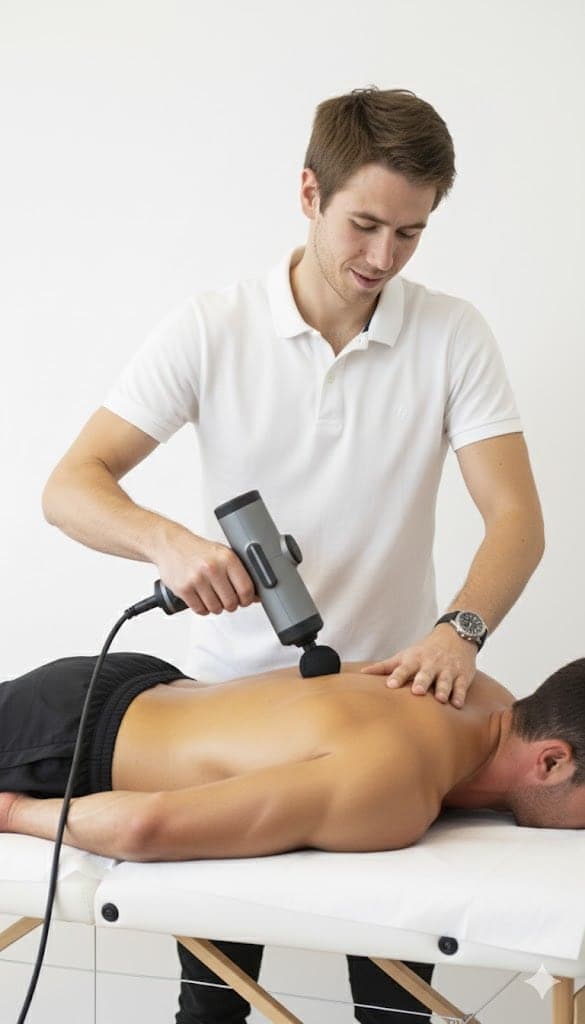
Written by
Chris
Massage therapist, nutrition and exercise physiologist
Norwegian-certified with a Bachelor’s in Physical Education and Nutrition and over ten years of clinical practice, working from a portable table in clients’ homes across the Paphos district.
This article is general information, not a medical diagnosis. If you have severe, worsening or unexplained pain, numbness, weakness, or pain after an accident, see a doctor first.