
Hip pain massage: mechanical deep-tissue work for the hip in Paphos
In short
Most hip pain I treat comes from tight hip flexors, gluteals and deep rotators rather than the joint itself. Mechanical deep-tissue work on those muscles, done at your home in Paphos, usually eases the ache within a few sessions.
Hip pain rarely starts in the hip joint. In most people I treat it comes from the muscles around it — the hip flexors, gluteals and deep rotators. Here is how I approach a hip pain massage using mechanical deep-tissue treatment, what it feels like, and how many sessions are realistic, at your home in the Paphos district.
Where hip pain usually comes from
The hip is a ball-and-socket joint surrounded by some of the strongest muscles in the body. When people describe hip pain to me, they usually point at the joint, but when I palpate the area the tender, restricted tissue is almost always in the muscles that cross it. My background in physical education and ten years of hands-on work have taught me to look at the whole region rather than the point that hurts.
Four groups matter most in the pattern I see:
- Iliopsoas (psoas and iliacus) — the deep hip flexors that run from the lumbar spine to the top of the thigh bone. They shorten with sitting and driving and produce a deep ache at the front of the hip and groin.
- Gluteus medius and minimus — the side stabilisers. When they are overloaded or inhibited they refer pain to the outer hip, and lying on that side at night becomes uncomfortable.
- Deep rotators and piriformis — small muscles under the gluteus maximus that tighten with prolonged sitting and can produce buttock pain, sometimes with a line of ache down the back of the thigh.
- Tensor fasciae latae and the IT band — a fascial suspension along the outer thigh that becomes tender when the gluteals are not doing their job.
Long hours at a desk, driving between villages, or a training block that ramps up too fast will load one or more of these groups, and the hip is where the strain shows up.
Why stretching and foam rolling often disappoint
Most people who contact me have already tried stretching, foam rolling, or a generic exercise sheet. Those tools have their place, but they tend to underperform on chronic hip tightness for a few reasons.
| Approach | Where it falls short for the hip |
|---|---|
| Static stretching | Pulls on the whole muscle-tendon unit; the dense, adhered sections do not lengthen much, the healthier fibres take the strain |
| Foam rolling the IT band | The IT band is passive tissue; the driver is usually the TFL and gluteals above it |
| Strengthening alone | Building strength on top of a restricted, guarded muscle often reinforces the same faulty pattern |
| Massage gun | Fast, shallow percussion; hard to hold a sustained pressure on the deep flexors or rotators |
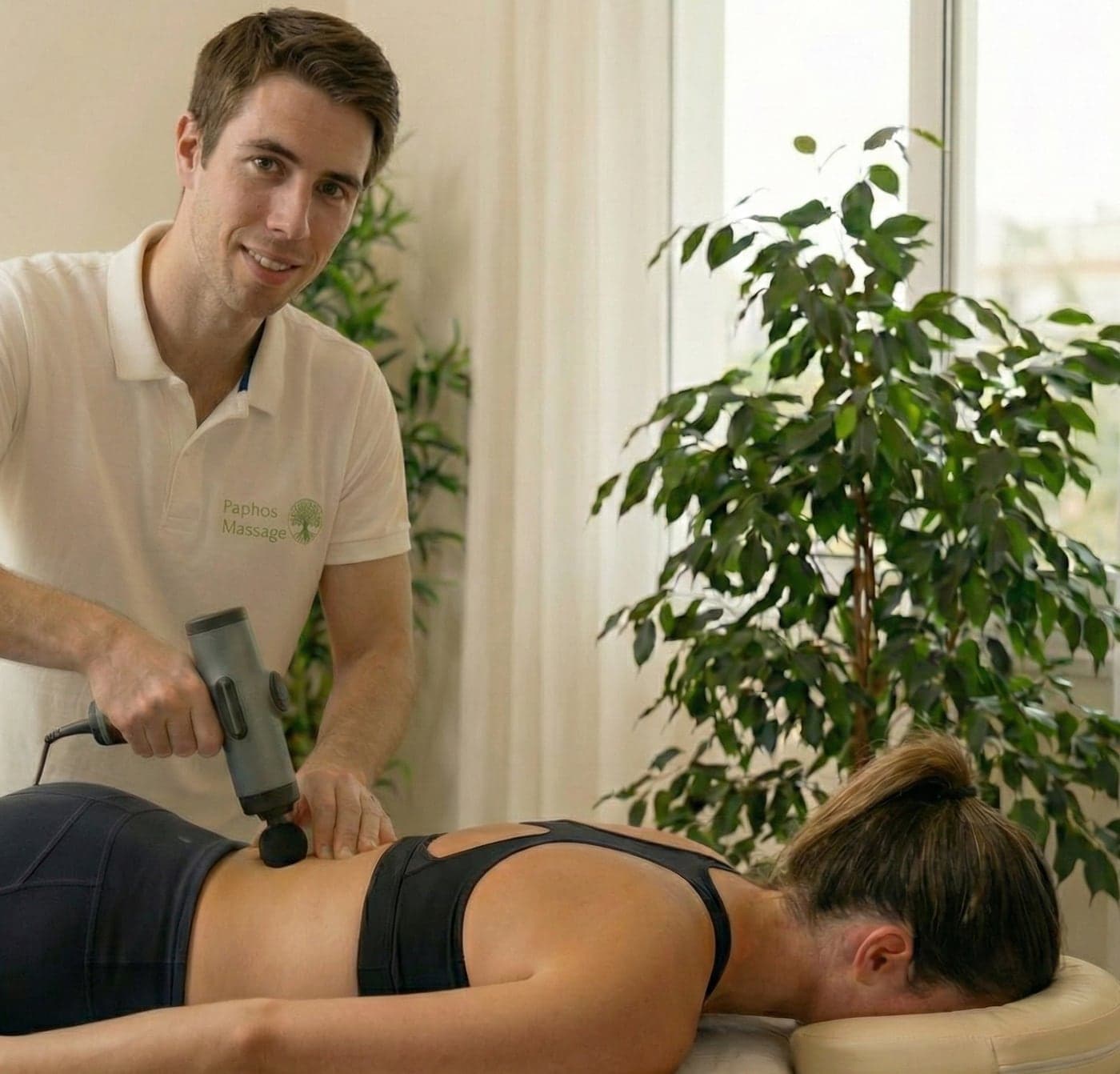
Hands are still central to how I work, but there is a limit to how long anyone can hold deep, steady pressure into the psoas or under the gluteus maximus. That is why I use a mechanical deep-tissue device alongside my hands: slow, controlled compression at a consistent depth for as long as the tissue needs, reaching the deep rotators and the iliacus more precisely than I could manually.
How a hip pain massage session works
Every session starts with a short conversation and a few simple movement checks. I want to know when the hip hurts, what eases it, how you sit and sleep, whether you train, and any history of injury or surgery. Then I palpate the region to find where the tissue is dense and reactive rather than assuming from the description.
Depth is calibrated to you. I work at the point where you feel firm, meaningful pressure but can still keep your breathing slow. If you tense against it the muscle guards and nothing changes, so pushing harder is not the aim.
A 60-minute session (€90) is enough for a focused hip treatment on one side or both. If the hip pain is part of a wider pattern with the lower back or the knee, the 90-minute session (€130) lets me address the whole chain. A package of five pre-booked sessions includes one additional free session, which matters for chronic cases where a series makes more sense than a one-off. Details are on the pricing page.
Common hip presentations and what I focus on
Hip pain is not one thing. The location tells me most of what I need to know about which tissue to prioritise.
| Where it hurts | What I usually find | Main focus of the treatment |
|---|---|---|
| Front of the hip / groin, worse after sitting | Short, dense iliopsoas; tender adductors | Deep psoas and iliacus release, adductor work |
| Outer hip, painful lying on that side | Overloaded gluteus medius, tender TFL | Gluteal complex, TFL, lateral thigh |
| Buttock, sometimes ache down the back of the thigh | Tight piriformis and deep rotators | Deep rotator release, gluteus maximus |
| Clicking or snapping at the front | Iliopsoas tendon riding over the joint | Iliopsoas release, hip flexor pattern |
| Vague, deep ache after long walks | Combination of the above, often with lower back involvement | Whole hip and lumbar chain, usually 90 minutes |
The presentation I see most often, whether in Paphos town or out in the villages, is the desk-and-car hip: an anterior ache from a shortened psoas, with the gluteals underworking as a result. Because the psoas attaches to the lumbar spine, this pattern often comes with a stiff lower back, and treating one without the other rarely holds.
The iliopsoas problem
The psoas is the muscle I spend the most time on. When it sits shortened for hours every day it pulls the hip into flexion; the gluteals cannot extend the hip cleanly, the hamstrings take over, and the lower back compresses. Releasing it needs slow, patient pressure through the lower abdomen and along the inner thigh, which is exactly where the mechanical method earns its place.
Lateral hip and the IT band
When the outer hip hurts, the IT band is usually blamed. It is passive fascia and does not tighten on its own; the tension comes from the tensor fasciae latae and gluteus medius above it, so that is where I work.
What to expect afterwards and how many sessions
Deep work on chronically tight hip muscles is not a relaxation massage. It is clinical, and it leaves the area feeling worked.
How many sessions is a fair question. Recent tightness from a training spike or a long drive often settles in one or two visits. Chronic patterns that have built up over months usually need a short series, weekly at first and then spaced out, and I will tell you at the first session whether that is what I think you are looking at. Pre-book five sessions as a package and receive one additional session free.
What I can help with is muscular and fascial hip pain — tight flexors, gluteal overload, deep rotator tension and the referred ache that goes with them. What I cannot treat is a labral tear, advanced arthritis, a stress fracture or a hernia, so see a doctor first if the pain followed a fall or trauma, if there is night pain that does not ease with position, unexplained swelling, fever, numbness or weakness in the leg, or if you cannot bear weight. If you have already been diagnosed with hip osteoarthritis, soft-tissue work can still ease the muscular component around the joint, and I am happy to work alongside your doctor's plan.
Keeping the hip moving between sessions
The change I create on the table lasts longer when the hip is used well between visits. Nothing complicated is needed.
- Break up sitting: stand and take a few steps every 30–40 minutes, particularly on long drives
- A gentle hip flexor stretch in a half-kneel, held for a slow minute each side, once or twice a day
- Glute activation before walks or runs — a set of bridges or side-lying leg lifts is enough
- Sleep with a pillow between the knees if the outer hip is the tender side
- For runners in the district, keep the ramp-up gradual and vary the surface where you can
If the tightness feels more like a stiff, bound sheet than a knot, my myofascial release page describes the slower fascial side of the same work; the two are often combined in one 90-minute session.
Frequently asked questions
Is hip pain massage painful?
It is firm and deliberate rather than painful. I work at the depth where you feel strong pressure but can still breathe slowly and stay relaxed. If you tense or hold your breath the pressure is too much and I ease off immediately. Most people describe the sensation as intense but satisfying, and there is usually a clear moment where the tissue lets go under the pressure. Some soreness afterwards is normal and settles within a day or two.
How is this different from a regular massage?
A general massage works broadly across the muscles for relaxation. Hip pain treatment is targeted: I assess first, then spend most of the session on the specific tight groups — psoas, gluteus medius, the deep rotators — using slow, sustained mechanical pressure alongside my hands. The aim is to change how the tissue moves and how the hip functions, not simply to relax you, though most people find they relax anyway once the deep tension eases.
Can massage help if I have hip arthritis?
I cannot change the joint surface, and I will not pretend otherwise. But much of the pain around an arthritic hip comes from the muscles guarding it — a shortened psoas, an overloaded gluteus medius, tight rotators. Releasing those often improves comfort and range noticeably. Please have your doctor's diagnosis first, and tell me at booking; I adjust the depth and positioning accordingly and avoid anything that stresses the joint.
Do you treat the front of the hip and groin?
Yes. Anterior hip and groin ache is the most common presentation I see, and it usually traces to the iliopsoas and the adductors. Treating the psoas means working slowly through the lower abdomen and along the inner thigh, which I explain and ask permission for beforehand. You stay covered throughout and can stop at any point. Where the groin pain followed a sudden strain, or there is a bulge, see a doctor first to rule out a hernia.
What should I prepare at home?
Very little. I bring the treatment table, the mechanical device, linens and everything else; I need a space roughly two metres by three and a few minutes to set up. Wear loose shorts or underwear you are comfortable in, as I need access to the hip and thigh. Avoid a heavy meal or hard training just before the session, and have a little time afterwards to walk gently rather than rushing straight into the car.
How do I book a hip pain massage in Paphos?
Send me a WhatsApp message or call. Tell me where the hip hurts, how long it has been going on, and where in the Paphos district you are — I am based in Chlorakas and travel across the district. I will suggest 60 or 90 minutes based on what you describe, and we agree a time. If anything you mention sounds like it needs a doctor's opinion first, I will say so before we book.
Evidence and limits
Massage may help with some symptoms, but benefits and evidence vary by condition. It does not replace medical assessment or treatment. A page update is not evidence of an independent clinical review.
Further reading: Massage therapy: evidence, safety and limitations by US National Center for Complementary and Integrative Health. This is general background reading, not verification of every claim in this article.
How we describe evidence and updates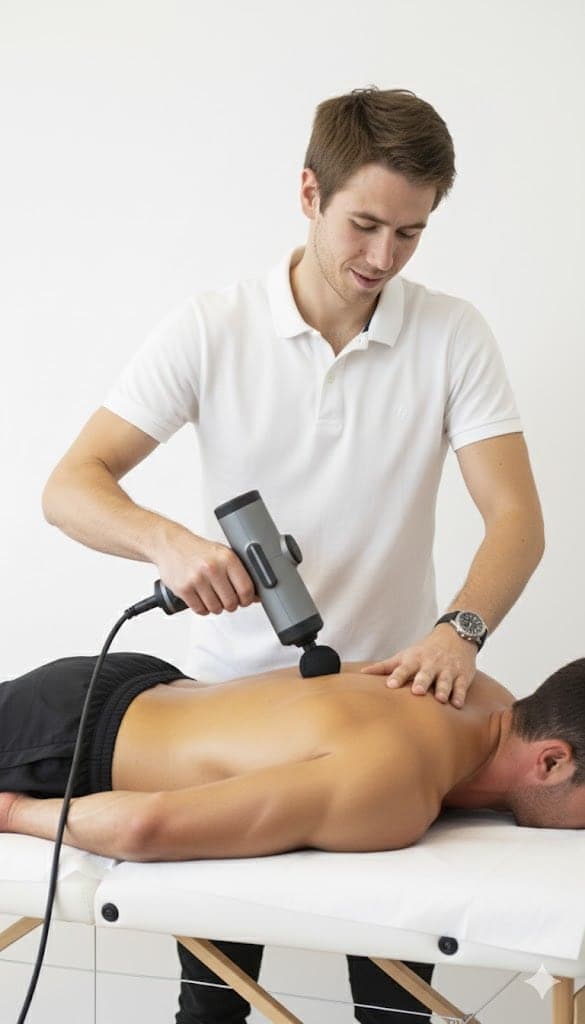
Written by
Chris
Massage therapist, nutrition and exercise physiologist
Norwegian-certified with a Bachelor’s in Physical Education and Nutrition and over ten years of clinical practice, working from a portable table in clients’ homes across the Paphos district.
- Norwegian-certified
- Nutrition & exercise physiologist
- 10+ years clinical practice
- Based in Chlorakas · all of Paphos district
- No call-out fee anywhere in Paphos district
Last updated
This article is general information, not a medical diagnosis. If you have severe, worsening or unexplained pain, numbness, weakness, or pain after an accident, see a doctor first.