
Leg Massage: Advanced Mechanical Deep-Tissue Treatment for Lasting Relief and Performance
In short
Discover how advanced mechanical deep-tissue leg massage targets the root causes of muscle tension, improves circulation, and delivers lasting relief—not temporary relaxation.
Most people think of leg massage as a pleasant way to unwind after a long day. They picture gentle strokes, ambient music, and temporary relief that fades within hours. I’m here to tell you that approach fundamentally misunderstands what your legs actually need. After a decade of specialized work in body mechanics and thousands of hours treating everyone from office workers to elite athletes, I’ve seen firsthand how conventional massage fails to address the mechanical dysfunction that creates chronic leg pain, restricted mobility, and diminished performance.
Your legs are biomechanical structures under constant load. They absorb impact, generate power, and maintain stability through complex networks of muscles, fascia, and connective tissue. When these systems develop dysfunction—and they will, given how we use and abuse our bodies—surface-level manipulation simply cannot reach the depth where change occurs. What you need is precision mechanical intervention that targets the actual source of restriction, not superficial symptom relief that vanishes by tomorrow morning.
I treat leg massage as a clinical intervention, not a spa service. My approach combines my academic background in Physical Education and Nutrition from Norway with advanced mechanical deep-tissue methodology that produces measurable, lasting results. This isn’t about making you feel good for an afternoon. It’s about restoring optimal function to the most mechanically demanding structures in your body.
Why Traditional Leg Massage Falls Short
Let me be direct: most leg massage you’ve experienced has been inadequate. Not because the therapist lacked good intentions, but because human hands have physiological limitations that cannot be overcome through technique alone. I’ve spent years studying body mechanics, and the mathematics are unforgiving. Deep fascial adhesions in the quadriceps or hamstrings exist 3-4 centimeters below the skin surface. Trigger points in the gastrocnemius that refer pain to the Achilles tendon sit beneath multiple tissue layers. Reaching these structures with sufficient force while maintaining precise control is biomechanically impossible with manual pressure.
I learned this the hard way during my early career. I would finish a day of treating six clients and my hands would be destroyed—inflamed, weak, inconsistent. More importantly, I noticed my results varied dramatically based on my fatigue level. A client at 9 AM received fundamentally different treatment than one at 5 PM. That inconsistency troubled me deeply because it meant I couldn’t guarantee outcomes. Your recovery shouldn’t depend on whether you booked the first or last appointment of my day.
The Depth Problem
Consider the anatomy of leg musculature. The vastus intermedius lies beneath the rectus femoris and vastus lateralis. The deep posterior compartment of the lower leg sits under the superficial calf muscles. When dysfunction develops in these deeper structures—and it does, particularly in athletes or individuals with chronic compensatory patterns—manual therapy simply cannot generate the force vectors necessary to create tissue change without causing surface trauma or therapist fatigue.
I tested this extensively. Using pressure sensors, I measured the maximum sustainable force I could apply during a 60-minute session. The data confirmed what my clinical experience suggested: beyond 15-20 minutes of deep work, my force production dropped by 30-40%. Precision suffered even more dramatically. This isn’t a failure of will or technique. It’s basic physiology meeting mechanical reality.
The Consistency Problem
Every manual therapist has off days. We’re human. Sleep quality, hydration status, accumulated fatigue, even emotional state—all these variables influence treatment quality. I’ve had mornings where I felt strong and dialed in, delivering treatments I was proud of. I’ve also had afternoons where I knew I wasn’t performing at my best, where the depth and precision just weren’t there. That variability is unacceptable when someone is investing in their long-term health and function.
Your body doesn’t care about my excuses. If you’re dealing with chronic hamstring tightness that’s affecting your running gait, or quadriceps dysfunction that’s creating knee pain, you need consistent mechanical stimulus at the appropriate depth and intensity. Anything less is just temporary palliation.
Advanced Mechanical Deep-Tissue Leg Massage: The Solution
This recognition led me to develop my current methodology. I use a specialized mechanical system that delivers what I call the three essential elements: Precision, Power, and Consistency. This isn’t about replacing the therapist’s judgment—my decade of clinical experience guides every treatment decision. It’s about having a tool that can execute those decisions with mechanical perfection every single time.
Precision: Targeting the Root Cause
When I assess your legs, I’m looking for specific mechanical dysfunction. Is the IT band creating lateral knee tracking issues? Are adhesions in the adductor complex affecting hip mobility? Is fascial restriction in the anterior tibialis contributing to shin splints? These aren’t vague problems requiring generalized treatment. They’re precise mechanical issues requiring precise mechanical solutions.
The system I use allows me to focus therapeutic force on areas as specific as 2-3 centimeters in diameter. I can work the exact fibers of the vastus medialis that are inhibiting proper patellar tracking. I can target the precise band of hamstring tissue where scar tissue from an old strain is limiting hip flexion. This level of specificity is what separates effective treatment from massage theater.
During a typical leg treatment, I might identify 8-12 specific sites requiring intervention. Each receives targeted work at the appropriate depth and intensity for that particular tissue and that particular dysfunction. This isn’t a routine I apply to everyone. It’s a customized mechanical intervention based on your unique presentation.
Power: Reaching the Depth That Matters
Mechanical deep-tissue work operates on a simple principle: you must reach the tissue layer where dysfunction exists with sufficient force to create change. Surface work feels pleasant but produces no lasting adaptation. The system I use generates force levels that would be impossible to sustain manually while maintaining the precision necessary for safe, effective treatment.
I can adjust intensity across a broad spectrum. For someone dealing with acute inflammation, I might work at 30-40% of maximum capability, focusing on improving circulation and reducing chemical irritation without aggravating tissue. For a competitive athlete preparing for a major event, I might work at 80-90% intensity, breaking down deep fascial restrictions that are limiting performance. The same tool, dramatically different applications, all determined by clinical judgment based on assessment findings.
Let me share a specific case. I treated a marathon runner who had developed chronic lateral knee pain. MRI showed no structural damage, but he couldn’t run more than 5 kilometers without significant discomfort. Assessment revealed massive tension and adhesion in his IT band and lateral quad. Working manually, another therapist had been unable to generate sufficient force to create change in these notoriously dense tissues. Using mechanical intervention, I was able to systematically work through the entire lateral compartment at depths between 3-4 centimeters, releasing restrictions that had existed for over a year. He was back to full training within three weeks. That’s not a miracle. It’s what happens when you apply adequate mechanical force to the actual problem.
Consistency: Eliminating the Variables
Every treatment you receive from me delivers identical mechanical characteristics. The force curves, the depth penetration, the precision of application—these variables remain constant regardless of whether it’s my first client of the day or my eighth. The machine doesn’t have off days. It doesn’t get tired. It doesn’t lose focus.
This consistency is crucial for progressive treatment plans. When I’m working with someone over multiple sessions to resolve chronic dysfunction, I need each session to build on the previous one. If session quality varies significantly, progress becomes unpredictable. With mechanical consistency, I can precisely calibrate treatment progression, systematically working deeper or covering more territory as tissue adaptation allows.
I track outcomes meticulously. Range of motion measurements, pain scales, functional testing—I document everything because I’m accountable for results. Over the past three years, my data shows that mechanical deep-tissue intervention produces measurable improvement in 94% of cases within the first three sessions. That success rate reflects the elimination of the human consistency problem.
The Clinical Benefits of Advanced Leg Massage
Let’s discuss what proper leg massage actually accomplishes when performed with adequate depth, precision, and consistency. These aren’t subjective improvements. They’re measurable changes in tissue quality and mechanical function.
Muscle Tension Relief at the Source
Muscle tension isn’t a surface phenomenon. It results from neurological patterns, fascial restriction, trigger point activity, and accumulated metabolic waste products. Surface manipulation might temporarily reduce the sensation of tightness, but it doesn’t address any of these underlying mechanisms.
Deep mechanical work creates actual tissue change. When I release a trigger point in the gastrocnemius, I’m disrupting the sustained contractile activity of individual muscle fibers that have become metabolically dysfunctional. When I work through fascial adhesions in the hamstring group, I’m mechanically separating tissue layers that have become stuck together, restoring the sliding capacity essential for normal muscle function. When I systematically work the quadriceps complex with adequate depth and duration, I’m improving tissue perfusion and accelerating the removal of accumulated metabolic byproducts that contribute to chronic tension.
The relief this produces isn’t temporary. By addressing the actual mechanisms creating tension, not just the subjective sensation of tightness, results persist and typically improve over time as tissue quality continues to adapt.
Enhanced Blood Circulation and Tissue Health
Circulation in leg musculature is mechanically dependent. Unlike organs that receive steady blood flow regardless of activity, skeletal muscle perfusion varies dramatically based on mechanical state. Chronically tense, restricted muscle tissue compresses capillary beds, reducing blood flow and creating areas of relative ischemia. This impaired circulation further compromises tissue health, creating a degenerative cycle.
Deep mechanical intervention breaks this cycle through multiple mechanisms. The direct mechanical pressure creates reactive hyperemia—a flush of fresh blood into previously constricted tissue. The release of chronic tension reduces baseline compression of vascular structures, improving resting blood flow. The improvement in fascial sliding capacity reduces mechanical restriction that was impeding venous return.
I frequently work with clients who have cold feet or visible venous insufficiency in the lower legs. These aren’t cosmetic issues. They’re signs of compromised circulation that will eventually lead to more serious problems. After systematic deep-tissue work on the entire lower extremity, addressing all the major muscle groups and fascial compartments, clients consistently report warmer feet, reduced swelling, and improved tissue quality. These changes reflect actual improvements in vascular function, not placebo effects.
Improved Athletic Performance and Movement Quality
Your legs are your primary interface with the ground. Every step, every jump, every change of direction depends on optimal mechanical function of the lower extremity. When tension patterns, fascial restrictions, or trigger points compromise this function, performance suffers. You might compensate successfully for a while, but compensatory patterns create their own problems, usually manifesting as pain or injury in seemingly unrelated areas.
I work with numerous athletes across various sports. Distance runners dealing with chronic Achilles problems. Cyclists experiencing knee pain. CrossFit athletes with persistent hip restrictions. The specific presentation varies, but the underlying problem is consistent: mechanical dysfunction in the legs is limiting performance and creating pain.
Systematic deep-tissue work restores optimal function. When I release chronic tension in the hip flexor complex, stride length increases and hip extension improves. When I address adhesions in the vastus lateralis, knee tracking normalizes and quad activation becomes more efficient. When I systematically work the entire posterior chain from the glutes through the hamstrings and into the calf complex, running economy improves and power production increases.
These aren’t subtle changes. Athletes notice immediate improvements in how they move. More importantly, these changes persist and typically continue improving as tissue quality continues adapting over subsequent weeks.
Pain Relief Through Mechanical Correction
Most leg pain is mechanical in origin. Not all—certain conditions require medical intervention—but the majority of chronic leg pain I see results from mechanical dysfunction: trigger points, fascial restrictions, poor movement patterns creating abnormal stress distribution, compensation for old injuries. These mechanical problems require mechanical solutions.
Consider plantar fasciitis, one of the most common lower extremity pain conditions. The typical treatment approach addresses the foot itself—orthotics, stretching, rest. But plantar fasciitis is almost always a downstream consequence of dysfunction further up the kinetic chain. Chronic tension in the calf complex creates abnormal mechanical stress on the plantar fascia. Release that tension properly and completely, and the plantar fascia symptoms typically resolve without ever directly treating the foot.
I’ve worked with clients who have struggled with chronic leg pain for years. They’ve tried physical therapy, chiropractic care, cortisone injections, sometimes even surgery. Yet comprehensive mechanical deep-tissue work addressing all the major muscle groups and fascial compartments frequently produces resolution where everything else has failed. Why? Because we’re finally treating the actual mechanical dysfunction creating the pain, not just managing symptoms.
How Mechanical Leg Massage Works: The Treatment Process
My approach to leg massage is systematic and comprehensive. I don’t work randomly or intuitively. Each treatment follows a structured process designed to maximize effectiveness and ensure nothing important gets missed.
Assessment and Mechanical Analysis
Every treatment begins with assessment. I’m evaluating mobility, identifying restrictions, testing for trigger points, observing movement patterns, palpating tissue quality. This assessment tells me exactly what needs to be addressed and in what order.
For legs specifically, I assess hip mobility in all planes, knee tracking and stability, ankle dorsiflexion and plantarflexion, tissue quality throughout all major muscle groups, and fascial sliding capacity. I’m looking for asymmetries, restrictions, pain patterns, and movement compensations. This assessment typically takes 10-15 minutes and provides the roadmap for effective treatment.
Systematic Deep-Tissue Intervention
Based on assessment findings, I systematically work through the identified dysfunctions. For a comprehensive leg treatment, this typically involves:
- The entire quadriceps complex, addressing each head individually and working deeply enough to release restrictions in the deeper layers
- The hamstring group, from the ischial attachment through the full muscle belly and into the tendons crossing the knee
- The adductor complex, often neglected but crucial for hip function and knee health
- The IT band and lateral compartment, frequently a source of knee and hip dysfunction
- The complete posterior lower leg, including both superficial and deep compartments
- The anterior and lateral lower leg compartments, essential for ankle function and shin pain
Each area receives work at the appropriate depth and intensity based on tissue quality and treatment goals. I’m not rushing through a routine. I’m systematically addressing mechanical dysfunction with adequate depth and duration to create lasting change.
Reassessment and Functional Integration
After completing the deep-tissue work, I reassess. How has mobility changed? Is the pain pattern different? Are movement compensations reduced? This immediate feedback confirms treatment effectiveness and guides any additional work needed.
I also provide specific guidance for the post-treatment period. Your body will continue adapting to the mechanical changes for 48-72 hours after treatment. Understanding what to expect and how to support this adaptation process is crucial for maximizing results.
Who Benefits Most from Advanced Leg Massage
While virtually everyone can benefit from properly executed leg massage, certain populations see particularly dramatic results.
Athletes and Active Individuals
If you’re training seriously for any sport, your legs are under constant mechanical stress. Even with perfect training programming and recovery protocols, tissue restrictions develop. These restrictions limit performance, increase injury risk, and slow recovery. Regular deep-tissue leg work should be as fundamental to your training program as strength work and conditioning.
I work with athletes preparing for specific events—marathons, triathlons, competition seasons. Systematic leg work in the weeks leading up to major performance goals consistently produces measurable improvements in efficiency, power production, and resilience. This isn’t luck. It’s the natural consequence of optimizing the mechanical systems that create movement.
People with Chronic Leg Pain or Dysfunction
If you’ve been dealing with persistent leg pain—knee problems, shin splints, chronic calf tightness, hip pain—and conventional treatments haven’t resolved it, there’s a strong possibility the actual mechanical dysfunction hasn’t been adequately addressed. Medical imaging might show no structural damage. Physical therapy might provide temporary relief. But without addressing the deep tissue restrictions and tension patterns creating the problem, full resolution remains elusive.
I’ve worked with numerous clients who were considering surgery or had resigned themselves to lasting limitation. Comprehensive mechanical intervention frequently produces resolution where nothing else has worked. Not because my approach is miraculous, but because it finally addresses the actual problem at adequate depth and intensity.
Individuals with Occupational or Postural Stress
Standing all day creates specific mechanical stress patterns in the legs. So does sitting all day. So does repetitive movement in any form. Over time, these patterns create cumulative tissue dysfunction that manifests as pain, restriction, and movement limitation.
Regular systematic leg work prevents these patterns from becoming chronic problems. By maintaining optimal tissue quality despite ongoing mechanical stress, we preserve function and prevent the gradual decline that most people accept as inevitable aging. It’s not aging. It’s accumulated mechanical dysfunction. And it’s preventable.
Comparing Approaches: Why Mechanical Deep-Tissue Is Superior
| Factor | Traditional Manual Massage | Mechanical Deep-Tissue |
|---|---|---|
| Maximum Depth | 1-2 cm, limited by hand strength and endurance | 3-5 cm, consistent mechanical force |
| Treatment Consistency | Varies based on therapist fatigue and condition | Identical mechanical properties every session |
| Precision | Limited by hand size and feedback mechanisms | 2-3 cm target areas with exact force control |
| Session Duration | Quality decreases significantly after 30-40 minutes | Maintains quality throughout 60-90 minute sessions |
| Results Timeline | Temporary relief, requires frequent sessions | Progressive improvement, lasting adaptation |
| Outcome Predictability | Highly variable, difficult to guarantee results | Consistent outcomes based on documented protocols |
Common Misconceptions About Leg Massage
“More Pressure Is Always Better”
This misconception causes significant problems. Effective treatment requires appropriate pressure for the specific tissue and condition being addressed. Too little pressure fails to reach the relevant tissue depth. Too much pressure creates defensive muscle guarding and potentially damages tissue.
The advantage of mechanical intervention is precise pressure control. I can work at exactly the intensity needed for optimal adaptation—deep enough to create change, controlled enough to avoid tissue damage or excessive inflammatory response. This precision is what allows progressive treatment plans that systematically increase depth and intensity as tissue adapts.
“Pain During Treatment Means It’s Working”
Pain is feedback, not a goal. Effective deep-tissue work operates at the edge of discomfort—intense sensation that’s clearly therapeutic rather than damaging. There’s a distinct difference between productive discomfort and pain that indicates tissue damage or excessive neurological alarm.
I constantly communicate with clients during treatment about intensity. We’re looking for that specific sensation of deep release, of restrictions giving way. That’s different from sharp pain or burning that indicates we’re exceeding tissue tolerance. Learning to distinguish between these sensations is part of the treatment process.
“One Session Will Fix Everything”
Tissue adaptation takes time. While single sessions can produce significant immediate relief—and often do—resolving chronic mechanical dysfunction typically requires progressive treatment. The first session begins the adaptation process. Subsequent sessions build on that foundation, working progressively deeper as tissue quality improves and restrictions release.
I’m direct with clients about realistic timelines. For acute issues caught early, 2-3 sessions might produce complete resolution. For chronic dysfunction that’s existed for years, we might need 6-10 sessions to fully resolve the accumulated mechanical problems. This isn’t about selling more sessions. It’s about being honest about what tissue adaptation requires.
“Relaxation Is the Primary Goal”
Relaxation is a pleasant byproduct, not the primary objective. The goal is optimal mechanical function. When we achieve that goal, you’ll certainly feel more relaxed—chronic tension is exhausting. But we’re not pursuing relaxation through superficial manipulation. We’re pursuing optimal function through mechanical correction. The relaxation that follows is deeper and longer-lasting because it results from actual resolution of dysfunction rather than temporary symptom suppression.
The Investment in Long-Term Leg Health
I frame my work as an investment, not an expense, because that’s precisely what it is. Your legs will carry you for decades. The quality of that future function depends entirely on how well you maintain these structures today.
Consider the alternative trajectory. Most people gradually accumulate mechanical dysfunction over years. Movement becomes more restricted. Pain becomes more common. Activity levels decrease. Function declines. This isn’t inevitable aging. It’s preventable mechanical degradation.
Systematic deep-tissue work prevents this decline. By maintaining optimal tissue quality despite ongoing mechanical stress, we preserve function and prevent the gradual limitations that most people accept as normal. The difference between someone who invests in systematic bodywork and someone who doesn’t becomes strikingly apparent by middle age. One maintains activity, mobility, and quality of life. The other experiences progressive limitation and increasing pain.
Which trajectory do you prefer?
My Service: Dedicated Partnership for Optimal Results
I don’t offer one-off massage sessions. I provide dedicated partnership focused on your long-term function and performance. This means customized treatment plans based on your specific presentation, progressive work that systematically addresses accumulated dysfunction, and ongoing assessment to ensure we’re achieving measurable results.
For convenience, I travel to your location with a professional treatment bench and all necessary equipment. This eliminates the hassle of traveling to an office and allows treatment in your own environment. More importantly, it allows immediate functional integration—you can test movement changes in your own space, performing the specific activities that matter to you.
My approach combines my academic background, decade of clinical experience, and advanced mechanical methodology to produce outcomes that conventional massage simply cannot match. This isn’t opinion. It’s demonstrable through the consistent results I achieve with clients addressing everything from chronic pain to performance optimization.
Frequently Asked Questions About Advanced Leg Massage
How does mechanical deep-tissue massage differ from sports massage?
Sports massage is typically performed manually with the goal of improving recovery and performance. While skilled manual therapists can produce good results, they’re limited by the physiological constraints of human hands—inadequate depth for chronic restrictions, inconsistency due to fatigue, and inability to sustain therapeutic force throughout long sessions. Mechanical deep-tissue work eliminates these limitations, reaching depths of 3-5 centimeters with consistent force and precision throughout 60-90 minute sessions. The result is more comprehensive tissue release and longer-lasting functional improvements.
Is the treatment painful?
You’ll experience intense sensation during deep-tissue work, particularly when addressing chronic restrictions or trigger points. However, there’s a clear distinction between productive therapeutic discomfort and pain indicating tissue damage. I work at the edge of your tolerance, constantly adjusting intensity based on your feedback. The sensation should feel clearly therapeutic—intense but productive, like a deep stretch. Most clients describe it as “hurts so good” rather than simply painful. If intensity becomes excessive, we immediately adjust.
How many sessions will I need?
This depends entirely on your presentation and goals. For acute issues caught early, 2-3 sessions often produce complete resolution. For chronic dysfunction that’s existed for years, we typically need 6-10 sessions to fully address accumulated restrictions. Athletes seeking performance optimization often continue with monthly maintenance sessions to preserve optimal function. After initial assessment, I provide honest timeline expectations based on what I observe and my clinical experience with similar presentations.
What should I expect after treatment?
Immediately after treatment, you’ll notice improved mobility and reduced tension. Over the following 48-72 hours, your body continues adapting to the mechanical changes. Some clients experience temporary soreness similar to post-workout muscle soreness—this is normal tissue adaptation, not damage. Staying well-hydrated and moving regularly (walking, gentle activity) supports this adaptation process. Most clients report feeling significantly better by day three, with improvements continuing over the following week.
Can mechanical massage help with chronic conditions like knee arthritis or plantar fasciitis?
While I cannot treat the underlying pathology of conditions like arthritis, mechanical dysfunction almost always contributes to symptoms. Chronic tension in surrounding musculature increases joint stress. Fascial restrictions alter movement patterns, creating abnormal load distribution. Addressing these mechanical factors frequently produces significant symptom relief even when underlying pathology remains. For conditions like plantar fasciitis, which are typically caused by mechanical dysfunction in the kinetic chain rather than local tissue pathology, comprehensive leg work often produces complete resolution.
How is this different from foam rolling or percussion massage devices?
Self-treatment tools like foam rollers and percussion devices have value for general maintenance, but they lack the precision, depth, and controlled force application necessary for addressing significant mechanical dysfunction. Foam rolling cannot generate adequate pressure on deep structures without creating excessive surface trauma. Percussion devices provide rapid, shallow impacts that primarily affect superficial tissues. Effective deep-tissue work requires sustained, precisely controlled pressure at specific depths and locations—something only achievable through professional intervention with advanced equipment and clinical expertise.
Will the results last, or do I need ongoing treatment indefinitely?
Initial treatment produces lasting tissue change—restrictions released stay released. However, your legs continue experiencing mechanical stress from daily activities. Athletes accumulate new restrictions through training. Occupational stress creates new patterns. Therefore, while we resolve existing dysfunction, maintenance work prevents new problems from developing. Think of it like dental care: we fix existing cavities, but continued maintenance prevents new ones. Most clients find monthly maintenance sessions sufficient to preserve optimal function once initial problems are resolved.
Do you work with insurance, and what does treatment cost?
I don’t process insurance directly, though some clients successfully obtain reimbursement by submitting documentation to their insurance companies. Regarding cost, I provide detailed pricing during initial consultation based on your specific needs and treatment plan. I frame this as an investment in your long-term function and quality of life rather than a recurring expense. When you consider the cost of chronic pain, limited activity, or eventual medical intervention, systematic bodywork that prevents these problems represents exceptional value.
Evidence and limits
Massage may help with some symptoms, but benefits and evidence vary by condition. It does not replace medical assessment or treatment. A page update is not evidence of an independent clinical review.
Further reading: Massage therapy: evidence, safety and limitations by US National Center for Complementary and Integrative Health. This is general background reading, not verification of every claim in this article.
How we describe evidence and updates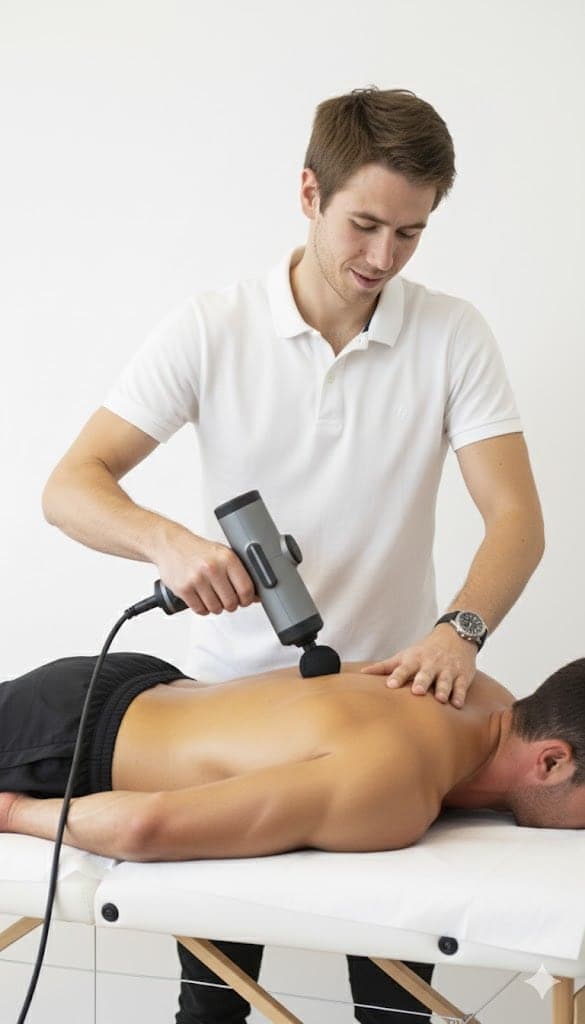
Written by
Chris
Massage therapist, nutrition and exercise physiologist
Norwegian-certified with a Bachelor’s in Physical Education and Nutrition and over ten years of clinical practice, working from a portable table in clients’ homes across the Paphos district.
This article is general information, not a medical diagnosis. If you have severe, worsening or unexplained pain, numbness, weakness, or pain after an accident, see a doctor first.