
Cycling recovery massage Kato Paphos: deep-tissue work after the ride
In short
Cycling recovery massage Kato Paphos: I come to your apartment or hotel with the table, assess how you move, then work the hip flexors, quads, glutes and calves layer by layer so the legs recover for the next ride.
I am a mobile massage therapist based in Chlorakas, and a good share of my work is massage for cyclists staying or living along the Kato Paphos seafront. This article explains what I actually do in a cycling recovery massage in Kato Paphos, why I work the way I do, and how to time it around your riding.
What long rides around Kato Paphos do to the legs
The riding out of Kato Paphos has a particular shape. The coast road towards Coral Bay and Pegeia is long, steady and often windy. The climbs inland towards Tsada and the Troodos foothills are sustained rather than punchy. Both create the same underlying pattern: hours in hip flexion, thousands of near-identical pedal strokes, and very little range of motion outside the pedalling arc.
The presentation I see most often after a big block of riding is predictable:
- Hip flexors that have shortened from sitting in the saddle, so standing tall and extending the hip feels stiff
- Dense, hypertonic zones in the mid-belly of vastus lateralis, where most of the downstroke force is generated
- Piriformis and gluteus medius working overtime because hip extension is limited
- A stiff thoracolumbar junction from holding the trunk forward for hours
- Calves that feel like a solid block after repetitive plantar flexion, with reduced ankle dorsiflexion
Add the Paphos heat and the effect of headwinds along the coast, which load one side more than the other, and you get asymmetries that show up as one heavy leg or a niggling knee. None of this is dramatic on its own. It becomes a problem when the next ride starts before the tissue has recovered.
How I work: mechanical deep tissue, layer by layer
My training is a BSc in Physical Education and Nutrition from Norway, and I have worked as a massage therapist for over ten years. Over that time I have moved almost entirely to a mechanical deep-tissue approach: a purpose-built treatment tool that lets me hold precise, sustained pressure at a chosen depth and angle without my hands tiring or the pressure drifting.
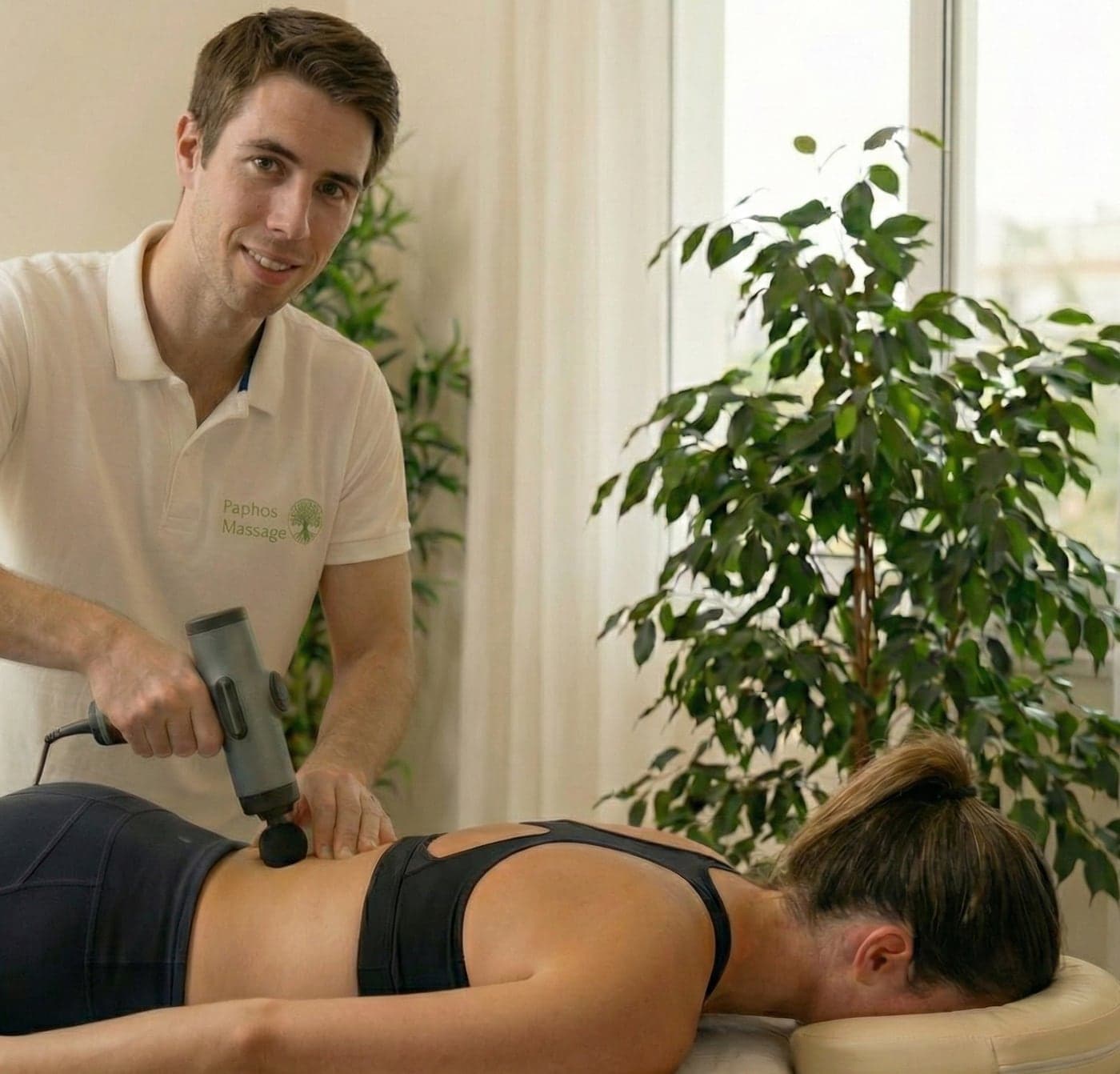
For cyclists this matters for three reasons.
I still use my hands to assess and to prepare the tissue. The tool is how I do the deep, sustained part of the work. It is not a percussion gun, and I do not simply press harder as I go. I work through distinct tissue planes, letting the superficial layer release before I move deeper.
What a cycling recovery massage in Kato Paphos looks like
I bring a proper treatment table and everything else needed. A one-bedroom apartment near the harbour or a hotel room is plenty of space. Sessions are 60 minutes (€90) or 90 minutes (€130); the 90-minute option is what I usually recommend for a full lower-body session after a long ride. Full details are on the pricing page.
Before I start I watch you walk, check hip rotation and ankle dorsiflexion, and palpate the usual landmarks. That tells me the order of work. I go proximal to distal: if the hip flexors are short, releasing the calves first is a waste of time, because the whole chain stays in the same pattern.
| Area | What cycling does to it | What I do |
|---|---|---|
| Hip flexors (psoas, iliacus, rectus femoris) | Shortened from sustained hip flexion | Sustained compression with the hip in extension; work along the muscle belly |
| Quadriceps | Dense zones from repeated concentric loading; adhesions between the vasti | Cross-fibre work along the muscle borders; held pressure on the dense zones |
| Hip external rotators and glute med | Overworking to compensate for poor hip extension | Slow, deep trigger-point work with the hip in internal rotation |
| IT band and TFL | Lateral tension, friction at the outer knee | Perpendicular pressure to free the fascial layers; TFL origin work |
| Thoracolumbar junction | Stiff from the forward trunk position | Paraspinal work and erector spinae release |
| Calves | Compartment density, poor dorsiflexion | Compartment-specific work; pressure at the muscle-tendon junction |
The work is not comfortable, and I will not pretend otherwise. It sits at the level of a strong stretch that you can breathe through, and I stay within what you can tolerate. Where I find an active trigger point in the piriformis or TFL, I hold pressure until it lets go, usually a minute or so, and you will often recognise the referral pattern down the leg as it fades.
Timing, frequency and what to expect afterwards
The window I aim for is roughly six to 24 hours after a hard ride. Earlier than that and the tissue is too irritable to work deeply; much later and the compensation patterns have started to settle in. Coming to you means you can finish the ride, cool down, eat and shower, and then get on the table without driving across town with your hips flexed again.
How often depends on load. During a heavy training block or a cycling holiday with back-to-back long days, every four to seven days keeps the legs workable. In lighter periods, every two to three weeks is usually enough to stop the hip flexors and quads winding back up. Riders who see me once after a big effort and then not again for months tend to arrive back at the same starting point; those I see regularly keep the tissue in a state that lets them train consistently. A package of five pre-booked sessions includes one additional free session, which is intended for exactly that kind of regular work.
What I can help with, and when to see a doctor first
I can help with the muscular side of cycling: heavy, tight legs after long rides, short hip flexors, quads and glutes that will not let go, IT band tension, calf density and a stiff lower back from the riding position. I cannot fix a poor bike fit, and no amount of soft-tissue work replaces adequate sleep, food and easy days. If you have sharp or worsening joint pain, numbness or weakness in a leg, swelling or heat in one calf, chest symptoms or dizziness on the bike, or pain that started after a crash, see a doctor first and come to me afterwards. Riders in Coral Bay and Pegeia who prefer to recover where they are staying can read more about mobile massage in Coral Bay.
Things I look for at the first session that suggest the problem is not just tired muscle:
- Pain that is worse at rest or at night rather than after riding
- Pins and needles or loss of strength below the knee
- One calf that is swollen, hot or tender to the touch
- Knee pain that has changed the way you walk, not just the way you pedal
Frequently asked questions
Is there a mobile massage therapist near me in Kato Paphos?
Yes. I am based in Chlorakas, a short drive north of Paphos town, and Kato Paphos, the harbour and the hotel strip along Poseidonos Avenue are all within my normal working area. I bring a full treatment table and set up in your apartment, villa or hotel room. Bookings are by WhatsApp or phone, and I can usually fit a post-ride session within a day or two.
How is this different from a sports massage?
Sports massage is a broad term and most of it is manual, aimed at circulation and general tension. What I do is narrower: I assess the chain, then use a mechanical tool to hold precise, sustained pressure on the specific structures that cycling loads, at depths and angles that are hard to keep steady with hands alone. If you want a relaxing rub-down, this is not that.
How painful is a cycling recovery massage?
Deep work is uncomfortable, and cyclists with very dense quads and glutes feel it more than most. It should feel like a strong, held stretch you can breathe through, never something you have to brace against. I adjust to your tolerance and check in as I go. Some soreness for a day or two afterwards is common and settles on its own with easy movement and fluids.
Can I ride the day after a session?
An easy spin is fine and usually helps. I would not put a hard interval session or a long climb the day after deep work, because the tissue is still adapting and you will not get much out of it. If you have an important ride coming up, tell me and I will keep the session lighter and more circulation-focused rather than going deep.
Do you only work with serious or competitive cyclists?
No. Most of the cyclists I see in Kato Paphos are on holiday doing bigger days than they would at home, or local riders putting in steady weekly volume. What matters is that you are riding enough to feel it in your legs the next day and want it dealt with properly. Triathletes and mountain bikers are welcome too; the patterns differ a little but the approach is the same.
How often should I book during a training block?
For a heavy block or a week of long rides, every four to seven days keeps the hip flexors, quads and calves from stacking up tension. In easier periods, every two to three weeks is usually enough. I would rather see you regularly for shorter, focused sessions than once in a while for a long rescue job. A package of five pre-booked sessions includes one additional free session, which suits that rhythm.
Evidence and limits
Massage may help with some symptoms, but benefits and evidence vary by condition. It does not replace medical assessment or treatment. A page update is not evidence of an independent clinical review.
Further reading: Massage therapy: evidence, safety and limitations by US National Center for Complementary and Integrative Health. This is general background reading, not verification of every claim in this article.
How we describe evidence and updates
Written by
Chris
Massage therapist, nutrition and exercise physiologist
Norwegian-certified with a Bachelor’s in Physical Education and Nutrition and over ten years of clinical practice, working from a portable table in clients’ homes across the Paphos district.
- Norwegian-certified
- Nutrition & exercise physiologist
- 10+ years clinical practice
- Based in Chlorakas · all of Paphos district
- No call-out fee anywhere in Paphos district
Last updated
This article is general information, not a medical diagnosis. If you have severe, worsening or unexplained pain, numbness, weakness, or pain after an accident, see a doctor first.