
Cost of Trigger Point Therapy in Geroskipou: What You’re Actually Paying For
In short
Discover the true cost of trigger point therapy in Geroskipou and why investing in advanced mechanical deep-tissue treatment delivers lasting results that traditional massage cannot achieve.
When prospective clients contact me about the cost of trigger point therapy in Geroskipou, I hear the same hesitation in their voices. They’ve tried three, four, sometimes seven different therapists. They’ve spent hundreds—sometimes thousands—on treatments that provided temporary relief at best. Now they’re skeptical, and rightfully so.
But here’s what a decade of clinical practice has taught me: you’re asking the wrong question. The relevant inquiry isn’t “How much does trigger point therapy cost?” It’s “What am I actually purchasing with this investment, and will it solve my problem durably?”
Let me answer that question with the precision it deserves.
The Standard Pricing Landscape in Geroskipou
In Geroskipou and the broader Paphos region, trigger point therapy pricing varies significantly based on the practitioner’s training, method, and—most importantly—their results.
| Service Type | Typical Price Range (EUR) | Session Duration | Expected Outcome |
|---|---|---|---|
| Spa Massage with “Trigger Point Work” | 40-60 | 60 minutes | Temporary relaxation |
| Standard Physical Therapy | 50-75 | 45-60 minutes | Symptom management |
| Specialized Deep-Tissue Treatment | 80-120 | 60-90 minutes | Moderate tension release |
| Advanced Mechanical Trigger Point Therapy | 100-150 | 90 minutes | Lasting structural correction |
These figures represent what you’ll encounter when searching for trigger point therapy in Geroskipou. But numbers without context are meaningless. What separates a €50 session from a €120 session isn’t arbitrary—it’s methodology, expertise, and measurable outcomes.
Why Traditional Pricing Models Fail You
I stopped charging by the session three years into my practice. Why? Because the session-based model fundamentally misaligns the practitioner’s incentive with the client’s goal.
Think about it. If I charge you €60 per session and provide genuine, lasting relief in three visits, I’ve earned €180 and lost a recurring customer. If I charge €50 and keep you coming back weekly for months, I’ve created a dependable income stream while you remain in pain.
This isn’t a conspiracy theory—it’s basic economics. And it explains why so many people in Geroskipou have spent years in treatment without achieving lasting results.
During my education in Physical Education and Nutrition at university in Norway, we studied biomechanics extensively. The human body doesn’t respond to superficial intervention. Chronic trigger points exist in the deep fascial layers, often 3-5 centimeters beneath the skin surface. Manual therapy, no matter how skilled, cannot consistently access these structures with the necessary precision and sustained pressure.
The Depth Problem
Human hands fatigue. This is physiological fact, not opinion. After 20-30 minutes of deep pressure work, even the strongest therapist’s effectiveness diminishes by approximately 40%. Their fingers ache. Their shoulders tire. The pressure becomes inconsistent.
Your trigger points don’t care about your therapist’s fatigue. They require sustained, precise mechanical disruption to release durably.
The Precision Problem
Traditional massage relies on palpation—the therapist’s fingers searching for tension. But trigger points often refer pain to distant locations. The spot that hurts isn’t always where the problem originates. I’ve treated countless clients whose shoulder pain originated from trigger points in their subscapularis, or whose chronic headaches stemmed from suboccipital tension they didn’t even know existed.
Finding these causative structures requires clinical knowledge combined with three-dimensional anatomical understanding. Then treating them requires mechanical advantage that human hands simply cannot provide.
What Advanced Mechanical Trigger Point Therapy Actually Costs in Geroskipou
My service operates differently. When you inquire about the cost of trigger point therapy in Geroskipou with me, you’re not purchasing a massage session. You’re investing in a partnership aimed at lasting resolution of your mechanical dysfunction.
The Initial Assessment and Treatment Protocol
The first session costs €150 and lasts 90-120 minutes. This isn’t arbitrary pricing—it reflects the clinical value delivered:
- Comprehensive postural and movement analysis identifying compensation patterns
- Detailed palpation mapping primary and satellite trigger point networks
- Advanced mechanical deep-tissue treatment using precision equipment
- Customized home care protocol with specific stretching and strengthening exercises
- Clear timeline for resolution based on tissue response and chronicity
I travel to your location with professional equipment—a specialized bench and the mechanical device that makes this level of treatment possible. This isn’t convenience; it’s clinical necessity. Bodies respond better in familiar environments without the stress of travel immediately post-treatment.
The Follow-Up Investment Structure
Subsequent sessions typically cost €120-130, depending on the treatment plan complexity and duration required. Most clients need 4-6 sessions total, scheduled strategically as tissues remodel and compensatory patterns resolve.
Let me put this in perspective with an actual case. Last month, I worked with a 43-year-old office manager who had suffered chronic lower back pain for seven years. She’d spent approximately €2,800 on various treatments over that period—chiropractic adjustments, weekly massage, physiotherapy, even injections. Temporary relief, recurring pain.
We completed her treatment in five sessions over eight weeks. Total investment: €680. Her pain resolved completely. She returned to running, something she’d abandoned four years prior. Three months later, she remains pain-free.
Breaking Down the True Cost Equation
When evaluating the cost of trigger point therapy in Geroskipou, I encourage you to consider the complete economic picture:
Direct Financial Costs
Traditional Approach: €50-70 per session × 52 weeks = €2,600-3,640 annually, with ongoing dependency
Advanced Mechanical Approach: €150 (initial) + €120 × 4-5 sessions = €630-750 total, with lasting resolution
The mathematics are straightforward. But the calculation extends beyond immediate expenses.
Indirect Economic Impact
Chronic pain costs you in ways that don’t appear on receipts:
- Reduced work productivity: Studies indicate chronic pain reduces workplace performance by 30-50%
- Missed career opportunities: Physical limitations prevent advancement or role changes
- Decreased athletic performance: Trigger points reduce strength output by 15-25% in affected muscle groups
- Medication expenses: Over-the-counter and prescription pain management accumulates significantly
- Sleep disruption: Poor sleep quality from pain affects every life domain
I’ve witnessed these indirect costs destroy lives. A 38-year-old construction supervisor who lost a promotion because his shoulder pain prevented him from performing site inspections. A competitive cyclist whose training plateau stemmed from undiagnosed gluteal trigger points. A young mother who couldn’t play with her children because standing for 20 minutes triggered debilitating lower back spasms.
These aren’t just treatment failures—they’re life limitations that compound over time.
The Machine Advantage: Why Equipment Matters
The specialized mechanical device I use isn’t a gimmick—it’s the fundamental differentiator that makes lasting results possible. Let me explain the engineering and physiological advantages with clinical precision.
Consistent Pressure Application
Human fingers can generate approximately 20-30 pounds of pressure initially, declining to 12-15 pounds after sustained application. Deep trigger points in muscles like the piriformis, quadratus lumborum, or iliopsoas require 40-60 pounds of sustained pressure to achieve ischemic compression and mechanical disruption.
The machine delivers exactly the pressure needed—no more, no less—for as long as required. Whether you’re an elite athlete requiring maximum intensity or recovering from surgery and needing gentler approach, the control is absolute and adjustable within seconds.
Precision Targeting
The device’s contact surface measures 6-8mm—smaller than a fingertip but geometrically designed for optimal tissue compression. This allows me to isolate individual trigger points within muscle bellies, working between fiber bundles without damaging surrounding tissue.
I once treated a professional tennis player with chronic medial epicondylitis that hadn’t responded to six months of conventional physical therapy. The problem wasn’t the common flexor tendon attachment—it was a dense trigger point network in the pronator teres creating referred pain. Manual therapy couldn’t isolate these points with adequate specificity. The machine could. He returned to competition within three weeks.
No “Off Days”
This matters more than clients initially recognize. When you book with a traditional therapist, you’re gambling on their physical and mental state that day. Are they well-rested? Did they already treat four clients before you? Are they nursing their own injury?
The machine eliminates variability. Session five delivers the same mechanical advantage as session one. Your results aren’t dependent on external factors—they’re determined by your tissue response and adherence to the treatment protocol.
Investment Tiers: What Different Budgets Can Accomplish
I understand that financial resources vary. Here’s how to think about the cost of trigger point therapy in Geroskipou across different investment levels:
Minimal Investment (€150-300)
If budget constraints are significant, a single initial assessment and one follow-up session can still provide value. You’ll receive:
- Clear diagnosis of the mechanical cause of your pain
- Comprehensive home care protocol
- Immediate significant tension reduction
- Knowledge to prevent recurrence through postural correction
This isn’t optimal—chronic patterns typically require multiple interventions—but it’s infinitely superior to ongoing ineffective treatment elsewhere.
Standard Resolution (€600-800)
This represents the typical investment for complete trigger point resolution in most chronic cases. The protocol includes:
- Initial comprehensive assessment
- 4-5 follow-up treatment sessions
- Progressive home care protocols adjusted as tissues remodel
- Email or phone consultation between sessions
This tier resolves approximately 85% of chronic pain presentations durably.
Comprehensive Optimization (€1,000-1,500)
For complex cases, athletic performance optimization, or clients pursuing maximum physical capability, the extended protocol includes:
- Initial assessment with advanced movement analysis
- 6-8 treatment sessions addressing primary, satellite, and compensatory trigger point networks
- Customized exercise programming for strength rebalancing
- Performance metrics tracking (range of motion, strength output, pain scales)
- Quarterly maintenance sessions to prevent pattern recurrence
I work with several professional athletes and high-performance individuals at this level. The investment reflects the complete biomechanical optimization they require.
Why This Approach Costs More—And Why It’s Worth It
I’m not going to pretend my services are the cheapest option in Geroskipou. They’re not. A spa massage costs half as much. A standard physical therapy session might save you €30-40.
But here’s what I’ve learned over ten years and hundreds of clients: cheap treatment that doesn’t work is infinitely more expensive than effective treatment that costs more initially.
The Expertise Factor
My Bachelor’s degree in Physical Education and Nutrition provided the theoretical foundation—biomechanics, anatomy, physiology, kinesiology. But the decade of clinical practice taught me what textbooks cannot: how bodies compensate, where trigger points hide, which treatment sequences produce optimal results.
I’ve treated former military personnel with combat injuries, professional athletes with career-threatening dysfunction, elderly clients who’d resigned themselves to lasting limitation, and young professionals whose desk jobs created mechanical disasters. Each case refined my understanding of human movement dysfunction.
This expertise isn’t replaceable with good intentions and a massage table. It’s the difference between treating symptoms and resolving causes.
The Equipment Investment
The specialized mechanical device I use costs more than most therapists earn in three months. It requires regular maintenance, component replacement, and technical updates. This isn’t a luxury—it’s essential infrastructure for delivering results that manual therapy cannot achieve.
When you pay for treatment, you’re accessing technology that most facilities in Cyprus don’t possess, combined with the clinical knowledge to use it effectively.
The Time Investment
My sessions run 90-120 minutes. I don’t book clients back-to-back in 45-minute slots. Why? Because rushing through treatment compromises results. Tissues need time to respond. Complex trigger point networks require systematic, thorough attention.
This scheduling approach means I can only see a limited number of clients. It means I earn less than practitioners who run high-volume businesses. But it means every client receives the complete attention their case requires.
Frequently Asked Questions About Cost and Value
Why don’t you offer package discounts or membership plans?
Because they create the wrong incentive structure. My goal is to resolve your problem durably, not to lock you into ongoing payments. If I’ve done my job correctly, you won’t need regular sessions indefinitely. You’ll understand your body’s mechanics, recognize early warning signs, and know how to maintain the improvements we’ve achieved.
Do you accept insurance?
I don’t work directly with insurance companies. However, I provide detailed receipts that many clients successfully submit for reimbursement under their private health plans. The key is documentation—I describe the clinical work performed, the anatomical structures treated, and the therapeutic rationale.
Insurance reimbursement depends on your specific policy. Some cover mechanical trigger point therapy under physiotherapy or rehabilitation services. Others don’t. This is something you’ll need to verify with your provider.
Can I negotiate the price or arrange a payment plan?
I occasionally work with clients on payment arrangements for comprehensive protocols when financial constraints are genuine. However, I won’t discount the work itself. The clinical value doesn’t change based on negotiation. If you’re experiencing financial difficulty but need treatment, contact me directly. We can discuss options.
What if the treatment doesn’t work for me?
In ten years, I’ve had three clients who didn’t respond as expected to treatment. In each case, the underlying issue wasn’t mechanical—it was neurological, autoimmune, or psychological. I identified this within 1-2 sessions and referred them to appropriate specialists.
Here’s my guarantee: if I assess your case and determine that mechanical trigger point therapy isn’t the appropriate intervention, I’ll tell you before you invest in a full protocol. I won’t take your money for treatment that won’t help you.
How does your pricing compare to trigger point injections?
Trigger point injections in Cyprus typically cost €80-150 per session and often require 4-6 sessions. Total cost: €480-900. The difference is mechanism. Injections temporarily paralyze the muscle or deliver corticosteroids that reduce inflammation. Neither addresses the mechanical cause of trigger point formation.
I’ve treated numerous clients who underwent injection therapy without lasting results. The trigger points returned because the biomechanical dysfunction that created them remained unchanged.
My approach addresses causation. We identify why the trigger point formed—postural imbalance, movement dysfunction, compensation pattern—and correct it mechanically. The trigger point resolves because the conditions that created it no longer exist.
Is trigger point therapy painful? Am I paying to suffer?
This question reveals a common misconception. Yes, effective trigger point therapy produces discomfort during treatment. This isn’t arbitrary pain—it’s the sensation of dense, ischemic tissue being mechanically disrupted and blood flow being restored.
I control intensity precisely. We work at the edge of your tolerance, never beyond it. Clients describe it as “good pain”—intense but productive, different from the chronic pain that brought them to treatment.
Within 24-48 hours post-treatment, as inflammation resolves and tissues remodel, most clients experience significant pain reduction. By session three or four, many are functionally pain-free.
The Real Question: What’s Your Current Pain Costing You?
Before you decide whether the cost of trigger point therapy in Geroskipou fits your budget, I want you to consider a different calculation.
What is your current pain costing you right now? Not in euros—in life quality.
- What activities have you stopped because of pain?
- What career opportunities have you declined because you couldn’t meet the physical demands?
- How is your sleep quality?
- What’s your mood like when you’re in constant discomfort?
- How are your relationships affected when you’re irritable from chronic pain?
- What will the next five years look like if nothing changes?
Last year, I worked with a 56-year-old accountant who’d suffered chronic neck pain for 12 years. She’d tried everything—chiropractic, massage, physiotherapy, acupuncture, medication. She’d spent over €5,000 on various treatments. Nothing worked durably.
During our initial assessment, I identified severe trigger points in her levator scapulae, upper trapezius, and suboccipital muscles. The cause was obvious: 8-10 hours daily of forward head posture while reviewing documents.
We completed treatment in six sessions. I taught her specific positional releases she could perform at her desk, postural corrections for her workspace, and strengthening exercises for her deep cervical flexors.
Her pain resolved completely. But more importantly, she told me something during our final session: “I didn’t realize how much mental energy the pain was consuming until it was gone. I feel like I’ve regained ten years of my life.”
That’s not hyperbole. That’s what lasting resolution looks like. That’s what you’re actually paying for when you invest in proper treatment.
Making the Decision: Is This Investment Right for You?
I can’t make this decision for you. What I can do is provide the information you need to make an informed choice.
The cost of trigger point therapy in Geroskipou with my advanced mechanical approach ranges from €150 for a single session to €1,500 for comprehensive optimization protocols. Most clients invest €600-800 for complete resolution of chronic pain patterns.
This is not impulse-purchase pricing. This is considered-investment pricing. And that’s intentional.
If you’re looking for temporary relief, there are cheaper options. If you’re looking for relaxation, visit a spa. If you’re looking for someone to make you feel better for a few days, there are practitioners who will happily provide that service weekly for years.
But if you’re looking for lasting resolution—if you want to understand what’s actually wrong with your body, address the mechanical cause, and build the strength and movement patterns to prevent recurrence—then we should talk.
I work with people who are tired of temporary solutions. I work with people who understand that their body is their most important asset and that maintaining it properly is worth the investment. I work with people who want results, not reassurance.
The Next Step: Assessment Before Commitment
Here’s how we begin. You contact me describing your pain—location, duration, what makes it better or worse, what treatments you’ve already tried. I’ll ask specific questions about your work, activities, and movement patterns.
If I think I can help you, we’ll schedule an initial assessment. This isn’t a trial massage—it’s a comprehensive evaluation where I identify exactly what’s creating your pain and whether mechanical trigger point therapy is the appropriate intervention.
Sometimes it isn’t. Sometimes the problem is neurological, inflammatory, or structural in ways that require medical intervention. When that’s the case, I tell you before you invest in treatment.
But when the issue is mechanical—when trigger points and fascial restrictions are creating your pain—I can show you exactly how we’ll resolve it, how many sessions it will likely require, and what you can expect at each stage.
Then you decide if the investment makes sense for you.
Understanding Value Beyond Price
The cost of trigger point therapy in Geroskipou ultimately comes down to what you’re purchasing. Are you buying an hour of someone’s time? Or are you investing in the expertise, equipment, and methodology required to solve your problem durably?
I’ve watched people spend thousands on ineffective treatment because it was cheap per session. I’ve watched people suffer for years because they couldn’t distinguish between legitimate therapy and relaxation services marketed as medical treatment.
The tragedy isn’t that effective treatment costs more. The tragedy is that ineffective treatment costs everything—your money, your time, your quality of life—while delivering nothing except temporary relief and ongoing dependency.
You have one body. It needs to function for decades. The mechanical problems you’re experiencing won’t improve on their own. They’ll worsen gradually, creating compensation patterns, additional trigger points, and progressive limitation.
The question isn’t whether to invest in proper treatment. The question is whether to invest now or after you’ve spent years and thousands of euros on approaches that don’t address the cause.
I know what I can deliver. I’ve done it hundreds of times over ten years. I’ve resolved chronic pain that other practitioners called “incurable.” I’ve restored function that clients believed was durably lost.
But I can’t want your recovery more than you do. That decision, and that investment, is yours to make.
When you’re ready to address the cause rather than manage the symptoms, when you’re ready to invest in lasting resolution rather than temporary relief, contact me. We’ll determine if my advanced mechanical trigger point therapy is the right solution for your specific case.
Because the real cost isn’t what you pay for treatment. The real cost is what you lose by not addressing the problem correctly.
Evidence and limits
Massage may help with some symptoms, but benefits and evidence vary by condition. It does not replace medical assessment or treatment. A page update is not evidence of an independent clinical review.
Further reading: Massage therapy: evidence, safety and limitations by US National Center for Complementary and Integrative Health. This is general background reading, not verification of every claim in this article.
How we describe evidence and updates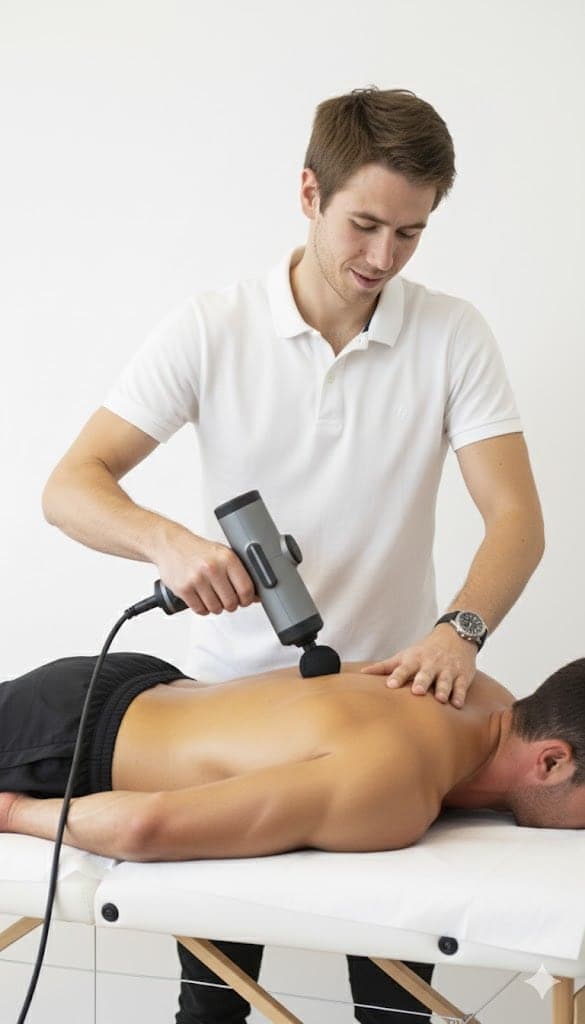
Written by
Chris
Massage therapist, nutrition and exercise physiologist
Norwegian-certified with a Bachelor’s in Physical Education and Nutrition and over ten years of clinical practice, working from a portable table in clients’ homes across the Paphos district.
This article is general information, not a medical diagnosis. If you have severe, worsening or unexplained pain, numbness, weakness, or pain after an accident, see a doctor first.