Pre-Golf Massage Coral Bay: Advanced Mechanical Treatment for Peak Performance on the Course
In short
Discover how specialized pre-golf massage in Coral Bay prepares your body mechanically for optimal performance. Evidence-based deep-tissue treatment targeting golf-specific movement patterns.
I’ve spent a decade studying human movement patterns, and I can tell you with certainty: most golfers are preparing their bodies incorrectly before a round. They stretch passively, swing a few practice shots, perhaps roll a foam roller over their backs—and then wonder why their swing feels tight by the seventh hole, or why that familiar lower back tension returns on the back nine.
The reality is that golf demands an extraordinary degree of rotational mobility, precise neuromuscular coordination, and sustained postural control over four to five hours. Your body doesn’t just need to be “warmed up”—it needs to be mechanically optimized. That’s where genuine pre-golf massage comes in, and that’s exactly what I provide to golfers here in Coral Bay.
Why Traditional Pre-Round Preparation Fails Golfers
Let me share something I observe consistently with new clients: they arrive with compensation patterns so deeply embedded that they don’t even recognize them anymore. A right-handed golfer who’s been favoring his left side for years. Thoracic restrictions that force excessive lumbar rotation. Hip flexors shortened from hours of sitting that prevent proper weight transfer through the swing.
These aren’t problems you solve with a quick stretch or a five-minute rubdown. These are biomechanical issues that require precise, deep intervention—and most importantly, they need to be addressed before you add the complex, asymmetrical stress of 80 to 100 golf swings.
I hold a Bachelor’s degree in Physical Education and Nutrition from Norway, and my training taught me to view the body as an integrated mechanical system. When I work with a golfer before their round, I’m not simply “loosening them up.” I’m systematically identifying and releasing the specific fascial restrictions, muscle adhesions, and trigger points that will limit their performance over the next four hours.
The Golf-Specific Movement Requirements
Consider what actually happens during a golf swing from a biomechanical perspective:
- Thoracic rotation of 45-60 degrees while maintaining stable pelvis
- Coordinated hip internal and external rotation through the kinetic chain
- Scapular stability throughout the backswing and follow-through
- Controlled lumbar flexion and extension under load
- Precise ankle mobility for weight transfer and balance
Each of these movement patterns requires optimal tissue quality and neuromuscular responsiveness. When I perform pre-golf massage, I’m targeting the exact structures that enable these movements: the latissimus dorsi and thoracolumbar fascia for rotation, the hip flexor complex for proper sequencing, the rotator cuff mechanism for club control, and the posterior chain for power generation.
This isn’t relaxation therapy. This is performance optimization based on functional anatomy.
My Specialized Machine-Based Approach to Pre-Golf Treatment
After ten years of hands-on work, I’ve learned something that challenges conventional thinking in the massage industry: human hands, no matter how skilled, have limitations that can compromise results. Therapist fatigue affects pressure consistency. Finger strength varies. “Off days” happen.
That’s why I utilize a specialized mechanical deep-tissue device that delivers what I call the three essential elements: Precision, Power, and Consistency.
How Machine-Assisted Treatment Surpasses Traditional Methods
| Treatment Aspect | Traditional Hands-On | Machine-Assisted Method |
|---|---|---|
| Penetration Depth | Limited by therapist strength (typically 2-3cm) | Controlled depth up to 5-6cm into deep fascia |
| Pressure Consistency | Decreases with therapist fatigue | Maintained precisely throughout session |
| Treatment Duration | Shortened by physical limits | Extended as needed without quality loss |
| Precision Targeting | Broad application, less specific | Exact anatomical targeting possible |
| Session-to-Session Reliability | Variable based on multiple factors | Identical pressure and technique every time |
I want to be direct about this: when you’re preparing for a golf tournament, or even just an important round with clients, you cannot afford inconsistency. You need to know that your body will respond exactly as it should, that the preparation work was done to the same exacting standard as last time.
The machine I use allows me to work deeper than hands can reach—into the dense connective tissue where chronic restrictions actually live. I can sustain that depth for the necessary duration without fatigue affecting the quality. And critically, I can adjust the intensity with absolute precision, from gentle fascial work to powerfully deep treatment for conditioned athletes.
The Pre-Golf Treatment Protocol
When a golfer books a pre-round session with me in Coral Bay, here’s what actually happens:
Phase One: Movement Assessment (5-7 minutes)
I observe your golf posture and ask you to demonstrate several movement patterns. I’m looking for asymmetries, restrictions, and compensation strategies. Where does your thoracic rotation stop? Which hip shows reduced internal rotation? How does your shoulder complex move through the swing plane?
This assessment isn’t guesswork—it’s biomechanical analysis based on functional anatomy and movement science.
Phase Two: Targeted Mechanical Release (35-45 minutes)
Based on what I’ve identified, I systematically work through the priority areas using the specialized device. For most golfers, this includes:
- Thoracolumbar fascia and paraspinals to enable rotation without lower back strain
- Hip flexor complex (psoas, iliacus, rectus femoris) to restore proper pelvic positioning
- Gluteal group and piriformis to optimize hip rotation and stability
- Latissimus dorsi and subscapularis for unrestricted shoulder movement
- Forearm flexors and extensors for grip strength and club control
The machine allows me to reach tissue layers that manual therapy simply cannot access effectively. I’m releasing adhesions in the deep fascial planes, breaking up trigger point formations that have existed for months or years, and restoring optimal slide-and-glide between muscle layers.
Phase Three: Neuromuscular Activation (8-10 minutes)
This is where many therapists stop too soon. Deep tissue work creates temporary neurological inhibition—your nervous system needs to be “reminded” how to fire the muscles properly after the release work. I guide you through specific activation patterns that integrate the mechanical changes we’ve just created.
This isn’t stretching. This is movement reprogramming.
The Evidence: Why This Approach Works for Golf Performance
I’ve worked with golfers ranging from weekend players to semi-professional competitors here in Coral Bay and across Cyprus. The results follow a consistent pattern because the biomechanics are consistent.
A 52-year-old client came to me three months ago complaining of progressive back pain during rounds. By the 13th or 14th hole, he couldn’t complete a full backswing without sharp discomfort. His handicap had increased two strokes over the past year simply because he couldn’t swing properly on the back nine.
During assessment, I identified severe restriction in his right thoracolumbar junction and left hip internal rotation—classic compensation patterns from years of asymmetrical movement. His body was forcing excessive rotation through his lumbar spine because his thoracic spine and hips couldn’t contribute properly to the movement.
After three comprehensive sessions addressing the deep fascial restrictions, followed by pre-round treatments before his weekly games, he’s now completing 18 holes without pain. More significantly, his swing mechanics have normalized—he’s generating more clubhead speed with less perceived effort because his body is moving as an integrated system rather than compensating around restrictions.
That’s not a miracle. That’s simply what happens when you treat the mechanical cause of dysfunction rather than temporarily masking symptoms.
Performance Metrics That Matter
When golfers ask me what results they should expect from proper pre-round preparation, I focus on objective measures:
- Maintained swing speed throughout the round: Most golfers lose 3-5 mph of clubhead speed between the first and eighteenth holes due to fatigue and accumulated tension. Proper preparation minimizes this degradation.
- Consistency in ball striking: Mechanical restrictions create variability in your swing plane and contact point. Released tissue allows more repeatable movement patterns.
- Reduced post-round soreness: When your body moves efficiently, you’re not creating excessive strain in compensating structures. Less inflammation, faster recovery.
- Extended playing longevity: This matters most to older golfers. Proper mechanical preparation doesn’t just help today’s round—it protects your body’s long-term capacity to play the game.
I’m not promising you’ll suddenly drive the ball 30 yards further. I’m telling you that your body will be mechanically prepared to execute the swing your skill level allows, repeatedly, for the full duration of your round.
Why Location Matters: Treatment in Coral Bay
I travel directly to your location in Coral Bay with professional equipment—a specialized treatment bench and the mechanical device system. This isn’t just about convenience; it’s strategically important for golf preparation.
Consider the typical scenario: you drive to a clinic, navigate parking, wait in a reception area, receive treatment, then drive to the golf course. By the time you arrive at the first tee, 30 to 45 minutes have elapsed since treatment ended. Your nervous system has partially reverted to its habitual patterns. Tension is already beginning to return.
When I come to your residence or accommodation in Coral Bay, you can complete your treatment and be at the course within 15 minutes. Your body is still in the optimally prepared state we’ve created. The neuromuscular activation is fresh. The tissue quality improvements haven’t been compromised by sitting in a car.
The Coral Bay Golf Demographic
I work extensively with the golf community here, and I understand the specific context: you’re often visiting for a golf holiday, playing multiple rounds over several days, possibly in tournament conditions. Your body needs to perform consistently across this concentrated period of activity.
This is distinctly different from the occasional weekend golfer back home. You’re asking your body to handle repeated high-level demand without adequate recovery time between rounds. Without proper mechanical preparation and maintenance, accumulated fatigue and restriction build progressively—your Thursday round suffers because of unresolved tension from Monday, Tuesday, and Wednesday.
My approach addresses this through systematic treatment protocols that match your playing schedule. Pre-round preparation before each round, supplemented by deeper maintenance sessions every second or third day to address the cumulative load.
Investment Versus Expense: The Long-Term Perspective
I need to address something directly: proper mechanical treatment is an investment in your body’s long-term function, not an expense to be minimized.
Many golfers spend thousands of euros on equipment—new drivers promising extra distance, custom-fitted irons, advanced rangefinders—while neglecting the actual machine generating the swing: their body. You cannot purchase mechanical efficiency or tissue quality. You can only develop it through systematic, expert intervention.
When I work with a client over time—not just a single session, but a committed partnership focused on results—we’re building sustainable improvements. We’re addressing chronic restrictions that have existed for years. We’re retraining movement patterns that have been dysfunctional for decades.
This takes more than one treatment. The golfers who see transformative results are those who commit to the process: initial comprehensive sessions to address the foundational restrictions, followed by regular pre-round preparation to maintain optimal function.
The Typical Partnership Timeline
Initial Phase (Weeks 1-3): Two to three comprehensive 60-minute sessions focused on identifying and releasing primary restrictions. This establishes the baseline improvements in tissue quality and movement capacity.
Preparation Phase (Weeks 4-8): Pre-round treatments before each golf session, with one deeper maintenance session weekly. This integrates the improvements into your actual golf performance and prevents regression.
Maintenance Phase (Ongoing): Pre-round preparation as needed, with periodic comprehensive sessions to address any emerging restrictions or to progress to deeper layers of tissue work.
The clients I’ve worked with longest—some for over two years—have bodies that function fundamentally differently than when we started. They move better, generate power more efficiently, recover faster, and most importantly, they’re still playing golf without progressive pain or limitation.
That’s the outcome I’m pursuing with every client: not temporary relief, but lasting optimization.
Common Misconceptions About Pre-Golf Massage
Let me address several misunderstandings I encounter regularly, because these misconceptions prevent golfers from accessing the treatment they actually need.
Misconception 1: “I need to be relaxed before golf”
No. You need to be mechanically prepared and neuromuscularly activated. “Relaxation massage” before athletic performance is counterproductive—it reduces muscle tone and neural drive when you need both to be optimally tuned. What I provide is the opposite: targeted release of restrictive tissue followed by activation, preparing your body for high-level performance.
Misconception 2: “Light pressure is safer”
Restriction exists in deep fascial layers and within muscle bellies that light pressure cannot reach. If the goal is to change mechanical function—which it must be for golf performance—then treatment must access the tissue layers where restrictions actually live. The machine I use allows me to work deeply while maintaining absolute control and safety.
Misconception 3: “One session before a tournament is sufficient”
If you’ve never received proper mechanical treatment before, one pre-tournament session will help, but you’re attempting to address years of accumulated restriction in 45 minutes. The golfers who see dramatic improvements are those who begin the work weeks or months before important competitions, establishing optimal tissue quality and movement patterns before high-stakes performance.
Misconception 4: “This is the same as what I get at the resort spa”
Resort spa massage serves an important purpose: stress reduction and general wellness. What I provide is clinical, results-focused mechanical treatment based on biomechanical assessment and functional anatomy. These are fundamentally different services with different objectives and different outcomes.
The Physiological Reality of Golf-Specific Restrictions
Understanding why you need specialized pre-golf preparation requires understanding what golf actually does to your body over time.
Golf is perhaps the most asymmetrical sport in existence. You swing in one direction, thousands of times per year, for decades. This creates predictable patterns of overuse, adaptive shortening, and compensatory dysfunction.
The Right-Handed Golfer’s Typical Pattern
- Left thoracic and rib restrictions from repeated rotation in one direction
- Right hip internal rotation limitation from habitual loading patterns
- Left-side dominance with associated right-side weakness
- Thoracolumbar junction hypomobility forcing excessive lumbar rotation
- Right shoulder external rotation restriction affecting backswing depth
These aren’t possibilities—these are near-universal findings in golfers with five or more years of regular play. Your body adapts to the demands you place on it, and golf’s demands are unilateral and repetitive.
Pre-golf massage, done correctly, addresses these patterns before you add another 80 swings to the accumulated load. I’m creating space in restricted joints, restoring slide capacity in shortened fascia, releasing trigger points in overworked muscles, and rebalancing the neuromuscular activation patterns that have adapted to compensate for the restrictions.
Frequently Asked Questions: Pre-Golf Massage in Coral Bay
How long before my tee time should I schedule treatment?
Ideally, 60 to 90 minutes before you need to be at the course. This allows time for the full treatment protocol plus a brief period for your nervous system to integrate the changes before you begin warming up. I travel to your location in Coral Bay, so there’s no commute time affecting the timing.
Will I feel sore after the treatment?
Not in a way that impairs performance. Deep mechanical work creates temporary inflammation as restricted tissue releases—this is a necessary part of the process. However, the treatment protocol I use is specifically designed to minimize post-treatment soreness while maximizing functional improvement. You’ll feel worked, possibly slightly tender in specific areas, but mechanically you’ll be more capable, not less.
How is this different from what a physiotherapist provides?
Physiotherapy and specialized massage address different aspects of the movement system. Physiotherapists excel at rehabilitation protocols, exercise prescription, and injury management. My focus is exclusively on the mechanical quality of soft tissue—fascia, muscle, and connective tissue—and how these structures enable or restrict movement. Both approaches have value; they’re complementary rather than competing.
Can you help with a specific injury before an important round?
I need to be clear about this: if you have an acute injury—something that occurred within the past 72 hours—deep tissue work is contraindicated. The inflammatory process needs to complete before mechanical intervention is appropriate. However, if you have chronic pain or dysfunction that’s been present for weeks or months, that’s exactly what I specialize in addressing. I treat the cause, not the acute symptoms.
Do you work with high-handicap golfers or only serious players?
Your handicap is irrelevant to whether you’ll benefit from proper mechanical preparation. What matters is that you’re asking your body to perform a complex, repetitive movement pattern, and that you want to do it as efficiently and painlessly as possible. I work with golfers across the full spectrum of ability levels because the biomechanics are universal—everyone’s body operates according to the same principles of functional anatomy.
What should I do after the treatment to maintain the results?
Hydration is critical—deep tissue work releases metabolic waste products that need to be cleared through your lymphatic system. Drink water consistently throughout your round. Beyond that, I’ll provide specific movement patterns or activation exercises based on what we addressed in your session. These aren’t complicated; they’re simple, targeted movements that reinforce the mechanical changes we’ve created.
How many sessions do I need before seeing results?
You’ll notice immediate improvements in range of motion and movement quality after the first session—that’s unavoidable when restrictions are properly released. However, sustainable, lasting changes require multiple sessions. Your body has adapted to its current state over months or years; reversing those adaptations completely takes time and consistent work. Most clients begin to feel genuinely transformed after four to six sessions over several weeks.
Is the machine-based treatment painful?
Discomfort and pain are different phenomena. Deep work into restricted tissue creates intense sensation—pressure, sometimes burning or aching as blood flow increases and waste products are mobilized. This is discomfort, and it’s a necessary part of effective treatment. However, I maintain complete control over intensity and can adjust immediately based on your tolerance. Productive work requires you to be at the edge of your comfort zone, but never beyond it into genuine pain.
The Competitive Advantage of Proper Mechanical Preparation
I’ll conclude with this: golf at any level is competitive. Even if you’re not playing tournaments, you’re competing against the course, against your handicap, against your own previous performance.
When two golfers of equal skill and experience tee off, and one has properly prepared their body’s mechanical systems while the other hasn’t, the prepared golfer will outperform. Not because of superior talent or practice—because their body can execute what their skill allows without mechanical restriction interfering.
Over 18 holes, small advantages compound. Better rotation through your thoracic spine means more consistent ball striking, which over a full round translates to several strokes. Maintained power generation on the back nine instead of progressive fatigue is worth another two to three strokes. Reduced compensatory movement preventing lower back strain means you can focus on shot execution instead of managing discomfort.
These aren’t theoretical benefits. This is the practical reality I observe with clients here in Coral Bay every week.
Beginning Your Partnership: What Happens Next
If you’re serious about optimizing your golf performance through proper mechanical preparation, the next step is straightforward: contact me to schedule an initial comprehensive session.
This first session serves two purposes. Primarily, it’s an opportunity for me to conduct a thorough biomechanical assessment and begin addressing your primary restrictions using the specialized mechanical device. Secondarily, it allows you to experience the method and determine whether my approach aligns with your goals and expectations.
I travel to your location anywhere in Coral Bay with professional equipment. The session typically requires 60 to 75 minutes depending on the complexity of your restriction patterns.
Following this initial work, we’ll discuss a customized treatment plan based on your golf schedule, your body’s response to treatment, and your performance objectives. Some clients need pre-round preparation before every round; others benefit from less frequent but more comprehensive maintenance sessions.
The essential point is this: I’m not offering quick fixes or temporary relief. I’m proposing a partnership focused on durably optimizing your body’s mechanical function for golf performance and long-term health.
Your body is the most sophisticated piece of equipment in your golf bag. It deserves the same level of expert attention and investment as your clubs—arguably more, because unlike equipment, you cannot replace it.
After ten years of specialized work with hundreds of clients, I know with certainty what proper mechanical treatment can achieve. The question isn’t whether this approach works—the biomechanics and the results prove that conclusively. The question is whether you’re ready to invest in your body’s optimization rather than continuing to manage its limitations.
For golfers in Coral Bay who are serious about performance, about longevity in the game, and about understanding what their bodies are truly capable of when mechanical restrictions are systematically addressed—I’m here, with a decade of expertise, university-level education, and a method that delivers measurable, repeatable results.
The machine provides precision, power, and consistency. I provide the expertise to apply those capabilities toward your specific mechanical needs. Together, we can prepare your body to perform at its highest level, round after round, year after year.
Evidence and limits
Massage may help with some symptoms, but benefits and evidence vary by condition. It does not replace medical assessment or treatment. A page update is not evidence of an independent clinical review.
Further reading: Massage therapy: evidence, safety and limitations by US National Center for Complementary and Integrative Health. This is general background reading, not verification of every claim in this article.
How we describe evidence and updates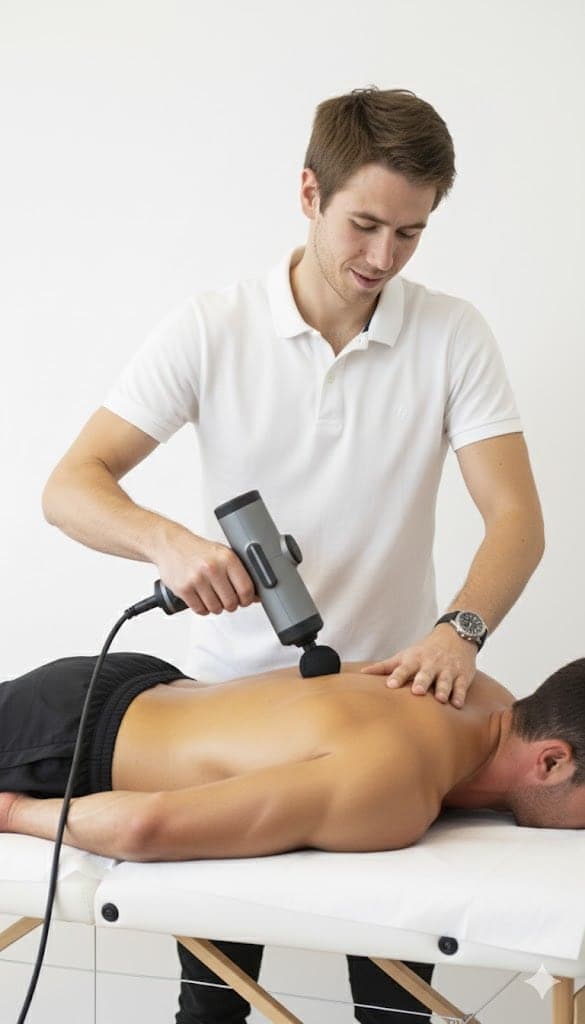
Written by
Chris
Massage therapist, nutrition and exercise physiologist
Norwegian-certified with a Bachelor’s in Physical Education and Nutrition and over ten years of clinical practice, working from a portable table in clients’ homes across the Paphos district.
This article is general information, not a medical diagnosis. If you have severe, worsening or unexplained pain, numbness, weakness, or pain after an accident, see a doctor first.