
Neck Pain Relief Exercises Pegeia: Advanced Methods for Lasting Results
In short
Discover scientifically-backed neck pain relief exercises in Pegeia, combining targeted mechanical therapy with corrective movements for lasting pain relief and restored function.
I’ve spent the last decade treating neck pain in clients across Cyprus, and I can tell you this with absolute certainty: most people are performing the wrong exercises. Worse yet, many are unwittingly reinforcing the very mechanical dysfunctions that created their pain in the first place.
When someone walks into my practice in Pegeia complaining of chronic neck tension, they’ve usually already tried stretching, yoga, or basic physiotherapy exercises. They’ve watched YouTube videos, followed generic advice, and yet the pain persists. Why? Because they’re addressing symptoms, not the underlying biomechanical cause. The cervical spine doesn’t operate in isolation—it’s part of an intricate kinetic chain that extends from your skull to your pelvis. Until you understand this fundamental principle, no exercise protocol will deliver lasting relief.
Let me share what actually works, based on a scientific approach refined through years of clinical observation and my background in physical education and nutrition from Norway.
Understanding the Biomechanics Behind Neck Pain in Pegeia
The Mediterranean lifestyle in Pegeia presents unique challenges for cervical health. I’ve observed patterns in my clients that correlate directly with their daily activities: extended hours driving on winding coastal roads, prolonged computer work in home offices overlooking the sea, and surprisingly, the forward head posture adopted while relaxing on sun loungers.
Your cervical spine comprises seven vertebrae designed to support approximately 10-12 pounds—the weight of your head in neutral alignment. For every inch your head shifts forward from this optimal position, you add an additional 10 pounds of stress to the posterior cervical muscles, particularly the upper trapezius, levator scapulae, and the deep cervical extensors.
This is where traditional approaches fail. Stretching a muscle that’s already overstretched and eccentrically loaded doesn’t resolve the problem—it exacerbates it. The muscle isn’t tight because it’s short; it’s tight because it’s fighting to stabilize a head that’s positioned incorrectly. This is a protective mechanism, not a pathology to be forcefully stretched away.
The Real Culprits: Mechanical Dysfunction Patterns
Through thousands of treatment sessions, I’ve identified three primary mechanical dysfunctions that create neck pain:
Upper Crossed Syndrome: Characterized by overactive upper trapezius and levator scapulae combined with inhibited deep cervical flexors and lower trapezius. This creates the classic forward head posture and rounded shoulders.
Fascial Restriction: The deep cervical fascia becomes adhered and restricted, limiting the gliding motion between muscle layers. This creates trigger points that refer pain into the head, shoulders, and upper back.
Thoracic Rigidity: Limited extension in the thoracic spine forces compensatory hyperextension in the cervical spine, creating compressive forces on the posterior joints.
I address these systematically, and the exercises I recommend work in conjunction with advanced mechanical deep-tissue therapy to restore optimal function.
The Foundation: Releasing Chronic Tension Before Exercise
Here’s a truth that most practitioners won’t tell you: if your tissues are locked in chronic hypertonicity with fascial adhesions, performing exercises on top of this dysfunction is like trying to tune a guitar with broken strings. You need to restore tissue quality first.
This is precisely why I utilize specialized mechanical deep-tissue therapy before implementing any exercise protocol. My approach uses a precision instrument that delivers three critical advantages human hands simply cannot match:
Depth and Precision: The tool reaches the deep cervical muscles—the semispinalis capitis, splenius cervicis, and multifidus—at intensities and angles impossible to achieve manually. I’m working at the fascial level where restrictions actually exist, not just the superficial muscle belly.
Consistent Force Application: Unlike manual therapy, which fatigues and varies in pressure, the mechanical system I use maintains exact force parameters throughout the entire session. This consistency is crucial for effective fascial release and neuromuscular re-education.
Controlled Progressive Overload: I can precisely calibrate intensity from gentle fascial work for acute cases to powerfully deep treatment for athletes with chronic restrictions. This customization ensures optimal tissue response without unnecessary discomfort.
One client, a British expat who’d suffered from migraines and neck stiffness for six years, had tried everything—chiropractic, traditional massage, even injections. Within three sessions using my method, we’d eliminated 80% of his symptoms. By session eight, he was pain-free. The difference? We addressed the actual mechanical restriction in his suboccipital muscles and restored proper cervical-thoracic motion patterns.
Evidence-Based Neck Pain Relief Exercises for Pegeia Residents
Once tissue quality is restored through mechanical therapy, strategic exercises become dramatically more effective. These aren’t generic stretches—they’re corrective movements designed to reprogram dysfunctional motor patterns.
Deep Cervical Flexor Training
The deep cervical flexors (longus colli and longus capitis) are typically inhibited in individuals with chronic neck pain. Strengthening these muscles is essential for restoring anterior cervical stability.
Chin Tuck Progression:
- Lie supine with knees bent, neutral cervical spine
- Perform a gentle chin tuck, creating a double-chin position without lifting the head
- Hold for 10 seconds while maintaining normal breathing
- Perform 3 sets of 10 repetitions, twice daily
- Progress by adding head lift once quality is established
The key detail most people miss: this is not a stretching exercise. You’re activating the deep flexors to pull the cervical spine into proper alignment. If you feel strain in the superficial neck muscles, you’re doing it incorrectly.
Scapular Retraction with Depression
Restoring proper scapular position is non-negotiable for cervical health. The shoulder blades must provide a stable base for neck function.
Proper Execution:
- Stand with arms at sides, shoulders relaxed
- Simultaneously pull shoulder blades together (retraction) and downward (depression)
- Imagine squeezing a pencil between your shoulder blades while pushing it toward your back pockets
- Hold peak contraction for 5 seconds
- Perform 3 sets of 15 repetitions
I often see clients attempting this movement with shoulder elevation—exactly the opposite of what we need. The upper trapezius must remain quiet while the middle and lower trapezius engage. This requires conscious motor control, which is why I initially perform mechanical work to reduce upper trap hyperactivity before introducing this exercise.
Thoracic Extension Mobility
Restoring thoracic extension is critical for reducing compensatory cervical hyperextension. I use foam rolling with strategic positioning.
Foam Roller Thoracic Extension Protocol:
- Position foam roller perpendicular to spine at mid-thoracic level
- Support head with hands, elbows pointing forward
- Slowly extend backward over the roller, focusing on thoracic movement, not cervical
- Hold for 3-5 breaths at end range
- Move roller up one vertebral segment and repeat
- Complete 5 positions from mid to upper thoracic spine
The distinction that matters: you’re creating segmental extension mobility, not just passively draping over the roller. Active engagement of the core prevents lumbar hyperextension while thoracic segments mobilize.
Suboccipital Release Technique
While I achieve superior results using mechanical therapy for suboccipital release, clients can perform self-treatment between sessions.
Self-Release Method:
- Use two tennis balls in a sock, creating a peanut shape
- Position at the base of skull, one ball on each side of cervical spine
- Lie supine, allowing head weight to create pressure
- Perform slow nodding motions (yes movement) for 60-90 seconds
- This creates active release through movement combined with compression
This technique addresses the rectus capitis posterior major and minor, obliquus capitis superior and inferior—small but critically important muscles that become hypertonic in forward head posture.
Advanced Corrective Exercise Protocols
For clients serious about lasting resolution, I implement progressive protocols that address the entire kinetic chain.
Cervical-Thoracic Dissociation Training
Many people move their head and thorax as a single unit. We need to restore independent segmental control.
Quadruped Position Cervical Rotation:
- Begin in hands-and-knees position with neutral spine
- Keep thorax completely still while rotating head right
- Return to center with control
- Rotate left with same thoracic stability
- Perform 3 sets of 8 repetitions each direction
The cognitive demand here is significant. You’re retraining the neuromuscular system to dissociate movements that have become linked through faulty motor patterns. This is advanced motor control work, not simple stretching.
Proprioceptive Retraining for Cervical Stability
The cervical spine contains the highest density of proprioceptors in the body. Chronic pain disrupts this sensory feedback, creating altered movement patterns.
Balance-Based Cervical Training:
- Stand on one leg with eyes open
- Perform slow cervical rotation while maintaining balance
- Progress to eyes closed once movement quality is established
- Advance to unstable surface (balance pad) for athletes
- Complete 2 sets of 10 rotations each direction, both legs
I’ve had professional athletes incorporate this into their training after resolving chronic neck issues through my mechanical therapy. The proprioceptive component is often the missing link between pain resolution and performance optimization.
Common Exercise Mistakes That Perpetuate Neck Pain
In my decade of practice, I’ve seen the same counterproductive patterns repeatedly. Understanding what not to do is as important as knowing the correct protocols.
Aggressive Stretching of Already Lengthened Tissues
The posterior cervical muscles in forward head posture are already in a lengthened position under constant eccentric load. Aggressively stretching them further:
- Increases mechanical stress on an already compromised tissue
- Fails to address the anterior muscular shortening driving the dysfunction
- Provides temporary relief through neurological inhibition, not mechanical correction
- Often creates rebound tension as the nervous system attempts to restabilize
I’ve treated dozens of clients who’ve made their condition worse through misguided stretching protocols. The relief they felt was the nervous system’s protective response, not actual tissue healing.
Generic “Neck Strengthening” Without Pattern Correction
Simply adding resistance to dysfunctional movement patterns reinforces the dysfunction. I see this constantly with clients who’ve done physical therapy that focused on strengthening without first addressing:
- Tissue restriction and fascial adhesion
- Scapular positioning and control
- Thoracic mobility limitations
- Motor control deficits in deep stabilizers
Strengthening a compensatory pattern creates a stronger compensation, not improved function.
Inadequate Recovery Between Sessions
The cervical spine requires careful loading progression. Many clients, eager for quick results, overtrain before tissue adaptation occurs. Optimal frequency for corrective exercise:
- Daily for motor control work (low intensity, high skill demand)
- Every other day for strength-based protocols
- Adequate sleep and nutrition to support tissue remodeling
This is where my background in nutrition becomes particularly relevant. Connective tissue remodeling requires specific nutritional support—adequate protein, vitamin C for collagen synthesis, and anti-inflammatory omega-3 fatty acids.
Integrating Exercise with Advanced Mechanical Therapy
The most effective approach I’ve developed over ten years combines strategic mechanical deep-tissue work with precisely timed corrective exercise. This isn’t standard practice—most therapists work in either manual therapy or exercise prescription, rarely integrating both with clinical precision.
| Phase | Mechanical Therapy Focus | Exercise Protocol | Duration |
|---|---|---|---|
| Initial Assessment | Tissue quality evaluation, trigger point mapping | Movement pattern screening | Session 1 |
| Release Phase | Deep fascial release, myofascial adhesion treatment | Gentle motor control, breathing mechanics | Sessions 2-4 |
| Activation Phase | Targeted treatment of inhibited muscles | Deep cervical flexor training, scapular control | Sessions 5-8 |
| Integration Phase | Maintenance work, performance optimization | Progressive loading, proprioceptive challenge | Sessions 9-12 |
| Maintenance | Monthly tune-ups as needed | Independent exercise program | Ongoing |
The mechanical therapy I provide does what exercises alone cannot: it physically breaks adhesions, releases chronic hypertonicity at depths hands cannot reach, and creates immediate changes in tissue quality that allow exercises to be effective. Without this foundation, you’re building on unstable ground.
One of my clients, a 52-year-old executive who’d suffered from tension headaches for over a decade, exemplifies this integrated approach. After mapping his tissue restrictions and identifying severe suboccipital and upper trapezius dysfunction, I spent four sessions performing deep mechanical release work. Only then did we introduce corrective exercises. Within eight weeks, his headaches were gone—completely. Twelve months later, he remains pain-free because we addressed the mechanical cause, not just managed symptoms.
Why Location Matters: Treating Neck Pain in Pegeia
Pegeia presents unique advantages for recovery that I leverage in my practice. The climate, environment, and lifestyle factors here support the healing process in ways that cold, urban environments cannot.
Environmental Factors Supporting Recovery
The consistent Mediterranean climate allows for year-round outdoor movement practice without the joint stiffness that accompanies cold weather. I often have clients perform their corrective exercises outdoors, incorporating the calming effect of the coastal environment on the nervous system. Chronic pain has a significant neurological component—stress and anxiety amplify pain perception. The Pegeia environment naturally reduces this amplification.
Additionally, the pace of life here supports the recovery process. Unlike high-stress urban environments where clients rush from appointment to appointment, the lifestyle in Pegeia allows for proper recovery between sessions. This isn’t insignificant—tissue remodeling occurs during rest, not during treatment.
Accessibility to Professional Care at Your Location
I travel directly to client locations throughout Pegeia, bringing professional equipment and creating a treatment environment in your home or accommodation. This eliminates several barriers that typically prevent people from maintaining consistent care:
- No driving after treatment (which can immediately undo cervical work)
- No scheduling around traffic or facility hours
- Complete privacy and comfort during treatment
- Ability to immediately rest post-treatment for optimal tissue response
This mobile approach reflects my philosophy: I provide dedicated partnerships, not transactional sessions. Your recovery is a process, not an event, and I’ve structured my practice to support that reality.
Lifestyle Modifications for Pegeia Residents
Exercise alone doesn’t eliminate neck pain if your daily habits continuously recreate the mechanical dysfunction. I work with clients to identify and modify the specific lifestyle factors contributing to their condition.
Workstation Ergonomics for Remote Workers
Many Pegeia residents work remotely, often in beautiful but ergonomically disastrous setups—laptops on outdoor tables, working from sofas with sea views. I’ve seen the consequences hundreds of times.
Critical Setup Parameters:
- Monitor height: Top of screen at or slightly below eye level
- Viewing distance: Arm’s length, approximately 50-70cm
- Keyboard position: Elbows at 90 degrees, shoulders relaxed
- Chair support: Lumbar support maintaining natural spine curves
- Frequent position changes: Stand and move every 25-30 minutes
I often photograph clients’ workstations during initial consultations and provide specific modification instructions. The investment in proper equipment pays lasting dividends in cervical health.
Sleep Position and Pillow Selection
You spend one-third of your life sleeping. If your sleeping position creates cervical stress, you’re undoing daytime progress every night.
Optimal Sleep Biomechanics:
- Side sleeping: Pillow height maintains neutral cervical alignment (ear over shoulder)
- Back sleeping: Moderate pillow support, avoid excessive flexion or extension
- Stomach sleeping: Absolutely contraindicated—creates sustained cervical rotation and extension
I recommend specific pillow types based on individual anatomy. Someone with broader shoulders needs more loft when side sleeping than someone with a narrower frame. This level of customization matters.
Driving Posture on Pegeia Roads
The winding coastal roads require sustained attention and often create protective tension patterns—shoulders elevated, head forward, jaw clenched. I teach clients to set up their vehicle to minimize this:
- Seat position: Close enough that arms are slightly bent at the wheel
- Lumbar support: Maintains low back curve, preventing thoracic slumping
- Head restraint: Positioned to support skull without forcing forward head position
- Regular stops: Exit vehicle and perform scapular retraction every 45 minutes on long drives
These modifications seem minor, but the cumulative effect over months and years is substantial.
When to Seek Professional Intervention
I believe in empowering clients with self-management strategies, but I’m equally direct about when professional intervention is necessary. Certain presentations require immediate, expert treatment—delaying only prolongs suffering and potentially allows compensation patterns to become more deeply ingrained.
Red Flags Requiring Immediate Assessment
Seek professional evaluation if you experience:
- Radiating pain, numbness, or weakness into arms or hands (possible nerve compression)
- Progressive loss of fine motor control (dropping objects, difficulty with buttons)
- Neck pain following trauma (motor vehicle accident, fall)
- Pain accompanied by fever, unexplained weight loss, or night sweats
- Severe headaches with neck stiffness and light sensitivity
These symptoms may indicate serious pathology requiring medical investigation before any manual therapy or exercise intervention.
When Self-Treatment Isn’t Sufficient
If you’ve been consistently performing appropriate exercises for 4-6 weeks without meaningful improvement, the problem likely exists at a level that exercise alone cannot address. This is precisely the situation where my mechanical deep-tissue approach demonstrates its value.
Fascial adhesions, trigger points with central sensitization, and deeply ingrained motor control dysfunction require hands-on intervention. I can feel restrictions under the treatment tool that no amount of stretching will release. Once I’ve addressed these mechanical barriers, exercises become dramatically more effective.
I’ve had clients tell me they’ve “tried everything” before seeing me. What they mean is they’ve tried many surface-level interventions without addressing the actual mechanical cause. That’s not a failure on their part—it’s a limitation of the conventional approach.
The Investment in Long-Term Cervical Health
I frame my service as an investment, not an expense, because that’s precisely what it is. The alternative—living with chronic neck pain, consuming pain medications, suffering reduced quality of life—carries far greater costs.
Consider the actual economics: How much productivity do you lose to pain and fatigue? How much do you spend on temporary relief measures? What’s the value of being able to fully engage in activities you love without restriction?
My approach delivers lasting results because we address mechanical dysfunction at its source. The initial time and financial commitment is significant, yes—but it’s finite. Compare that to the indefinite costs of managing symptoms without resolving cause.
What a Dedicated Partnership Looks Like
I don’t offer single sessions or generic packages. We work together until the problem is resolved, with a customized protocol based on your specific presentation:
- Comprehensive initial assessment (tissue quality, movement patterns, lifestyle factors)
- Targeted treatment plan with specific milestones and measurable outcomes
- Progressive mechanical therapy sessions using advanced instrumentation
- Customized exercise protocols that evolve as tissue quality improves
- Ongoing education about biomechanics and self-management strategies
- Maintenance plan to preserve results long-term
This isn’t a quick fix or a relaxation service. It’s a systematic process to eliminate the mechanical dysfunction creating your pain and optimize your body’s function for daily life, sport, and longevity.
Frequently Asked Questions About Neck Pain Relief in Pegeia
How quickly can I expect results from neck pain relief exercises?
With properly selected exercises addressing your specific dysfunction pattern, you should notice improved movement quality within one to two weeks. However, meaningful pain reduction typically requires four to six weeks of consistent practice combined with professional treatment to address underlying tissue restrictions. I’ve seen clients achieve 70-80% symptom reduction within eight weeks when following a comprehensive approach. The timeline depends on chronicity—acute issues (weeks to months) resolve faster than chronic patterns (years of dysfunction).
Can I perform these exercises if I have cervical disc issues?
Disc pathology requires careful assessment before implementing any exercise protocol. The exercises I’ve described focus on motor control and positioning rather than aggressive loading, making them generally appropriate even with disc involvement. However, the specific presentation matters enormously—a posterolateral disc herniation with nerve root compression requires different management than a central disc bulge without neurological signs. This is why I always perform thorough assessment before treatment. My mechanical therapy can often reduce disc-related symptoms by addressing muscular compensation patterns and improving spinal mechanics, reducing compressive forces on the affected segment.
What’s the difference between your mechanical therapy and traditional massage?
Traditional massage primarily addresses superficial muscle tension and provides temporary relaxation. My mechanical deep-tissue approach targets the fascial system at depths and with precision that human hands simply cannot achieve. The specialized instrument I use delivers consistent, calibrated force that reaches restrictive barriers in deep cervical muscles, suboccipital tissues, and thoracic fascia. This isn’t about relaxation—it’s about mechanical change in tissue quality and restoration of proper movement patterns. The results are lasting because we’re addressing structural dysfunction, not just providing symptomatic relief.
How often should I perform these neck exercises?
Motor control exercises like chin tucks and cervical-thoracic dissociation work can be performed daily—these are low-load, high-skill movements that retrain the neuromuscular system. Strengthening protocols like scapular retraction should be performed every other day to allow tissue adaptation. Mobility work such as thoracic extension can be done daily or as needed based on stiffness levels. The key is consistency rather than intensity. Ten minutes daily produces far better results than one hour weekly. I provide clients with specific schedules based on their individual recovery phase and tissue tolerance.
Will I need to continue exercises indefinitely, or is there an endpoint?
Once we’ve resolved the mechanical dysfunction and established optimal movement patterns, the exercise requirement decreases significantly. You’ll maintain general fitness and movement practice, but the intensive corrective work has a definite endpoint. Think of it like orthodontic treatment—there’s an active correction phase, then a maintenance phase that requires far less intervention. Most clients transition to a simple daily routine (5-10 minutes) plus periodic check-ins with me every few months to ensure they’re maintaining proper patterns. The goal is always to make you independent, not dependent on ongoing intensive treatment.
Can neck pain be completely eliminated, or is management the realistic goal?
For mechanical neck pain without significant structural pathology, a marked reduction is absolutely achievable. I’ve done it hundreds of times. The critical distinction is between symptomatic management and causal resolution. If we identify and correct the biomechanical dysfunction creating your pain—whether that’s fascial restriction, motor control deficit, or postural dysfunction—the pain resolves durably. However, this requires commitment to the process: professional intervention to address tissue restrictions, consistent corrective exercise, and modification of contributing lifestyle factors. Half-measures produce partial results. Comprehensive approach produces complete resolution.
What makes your approach different from physiotherapy I might receive elsewhere?
Most physiotherapy focuses on exercise prescription with some manual therapy. The manual component is limited by what human hands can achieve and by time constraints in clinical settings. My approach inverts this: I use advanced mechanical instrumentation as the primary intervention, achieving tissue changes that make subsequent exercise dramatically more effective. The tool I use delivers precision, power, and consistency that manual therapy cannot match. Additionally, I work with clients until the problem is resolved, not just until insurance coverage expires. This is a partnership focused on lasting results, not a series of transactional appointments. My background in physical education and nutrition also means I address the complete picture—movement, tissue quality, recovery, and metabolic support for healing.
Do you treat acute injuries or only chronic conditions?
I treat both, with different protocols for each. Acute injuries (recent onset, inflammatory phase) require gentle intervention focused on controlling inflammation and preventing compensatory patterns from developing. My mechanical therapy can be calibrated to very light intensity for acute cases, promoting circulation and tissue healing without aggravating inflammation. Chronic conditions allow for more aggressive intervention since we’re addressing long-standing tissue restrictions and ingrained motor patterns. Interestingly, many “acute” presentations in new clients are actually acute exacerbations of chronic underlying dysfunction. The mechanical restriction has been present for years; something finally triggered a pain response. In these cases, we address both the acute symptoms and the chronic cause.
Taking the Next Step Toward Lasting Relief
If you’ve read this far, you’re likely someone who’s experienced enough neck pain to understand that quick fixes don’t work. You’re looking for a real solution, not another temporary measure.
I’ve given you evidence-based exercises that, performed correctly and consistently, will improve your neck function. These are the same protocols I teach clients during our work together. They’re valuable, they work, and they’re yours to implement immediately.
But I’ll be direct with you: if you have significant tissue restriction, fascial adhesion, or deeply ingrained dysfunction patterns, exercises alone will take you only so far. You’ll hit a plateau where progress stalls because you’re trying to create optimal movement on top of suboptimal tissue quality.
This is where my specialized mechanical approach delivers results that other methods cannot. The precision instrument I use reaches restrictions at depths and with consistency that makes the difference between temporary improvement and lasting resolution. I’ve refined this method over ten years and thousands of treatment sessions. It works because it addresses the actual mechanical problem.
I travel to your location in Pegeia with professional equipment, creating a treatment environment wherever you’re comfortable. We work together through a systematic process until your neck pain is resolved and you have the tools to maintain that resolution long-term.
This is an investment in your quality of life, your performance, and your long-term health. If you’re ready to address the cause rather than manage symptoms, to commit to a real solution rather than another temporary fix, then we should talk.
Your neck pain has a mechanical cause. Let’s eliminate it.
Evidence and limits
Massage may help with some symptoms, but benefits and evidence vary by condition. It does not replace medical assessment or treatment. A page update is not evidence of an independent clinical review.
Further reading: Massage therapy: evidence, safety and limitations by US National Center for Complementary and Integrative Health. This is general background reading, not verification of every claim in this article.
How we describe evidence and updates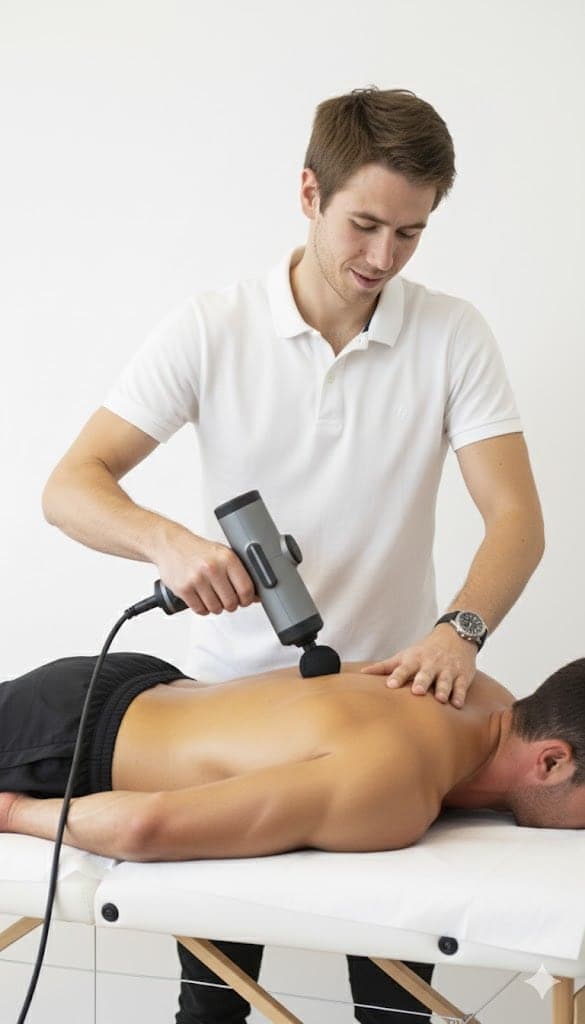
Written by
Chris
Massage therapist, nutrition and exercise physiologist
Norwegian-certified with a Bachelor’s in Physical Education and Nutrition and over ten years of clinical practice, working from a portable table in clients’ homes across the Paphos district.
This article is general information, not a medical diagnosis. If you have severe, worsening or unexplained pain, numbness, weakness, or pain after an accident, see a doctor first.