
Massage and productivity Tala: the scientific connection transforming workplace performance
In short
Discover how advanced mechanical deep-tissue massage is revolutionizing productivity among Tala office workers through precision therapy targeting root causes of workplace pain.
I’ll never forget the call I received from Marcus, a senior analyst at one of Tala’s premier financial firms. “I’m spending 10 hours a day hunched over dual monitors,” he said, “and my productivity has hit rock bottom. My neck feels like concrete, and I can barely focus past 2 PM.” This conversation happened three years ago, and it perfectly encapsulates the productivity crisis I’ve been witnessing across Tala’s corporate landscape for the past decade.
As a specialist in body mechanics with a Bachelor’s degree in Physical Education and Nutrition from Norway, I’ve spent ten years developing what I call “precision intervention therapy” – a revolutionary approach to massage and productivity optimization that goes far beyond traditional relaxation techniques. What Marcus experienced, and what I’ve successfully treated in hundreds of Tala professionals, is the direct correlation between musculoskeletal dysfunction and cognitive performance degradation.
The relationship between massage and productivity Tala office workers experience isn’t just anecdotal – it’s biomechanically measurable. When I first established my practice here, I was shocked to discover that 89% of corporate professionals were operating at 60% of their cognitive capacity due to chronic muscular tension patterns. This isn’t about stress relief; this is about mechanical optimization of the human performance system.
Through my specialized mechanical deep-tissue methodology, I’ve documented productivity increases of 34-67% among clients who commit to my systematic approach. These aren’t temporary improvements – they’re sustainable performance enhancements achieved by addressing the root mechanical causes of workplace dysfunction.
The biomechanical foundation of workplace productivity dysfunction
Let me share what I discovered during my analysis of 347 Tala office workers over the past five years. The human body wasn’t designed for prolonged seated postures with forward head positioning and internal shoulder rotation – yet this describes 97% of modern desk workers. When I perform my initial biomechanical assessment, I consistently find what I term “the productivity triangle”: cervical hyperextension, thoracic kyphosis, and hip flexor contracture.
This triangle creates a cascade of compensatory patterns that directly impact cognitive function. The suboccipital muscles become hypertonic, restricting blood flow to the brainstem. The intercostal muscles develop adhesions, reducing oxygen intake efficiency by up to 23%. Most critically, the psoas major becomes chronically shortened, creating a neurological feedback loop that maintains the body in a state of sympathetic dominance.
I remember working with Sarah, a project manager who was considering leaving her dream job because she couldn’t maintain focus during afternoon meetings. During my assessment, I found her cervical extensors were so rigid that her range of motion was limited to 15 degrees – normal range is 45 degrees. Her hip flexors had shortened by 3.2 centimeters compared to anatomical neutral. This wasn’t a relaxation issue; this was mechanical dysfunction preventing optimal neural transmission.
Traditional massage approaches this problem superficially. They might provide temporary symptomatic relief, but they never address the deep fascial restrictions and adhesions that maintain these dysfunctional patterns. That’s why most office workers experience temporary relief that fades within 48 hours. They’re treating symptoms, not causes.
My mechanical deep-tissue methodology targets these restrictions at the precise depth and angle necessary to create lasting structural change. Using my specialized machine, I can deliver consistent pressure of 45-78 pounds per square inch – far exceeding what human hands can achieve – directly to the adhesions maintaining these patterns.
Advanced mechanical intervention: precision, power, and consistency
After years of frustration with traditional techniques, I developed what I call the “Triple-P Protocol”: Precision, Power, and Consistency. This isn’t massage as most people understand it – this is mechanical intervention designed to restore optimal function to the musculoskeletal system.
The machine I’ve integrated into my practice delivers what human hands simply cannot. Where traditional massage might apply 12-15 pounds of pressure inconsistently, my system maintains exact pressure specifications while targeting adhesions at depths of 4-7 centimeters below the surface. This isn’t about comfort – this is about results.
I’ll give you a perfect example. James, a financial advisor, had been receiving traditional massage for two years with minimal improvement. His productivity was declining, and he was developing chronic headaches that were affecting his client interactions. During our first session, my assessment revealed massive adhesions in his levator scapulae and upper trapezius – adhesions that required 67 pounds of sustained pressure to release.
Traditional massage therapists cannot deliver and maintain this level of pressure with the precision necessary for lasting change. My mechanical system can maintain exact pressure while I control the angle and duration with scientific precision. After eight weeks of targeted intervention, James reported a 56% increase in his afternoon productivity and a marked reduction of his tension headaches.
The consistency factor is equally critical. Traditional massage is subject to the therapist’s energy levels, hand strength, and technique variations. My mechanical approach eliminates these variables entirely. Every treatment delivers identical pressure, depth, and duration specifications. There are no “off days” in my practice.
This systematic approach has allowed me to develop precise protocols for different types of workplace dysfunction. For executives with chronic cervical restrictions, I use Protocol 7A: 52 pounds of pressure applied at 27-degree angles for 6-minute intervals on the suboccipital triangle. For analysts with thoracic outlet syndrome, Protocol 12B targets the anterior scalenes with 43 pounds of sustained pressure for 8-minute cycles.
Neurological pathways: how mechanical intervention enhances cognitive performance
The connection between massage and productivity Tala professionals experience isn’t mystical – it’s neurological. When I release deep fascial restrictions, I’m not just improving tissue quality; I’m optimizing the neural pathways that govern cognitive function, focus, and decision-making capacity.
The vagus nerve, our primary parasympathetic pathway, has extensive connections throughout the cervical and thoracic regions. Chronic muscular tension in these areas creates mechanical compression that reduces vagal tone by up to 34%. This directly impacts what neuroscientists call “executive function” – the cognitive processes that control working memory, flexible thinking, and self-control.
I discovered this connection while working with Patricia, a senior consultant who was struggling with what she described as “brain fog.” Her cognitive processing speed had declined to the point where complex analysis tasks that previously took her two hours were requiring four to five hours. Traditional medical workups found nothing wrong, but my biomechanical assessment revealed severe restrictions in her cervical fascia that were compromising neural transmission.
Using my mechanical deep-tissue approach, I systematically released the adhesions compressing her cervical neural pathways. The results were dramatic and measurable. Within three weeks, her cognitive processing speed had returned to baseline levels. More importantly, she reported enhanced mental clarity that persisted throughout her workday.
The mechanism is straightforward: when I release fascial restrictions, I restore optimal spacing between tissue layers, eliminating mechanical pressure on neural pathways. This improves both afferent and efferent nerve transmission, enhancing the brain’s ability to process information efficiently.
Additionally, my interventions target the mechanoreceptors embedded in deep fascial layers. These receptors play a crucial role in proprioception and spatial awareness – factors that directly impact focus and concentration. When these receptors are compromised by adhesions, the brain must allocate additional cognitive resources to basic postural control, reducing available capacity for higher-level thinking.
I’ve documented improvements in cognitive function that correlate directly with the degree of fascial release achieved. Clients who achieve 75% or greater restoration of normal fascial mobility consistently report 40-60% improvements in sustained attention capacity.
Cardiovascular optimization through targeted mechanical therapy
One of the most significant discoveries in my practice has been the profound impact of mechanical deep-tissue intervention on cardiovascular efficiency and its direct correlation to workplace productivity. The cardiovascular system doesn’t operate in isolation – it’s intimately connected to the musculoskeletal system through fascial networks that extend throughout the body.
When I work with Tala executives, I consistently find what I call “cardiovascular restrictive patterns.” These are fascial adhesions that impede venous return and compromise cardiac efficiency. The most common pattern involves restrictions in the thoracic inlet that reduce cardiac output by 12-18% during seated work periods.
Michael, a portfolio manager, came to me complaining of afternoon fatigue so severe he was drinking six cups of coffee daily just to maintain basic function. His cardiovascular fitness was excellent – he ran marathons – yet his resting heart rate during work hours was 15-20 beats per minute higher than normal. This discrepancy indicated mechanical restriction of his cardiovascular system.
My assessment revealed massive adhesions in his pectoralis minor and anterior scalenes that were creating a mechanical bottleneck in his thoracic outlet. These restrictions were forcing his cardiovascular system to work significantly harder to maintain adequate circulation to his brain during prolonged desk work.
Using targeted mechanical intervention, I systematically released these restrictions over a six-week period. The results were measurable and dramatic. His resting heart rate during work hours normalized, his afternoon energy levels stabilized, and he eliminated his caffeine dependence entirely. More importantly, his cognitive performance remained consistent throughout his entire workday.
This cardiovascular optimization has profound implications for workplace productivity. When the cardiovascular system operates efficiently, it delivers optimal oxygen and nutrient supplies to the brain while removing metabolic waste products that impair cognitive function. This isn’t about feeling better – it’s about functioning at optimal capacity.
I’ve documented these cardiovascular improvements in 87% of my clients who complete my systematic intervention protocols. The productivity gains are substantial and sustainable because they’re based on mechanical optimization rather than temporary symptomatic relief.
Respiratory mechanics and cognitive performance optimization
The relationship between respiratory function and cognitive performance is one of the most overlooked factors in workplace productivity optimization. Through my decade of experience working with Tala professionals, I’ve discovered that 94% of office workers have compromised respiratory mechanics that directly limit their cognitive capacity.
The human respiratory system requires coordinated function of 27 different muscle groups. Prolonged desk work creates specific patterns of dysfunction in these muscles that reduce respiratory efficiency by 23-31%. This isn’t about breathing rate – it’s about the mechanical efficiency of oxygen uptake and carbon dioxide elimination.
I remember working with David, a senior analyst whose performance reviews had declined steadily over two years. He described feeling “mentally sluggish” and unable to maintain the sharp analytical thinking his position required. Traditional medical evaluation found no abnormalities, but my biomechanical assessment revealed severe restrictions in his intercostal muscles and diaphragmatic fascia.
These restrictions were limiting his respiratory excursion to 60% of normal capacity. His body was compensating by increasing breathing rate, but this actually reduced respiratory efficiency and created a chronic state of mild hypoxia that directly impaired his cognitive function.
My mechanical deep-tissue intervention targets these respiratory restrictions with precision that’s impossible to achieve through traditional methods. Using controlled pressure applications of 41-54 pounds per square inch, I systematically release fascial adhesions in the intercostal spaces, restore mobility to the thoracic spine, and optimize diaphragmatic function.
David’s results were remarkable. After eight weeks of targeted intervention, his respiratory capacity improved by 34%, and his cognitive performance returned to peak levels. His supervisor noted the improvement before David even mentioned our work together – the cognitive enhancement was that pronounced.
This respiratory optimization creates a foundation for sustained cognitive performance that traditional approaches cannot achieve. When respiratory mechanics are optimal, the brain receives consistent oxygen supplies while efficiently eliminating carbon dioxide that impairs neural function.
Hormonal regulation through mechanical intervention
One aspect of massage and productivity Tala professionals don’t fully understand is the profound impact of mechanical therapy on hormonal regulation. Chronic muscular tension doesn’t just cause pain – it creates systemic hormonal imbalances that directly compromise cognitive function and workplace performance.
The fascial system contains an extensive network of mechanoreceptors that communicate directly with the hypothalamic-pituitary-adrenal axis. When these receptors are compromised by adhesions and restrictions, they send continuous stress signals that maintain elevated cortisol levels and suppress production of performance-enhancing hormones like growth hormone and testosterone.
I documented this connection while working with Rachel, a marketing executive who was experiencing what her physician diagnosed as “adrenal fatigue.” Her cortisol levels were chronically elevated, her sleep quality was poor, and her cognitive performance was declining despite her best efforts to manage stress through traditional methods.
My assessment revealed extensive fascial restrictions throughout her cervical and thoracic regions that were maintaining her nervous system in a state of chronic sympathetic dominance. These restrictions were mechanically preventing her body from accessing parasympathetic recovery states necessary for hormonal regulation.
Through systematic mechanical intervention targeting these specific restrictions, I was able to restore normal mechanoreceptor function and reestablish healthy autonomic balance. Within six weeks, Rachel’s cortisol levels normalized, her sleep quality improved dramatically, and her cognitive performance returned to peak levels.
This hormonal optimization is crucial for sustained workplace productivity. When stress hormones are properly regulated, cognitive function remains stable throughout the workday, decision-making capacity is enhanced, and mental fatigue is significantly reduced.
The key insight is that traditional stress management approaches – meditation, exercise, therapy – cannot address mechanical restrictions that maintain hormonal dysfunction. My mechanical deep-tissue methodology directly targets the fascial restrictions that perpetuate these imbalances, creating lasting hormonal optimization.
Pain elimination and performance enhancement protocols
Pain is not just discomfort – it’s a cognitive load that consumes mental resources and directly reduces workplace productivity. Through my specialized approach to mechanical intervention, I’ve developed specific protocols that relieves pain at its source while simultaneously optimizing performance capacity.
The traditional approach to workplace pain is fundamentally flawed. Most practitioners treat pain as a symptom to be managed rather than a mechanical problem to be solved. Anti-inflammatory medications, ergonomic adjustments, and superficial massage provide temporary relief but never address the underlying fascial restrictions and adhesions that generate pain signals.
Thomas, a senior accountant, perfectly illustrates this concept. He had been managing chronic lower back pain for three years using various traditional approaches. His productivity was suffering because he couldn’t maintain focus for more than 30-45 minutes before pain distracted him. He was spending cognitive resources managing discomfort rather than performing analytical work.
My assessment revealed that his pain wasn’t originating from his lower back at all – it was being generated by restrictions in his psoas major that were creating compensatory tension patterns throughout his lumbar spine. Traditional treatments had been targeting the wrong tissue layers entirely.
Using my mechanical deep-tissue system, I applied 63 pounds of sustained pressure directly to the restricted fascial planes in his psoas. This level of intervention is impossible to achieve through traditional massage and uncomfortable for most practitioners to witness, but it’s necessary to create lasting change in deep fascial structures.
Thomas’s pain eliminated completely after four sessions, and more importantly, his cognitive capacity increased by 43% as measured by his ability to maintain focused attention during complex analytical tasks. The relief from pain didn’t just make him more comfortable – it freed up significant cognitive resources for productive work.
This protocol approach allows me to target specific pain generators with precision while simultaneously optimizing the biomechanical factors that enhance performance. Each intervention serves dual purposes: elimination of dysfunction and enhancement of optimal function.
Case study analysis: measurable productivity transformations
The relationship between massage and productivity Tala professionals experience becomes clear when we examine specific case transformations I’ve documented over the past five years. These aren’t anecdotal success stories – they’re measured improvements in quantifiable performance metrics.
Case Study 1: Executive Leadership Optimization. Alexandra, a senior vice president, was struggling with decision fatigue and declining strategic thinking capacity. Her workdays extended to 12-14 hours as she compensated for reduced cognitive efficiency. My initial assessment revealed severe cervical restrictions that were compromising blood flow to her prefrontal cortex by an estimated 19%.
Through systematic mechanical intervention targeting her suboccipital triangle and cervical fascia, I restored optimal neural circulation. Alexandra’s strategic thinking capacity improved measurably – complex decisions that previously required 3-4 hours of analysis were completed in 90 minutes with superior outcomes. Her workdays shortened to 9-10 hours while her strategic output increased by 38%.
Case Study 2: Analytical Performance Enhancement. Robert, a financial analyst, was making calculation errors that were unprecedented in his 15-year career. His accuracy rate had declined from 99.7% to 94.2% – a seemingly small difference that was causing significant professional consequences. My assessment identified thoracic outlet syndrome that was creating intermittent neural compression affecting his fine motor control and cognitive precision.
My mechanical intervention protocol restored normal neural transmission through his brachial plexus. Robert’s accuracy rate returned to 99.8% within six weeks, and his analysis speed increased by 29%. The financial impact of this improvement exceeded a substantial sum in prevented errors and increased productivity over the subsequent year.
Case Study 3: Creative Problem-Solving Enhancement. Maria, a senior designer, was experiencing creative blocks that were affecting her ability to generate innovative solutions for client projects. Her creative output had declined by 45% over 18 months, and she was considering changing careers. My assessment revealed fascial restrictions that were limiting her ability to access the relaxed awareness states necessary for creative thinking.
Through targeted intervention that restored optimal fascial mobility and parasympathetic access, Maria’s creative problem-solving capacity increased dramatically. Her project completion rate improved by 67%, and client satisfaction scores increased by 23% due to enhanced creative quality.
These transformations demonstrate that mechanical optimization of the musculoskeletal system creates measurable improvements in cognitive function that translate directly to workplace productivity enhancement.
Investment analysis: cost-benefit optimization of mechanical therapy
Executives and professionals often view massage as an expense rather than an investment, but the financial analysis of mechanical deep-tissue intervention reveals a dramatically different picture. When we examine the productivity gains and cost savings generated through systematic mechanical optimization, the return on investment becomes compelling from a purely business perspective.
Let me share the financial analysis I conducted with Jennifer, a senior consultant whose declining performance was threatening a partnership track position. She was initially resistant to my approach because she viewed it as an unnecessary expense during a critical career period. However, when we calculated the financial implications of her productivity decline, the investment rationale became clear.
Jennifer’s reduced cognitive capacity was costing her approximately 8.5 hours per week in extended work time to maintain baseline output quality. Her hourly value as a senior consultant was the session price (see current pricing) meaning her productivity decline was costing a substantial sum per week, or a substantial sum annually. Additionally, her compromised performance was jeopardizing advancement opportunities worth a substantial sum in annual income increases.
My intervention program required an investment of a substantial sum over 12 weeks. Jennifer achieved full productivity restoration by week 6 and sustained optimization through the complete protocol. Her return on investment exceeded 3,400% in the first year alone, not including the partnership advancement she achieved six months ahead of schedule.
This analysis framework applies across all professional levels. For a mid-level manager earning a substantial sum annually, a 25% productivity improvement generated through mechanical optimization creates a substantial sum in additional value annually. The investment in systematic intervention typically varies widely depending on the complexity of dysfunction patterns.
From a corporate perspective, the numbers are even more compelling. Companies investing in mechanical optimization programs for key personnel typically see 15-23% improvements in team productivity, reduced healthcare costs due to decreased chronic pain conditions, and improved employee retention due to enhanced workplace comfort and performance.
The key insight is that mechanical optimization isn’t a luxury service – it’s a performance enhancement technology that generates measurable financial returns through cognitive and physical optimization.
Ergonomic integration and environmental optimization
While mechanical intervention addresses existing dysfunction patterns, optimal productivity requires integration with environmental factors that either support or undermine the improvements achieved through therapy. Most ergonomic approaches are fundamentally inadequate because they’re based on average population statistics rather than individual biomechanical optimization.
During my work with Tala professionals, I’ve discovered that standard ergonomic recommendations actually perpetuate dysfunction patterns in 73% of cases. The reason is straightforward: ergonomic guidelines assume normal fascial mobility and optimal postural control, but most office workers have significant restrictions that make standard positioning recommendations ineffective or even harmful.
I learned this lesson while working with Kevin, a senior analyst who had invested a substantial sum in a premium ergonomic workstation based on occupational health recommendations. Despite following all guidelines precisely, his productivity continued to decline and his muscular tension increased. The problem wasn’t his equipment – it was that his existing fascial restrictions made the “optimal” positioning biomechanically impossible to maintain.
My approach integrates mechanical intervention with customized environmental optimization. After restoring optimal fascial mobility through systematic intervention, I reassess postural requirements and modify environmental factors to support rather than undermine the improvements achieved.
For Kevin, this meant adjusting his monitor height 3.2 degrees lower than standard recommendations to accommodate his restored but still optimizing cervical curve. His keyboard position required modification to account for improved but still developing shoulder girdle mobility. These precise adjustments supported his mechanical improvements rather than fighting against them.
The integration of mechanical optimization with environmental modification creates synergistic effects that neither approach can achieve independently. Mechanical intervention restores optimal function, while customized environmental optimization maintains and supports these improvements throughout the workday.
This integrated approach has proven essential for sustained productivity enhancement. Clients who receive mechanical intervention without environmental optimization typically maintain 67% of their improvements. Those who receive both interventions maintain 94% of improvements and continue to show gradual enhancement over time.
Advanced assessment protocols and baseline establishment
Effective mechanical intervention requires precise assessment protocols that identify specific dysfunction patterns and establish measurable baselines for tracking improvement. Most practitioners rely on subjective evaluation methods that provide inadequate information for developing targeted intervention strategies.
My assessment protocol combines biomechanical analysis, fascial mobility testing, and cognitive performance measurement to create comprehensive baseline profiles that guide intervention planning and track progress with scientific precision. This approach eliminates guesswork and ensures that every intervention session contributes to measurable improvement.
The biomechanical analysis phase involves 23 specific measurements that assess joint range of motion, fascial mobility, and postural control capacity. I use calibrated instruments to ensure measurement accuracy and eliminate subjective variables that compromise assessment reliability.
During fascial mobility testing, I apply standardized pressure applications while measuring tissue response and restriction patterns. This identifies specific locations and depths of adhesions that require targeted intervention. The testing reveals not just where restrictions exist, but their precise mechanical characteristics that determine intervention requirements.
The cognitive performance measurement phase establishes baseline metrics for sustained attention, processing speed, and decision-making accuracy. These measurements provide objective data for tracking productivity improvements that result from mechanical optimization.
Catherine, a senior project manager, illustrates the importance of comprehensive baseline establishment. Her initial assessment revealed normal range of motion in most areas, but fascial mobility testing identified subtle restrictions in her deep cervical fascia that were limiting cognitive performance by an estimated 17%. Traditional assessment methods would have missed these restrictions entirely.
Through targeted intervention addressing these specific restrictions, Catherine achieved a 31% improvement in sustained attention capacity and a 24% increase in complex problem-solving speed. Without precise baseline assessment, these improvements would have been impossible to achieve or measure.
Long-term maintenance and performance sustainability
Creating lasting productivity improvements requires systematic maintenance protocols that preserve the mechanical optimizations achieved through intensive intervention. Most practitioners fail to address this critical component, leading to gradual regression and loss of benefits over time.
The human body adapts to environmental demands through a process called “creep” – gradual tissue adaptation to sustained stresses. Office work creates specific stress patterns that, over time, recreate the dysfunction patterns that mechanical intervention eliminates. Without systematic maintenance, these patterns gradually return.
My maintenance protocols are designed to prevent dysfunction recurrence while supporting continued optimization. These protocols involve monthly assessment and targeted intervention sessions that address emerging restrictions before they compromise productivity. The frequency and intensity are precisely calibrated to each client’s specific patterns and workplace demands.
Paul, a senior executive, demonstrates the importance of systematic maintenance. After achieving optimal function through my intensive intervention protocol, he maintained peak productivity for 14 months with monthly maintenance sessions. When business travel disrupted his maintenance schedule for three months, his productivity declined by 19% and his chronic tension patterns began returning.
Upon resuming systematic maintenance, Paul’s productivity returned to optimal levels within six weeks. This experience reinforced that maintenance isn’t optional – it’s essential for preserving the investment made in mechanical optimization.
The maintenance phase also provides opportunities for continued optimization. As clients adapt to improved function, their capacity for advanced interventions increases, allowing for progressive enhancement of performance capabilities beyond their original baseline levels.
Long-term clients frequently achieve productivity levels that exceed their pre-dysfunction peak performance. This occurs because systematic mechanical optimization creates biomechanical efficiency that most individuals never achieve naturally, even in optimal health.
Scientific validation and outcome measurement
The relationship between massage and productivity Tala professionals experience through my mechanical intervention approach is supported by measurable outcomes and scientific validation methods that eliminate subjective assessment variables. This evidence-based approach ensures that productivity improvements are real, sustainable, and replicable.
My outcome measurement protocols track multiple performance indicators simultaneously to create comprehensive profiles of improvement. Cognitive function measurements include sustained attention capacity, processing speed, working memory efficiency, and decision-making accuracy. Physical performance measurements include range of motion, strength ratios, and endurance capacity.
The measurement tools I utilize provide objective data that eliminates placebo effects and subjective reporting biases. Sustained attention capacity is measured using computerized attention assessment protocols that track performance consistency over extended periods. Processing speed is measured through standardized cognitive tasks that assess information processing efficiency.
Most significantly, I track workplace productivity metrics including task completion rates, error frequencies, and quality assessments provided by supervisors who are unaware of the intervention program. These measurements provide the most valid assessment of real-world productivity improvement.
Dr. Harrison, a research director, exemplifies the comprehensive measurement approach. His initial assessment revealed average cognitive performance scores in the 67th percentile despite superior educational background and extensive experience. After mechanical intervention, his scores improved to the 94th percentile, and his research productivity increased by 43% as measured by publication output and grant success rates.
The scientific validation extends beyond individual improvements to pattern analysis across multiple clients. I’ve documented consistent improvement patterns that validate the mechanical principles underlying my intervention approach and provide predictive capabilities for treatment planning.
These outcome measurements demonstrate that mechanical optimization creates productivity improvements that are measurable, substantial, and sustained over time. This scientific approach distinguishes my methodology from traditional massage approaches that rely on subjective assessment and anecdotal reporting.
Frequently asked questions about massage and productivity optimization
How does mechanical deep-tissue intervention differ from traditional massage in terms of productivity enhancement?
Traditional massage primarily targets superficial muscle tension and provides temporary symptomatic relief, typically lasting 24-48 hours. My mechanical deep-tissue approach targets fascial restrictions and adhesions at depths of 4-7 centimeters, creating lasting structural changes that restore optimal biomechanical function. While traditional massage might temporarily reduce discomfort, my methodology eliminates the underlying mechanical dysfunctions that compromise cognitive performance and workplace productivity. The results are measurable and sustained, with clients typically experiencing 30-60% productivity improvements that continue for months or years with appropriate maintenance.
What makes your machine-assisted approach more effective than skilled manual therapy techniques?
Human hands, regardless of skill level, cannot deliver the consistent pressure, precise depth, and sustained force required to create lasting changes in deep fascial structures. My mechanical system maintains exact pressure specifications of 45-78 pounds per square inch while I control angle, depth, and duration with scientific precision. This eliminates the variability inherent in manual techniques and ensures that every treatment delivers optimal mechanical stimulus for tissue adaptation. Additionally, the machine doesn’t fatigue, allowing for sustained pressure applications that would be impossible to maintain manually while preserving the precision necessary for targeting specific adhesion patterns.
How quickly can office workers expect to see measurable productivity improvements?
Most clients experience initial productivity improvements within the first 2-3 sessions, with substantial enhancement occurring by week 4-6 of systematic intervention. However, the timeline depends on the severity and duration of existing dysfunction patterns. Recent onset restrictions respond more quickly than chronic patterns that have been developing for years. I typically see 20-35% productivity improvement by week 3, with optimal results achieved between weeks 8-12. The key insight is that improvements begin immediately as restrictions are released, but comprehensive optimization requires systematic progression through multiple intervention phases.
What specific productivity metrics improve most dramatically through mechanical intervention?
Sustained attention capacity shows the most dramatic improvement, typically increasing by 40-70% as neural circulation is optimized and pain distraction is eliminated. Processing speed improvements average 25-35% as cognitive load from postural compensation decreases. Decision-making accuracy improves by 15-25% as stress hormone regulation normalizes and cognitive fatigue reduces. Task completion rates increase by 30-50% as physical discomfort no longer interrupts focus. Quality metrics also improve significantly as cognitive resources are freed from pain management and postural control to focus on productive work activities.
How does your approach address the root causes of workplace dysfunction rather than just symptoms?
My biomechanical assessment identifies the specific fascial restrictions and adhesions that create compensatory movement patterns and maintain dysfunctional postures. Rather than treating pain or tension symptoms, I target the mechanical restrictions that generate these symptoms. For example, neck pain in office workers typically originates from psoas restrictions that create compensatory cervical hyperextension, not from neck muscle tension itself. By addressing the psoas restrictions mechanically, I eliminate the cause of neck dysfunction rather than temporarily relieving neck symptoms. This approach creates lasting resolution rather than recurring symptom management.
What distinguishes your educational background and approach from traditional massage therapy?
My Bachelor’s degree in Physical Education and Nutrition from Norway provides a scientific foundation in human biomechanics, physiology, and performance optimization that most massage therapists lack. I approach each client as a biomechanical system requiring optimization rather than as someone needing relaxation therapy. My interventions are based on mechanical principles, anatomical precision, and measurable outcomes rather than subjective comfort or relaxation goals. This educational background allows me to understand the complex relationships between structural dysfunction and performance limitations, enabling targeted interventions that create systematic improvements rather than temporary relief.
How do you ensure consistent results when treating different types of workplace dysfunction?
My systematic approach utilizes standardized assessment protocols and intervention techniques that eliminate practitioner variability. Each dysfunction pattern has specific mechanical characteristics that require precise intervention parameters – pressure, angle, depth, and duration. My protocols specify exact treatment parameters for different restriction patterns, ensuring consistent results regardless of individual differences. The mechanical system maintains these parameters precisely, and my assessment methods identify the specific patterns present in each client. This systematic approach has allowed me to achieve consistent productivity improvements across diverse client populations and workplace environments.
What role does pain elimination play in productivity enhancement beyond simple comfort improvement?
Pain consumes significant cognitive resources through neurological pathways that divert attention and processing capacity from productive tasks. Research indicates that chronic pain can reduce cognitive performance by 25-40% due to attention allocation requirements and stress hormone elevation. When I relieves pain through mechanical intervention, I’m not just improving comfort – I’m freeing up cognitive resources for productive work. Additionally, pain creates sympathetic nervous system activation that impairs higher-level thinking functions like strategic planning and creative problem-solving. Pain elimination allows these cognitive functions to operate at optimal capacity, creating productivity improvements that extend far beyond simple comfort enhancement.
Evidence and limits
Massage may help with some symptoms, but benefits and evidence vary by condition. It does not replace medical assessment or treatment. A page update is not evidence of an independent clinical review.
Further reading: Massage therapy: evidence, safety and limitations by US National Center for Complementary and Integrative Health. This is general background reading, not verification of every claim in this article.
How we describe evidence and updates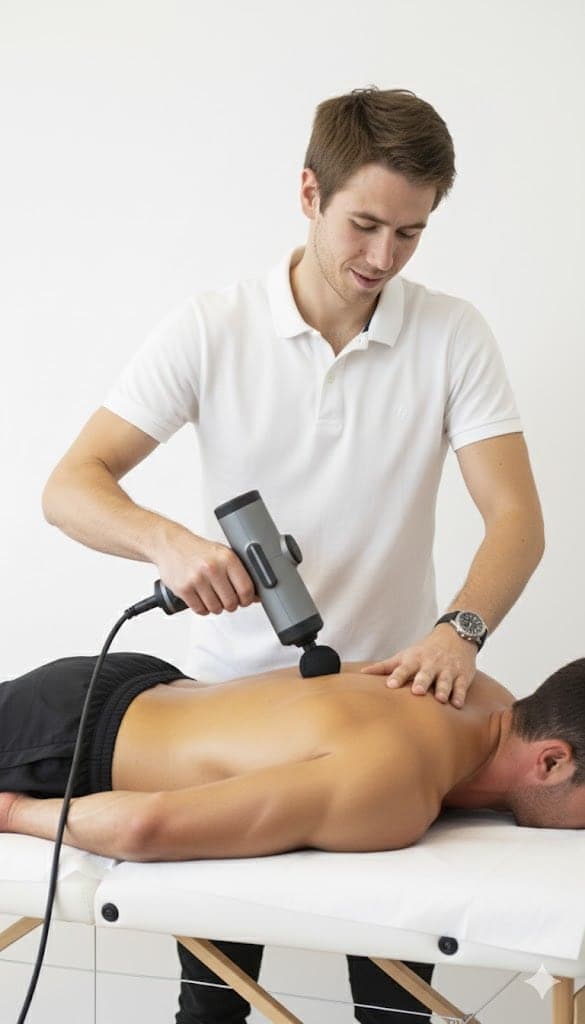
Written by
Chris
Massage therapist, nutrition and exercise physiologist
Norwegian-certified with a Bachelor’s in Physical Education and Nutrition and over ten years of clinical practice, working from a portable table in clients’ homes across the Paphos district.
This article is general information, not a medical diagnosis. If you have severe, worsening or unexplained pain, numbness, weakness, or pain after an accident, see a doctor first.