
Kurs i Kroppsholdning Konia: Advanced Postural Correction Through Mechanical Deep-Tissue Therapy
In short
Discover specialized postural correction courses in Konia that address the root causes of poor body alignment. Professional mechanical deep-tissue therapy with 10 years of clinical experience delivers lasting results.
Poor posture isn’t just about aesthetics—it’s a mechanical dysfunction that creates cascading problems throughout your entire kinetic chain. After a decade of clinical practice and thousands of hours spent studying biomechanics, I’ve witnessed firsthand how conventional approaches to postural correction fundamentally misunderstand the problem. Most courses teach you exercises and awareness techniques, which address symptoms. What I offer in Konia is something categorically different: a systematic, mechanical intervention that resolves the underlying fascial restrictions and muscular imbalances that lock your body into dysfunctional patterns.
When clients first contact me about postural issues, they typically describe symptoms—rounded shoulders, forward head posture, chronic lower back tension. What they don’t realize is that these visible manifestations are merely the end result of deep-seated mechanical problems: shortened hip flexors pulling the pelvis into anterior tilt, adhesed thoracic fascia restricting scapular movement, trigger points in the suboccipital muscles forcing cervical hyperextension. This is where my background in Physical Education and Nutrition from Norway, combined with specialized training in advanced mechanical therapy, provides a distinct advantage.
Why Traditional Postural Correction Courses Fall Short
I need to be direct here: most postural correction programs are built on incomplete understanding of tissue mechanics. They teach you to “sit up straight” or perform stretching routines, without first addressing the physical restrictions that make proper alignment impossible. It’s like trying to straighten a rope while someone stands on the middle of it—you’re fighting against mechanical reality.
During my early years of practice, I experimented extensively with conventional manual therapy techniques. The results were inconsistent at best. A client would leave with improved posture after 90 minutes of intensive work, only to return the following week locked back into their original pattern. The human hand, regardless of skill level, has fundamental limitations:
- Inconsistent pressure application across treatment sessions
- Inability to maintain therapeutic intensity for extended periods
- Limited penetration depth in dense fascial tissue
- Practitioner fatigue affecting treatment quality
- Subjective assessment of tissue release
This realization led me to develop a completely different approach—one that combines biomechanical analysis with advanced mechanical deep-tissue intervention.
The Mechanical Reality of Postural Dysfunction
Let me explain what actually happens when your posture deteriorates. Your fascia—the connective tissue that surrounds every muscle, organ, and structure in your body—responds to habitual positioning by remodeling itself. Spend eight hours daily hunched over a computer, and your anterior thoracic fascia literally shortens and densifies. Your pectoralis minor develops adhesions. Your serratus anterior weakens from chronic lengthening. Your upper trapezius goes into protective spasm.
This isn’t something you can simply “stretch away” or “strengthen out.” The tissue has physically changed its structure. What’s required is systematic mechanical intervention that:
- Breaks down pathological cross-linkages in fascial tissue
- Releases trigger points that maintain dysfunctional firing patterns
- Restores optimal length-tension relationships in affected musculature
- Re-establishes proper proprioceptive feedback from mechanoreceptors
- Allows neuromuscular re-education to occur naturally
This is precisely what my specialized mechanical therapy accomplishes—and why clients in Konia are experiencing transformations that eluded them through years of conventional treatment.
The Advanced Mechanical Deep-Tissue Method: How It Works
The specialized machine I use represents a quantum leap beyond manual therapy. This isn’t a massage gun or percussion device—those tools work superficially and create temporary sensory overwhelm. What I employ is a precision mechanical instrument capable of delivering controlled, sustained pressure at depths and intensities impossible to achieve with human hands.
Precision: Targeting the Exact Source
Through detailed postural assessment, I identify the specific structures maintaining your dysfunctional pattern. For someone presenting with forward head posture, this might be hypertonic suboccipitals, shortened sternocleidomastoid muscles, and adhesed deep cervical fascia. The mechanical tool allows me to address each structure with millimeter-level precision, applying therapeutic pressure exactly where tissue restriction exists—not where it hurts, but where the mechanical problem originates.
I had a client two months ago, a competitive cyclist who’d spent thousands on ergonomic bike fitting and physiotherapy for persistent thoracic outlet symptoms. Every practitioner had treated his neck and shoulders. Within the first assessment, I identified severe restrictions in his pectoralis minor and scalenes—muscles deep enough that manual pressure barely reaches them. Three sessions with targeted mechanical intervention, and his symptoms resolved completely. His bike position hadn’t changed; his tissue mechanics had.
Power: Achieving Therapeutic Depth
Here’s an uncomfortable truth about manual therapy: most practitioners can’t generate sufficient force to affect deep fascial restrictions without compromising their own body mechanics. I’ve seen therapists develop repetitive strain injuries trying to work deeply enough. The mechanical tool eliminates this limitation entirely.
When treating postural dysfunction, particularly in athletic or dense-tissue clients, superficial work accomplishes nothing. The machine delivers consistent, powerful pressure that reaches deep fascial layers, breaks down pathological adhesions, and creates actual structural change in tissue. You feel it—there’s no question whether the work is affecting tissue or just sliding over the surface.
| Treatment Approach | Penetration Depth | Consistency | Practitioner Limitation | Structural Change |
|---|---|---|---|---|
| Manual Massage | Superficial to moderate | Variable | Significant | Temporary |
| Percussion Devices | Superficial | High frequency, low depth | None | Minimal |
| Mechanical Deep-Tissue | Deep fascial layers | Absolute | None | Lasting |
| Stretching/Exercise | N/A | Depends on adherence | Client-dependent | Limited by restriction |
Consistency: Eliminating the Human Variable
Every manual therapist has off days—fatigue, illness, distraction. Your treatment quality varies based on factors completely outside your control. The mechanical method eliminates this entirely. Session ten delivers identical therapeutic intensity as session one. This consistency is crucial for postural correction, which requires progressive, cumulative tissue work over multiple sessions.
I track every client’s progress through objective measurements: cervical rotation degrees, thoracic flexion range, pelvic tilt angles. The data confirms what clients feel—steady, predictable improvement without the plateaus and regressions typical of conventional therapy.
What a Postural Correction Course in Konia Actually Involves
When I say “course,” I’m not referring to a weekend workshop where you learn stretches and ergonomic principles. What I provide is a structured therapeutic intervention—a dedicated partnership focused on durably resolving your postural dysfunction.
Initial Comprehensive Assessment
The first session is entirely diagnostic. I conduct a thorough biomechanical evaluation examining:
- Static posture from anterior, posterior, and lateral views
- Dynamic movement patterns during functional activities
- Range of motion limitations in all relevant joints
- Palpatory examination of fascial tissue quality and restriction patterns
- Identification of primary versus compensatory dysfunctions
This assessment reveals your specific mechanical story—not just what’s wrong, but why it’s wrong and what sequence of interventions will resolve it most efficiently.
Customized Treatment Protocol
Based on assessment findings, I design a targeted treatment plan. This isn’t a generic protocol; it’s a precise roadmap addressing your individual restriction patterns. For someone with upper crossed syndrome—forward head posture and rounded shoulders—the protocol might involve:
Phase One (Sessions 1-3): Releasing shortened anterior structures—pectoralis major and minor, anterior deltoid, sternocleidomastoid, scalenes. These muscles are physically holding you in forward posture. No amount of back strengthening helps until they’re released.
Phase Two (Sessions 4-6): Addressing compensatory restrictions—upper trapezius hypertonicity, levator scapulae adhesions, suboccipital trigger points. These developed as protective mechanisms and won’t release until primary restrictions resolve.
Phase Three (Sessions 7-9): Deep fascial work on thoracolumbar fascia, erector spinae, and posterior shoulder girdle. Now that anterior restrictions are released, posterior structures can be optimized for proper alignment.
Integration Phase: Fine-tuning work and addressing any remaining minor restrictions. At this point, your body naturally assumes correct posture—it’s no longer fighting mechanical restrictions.
Progressive Intensity Adjustment
One advantage of mechanical therapy is infinitely variable intensity control. Early sessions work at moderate intensity, allowing your nervous system to adapt to deep tissue work. As your tissue quality improves and tolerance increases, intensity escalates proportionally. Advanced athletes might finish at intensities that would be impossible in session one.
I had a CrossFit competitor from Konia whose chronic thoracic kyphosis was limiting his overhead lifts. Initial sessions worked at 40% maximum intensity. By session eight, we were at 85%, working deep into his rhomboids and mid-trapezius. His posture transformed, and his snatch personal record increased by 15 kilograms—not from training harder, but from moving through optimal mechanical positions.
Why Location Flexibility Matters for Postural Work
I travel to your location in Konia with a professional treatment bench and all necessary equipment. This isn’t merely convenience—it’s therapeutically significant. Postural dysfunction is often environment-specific. Treating you in your actual living and working space allows me to:
- Observe your habitual positioning in your real environment
- Identify environmental factors contributing to dysfunction
- Provide specific ergonomic recommendations relevant to your space
- Eliminate the stress and time cost of traveling while injured
- Enable more frequent sessions without logistical barriers
After treatment, your body is in an optimized state—this is when I assess how you interact with your desk, your chair, your sleeping position. These observations inform both immediate adjustments and long-term maintenance strategies.
The Investment Perspective: Cost Versus Value
Let me address the financial consideration directly. Specialized mechanical deep-tissue therapy costs more than standard massage. It should—you’re receiving a categorically different service from a practitioner with a university degree and a decade of specialized experience, using advanced equipment that represents significant capital investment.
The question isn’t cost; it’s value. What’s the value of eliminating chronic pain that’s affected your sleep quality for three years? What’s the value of resolving postural dysfunction that’s limiting your athletic performance or career prospects? What’s the value of addressing a mechanical problem now, before it progresses to require surgical intervention?
I’ve had clients who spent years pursuing cheaper alternatives—generic physical therapy, massage chains, online exercise programs. They’d invested far more cumulatively than my complete treatment protocol costs, without achieving results. This isn’t because those practitioners lack skill; it’s because the modality itself is fundamentally limited.
One client calculated he’d spent over €2,000 across two years on weekly massage appointments that provided temporary relief but no structural change. After nine sessions of mechanical deep-tissue work, his chronic cervicogenic headaches resolved completely. He hasn’t needed maintenance treatment in eight months. Which approach was actually expensive?
Postural Correction for Specific Populations in Konia
Office Professionals and Remote Workers
If you spend hours daily at a computer, you’re developing predictable postural dysfunction: forward head posture, rounded shoulders, anterior pelvic tilt. These aren’t minor aesthetic issues—they’re mechanical problems that create:
- Chronic cervicogenic headaches
- Reduced respiratory capacity from compressed thoracic cavity
- Thoracic outlet syndrome symptoms—numbness, tingling in hands
- Decreased athletic performance from compromised shoulder mechanics
- Accelerated degenerative changes in cervical and lumbar spine
My approach addresses the actual tissue restrictions maintaining these patterns, combined with specific ergonomic interventions for your workspace.
Athletes and Performance-Oriented Clients
Athletic performance is fundamentally about efficient force transfer through optimal mechanical positions. Postural dysfunction disrupts this chain catastrophically. A cyclist with forward head posture wastes energy fighting dysfunctional alignment. A runner with anterior pelvic tilt generates excessive lumbar stress with every stride. A weightlifter with thoracic kyphosis can’t achieve proper overhead positions.
I work with numerous competitive athletes in Konia, and the performance improvements following postural correction are consistently dramatic—not because they trained harder, but because they’re finally moving through biomechanically efficient positions. When tissue restrictions no longer force compensatory movement patterns, your body expresses its actual potential.
Chronic Pain Sufferers
Most chronic musculoskeletal pain originates from postural dysfunction. Your body is brilliantly adaptive—it will tolerate dysfunctional positioning for months or years, using compensatory patterns to maintain function. Eventually, compensation capacity exhausts, and pain emerges.
The crucial insight: the pain location is rarely the problem location. Lower back pain frequently originates from hip flexor restrictions or thoracic immobility. Shoulder pain often stems from cervical dysfunction or scapular dyskinesis. Conventional treatment targets the painful area—I target the mechanical cause.
What to Expect During Treatment Sessions
Professional mechanical deep-tissue therapy is intense work. I’ll be direct about this—sessions involve significant pressure at therapeutic intensities. This isn’t relaxation massage with aromatherapy candles. You’re receiving clinical intervention aimed at structural tissue change.
That said, intensity is precisely controlled and continuously adjusted. We work at the maximum therapeutic level your tissue can productively respond to—pushing hard enough to create change, but never crossing into counterproductive territory where your nervous system goes defensive.
During treatment, you’ll feel:
- Initial pressure as the mechanical tool contacts restricted tissue
- Therapeutic discomfort—distinct from pain, this is your tissue releasing
- Sudden release sensations when adhesions break down
- Referred sensations as fascial restrictions release along kinetic chains
- Progressive easement as tissue quality improves through the session
Post-treatment, most clients report immediate improvements in range of motion and positional comfort, combined with tissue soreness similar to intense exercise—your body responding to structural work.
Long-Term Maintenance and Sustainability
Here’s what separates my approach from conventional therapy: the goal is lasting resolution, not endless maintenance. Once we’ve systematically addressed your restriction patterns and restored optimal tissue quality, your body naturally maintains correct posture. You’re not fighting mechanical limitations anymore.
Some clients require no further treatment. Others, particularly those in high-demand occupations or serious athletic training, benefit from quarterly or semi-annual optimization sessions—not because dysfunction returns, but to maintain peak mechanical efficiency under continuous stress.
I provide specific guidance for maintaining results:
- Targeted mobility work addressing your individual restriction patterns
- Ergonomic modifications specific to your environment and activities
- Movement pattern awareness for your highest-risk positions
- Early warning signs indicating developing restrictions before they become symptomatic
This isn’t about creating dependence—it’s about transferring knowledge so you can sustain the mechanical optimization we’ve achieved.
Frequently Asked Questions About Postural Correction in Konia
How is this different from regular massage or physiotherapy?
The fundamental difference is depth, precision, and consistency. Manual therapy is limited by human physical capabilities—practitioners fatigue, pressure varies, and deep fascial restrictions often remain unaddressed. Physiotherapy typically focuses on exercise prescription, which can’t resolve tissue restrictions preventing proper movement. My mechanical approach directly addresses the structural tissue problems maintaining postural dysfunction with precision and power impossible through conventional methods.
How many sessions does postural correction require?
This depends entirely on severity and chronicity of dysfunction. Acute postural issues in younger clients might resolve in 4-6 sessions. Chronic, longstanding dysfunction in clients over 40 typically requires 8-12 sessions for complete resolution. During initial assessment, I provide a realistic timeline based on your specific presentation. I’ve never had a client require more than 15 sessions for even severe postural dysfunction.
Is the treatment painful?
“Painful” isn’t the right descriptor—”intense” is more accurate. You’re receiving therapeutic intervention at depths that create structural tissue change. This involves significant pressure and what I call “therapeutic discomfort”—distinctly different from injury pain. Intensity is continuously controlled and adjusted to your tolerance. Most clients describe sessions as challenging but productive, similar to intensive athletic training.
Can postural problems return after treatment?
If you return to the exact circumstances that created the dysfunction—identical ergonomics, movement patterns, and loading—restrictions can gradually redevelop. However, this typically takes years, not weeks. Most clients find that once tissue restrictions are resolved, their body naturally maintains improved posture with minimal conscious effort. I provide specific guidance for sustaining results based on your lifestyle and risk factors.
Do you work with severe postural deformities or just minor issues?
I work across the entire spectrum—from athletes optimizing already-good mechanics to individuals with severe chronic dysfunction. The mechanical method’s adjustable intensity allows treatment of both highly sensitive individuals and dense-tissue athletes requiring maximum pressure. During assessment, I’ll determine whether your presentation is appropriate for this modality or would benefit from interdisciplinary collaboration with medical specialists.
Why travel to clients instead of having a fixed location?
Multiple reasons. First, it eliminates logistical barriers that prevent consistent treatment—clients often postpone or skip sessions due to travel inconvenience, especially when already experiencing pain or dysfunction. Second, observing your actual environment provides crucial information for addressing environmental factors contributing to postural problems. Third, post-treatment is an optimal state for implementing ergonomic modifications in your real workspace. Fourth, it’s simply more professional—I provide a complete service, not a generic clinic experience.
What makes your approach superior to DIY solutions or online programs?
Online programs teach exercises and awareness—valuable tools, but they can’t address the underlying tissue restrictions preventing proper movement. It’s like trying to improve your swimming technique while wearing a straitjacket. You need someone with clinical expertise to assess your specific mechanical dysfunctions, systematically release tissue restrictions using advanced mechanical intervention, and then provide targeted guidance for maintaining results. Generic programs can’t diagnose your individual pattern, can’t provide therapeutic deep-tissue work, and can’t adjust the protocol based on your response to treatment.
How quickly will I see results?
Most clients notice immediate improvements in range of motion and positional comfort after the first session. However, sustainable structural change requires multiple sessions as we systematically work through restriction patterns. You’re not just getting temporary relief—we’re progressively resolving the mechanical dysfunctions that created your postural problems. Expect noticeable improvements weekly, with substantial transformation by sessions 6-8 for moderate dysfunction.
The Science Behind Mechanical Deep-Tissue Intervention
My approach is grounded in established principles of fascial mechanics, neuromuscular physiology, and biomechanics—not pseudoscience or trendy wellness concepts. When sustained mechanical pressure is applied to restricted fascial tissue, several physiological processes occur:
Piezoelectric Effect: Mechanical deformation of collagen fibers generates electrical charges that stimulate fibroblast activity and tissue remodeling.
Thixotropic Response: Ground substance within fascia transitions from gel to sol state under sustained pressure, allowing realignment of collagen fiber orientation.
Trigger Point Deactivation: Sustained pressure disrupts the feedback loop maintaining hypertonic nodules in muscle tissue, normalizing sarcomere length.
Mechanoreceptor Stimulation: Deep pressure activates Ruffini and Pacinian corpuscles, modulating proprioceptive feedback and reducing protective muscle guarding.
Fascial Plane Separation: Mechanical intervention breaks down pathological adhesions between fascial layers, restoring independent gliding motion.
These aren’t theoretical concepts—they’re measurable physiological responses that explain why mechanical intervention produces lasting structural change while superficial techniques provide only temporary symptomatic relief.
Taking the Next Step: Initiating Your Postural Transformation
If you’ve read this far, you likely recognize yourself in the descriptions of postural dysfunction—the chronic tension, the mechanical limitations, the persistent discomfort that never quite resolves through conventional approaches. You’ve probably tried various solutions with limited success, and you’re wondering whether this approach might finally address the underlying problem.
The answer depends on your commitment level. This isn’t a passive experience where you lie down while someone “fixes” you. It’s a collaborative process requiring your engagement, tolerance for intensive therapeutic work, and willingness to implement maintenance strategies. If you’re seeking easy relaxation or temporary symptom relief, this isn’t the appropriate service.
However, if you’re genuinely committed to resolving postural dysfunction durably—if you’re willing to invest in addressing the root cause rather than perpetually managing symptoms—then mechanical deep-tissue therapy represents the most effective intervention available. My decade of clinical experience and university-level understanding of biomechanics, combined with advanced mechanical tools, provides capabilities that simply don’t exist through conventional methods.
Postural dysfunction isn’t just about appearance or comfort—it’s about optimal mechanical function, injury prevention, athletic performance, and long-term musculoskeletal health. Every year you postpone addressing these issues, they become more entrenched, more compensated, and more difficult to resolve.
The question isn’t whether you need postural correction—if you’ve experienced chronic tension, limited mobility, or persistent discomfort, you already know you do. The question is whether you’re ready to pursue an approach that actually resolves the problem rather than temporarily managing it.
I provide this specialized service throughout Konia, traveling to your location with professional equipment and delivering results that conventional therapy cannot achieve. This is clinical intervention aimed at lasting structural change—not wellness services, not relaxation therapy, but biomechanical optimization through advanced mechanical methods.
Your body’s mechanical function determines your quality of life—how you move, how you perform, how you feel daily. Postural dysfunction progressively compromises all of these. The solution exists; it requires expertise, appropriate tools, and systematic application. That’s precisely what I provide.
Evidence and limits
Massage may help with some symptoms, but benefits and evidence vary by condition. It does not replace medical assessment or treatment. A page update is not evidence of an independent clinical review.
Further reading: Massage therapy: evidence, safety and limitations by US National Center for Complementary and Integrative Health. This is general background reading, not verification of every claim in this article.
How we describe evidence and updates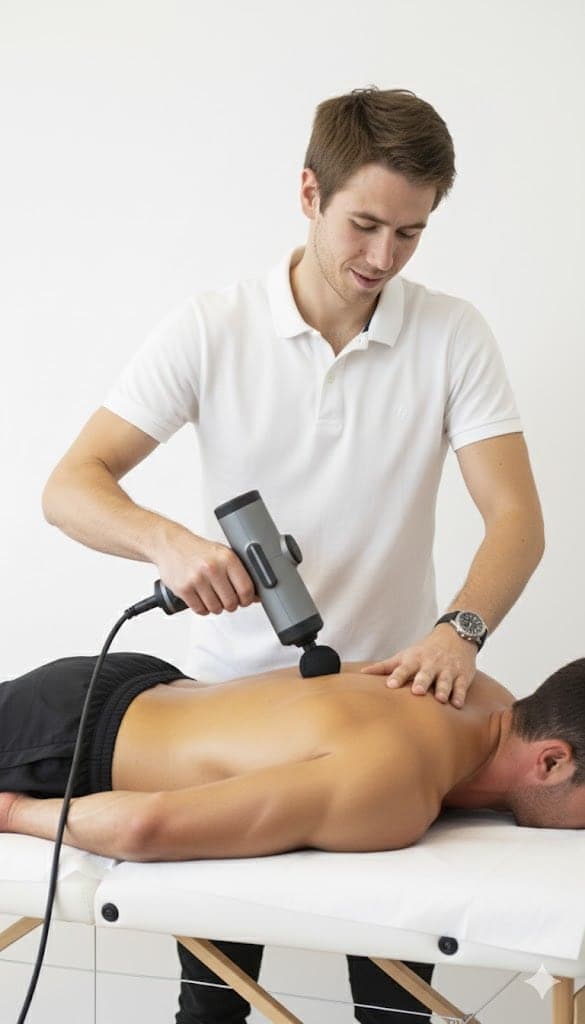
Written by
Chris
Massage therapist, nutrition and exercise physiologist
Norwegian-certified with a Bachelor’s in Physical Education and Nutrition and over ten years of clinical practice, working from a portable table in clients’ homes across the Paphos district.
This article is general information, not a medical diagnosis. If you have severe, worsening or unexplained pain, numbness, weakness, or pain after an accident, see a doctor first.