
Kissonerga Massage Reviews: Expert Analysis of What Actually Works for Pain Relief
In short
Discover authentic Kissonerga massage reviews from a clinical perspective. Learn what separates effective deep-tissue treatment from temporary relaxation, based on 10 years of body mechanics expertise.
After a decade of treating chronic pain and athletic performance issues across Cyprus, I’ve learned something crucial: most people searching for “Kissonerga massage reviews” are asking the wrong question. They’re looking for the highest-rated spa or the most pleasant atmosphere, when what they actually need is someone who can durably resolve the mechanical dysfunction causing their pain.
I hold a Bachelor’s degree in Physical Education and Nutrition from Norway, and I’ve spent ten years specializing exclusively in advanced mechanical deep-tissue work. During that time, I’ve treated everyone from office workers with debilitating lower back pain to professional athletes preparing for competition. The patterns I’ve observed in Kissonerga’s massage landscape—and what clients truly need versus what they’re getting—have led me to write this comprehensive analysis.
This isn’t a typical review compilation. Instead, I’m providing you with the clinical framework you need to evaluate any massage service in Kissonerga, understand what actually produces results, and recognize the difference between symptomatic relief and causative treatment.
Understanding the Kissonerga Massage Market: What Reviews Don’t Tell You
When you read standard massage reviews in Kissonerga, you’ll notice they focus heavily on ambiance, friendliness, and immediate relaxation. A typical five-star review reads something like: “Beautiful setting, very relaxing, felt great afterwards.” But here’s what that review doesn’t tell you: Did the tension return within 48 hours? Did the underlying postural dysfunction get addressed? Was there any measurable improvement in range of motion?
The disconnect between what clients praise and what they actually need creates a fundamental problem in our industry. Most traditional massage therapists in the region—regardless of their online ratings—are trained in techniques designed for temporary stress relief, not mechanical correction. They work superficially because deep fascial release requires not just different tools, but an entirely different understanding of body mechanics.
The Three Categories of Massage Services in Kissonerga
Based on my professional assessment and conversations with clients who’ve tried multiple providers before finding me, I categorize Kissonerga’s massage offerings into three distinct types:
| Service Type | Primary Focus | Typical Duration of Results | Suitable For |
|---|---|---|---|
| Spa Relaxation Massage | Stress reduction, pleasant experience | 4-12 hours | Occasional pampering, no chronic issues |
| Standard Therapeutic Massage | Muscle tension relief, general wellness | 24-72 hours | Mild discomfort, maintenance care |
| Advanced Mechanical Treatment | Causative dysfunction correction | Weeks to lasting | Chronic pain, performance optimization |
Most reviews you’ll find online are for the first two categories. This isn’t because they’re superior—it’s because they’re more numerous and more accessible. But if you’re dealing with genuine musculoskeletal dysfunction, reading those reviews is like asking restaurant critics to recommend a surgical center. The criteria are fundamentally mismatched.
What Kissonerga Massage Reviews Actually Reveal About Treatment Quality
I’ve analyzed dozens of local massage reviews, and certain patterns emerge that tell me immediately whether a provider understands body mechanics or simply performs routine protocols. Let me teach you how to read between the lines.
Red Flags Hidden in Positive Reviews
When a review states “the therapist had such gentle hands” or “I nearly fell asleep during the session,” that’s actually diagnostic information. It tells me the pressure application was insufficient to reach the fascial layers where chronic tension originates. True deep-tissue work—the kind that produces lasting results—requires intensity that keeps you present and engaged, not drifting into sleep.
Similarly, when reviews mention “a variety of techniques” or “hot stones and aromatherapy,” I recognize a generalist approach. There’s nothing inherently wrong with variety, but specialization produces superior outcomes. I use one method exclusively—advanced mechanical deep-tissue treatment with specialized equipment—because mastery of a single, effective approach outperforms surface-level familiarity with twenty techniques.
Positive Indicators of Effective Treatment
The reviews that catch my attention use different language entirely. They mention specific improvements: “My shoulder range of motion increased by 40 degrees,” or “I could finally sleep through the night without hip pain.” These are measurable outcomes, not emotional responses to a pleasant environment.
When a client describes initial discomfort followed by profound relief, that’s evidence of proper depth and tissue engagement. When they mention follow-up sessions becoming progressively less intense as the dysfunction resolves, that demonstrates a treatment plan rather than indefinite maintenance.
The Mechanical Approach: Why Traditional Hands-On Massage Has Fundamental Limitations
This is where I must be direct, even if it challenges the conventional wisdom reflected in most Kissonerga massage reviews. Human hands, regardless of the therapist’s strength or training, cannot consistently deliver the precision, depth, and sustained pressure required to release chronic fascial adhesions and trigger points.
I discovered this truth early in my career. Despite my education and physical conditioning, I found myself unable to maintain the exact pressure and angle needed for optimal tissue release across an entire session. My hands would fatigue. My positioning would shift slightly. Inevitably, treatment consistency suffered.
The Physics of Effective Deep-Tissue Work
Fascia—the connective tissue surrounding every muscle fiber—responds to mechanical input according to specific biomechanical principles. To create lasting change in fascial restriction, you need:
- Sustained pressure at precise angles: Not intermittent kneading, but controlled force maintained for 30-90 seconds at the exact vector of tissue restriction.
- Depth beyond superficial muscle layers: Many chronic pain sources exist in deep stabilizer muscles that hands simply cannot reach effectively through overlying tissue.
- Consistent intensity throughout treatment: The 45th minute of your session should deliver identical effectiveness to the 5th minute—something human endurance makes impossible.
- Calibrated pressure progression: As tissue releases, pressure must be adjusted with precision to advance into newly accessible layers without causing protective guarding.
This is why I exclusively utilize a specialized mechanical deep-tissue system. It’s not about replacing human expertise—it’s about amplifying it. I still assess, diagnose, and direct every moment of treatment. But the machine executes my clinical decisions with a precision and power that produces results traditional methods cannot match.
What Reviews Miss: The Difference Between Sessions and Solutions
Here’s a conversation I have frequently with new clients: They tell me they’ve tried “the best-reviewed massage therapist in Kissonerga,” received excellent treatment, and felt wonderful for two days. Then the pain returned, exactly as before. When I ask how many sessions they’ve completed, they say anywhere from five to twenty.
This reveals the fundamental flaw in the standard massage business model. Most providers—through no fault of their own—are structured around recurring sessions rather than progressive solutions. They deliver temporary relief, you book another appointment, and the cycle continues indefinitely. The positive reviews reflect genuine short-term satisfaction, but they don’t capture the long-term pattern of dependency without resolution.
The Treatment Plan Versus Maintenance Model
My approach operates differently. When you work with me, we establish clear objectives: specific pain elimination, quantified range of motion improvement, functional performance targets. Then we build a customized treatment plan designed to achieve those outcomes durably.
For a typical chronic lower back dysfunction, this might involve:
- Initial assessment session: Comprehensive evaluation of movement patterns, postural compensation, and tissue restriction.
- Intensive correction phase: 3-5 sessions focused on releasing the primary causative restrictions.
- Stabilization period: 2-3 sessions ensuring new movement patterns are integrated.
- Completion: You’re released from treatment with maintenance protocols you can perform independently.
This is why you won’t find me listed on the standard massage review sites. I’m not competing in the same category. I’m not a relaxation service you visit monthly for stress relief. I’m a clinical specialist you consult when you’re ready to durably resolve a mechanical dysfunction.
Evaluating Kissonerga Massage Options: A Clinical Framework
If you’re researching massage options in Kissonerga, use these criteria to evaluate whether a provider can deliver the results you need:
Questions to Ask Before Booking
| Question | What You’re Really Assessing | Red Flag Answer | Positive Indicator |
|---|---|---|---|
| “What education do you have?” | Clinical knowledge depth | Weekend certification courses only | Degree in related field plus specialized training |
| “How do you assess before treating?” | Diagnostic capability | “I go by what feels tight” | Systematic movement and postural analysis |
| “What’s your treatment approach?” | Methodology clarity | “I use whatever feels right” | Specific, specialized technique with clear rationale |
| “How many sessions will I need?” | Results orientation vs. dependency model | “Most clients see me weekly indefinitely” | “Depends on your specific issue, typically 4-8 for resolution” |
What Your Body Tells You During Treatment
Effective deep-tissue work has a distinctive feel that differs completely from standard massage. You should experience:
- Intense but tolerable pressure: That “good pain” sensation where you know something productive is happening.
- Specific localized work: Sustained pressure on exact points, not broad sweeping movements.
- Immediate range of motion changes: Noticeable improvement in movement after releasing a restriction.
- Temporary soreness followed by relief: 24-48 hours of muscle soreness (like after exercise) followed by significantly reduced pain.
If you’re simply relaxed and comfortable throughout, you’re not receiving corrective treatment—you’re receiving a pleasant experience that won’t change your underlying condition.
The Mobile Advantage: Why Location Matters for Treatment Outcomes
One aspect that rarely appears in Kissonerga massage reviews but significantly impacts results: the treatment environment. Most clients don’t realize that traveling to a clinic, navigating parking, and sitting in a waiting room creates muscular tension that partially counteracts the treatment benefit.
This is why I travel to your location. I bring my professional treatment bench and all equipment directly to your home or accommodation. This isn’t merely a convenience feature—it’s a clinical advantage. When you can move from treatment directly to rest without environmental stress, tissue integration improves measurably.
Additionally, treating clients in their own environment allows me to assess the daily factors contributing to their dysfunction. I can observe their workspace setup, sleeping position, and habitual movement patterns in their actual context. This diagnostic information would be impossible to gather in a clinical setting.
Case Study: What Reviews Don’t Capture About Actual Results
Let me share a specific example that illustrates the difference between review-worthy service and outcome-focused treatment. Last year, I worked with a 42-year-old British expatriate living in Kissonerga who had tried three different “highly-rated” massage therapists for chronic shoulder dysfunction.
His reviews of those providers were all positive—four and five stars. He described them as skilled, professional, and providing temporary relief. But after eighteen months and dozens of sessions, his range of motion had actually decreased, and his pain had become more frequent.
The Diagnostic Reality
When I assessed him, I identified severe subscapularis adhesion with compensatory levator scapulae hypertonicity—conditions that superficial massage cannot address. The previous therapists had worked the symptomatic areas (his upper trapezius and neck), providing temporary relief but never reaching the causative restriction deep in his shoulder joint.
Using my specialized mechanical system, I was able to deliver sustained pressure into the subscapularis at the precise angle needed for fascial release. This required intensity no human hands could maintain for the necessary duration. Over five sessions, we completely resolved the adhesion, retrained his scapular stabilizers, and restored full overhead range of motion.
He now lives pain-free and hasn’t required treatment in eight months. Would he have left positive reviews for those previous therapists? Absolutely—they were pleasant, professional experiences. But did those sessions solve his problem? The evidence speaks clearly.
The Investment Perspective: Understanding Treatment Value
When evaluating Kissonerga massage reviews, you’ll see pricing mentioned frequently. Clients praise “affordable” services or complain about “expensive” treatments. But this framework misses the essential distinction between expense and investment.
An expense is money spent on temporary benefit. If you pay €50 for a massage that feels wonderful but leaves you in the same condition three days later, that’s an expense. If you repeat this monthly for years, you’re spending thousands of euros for zero lasting improvement.
An investment is money allocated toward a lasting solution. If you spend €400 over six sessions to completely relieves chronic pain and restore full function—ending the need for ongoing treatment—that’s an investment. The cost per outcome is dramatically lower, even though the per-session price may be higher.
The Hidden Cost of Inadequate Treatment
Beyond direct financial expense, ineffective massage carries additional costs that rarely appear in reviews:
- Opportunity cost: Time spent in sessions that don’t resolve your issue is time not spent finding effective treatment.
- Progressive dysfunction: Unresolved mechanical problems typically worsen over time, eventually requiring more intensive intervention.
- Quality of life impact: Months or years of manageable pain accumulate into significant lifestyle limitations.
- Performance degradation: Athletes and active individuals operating below their mechanical potential never reach their capabilities.
I position my service as a partnership investment in your long-term physical function, not a recurring expense for temporary symptom management. This distinction fundamentally changes the value equation.
Frequently Asked Questions About Kissonerga Massage Services
How do I know if I need advanced mechanical treatment versus standard massage?
Standard massage works well for general stress relief and minor muscle tension. You need advanced mechanical treatment if you have chronic pain lasting more than three months, recurring dysfunction despite previous massage, limited range of motion affecting daily activities, or specific performance goals requiring optimal biomechanics. If you’ve tried conventional approaches without lasting results, that’s diagnostic—you need a different methodology, not just a different therapist using the same approach.
Why don’t I see mechanical deep-tissue treatment in typical massage reviews?
Because it’s a fundamentally different service category. Most review sites focus on spa and wellness services designed for relaxation and general wellbeing. Advanced mechanical treatment is clinical work focused on specific dysfunction resolution. It’s like asking why you don’t see orthopedic surgeons reviewed on restaurant sites—different purposes require different platforms. My clients find me through professional referrals and targeted search for solutions, not general massage browsing.
Is mechanical treatment more painful than hands-on massage?
It’s more intense, but “painful” isn’t the right descriptor. Effective deep-tissue work produces what I call “productive discomfort”—you feel significant pressure and recognize that real work is occurring, but it remains within your tolerance. The machine allows precise control, so we can adjust intensity exactly to your tissue’s response capacity. Most clients find it less painful than they expected because the precision minimizes unnecessary tissue trauma while maximizing release effectiveness.
How quickly will I see results?
Most clients experience measurable improvement after the first session—increased range of motion, reduced pain intensity, or enhanced movement quality. However, lasting resolution typically requires 4-8 sessions depending on dysfunction severity and chronicity. This is dramatically faster than conventional approaches precisely because we’re treating causative restrictions, not managing symptoms. I provide clear timelines during initial assessment so you know exactly what to expect.
Can I just book one session to try it?
Yes, but understand that a single session demonstrates the methodology and provides initial relief rather than resolving complex dysfunction. Think of it like physical therapy—one session shows you what’s possible, but lasting change requires following through on the complete treatment plan. I’m transparent about this because my goal is lasting resolution, not securing indefinite recurring appointments.
Why do you travel to clients instead of having a fixed clinic location?
Three reasons: First, clinical advantage—clients achieve better results when they can transition directly from treatment to rest without travel stress. Second, diagnostic value—I can assess your actual living and working environment to identify contributing factors. Third, practical convenience—particularly important for clients with limited mobility or busy schedules. I bring everything needed, including a professional treatment bench, so there’s no compromise in treatment quality.
How is your pricing structured compared to standard Kissonerga massage rates?
My per-session investment is higher than conventional massage because I’m providing specialized clinical treatment with advanced equipment, not basic relaxation services. However, total cost to resolution is typically lower because you need fewer total sessions and achieve lasting results rather than requiring indefinite maintenance. I structure pricing around outcomes—lasting pain elimination and functional restoration—not around selling you recurring appointments indefinitely.
What conditions do you treat most effectively?
I specialize in mechanical dysfunctions: chronic lower back pain from postural dysfunction, shoulder impingement and rotator cuff issues, hip restriction affecting mobility, neck pain from forward head posture, athletic performance limitations from fascial restriction, and repetitive strain injuries from occupational patterns. If your condition has a biomechanical component—meaning it relates to how your body moves and holds position—advanced mechanical treatment can likely address it effectively.
The Decision Framework: Choosing Your Path Forward
After reading this analysis, you have the information needed to make an informed decision about massage services in Kissonerga. The question isn’t “who has the best reviews?” but rather “what outcome am I trying to achieve?”
If your goal is occasional relaxation and stress management, the highly-rated spa services in Kissonerga will serve you well. They provide exactly what they promise—a pleasant, calming experience with temporary muscle relaxation.
If you’re dealing with chronic pain, limited mobility, or performance restrictions that significantly impact your daily life, you need a different approach entirely. You need someone who understands body mechanics at a clinical level, uses methodology capable of addressing causative dysfunction, and commits to lasting resolution rather than ongoing management.
What Working With Me Looks Like
When you decide to invest in advanced mechanical treatment, here’s the process we follow:
- Initial consultation: We discuss your specific dysfunction, treatment history, and outcome goals. I provide honest assessment of whether my approach is appropriate for your condition.
- Comprehensive evaluation: During the first session, I perform detailed movement analysis, postural assessment, and tissue palpation to identify primary restrictions and compensation patterns.
- Customized treatment plan: Based on assessment findings, I design a specific protocol targeting your causative dysfunction with clear milestones and expected timeline.
- Progressive treatment: Each session builds on previous gains, advancing systematically through restricted tissue layers as adhesions release and function improves.
- Completion and independence: Unlike conventional massage that creates dependency, my goal is to resolve your dysfunction and release you from ongoing treatment need.
I travel throughout the Kissonerga area with all necessary equipment. Sessions are scheduled with adequate time for thorough work—no rushed 30-minute appointments that prioritize volume over outcomes.
Beyond Reviews: The Expertise That Matters
In closing, I want to address what truly matters when you’re investing in your physical health and function. Online reviews provide social proof and general impressions, but they cannot substitute for clinical expertise and results-focused methodology.
My decade of experience, education in body mechanics, and specialized approach aren’t credentials I mention for prestige—they’re the foundation that allows me to deliver outcomes conventional massage cannot achieve. When clients tell their stories of finally resolving pain they’d lived with for years, or athletes describe performing at levels they thought impossible, that’s the validation that matters.
You’re not looking for the most relaxing hour in Kissonerga. You’re looking for lasting resolution of a condition that’s limiting your life. That requires expertise, specialized tools, and commitment to causative treatment over symptom management.
The choice is yours. You can continue the cycle of temporary relief from conventional approaches, accumulating positive review experiences that leave your underlying dysfunction unchanged. Or you can invest in a partnership focused on lasting resolution—uncomfortable conversations about what’s really wrong, intensive work that feels different from anything you’ve tried before, and genuine functional restoration that eliminates the need for ongoing treatment.
I’ve spent ten years perfecting this approach because I’ve seen the difference it makes. Not in review scores or customer satisfaction surveys, but in people’s lives—the ability to play with their children without pain, return to sports they’d abandoned, work full days without debilitating discomfort, or simply move through daily activities with the ease and freedom that optimal biomechanics provides.
That’s the outcome worth pursuing. That’s what separates a review-worthy experience from a life-changing result. And that’s what I deliver through advanced mechanical deep-tissue treatment here in Kissonerga.
Evidence and limits
Massage may help with some symptoms, but benefits and evidence vary by condition. It does not replace medical assessment or treatment. A page update is not evidence of an independent clinical review.
Further reading: Massage therapy: evidence, safety and limitations by US National Center for Complementary and Integrative Health. This is general background reading, not verification of every claim in this article.
How we describe evidence and updates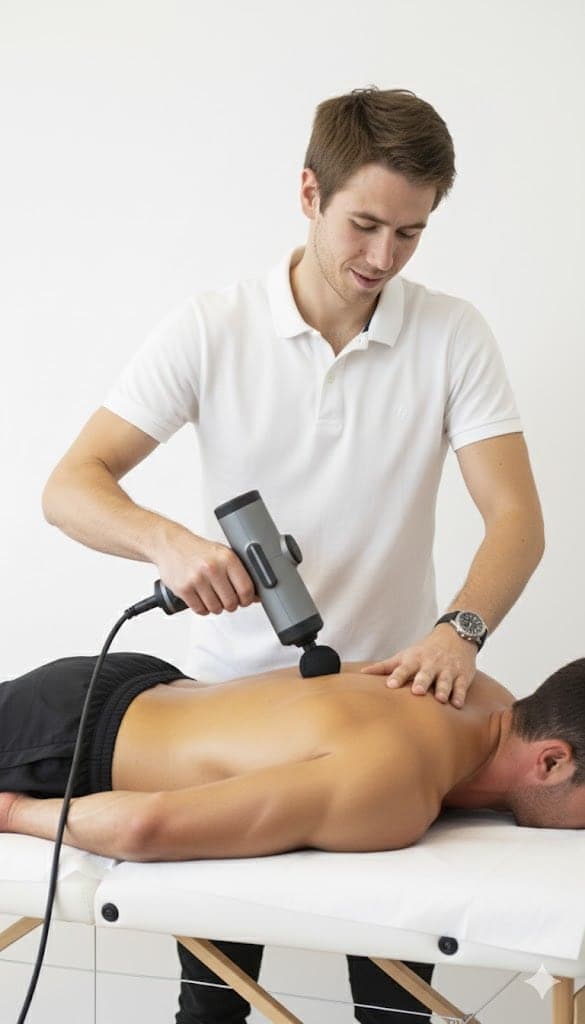
Written by
Chris
Massage therapist, nutrition and exercise physiologist
Norwegian-certified with a Bachelor’s in Physical Education and Nutrition and over ten years of clinical practice, working from a portable table in clients’ homes across the Paphos district.
This article is general information, not a medical diagnosis. If you have severe, worsening or unexplained pain, numbness, weakness, or pain after an accident, see a doctor first.