Massage for office workers: a clinical approach to desk-related pain
In short
Massage for office workers should target the muscles that hold you at a desk all day: upper trapezius, levator scapulae, suboccipitals, pecs and hip flexors. I treat them with mechanical deep-tissue work at your home or office across Paphos district.
I have spent more than ten years treating people whose bodies carry the cost of desk work, and the pattern is remarkably consistent. If you are looking for massage for office workers in Paphos, this article explains what I actually do, why the discomfort behaves the way it does, and how trigger point massage in Paphos fits into it.
I trained in Norway and hold a BSc in Physical Education and Nutrition, so I tend to look at a stiff neck or an aching lower back as a loading problem rather than a mystery. That framing matters, because it tells you which muscles to treat and, just as importantly, which ones to leave alone.
Why desk work hurts in such a predictable way
The human body copes well with movement and poorly with stillness. Eight hours of sitting is not a heavy load in absolute terms, but it is a sustained one, and sustained low-level contraction is exactly what makes muscle tissue tighten, thicken and develop trigger points.
The typical desk posture — head slightly forward, shoulders rounded, spine flexed, hips bent at ninety degrees — asks a small group of muscles to work as postural stabilisers all day. They were never designed for that job.
The muscles I see overloaded most often are:
- Upper trapezius and levator scapulae — holding the shoulder girdle up while the arms reach forward to a keyboard
- Suboccipitals — small muscles at the base of the skull that keep the eyes level when the head drifts forward
- Pectoralis minor and the anterior shoulder — shortened by rounded shoulders, pulling the shoulder blade forward
- Hip flexors and lumbar erectors — shortened by sitting, then asked to stabilise a flattened lower back
- Forearm extensors — quietly overworked by mouse and keyboard hours
None of this is dramatic. It is simply the body adapting to the position it spends most of its time in. The problem is that after a few years the adaptation stops being reversible by a good stretch and a weekend off, and that is usually the point at which someone contacts me.
The compensation chain
Tension rarely stays where it starts. When the shoulders sit high and forward, the mid-back stiffens, the neck extends to compensate, and the jaw and temples take part of the load. Someone who books me for a headache is often carrying the actual problem in the chest and upper back. This is why I assess the whole upper quarter rather than working only where it hurts.
What a session for a desk worker actually involves
Relaxation massage has a place, but it is not what most desk workers need. Chronically shortened tissue with active trigger points responds to specific, sustained, mechanical pressure — deep enough to reach the muscle belly, slow enough that the tissue lets go rather than guarding against it.
I work with a mechanical deep-tissue device alongside my hands. The device gives me consistent depth and pressure that I can hold for longer than manual work allows, which is useful when the target is a small, dense knot in the levator scapulae or a band of tight fibres in the hip flexor. My hands do the assessment, the finer work and the connecting strokes; the device does the heavy lifting.
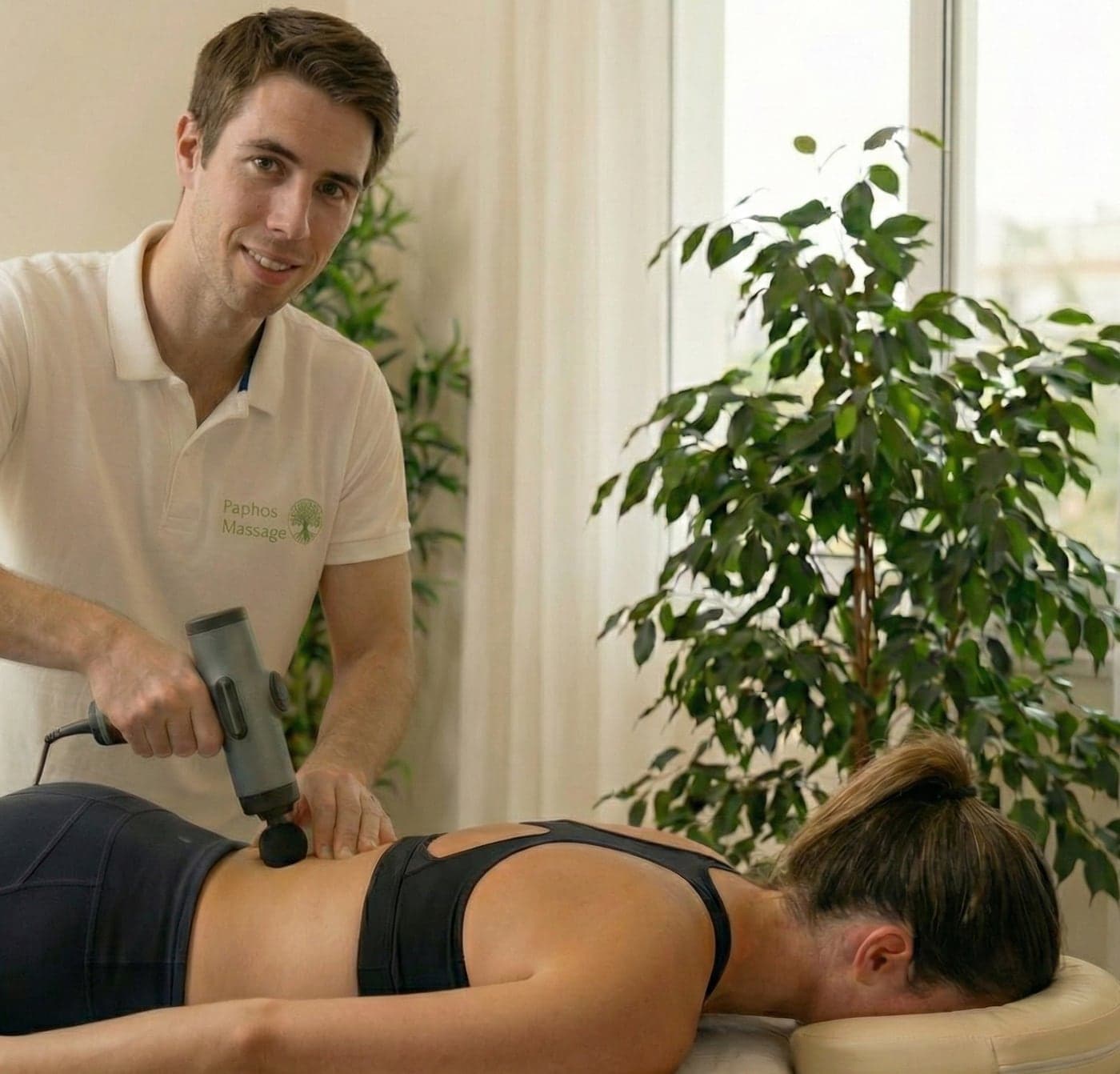
A first session for a desk worker usually looks like this:
| Stage | What I am doing | Roughly how long |
|---|---|---|
| Assessment | Posture, neck and shoulder range, palpation of the usual suspects | 5–10 minutes |
| Upper back and neck | Trapezius, levator scapulae, rhomboids, suboccipitals | 20–30 minutes |
| Chest and shoulder | Pectoralis minor, anterior deltoid, biceps tendon area | 10–15 minutes |
| Hips and lower back | Hip flexors, glutes, lumbar erectors, quadratus lumborum | 15–25 minutes |
| Reassessment | Quick check of range and a note of what to do next | 5 minutes |
The proportions shift depending on where your discomfort lives. Someone with mainly neck and headache symptoms gets a longer upper-body block; someone with a stiff lower back after long drives to the office gets more time on the hips.
Massage for office workers — session by session
Pre-book five sessions as a package and receive one additional session free. What I can describe honestly is the pattern I see most often.
Some things I will say plainly. Deep-tissue work on chronically tight muscle is uncomfortable, and I would be misleading you if I said otherwise. It should not be unbearable, and I adjust pressure constantly based on how the tissue and you are responding. Pain that makes you brace defeats the purpose, because a braced muscle does not release.
The other honest point is that no amount of good treatment will out-work eight hours a day of the same posture indefinitely. Treatment brings the tissue back to a place where it can cope; the desk set-up and your movement habits decide how long it stays there.
Working at your home or office in Paphos
I am a mobile, one-man practice based in Chlorakas, just north of Paphos town, and I cover the Paphos district. I bring a proper treatment table, the device, towels and everything else. You need a space roughly two by three metres and a socket.
For desk workers this arrangement has a practical advantage beyond convenience:
- No drive across town at the end of a working day, which is another forty minutes of sitting
- If I treat you at your desk location, I can see the actual chair, screen height and keyboard position, and comment on them
- You can lie down for a while afterwards rather than getting straight back into a car
- Evening and weekend slots are easier to fit around office hours
Sessions are €90 for 60 minutes and €130 for 90 minutes, and a package of five pre-booked sessions includes one additional free session. Full details are on the pricing page. Booking is by WhatsApp or phone; I usually reply within the day.
If your work involves a lot of driving as well as sitting — sales roles, site visits, the commute from the villages — the lower back and hips typically need more attention than the neck, and I would point you towards the same treatment I use for lower back and hip work alongside the upper-body release.
What you can do between sessions
Treatment does the work of releasing tissue that will not release on its own. Between sessions, small changes to how you spend the day decide whether that release lasts three days or three weeks.
I keep this list short deliberately. Complicated exercise programmes tend not to survive a busy week, and none of these require equipment or time you do not have.
What I can and can't help with
I can help with the muscular side of desk-related pain: tight and painful shoulders, neck stiffness, tension-type headaches, a tight chest and rounded shoulders, forearm and wrist tightness, and lower back and hip stiffness from sitting. This is what mechanical deep-tissue and trigger point work is for.
I cannot help with — and would not treat without clearance — pain that is coming from something other than muscle. See a doctor first if you have numbness or tingling that runs down an arm or leg, weakness in a hand, pain that woke you at night unprovoked, a headache that is sudden and unlike any you have had before, chest pain, or a recent injury. If you have already been assessed and told the problem is muscular, that is exactly the situation I work in most.
- Muscular tension and trigger points from desk posture — yes
- Recent whiplash, disc symptoms with nerve involvement, or fracture — no, not until cleared
- Unsure — message me and describe it; I will tell you honestly whether it is something I treat
Frequently asked questions
How is this different from a relaxation massage?
Relaxation massage uses broad, flowing strokes to lower general tension, and it is pleasant. Desk-related pain usually sits in specific, chronically shortened muscles with active trigger points, and those need sustained, targeted pressure to change. My sessions are slower, deeper and more specific, spend most of their time on a handful of muscles, and I reassess range of movement afterwards to see what actually shifted.
How many sessions will I need?
I cannot give an honest fixed number, because it depends on how long the tension has been building and what your desk day looks like. Most desk workers notice a meaningful change after the first session and a more stable change after two or three. From there, many settle into a maintenance rhythm of every three to six weeks. If I do not think you are benefiting, I will say so rather than keep booking you in.
Will the treatment hurt?
Working on chronically tight tissue is uncomfortable, and I would rather tell you that than surprise you. It should feel like strong, purposeful pressure that you can breathe through, not something you brace against. I adjust constantly and you can stop me at any point. Some tenderness the next day is normal, similar to the feeling after a hard gym session, and it usually settles within a day or two.
Can you help with headaches from screen work?
Often, yes. Tension-type headaches that start at the base of the skull or behind the eyes and build through the working day are frequently driven by the suboccipitals, upper trapezius and levator scapulae, all of which sit within reach of treatment. If your headaches are sudden, severe, unlike your usual pattern, or come with visual changes, see a doctor first; those are not muscular headaches and I would not treat them.
Do you treat at the office as well as at home?
Yes, provided there is a private room roughly two by three metres with a socket and enough time for you to lie down for the full session. Treating at the workplace has the advantage that I can see the chair, screen and desk you actually use, and give practical comments on them. Home visits are more common, but I am happy with either across the Paphos district.
Is deep-tissue work suitable if I have never had massage before?
Yes. Being new to massage does not change the muscles that desk work overloads, and it does not mean the pressure needs to be extreme. I start moderately, watch how the tissue responds, and only go deeper where it is clearly useful and tolerable. If you are unsure, tell me at the start of the session and I will pace it accordingly.
Evidence and limits
Massage may help with some symptoms, but benefits and evidence vary by condition. It does not replace medical assessment or treatment. A page update is not evidence of an independent clinical review.
Further reading: Massage therapy: evidence, safety and limitations by US National Center for Complementary and Integrative Health. This is general background reading, not verification of every claim in this article.
How we describe evidence and updates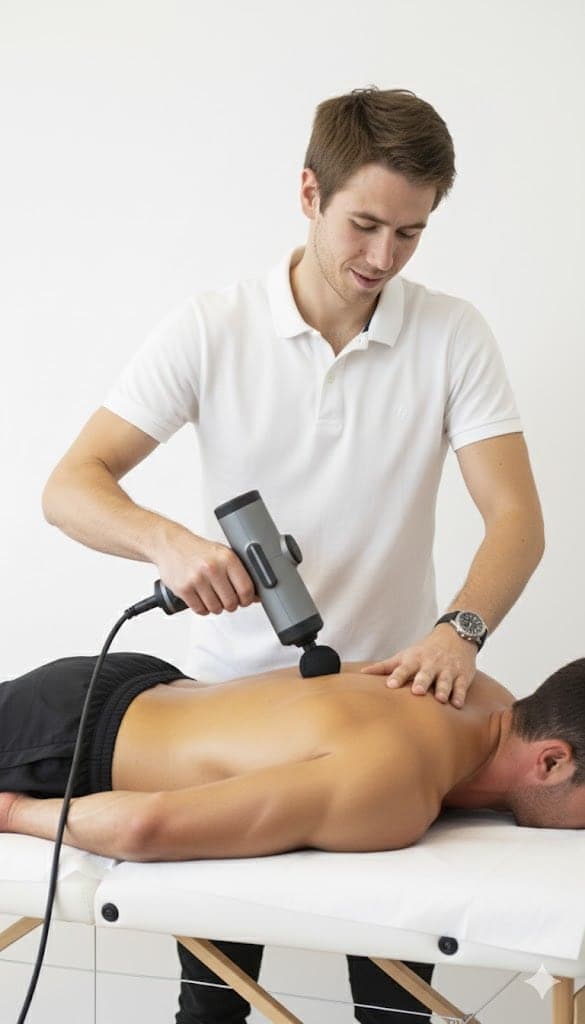
Written by
Chris
Massage therapist, nutrition and exercise physiologist
Norwegian-certified with a Bachelor’s in Physical Education and Nutrition and over ten years of clinical practice, working from a portable table in clients’ homes across the Paphos district.
- Norwegian-certified
- Nutrition & exercise physiologist
- 10+ years clinical practice
- Based in Chlorakas · all of Paphos district
- No call-out fee anywhere in Paphos district
Last updated
This article is general information, not a medical diagnosis. If you have severe, worsening or unexplained pain, numbness, weakness, or pain after an accident, see a doctor first.