
Simple Massage for Home Use: Expert Techniques That Actually Work
In short
Discover professional-grade massage techniques for home use from a mechanical deep-tissue specialist with 10 years of experience. Learn what truly releases chronic tension and pain.
After a decade of working with hundreds of clients—from chronic pain sufferers to elite athletes—I’ve learned something most people don’t realize: simple massage for home use can be remarkably effective when you understand the fundamental mechanics of what actually releases muscle tension. But here’s the critical distinction most home massage guides miss entirely: there’s a profound difference between surface-level relaxation and deep mechanical release that produces lasting results.
My background in Physical Education and Nutrition, combined with ten years of specialization in advanced mechanical deep-tissue work, has taught me that effectiveness isn’t about complexity—it’s about precision, understanding tissue mechanics, and applying the right pressure to the right structures. I’ve seen countless clients waste years on techniques that feel pleasant but accomplish nothing structurally. This article will change how you think about massage at home.
The most common mistake people make with home massage is treating symptoms rather than causes. You feel tight in your upper trapezius, so you rub it. Your lower back aches, so you press on it. This approach might provide temporary relief—five minutes, maybe an hour—but it fundamentally misses what’s creating the tension in the first place. Real results require understanding the mechanical chains of tension that run through your entire body.
Understanding Tissue Mechanics: Why Most Home Massage Fails
Let me share what happens during my first consultation with new clients. They typically arrive having already tried foam rollers, massage guns, tennis balls against walls, and having their partner knead their shoulders for months. They’re frustrated because nothing works beyond a fleeting sense of relief. When I assess their tissue quality and movement patterns, the reason becomes immediately apparent: they’ve been working superficially on structures that require deep, sustained, directional pressure to actually release.
Human muscle tissue exists in layers—superficial fascia, deep fascia, muscle belly, and the connective tissue that binds everything together. Chronic tension and adhesions develop in the deeper layers, particularly at myofascial junctions where muscle transitions into tendon. These structures cannot be adequately addressed with light pressure or rapid, percussive movements. They require sustained mechanical load applied with precision to the exact fiber direction.
This is why my specialized machine-assisted approach produces results that hands simply cannot replicate. The tool delivers consistent, powerful pressure at depths that would fatigue human hands within minutes. But understanding these principles allows you to dramatically improve your home massage techniques, even without professional equipment.
The Foundational Principles of Effective Home Massage
Before we discuss specific techniques, you need to grasp three non-negotiable principles that separate effective massage from time-wasting rubbing:
Principle One: Duration Over Intensity
Contrary to popular belief, more pressure isn’t always better. What matters most is sustained application. When I work on a chronically tight iliotibial band or a locked-up thoracolumbar fascia, I’m often holding steady pressure for 60 to 90 seconds on a single point. This duration allows the nervous system to downregulate protective tension and permits the tissue itself to undergo mechanical deformation—what we call creep in biomechanics.
At home, this means you should spend three to five minutes on a single area rather than rapidly moving around. If you’re using a massage tool on your quadriceps, don’t roll back and forth 20 times. Instead, find the most restricted area, apply pressure, and wait. You’ll feel the tissue gradually soften and release. This patience is what separates therapeutic work from mere stimulation.
Principle Two: Follow Fiber Direction
Muscle fibers run in specific directions, and effective release requires working along these lines of tension, not perpendicular to them. I see this error constantly: people rubbing side-to-side across their hamstrings when the fibers run longitudinally from sit bone to knee. This cross-fiber friction has its place in specific therapeutic contexts, but for general tension release and adhesion breakdown, you must work parallel to the muscle architecture.
Study basic anatomy. Understand that your pectoralis major fibers fan out from sternum to humerus. Your latissimus dorsi runs from your spine to your upper arm. Your gastrocnemius and soleus run vertically down your calf. When you apply pressure, move along these paths. The difference in effectiveness is dramatic.
Principle Three: Address the Kinetic Chain
This is where my education in body mechanics provides the greatest advantage. Your shoulder pain often originates from thoracic spine immobility. Your knee discomfort frequently stems from hip weakness and compensatory patterns. Your headaches may be driven by anterior pelvic tilt creating a cascade of postural adaptations up the chain.
Effective home massage requires thinking systematically. Don’t just work on what hurts. Consider what’s pulling on that structure. I’ve had clients whose chronic neck tension completely resolved after we released their hip flexors and restored proper pelvic positioning. The body functions as an integrated system, not isolated parts.
Specific Techniques for Common Problem Areas
Now let’s get practical. I’ll share the exact approaches I use with clients, adapted for self-application at home. These aren’t casual relaxation techniques—they’re clinical methods designed to produce measurable improvements in tissue quality and movement capacity.
Lower Back and Lumbar Erectors
The lumbar erector spinae group—longissimus, iliocostalis, and spinalis—becomes chronically hypertonic in most adults due to prolonged sitting and anterior pelvic tilt. Standard approaches like foam rolling provide minimal benefit because the required depth cannot be achieved while lying supine on an unstable surface.
Here’s what actually works: Position yourself prone with a firm massage ball (lacrosse ball density) placed lateral to your lumbar spine, about two finger-widths from midline. This targets the erector mass without compressing the spinous processes. Allow your body weight to sink into the ball for 60-90 seconds. You’re not rolling—you’re creating sustained compression that allows the tissue to release layer by layer.
Move the ball up one vertebral segment and repeat. Cover from L5 to T12 on both sides. This approach mirrors what I do with my specialized tool, but using gravity and body weight instead of mechanical assistance. The key is patience and allowing each area adequate time to respond.
Hip Flexor Complex
The psoas major and iliacus—collectively the iliopsoas—are perhaps the most commonly shortened and restricted muscles in modern humans. This group originates from your lumbar vertebrae and iliac fossa, inserting on the lesser trochanter of the femur. When chronically tight, it creates anterior pelvic tilt, lumbar hyperextension, and compensatory tension throughout the posterior chain.
Releasing this structure at home requires specific positioning. Lie prone with a massage ball placed approximately three inches lateral and two inches inferior to your ASIS (the bony prominence at the front of your hip). You’re accessing the muscle belly through the abdominal wall, which sounds intimidating but is completely safe when done correctly. Allow your body weight to compress the ball into the tissue for 90-120 seconds.
You’ll likely feel referral sensation down the anterior thigh—this is normal. What you’re experiencing is the release of a muscle that’s been locked short, possibly for years. I perform this same release with every client who presents with lower back pain, and the immediate improvement in pelvic positioning is remarkable. At home, patience and proper positioning will give you 60-70% of professional results.
Thoracic Spine and Scapular Stabilizers
The mid-back region—particularly the rhomboids, middle trapezius, and thoracic erector group—becomes chronically overworked in anyone with forward head posture and rounded shoulders. These muscles are fighting gravity all day, trying to prevent complete postural collapse.
Standard approaches like having someone knead your upper back provide temporary relief but miss the structural release needed. Instead, use a firm foam roller or specialized massage tool positioned perpendicular to your spine at mid-thoracic level (approximately T6-T7). Lie supine on the roller and allow your arms to fall overhead, opening the chest and creating stretch through the anterior chain while the roller provides sustained posterior pressure.
Hold this position for two to three minutes, breathing deeply to encourage thoracic expansion. Then move the roller up one segment and repeat. This combination of sustained compression and active stretching produces results that approach professional treatment. I use this exact principle with my machine-assisted work, but with greater depth and precision.
Advanced Self-Massage: Tools and Equipment Worth Investing In
After working with professional athletes, executives with chronic pain, and everyday clients seeking performance optimization, I’ve observed which home tools actually deliver results versus those that merely provide novelty. Here’s my professional assessment:
| Tool Type | Effectiveness Rating | Best Application | Limitations |
|---|---|---|---|
| Lacrosse Balls | 8/10 | Deep point pressure on gluteals, hip flexors, thoracic spine | Cannot address large muscle groups efficiently |
| Foam Rollers (Firm) | 6/10 | General tissue quality, broad compression of IT band, quadriceps | Lacks precision, limited depth |
| Massage Guns | 4/10 | Superficial stimulation, pre-workout muscle activation | Percussive action prevents deep adhesion release |
| Hook Tools | 7/10 | Upper trapezius, levator scapulae, suboccipital muscles | Requires technique learning, limited applications |
| Vibration Platforms | 3/10 | General circulation enhancement | No mechanical release of tension or adhesions |
The massage gun deserves special mention because it’s heavily marketed yet fundamentally misunderstood. Percussive therapy creates rapid, shallow impacts that stimulate mechanoreceptors and temporarily confuse pain signals. This feels pleasant and can reduce perceived discomfort for 20-30 minutes. However, it does not—cannot—break down the dense fascial adhesions and myofascial restrictions that create chronic dysfunction.
In my practice, I occasionally use percussive tools for specific applications: pre-treatment warming of tissue, post-treatment circulation enhancement, or working with clients who cannot tolerate sustained deep pressure initially. But the core therapeutic work—the mechanical release that produces lasting results—comes from sustained, directional pressure at depth. This is why my specialized machine outperforms any handheld tool: it delivers power and consistency that human hands fatigue from within minutes.
Creating an Effective Home Massage Routine
Sporadic, random massage—ten minutes on your shoulders one evening, five minutes on your calves three days later—produces sporadic, random results. Professional outcomes require systematic approach. Based on my decade of clinical experience, here’s how to structure home massage for maximum benefit:
The Daily Foundation (10-15 Minutes)
Every single day, address your primary restriction areas. For most adults, this means:
- Hip flexor release: 3 minutes per side using ball compression
- Thoracic extension: 4 minutes on foam roller with arm overhead position
- Gluteal release: 2 minutes per side focusing on gluteus medius insertion points
- Suboccipital release: 2 minutes using fingertip pressure at skull base
This isn’t negotiable if you want results. Tissue adapts to consistent input. Missing three days means you’ve lost ground, not simply maintained status quo. I tell my clients: “You wouldn’t skip brushing your teeth for three days. Your movement quality deserves the same daily attention.”
The Weekly Deep Session (45-60 Minutes)
Once weekly, perform comprehensive full-body work. This session addresses areas that might not demand daily attention but accumulate restriction over time. Work systematically from foot to head:
- Plantar fascia and intrinsic foot muscles (5 minutes)
- Gastrocnemius and soleus complex (8 minutes)
- Hamstring group and IT band (10 minutes)
- Quadriceps, adductors, and TFL (10 minutes)
- Lumbar erectors and quadratus lumborum (8 minutes)
- Thoracic spine and scapular stabilizers (8 minutes)
- Cervical extensors and upper trapezius (6 minutes)
During this session, you’re not just releasing tension—you’re assessing tissue quality, identifying areas of reduced mobility, and tracking improvements. This level of self-awareness separates those who make continuous progress from those who plateau.
The Monthly Assessment
Every four weeks, evaluate your movement quality objectively. Test your squat depth, overhead reach, spinal rotation, and hip internal rotation. Compare against baseline measurements. This data tells you whether your home routine is effective or whether you’re simply maintaining dysfunction.
When I work with clients in ongoing partnerships—which is how I structure all my professional services—we track these metrics rigorously. Progress isn’t about feeling; it’s about measurable improvement in movement capacity and pain reduction. Your home practice should follow the same principle.
When Home Massage Isn’t Enough: Recognizing Professional-Level Needs
I need to be direct about the limitations of self-treatment, because setting realistic expectations is part of responsible practice. Despite a decade of experience and extensive anatomical knowledge, even I cannot fully treat my own posterior chain restrictions. The biomechanics of reaching your own mid-back, applying adequate pressure, and maintaining that pressure while properly positioned—it’s simply not possible with the effectiveness required for deep structural change.
Certain conditions absolutely require professional intervention:
Chronic Pain Patterns Lasting Beyond Three Months
If you’ve been managing the same restriction, the same pain, the same limited movement for 90 days or longer, your home routine isn’t addressing the root cause. I see this frequently: intelligent, disciplined clients who’ve been diligently foam rolling, stretching, and self-massaging for months without meaningful improvement. The issue isn’t their effort—it’s that the depth and precision required to release long-standing adhesions exceeds what self-treatment can provide.
In my practice, I use a specialized machine that delivers power and consistency human hands simply cannot match. This tool works at depths that reach the genuine source of dysfunction—the myofascial restrictions, adhesions, and compensatory tension patterns that have developed over years. When clients ask me, “Why can’t I get these results at home?” the honest answer is: because you don’t have access to the specialized equipment and the decade of anatomical expertise needed to identify exactly where and how to apply that mechanical force.
Post-Surgical Scar Tissue and Adhesions
Surgical intervention creates internal scarring that binds tissues together in non-functional patterns. Releasing these adhesions requires specific techniques—sustained directional pressure, strategic positioning, and sometimes uncomfortable depth of treatment—that self-application cannot adequately provide. I’ve worked with post-operative clients whose range of motion improved 40-50% after professional scar tissue mobilization that they’d been unable to achieve through home therapy.
Athletic Performance Optimization
If you’re training seriously—competitive athletics, high-level fitness, or physically demanding profession—home massage maintains but doesn’t optimize. The difference between 90% function and 100% function is enormous at high performance levels. Elite athletes don’t rely on self-treatment for a fundamental reason: they understand that professional mechanical release, performed with specialized tools and expert assessment, provides competitive advantage that home routines cannot replicate.
This is why I structure my services as partnerships, not one-off sessions. Real optimization—lasting pain relief, enhanced performance, sustained improvement in quality of life—requires consistent professional input combined with your daily maintenance work. I travel to your location, bring professional equipment, and provide the level of treatment that actually changes tissue quality at the structural level.
The Economics of Professional Treatment Versus Home Management
Let me address the cost consideration directly, because I’ve had this conversation hundreds of times. Clients sometimes view professional massage as an expense—something nice but ultimately optional, a luxury they can replicate adequately at home with an inexpensive foam roller and some YouTube videos.
This perspective fundamentally misunderstands what we’re actually discussing. Professional mechanical deep-tissue work isn’t comparable to home massage any more than physical therapy is comparable to stretching in your living room. We’re talking about different interventions with different outcomes.
Consider the actual economics: How much have you spent on massage guns, foam rollers, specialized balls, hook tools, and other equipment? How much time have you invested in techniques that provided temporary relief but no lasting improvement? How much productivity have you lost to chronic pain or movement limitation? How many activities have you avoided because your body wouldn’t cooperate?
When I work with executives experiencing chronic tension headaches that limit their work capacity, or athletes whose performance is compromised by restricted movement, or individuals whose quality of life is diminished by persistent pain—the value equation becomes clear. This isn’t an expense; it’s an investment in your most fundamental asset: your physical capability.
My approach produces lasting results because it addresses root causes through mechanical precision that self-treatment cannot achieve. The specialized machine I use delivers depths and consistency that eliminate the “off days” inherent in manual therapy. Every session produces equal results. Every treatment advances your progress. This reliability—combined with customized treatment plans based on thorough assessment of your specific needs—is what transforms temporary relief into lasting resolution.
Integrating Professional Treatment with Home Maintenance
The optimal approach combines both: professional mechanical release that addresses deep structural restrictions, paired with daily home maintenance that preserves those gains and prevents regression. This is how I structure all my client partnerships.
Here’s what this integration looks like practically:
Phase One: Establishment (Weeks 1-4)
During initial treatment, we focus on breaking down the accumulated restrictions—the adhesions, compensatory patterns, and chronic tension that have developed over months or years. I provide professional sessions twice weekly, using specialized mechanical techniques to access depths that home treatment cannot reach. Between sessions, you perform specific maintenance routines I prescribe based on your assessment.
This phase requires professional frequency because we’re creating fundamental change in tissue quality. Spacing sessions too far apart allows tissue to revert to dysfunctional patterns before new, healthy patterns can establish.
Phase Two: Optimization (Weeks 5-12)
As your tissue quality improves and movement capacity increases, we shift to weekly professional sessions. You’re now capable of maintaining most of your gains through home work, but weekly professional treatment ensures we continue progressing rather than plateauing. I’m identifying restrictions you cannot access yourself, providing mechanical release at depths you cannot self-apply, and adjusting your home program based on how your body is responding.
This phase is where most clients experience the dramatic quality-of-life improvements they’ve been seeking: pain-free daily activities, return to sports or exercise they’d abandoned, improved sleep quality, enhanced work productivity.
Phase Three: Maintenance (Ongoing)
Once you’ve achieved your goals—whether that’s pain elimination, performance optimization, or simply moving through daily life without restriction—we transition to maintenance. This typically means professional sessions every 2-3 weeks, combined with your established home routine.
This isn’t lifelong dependence on treatment; it’s intelligent management of your physical health. Professional athletes receive regular bodywork not because they’re dependent but because they understand that maintaining optimal function requires professional input. Your body deserves the same standard of care.
Common Misconceptions About Massage and Pain Relief
My decade of professional experience has exposed me to countless misconceptions about massage, pain, and tissue health. Addressing these directly will help you approach both home massage and professional treatment more effectively.
Misconception: “Pain Means It’s Working”
This dangerous belief leads people to tolerate excessive pressure, thinking discomfort equals effectiveness. The reality is more nuanced. During deep tissue release, you should experience what I describe to clients as “productive discomfort”—an intense sensation that your nervous system recognizes as therapeutic, not threatening.
True pain—sharp, radiating, causing you to tense against the pressure—is counterproductive. It triggers protective muscle guarding that prevents release. When I work at depth with my specialized equipment, I’m constantly monitoring client response, ensuring we’re at the threshold of maximum effectiveness without crossing into counterproductive pain.
For home massage, listen to your body. Intensity should be high but tolerable. You should be able to breathe deeply and allow the tissue to soften under pressure. If you’re holding your breath, tensing, or experiencing sharp pain, reduce pressure immediately.
Misconception: “More Frequent Is Always Better”
Tissue needs recovery time between deep mechanical work. Over-treating an area prevents the inflammatory resolution and remodeling that produces lasting change. I typically don’t work the same area with maximal depth more than every 72 hours. Between these sessions, light maintenance work is appropriate, but attempting daily deep release often creates chronic inflammation rather than resolution.
This is particularly important for home practice. If you’re aggressively working the same area every single day and not seeing improvement, you’re likely preventing healing rather than promoting it. Strategic rest is part of effective treatment.
Misconception: “Relaxation and Therapeutic Are the Same”
Perhaps the most pervasive misunderstanding is conflating relaxation massage with therapeutic treatment. They serve entirely different purposes. Relaxation massage—light pressure, gentle stroking, aromatic oils, soothing music—activates parasympathetic response and reduces stress hormones. This has genuine health benefits.
Therapeutic deep-tissue work, by contrast, creates controlled mechanical stress to remodel tissue and break down restrictions. It’s not relaxing during treatment. Clients often leave my sessions feeling worked over, sometimes mildly sore, but with dramatically improved movement capacity. Results come within 48-72 hours as inflammation resolves and tissue reorganizes.
Both have value, but they’re not interchangeable. If your goal is chronic pain relief or performance optimization, relaxation massage won’t achieve it, no matter how pleasant it feels in the moment.
Frequently Asked Questions About Home Massage Techniques
How long should I hold pressure on a single point during self-massage?
Minimum 60 seconds for superficial release, 90-120 seconds for deeper restrictions. The tissue undergoes mechanical deformation over time—this is called viscoelastic creep. Short-duration pressure (10-20 seconds) provides sensory stimulation but minimal structural change. I typically hold sustained pressure for 90 seconds when working professionally, and I recommend the same duration for home practice when targeting specific adhesions or trigger points.
Should I use a massage tool before or after exercise?
The timing depends on your objective. Pre-exercise, light dynamic movement with superficial massage tools improves circulation and neural activation—think of it as tissue preparation rather than deep release. Reserve deep mechanical work for post-exercise or rest days. Attempting deep tissue release immediately before training temporarily reduces force production capacity and proprioceptive sensitivity. I advise athletes to separate deep massage from training by at least 24 hours for optimal performance.
Why does the pain sometimes increase the day after home massage?
Post-massage soreness indicates that you’ve created mechanical change in tissue—exactly what we want. Deep pressure causes localized inflammation as adhesions break down and tissue remodels. This temporary increase in discomfort, lasting 24-48 hours, precedes improvement. However, if pain intensifies beyond mild soreness, lasts longer than 72 hours, or includes sharp or radiating sensations, you’ve exceeded appropriate intensity. Reduce pressure in subsequent sessions.
Can home massage techniques help with sciatic nerve pain?
This requires careful distinction. True sciatica—compression or irritation of the sciatic nerve—requires medical evaluation and possibly professional treatment. However, what many people experience as “sciatica” is actually piriformis syndrome, SI joint dysfunction, or referred pain from gluteal trigger points. These conditions respond well to targeted massage. Focus on releasing piriformis, gluteus medius, and TFL using sustained pressure. If symptoms persist beyond two weeks of consistent home treatment, professional assessment is necessary to rule out nerve involvement.
How often should I perform deep tissue work on the same muscle group?
Allow 48-72 hours between intensive sessions on the same area. Tissue remodeling occurs during recovery, not during treatment itself. Daily maintenance work at lower intensity is appropriate, but maximal-depth pressure should be spaced to permit inflammatory resolution. In my professional practice, I rarely work the same structure at full depth more than twice weekly. Home practice should follow similar guidelines—deep work two to three times weekly, light maintenance on other days.
What’s the difference between working on muscle belly versus tendon attachments?
Muscle belly—the thick central portion—tolerates higher pressure and broader contact surfaces. Tendon attachments—where muscle transitions to connective tissue at bone—require more precise, localized pressure with longer duration. These attachment sites, particularly at the pelvis and scapula, are where chronic restrictions most commonly develop. When working tendons, use smaller tools (ball rather than roller), lower intensity, and longer holds. I spend disproportionate time on these areas because releasing them produces system-wide improvements.
Is it possible to damage tissue with home massage tools?
Causing significant damage requires either extreme force or working directly over contraindicated areas (acute injuries, inflamed tissues, vascular compromise). Standard home massage tools used with reasonable pressure on healthy tissue are extremely safe. The greater risk is ineffectiveness from inadequate pressure rather than harm from excessive force. Follow this guideline: if you can comfortably maintain a conversation while applying pressure, you’re in a safe zone. If you’re grimacing, holding your breath, or tensing against the pressure, reduce intensity.
Why do some areas hurt more when massaged than others?
Differential sensitivity reflects tissue health, density of nociceptors (pain receptors), and neural sensitization. Areas with chronic restriction and poor blood flow become hypersensitive—they hurt more with less pressure. This isn’t weakness; it’s your nervous system’s protective response. These hypersensitive areas often need the most work but require gradual pressure progression. Start with lower intensity, work the area consistently, and sensitivity typically decreases as tissue quality improves. I encounter this frequently in clients’ upper trapezius and hip flexors—initially very tender, progressively more tolerable as we restore normal tissue state.
The Long-Term Perspective: Building Sustainable Movement Health
After ten years of working with hundreds of clients across the spectrum—from desk workers with chronic pain to competitive athletes seeking performance edges—I’ve observed a clear pattern. Those who achieve and maintain optimal movement capacity share a common characteristic: they understand that tissue health requires ongoing attention, just like cardiovascular fitness or nutritional intake.
You cannot bank tissue quality. Three months of excellent massage practice doesn’t create lasting immunity to tension and restriction. Your body adapts continuously to the demands you place on it—both constructive demands like exercise and destructive demands like prolonged sitting or repetitive movements.
This isn’t discouraging; it’s liberating. Once you accept that maintaining optimal function requires consistent input, you can structure your life accordingly. Fifteen minutes of daily home massage isn’t a burden when you understand it’s preserving your capability to move without pain, perform athletically, and enjoy physical activities into advanced age.
The clients I’ve worked with longest—some for five or six years now—experience remarkably stable movement quality. They don’t suffer the progressive decline that most adults accept as inevitable aging. Their joints remain mobile, their tissues remain pliable, and their movement remains efficient because we’ve created a sustainable system: professional mechanical release at appropriate intervals, combined with disciplined daily maintenance.
This is what I offer through my traveling service—not temporary relief, but a genuine partnership in optimizing your physical capacity. I bring professional-grade equipment to your location, eliminating the barriers that prevent consistent professional care. The specialized machine I use delivers results that accumulate over time, creating compounding improvements in tissue quality, movement efficiency, and pain-free function.
Final Perspective: The Role of Home Massage in Comprehensive Body Mechanics
Simple massage for home use represents one component of comprehensive movement health—an important component, but not sufficient alone for those with significant dysfunction or performance goals. The techniques I’ve outlined in this article will substantially improve your tissue quality if applied consistently with proper understanding of biomechanics and anatomy.
However, I’ve also been direct about the limitations. There’s a reason elite athletes, successful executives, and anyone serious about optimizing their physical capability eventually seek professional intervention. The depth, precision, and consistency achievable with specialized mechanical tools and expert assessment simply exceeds what self-treatment provides.
My decade of experience has taught me that lasting results come from addressing root causes, not managing symptoms. The chronic tension in your shoulders isn’t a shoulder problem—it’s a systemic issue involving pelvic position, thoracic mobility, and movement patterns established over years. Resolving it requires comprehensive assessment and targeted mechanical release that identifies and addresses the actual source, not just the painful manifestation.
This is what differentiates my approach from conventional massage. I don’t provide relaxation sessions. I don’t offer temporary symptom relief. I deliver mechanical deep-tissue work that creates measurable, lasting improvements in movement capacity and pain reduction. This focus on results—on actual, verifiable change in how your body functions—is why clients stay with me for years, not just sessions.
If you’re ready to move beyond home management and experience professional-grade treatment that addresses dysfunction at its root, I travel to your location with everything needed for comprehensive mechanical release. This isn’t an expense; it’s an investment in your most fundamental asset—your ability to move through life without limitation.
For those committed to home practice, apply the principles I’ve shared with discipline and patience. Understand tissue mechanics, work systematically, and track objective improvements. Your consistent effort will produce meaningful results. And when you reach the natural limitations of self-treatment—as most people eventually do—you’ll know that professional intervention exists to take you further than home practice alone ever could.
Evidence and limits
Massage may help with some symptoms, but benefits and evidence vary by condition. It does not replace medical assessment or treatment. A page update is not evidence of an independent clinical review.
Further reading: Massage therapy: evidence, safety and limitations by US National Center for Complementary and Integrative Health. This is general background reading, not verification of every claim in this article.
How we describe evidence and updates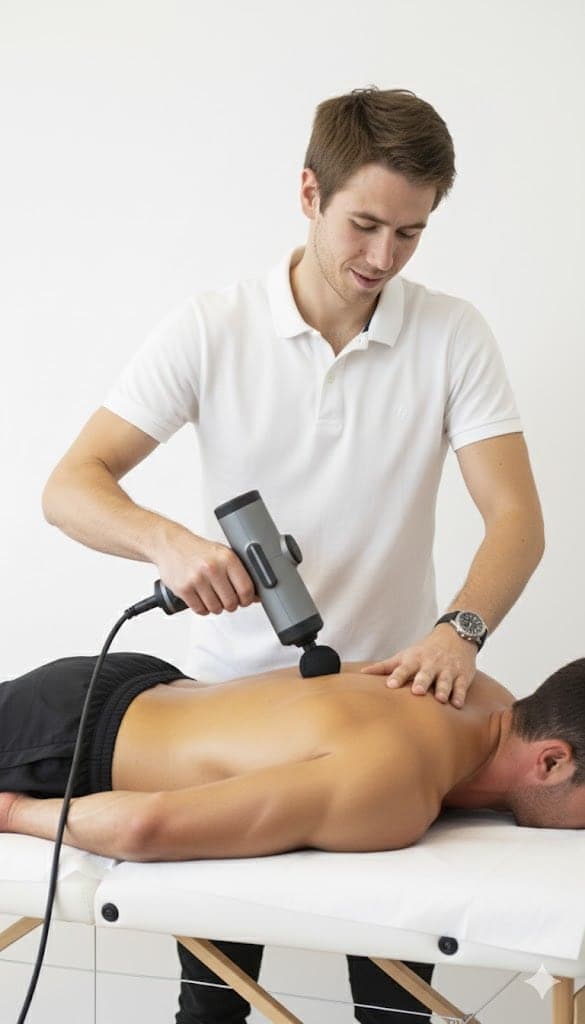
Written by
Chris
Massage therapist, nutrition and exercise physiologist
Norwegian-certified with a Bachelor’s in Physical Education and Nutrition and over ten years of clinical practice, working from a portable table in clients’ homes across the Paphos district.
This article is general information, not a medical diagnosis. If you have severe, worsening or unexplained pain, numbness, weakness, or pain after an accident, see a doctor first.