Massage for Stiffness Chloraka: Advanced Deep-Tissue Treatment That Actually Works
In short
Discover how specialized mechanical deep-tissue massage relieves chronic stiffness in Chloraka. Expert-led, science-based treatment targeting root causes, not symptoms—delivering lasting relief you can feel.
Stiffness isn’t just uncomfortable—it’s your body signaling that something fundamental needs attention. After a decade of treating clients across Cyprus, I’ve seen countless people in Chloraka struggling with the same pattern: temporary relief from traditional massage, followed by the same stiffness returning within days. This cycle isn’t your fault. The problem is that most massage approaches simply don’t address the mechanical reality of what’s happening in your tissue.
I’m a specialist in body mechanics with a Bachelor’s degree in Physical Education and Nutrition from Norway, and I’ve spent ten years developing a method that treats stiffness at its biomechanical source. This isn’t about relaxation or superficial kneading—it’s about precision intervention that creates measurable, lasting change in how your body functions.
When you’re dealing with stiffness in your shoulders, lower back, or legs that restricts your movement and diminishes your quality of life, you need more than temporary symptom management. You need someone who understands tissue architecture, fascial restriction patterns, and the mechanical principles that govern how muscles either move freely or become locked in dysfunctional holding patterns.
Understanding the Biomechanics of Stiffness
Stiffness occurs when muscle fibers and fascial layers develop adhesions—essentially, the tissues that should glide smoothly past each other become stuck together. This isn’t metaphorical language; it’s a precise description of what happens at the cellular level when chronic tension, repetitive movement patterns, or inadequate recovery create fibrous cross-links within your soft tissue.
Most people think of stiffness as “tight muscles,” but that’s an oversimplification that leads to ineffective treatment approaches. What you’re actually experiencing is a complex interplay of:
- Fascial restriction limiting the normal excursion of muscle tissue
- Trigger points creating referred tension patterns throughout kinetic chains
- Compensatory holding patterns where one area becomes stiff because another area isn’t functioning properly
- Inflammatory responses that thicken connective tissue and reduce elasticity
- Neural facilitation where your nervous system maintains elevated muscle tone as a protective mechanism
I’ve treated clients in Chloraka who had been managing stiffness for years—some for decades—without understanding this fundamental reality. One client, a property manager who spent hours daily in his car driving between sites, came to me with severe posterior chain stiffness. He’d tried everything: stretching routines, foam rolling, weekly spa massages. Nothing provided more than a few hours of relief.
The issue wasn’t that these approaches were wrong—it was that they weren’t addressing the depth and specificity required to actually remodel the restricted tissue. His hamstrings, glutes, and lower back had developed dense adhesions that no amount of surface-level manipulation could affect. Within three sessions using my specialized mechanical approach, he experienced range of motion improvements he hadn’t felt in over five years.
Why Traditional Massage Fails to Relieves Stiffness
I need to be direct about something that most massage therapists won’t tell you: traditional hands-on massage has inherent limitations when treating chronic stiffness. This isn’t about skill or intention—it’s about biomechanical reality.
Human hands, no matter how experienced, can only:
Generate limited force: The deepest restrictions require sustained, precise pressure that exceeds what hands can maintain without fatigue or injury to the therapist.
Maintain consistency: Every therapist has variations in energy, strength, and focus from session to session. Your treatment effectiveness shouldn’t depend on whether your therapist had a good day.
Access certain tissue depths: The layers where chronic stiffness resides—deep within the muscle belly, at fascial interfaces, around bone attachments—require a level of penetration and specificity that manual pressure simply cannot achieve safely.
I started my career using traditional techniques. I was effective, my clients felt better, but I noticed a frustrating pattern: the most stubborn cases—the people who genuinely needed lasting relief—would improve temporarily but rarely achieved complete resolution. This observation drove me to research advanced methodologies and ultimately develop a completely different approach.
The breakthrough came when I integrated specialized mechanical tools that could deliver what I call the three pillars of effective stiffness treatment: Precision, Power, and Consistency.
The Mechanical Advantage: How My Method Transforms Stiffness Treatment
My specialized machine-assisted approach isn’t about replacing the human element—it’s about augmenting my decade of expertise with technology that can do what hands cannot. This combination creates treatment outcomes that fundamentally differ from anything you’ve experienced before.
Deeper Than Hands: Reaching the Root of Restriction
The tool I use works at tissue depths that manual pressure cannot safely or effectively access. We’re talking about reaching the deepest muscle layers, the fascial planes between muscle groups, and the periosteal attachments where tendons meet bone—all areas where chronic stiffness establishes its strongest hold.
I had a client in Chloraka, a professional in his late forties, who described his upper back and neck as feeling “like concrete” every afternoon. Traditional massage provided temporary relief, but by the next day, the stiffness returned with the same intensity. When I examined his tissue, I could feel dense, rope-like bands through his trapezius and rhomboids—restrictions that had been building for years.
Using the mechanical tool, I could apply sustained, precise pressure directly to these restriction zones at a depth no human hands could maintain. The difference wasn’t subtle. After the first session, he had a 40% improvement in cervical rotation. After four sessions, the chronic stiffness that had plagued him for three years was completely resolved.
Complete Control: Customized Intensity for Your Specific Needs
One of the most significant advantages of this method is the ability to precisely calibrate treatment intensity. Whether you’re dealing with general stiffness that requires moderate intervention or you’re an athlete needing powerful, deep work to maintain peak performance, I can adjust the tool’s penetration and technique to your exact requirements.
This matters because effective stiffness treatment requires working at what I call the “therapeutic threshold”—that precise level where we’re creating positive tissue remodeling without causing protective guarding or inflammation. Too light, and we don’t affect the deeper restrictions. Too aggressive, and we trigger defensive responses that actually increase stiffness.
With traditional massage, finding and maintaining this threshold is guesswork influenced by the therapist’s strength, fatigue level, and subjective assessment. With my mechanical approach, it’s a precise, controllable parameter that I adjust in real-time based on your tissue response.
Consistent Results: Eliminating the Variable of Human Limitation
Every therapist has off days. Fatigue, personal stress, physical limitations—all these factors affect treatment quality with traditional massage. My method eliminates this variable entirely.
The machine delivers exactly the same quality of work in session one as in session twenty. This consistency is critical for achieving lasting results because effective stiffness elimination requires progressive treatment—each session building on the last, systematically addressing layers of restriction until we reach complete resolution.
I’ve structured my approach around this principle. Rather than one-off sessions that provide temporary relief, I work with clients through dedicated partnerships where we develop customized treatment plans aimed at lasting resolution. This isn’t about managing your stiffness indefinitely—it’s about eliminating it completely and then optimizing your tissue health for long-term performance.
Treating Causes, Not Symptoms: The Philosophy Behind Lasting Relief
Most massage therapy operates on a symptom-management model: you feel stiff, you get a massage, you feel better temporarily, the stiffness returns, you book another massage. This cycle can continue indefinitely because the underlying cause—the actual tissue dysfunction—is never fully addressed.
My approach is fundamentally different. I’m interested in one thing: lasting resolution.
This requires understanding that your stiffness isn’t random. It exists for specific biomechanical reasons:
Postural compensation patterns: If your hip flexors are restricted, your lower back will become stiff trying to compensate. Treating the back provides temporary relief, but the stiffness returns until we address the hip flexors.
Movement dysfunction: Poor movement patterns during daily activities create repetitive strain in specific tissue areas, building chronic restriction over time.
Incomplete recovery: Whether from exercise, injury, or simply daily stress, tissue that doesn’t fully recover accumulates micro-restrictions that eventually manifest as stiffness.
Systemic factors: Nutrition, hydration, sleep quality, and stress management all influence tissue health and recovery capacity.
With my background in both Physical Education and Nutrition, I don’t just treat your tissue—I educate you on the systemic factors contributing to stiffness and provide strategies for maintaining the results we achieve together.
Common Stiffness Patterns I Treat in Chloraka
After ten years of specialized practice, I’ve identified the most common stiffness presentations and developed targeted protocols for each:
| Stiffness Location | Common Causes | Treatment Focus | Typical Resolution Timeline |
|---|---|---|---|
| Neck and Upper Shoulders | Computer work, phone use, stress-induced tension | Suboccipital release, trapezius depth work, scapular mobilization | 3-5 sessions |
| Lower Back and Hips | Prolonged sitting, driving, postural compensation | Psoas release, lumbar fascial work, glute activation | 4-6 sessions |
| Shoulders and Rotator Cuff | Overhead work, swimming, poor sleeping position | Rotator cuff depth treatment, scapular stabilizer work | 5-7 sessions |
| Legs and Posterior Chain | Running, cycling, standing work | Hamstring depth work, IT band release, calf remodeling | 4-6 sessions |
These timelines reflect lasting resolution, not temporary improvement. Many clients notice significant changes after the first session, but complete relief from chronic stiffness requires systematic treatment that addresses all contributing layers.
The Science Behind Deep-Tissue Mechanical Treatment
Understanding why this method works requires basic knowledge of tissue remodeling. Your fascial and muscle tissue isn’t static—it’s constantly adapting based on the mechanical forces applied to it. This principle, called mechanotransduction, is the scientific foundation of my approach.
When we apply sustained, precise mechanical force to restricted tissue, several physiological processes occur:
- Adhesions between fascial layers begin to separate, restoring normal tissue gliding
- Fibroblasts—the cells responsible for connective tissue structure—receive signals to remodel dysfunctional collagen patterns
- Local blood flow increases, improving nutrient delivery and waste removal
- Neural receptors reset, reducing the elevated muscle tone that contributes to stiffness
- Trigger points release, eliminating referred tension patterns
This isn’t massage in the traditional sense—it’s therapeutic mechanical intervention based on principles of biomechanics and tissue physiology. The depth, precision, and sustained nature of the treatment create changes that superficial approaches simply cannot achieve.
I had a client who worked in construction—his hands, forearms, and shoulders were chronically stiff from repetitive manual labor. He’d been told this was just “part of the job” and something he’d have to manage with pain medication and occasional massage. Within two months of targeted mechanical treatment, his chronic stiffness was completely resolved. More importantly, we identified and corrected movement patterns that were contributing to the problem, preventing recurrence.
He described it as “getting my body back”—no longer waking up stiff, no longer losing strength and dexterity as the day progressed, no longer needing medication to get through his work. That’s the difference between symptom management and actual resolution.
Why Location Flexibility Matters: I Travel to Your Place in Chloraka
Convenience isn’t just about comfort—it’s a critical factor in treatment effectiveness. When you’re dealing with chronic stiffness, the last thing you need is the additional stress of traveling to a clinic, finding parking, and sitting in a waiting room.
I bring everything required directly to your location in Chloraka: professional treatment bench, all specialized equipment, and the focused, distraction-free environment necessary for optimal results. This approach serves several important purposes:
Reduces pre-treatment stress: Stress and rushing increase muscle tension, working against our treatment goals.
Allows immediate rest post-treatment: After deep tissue work, your body needs time to integrate the changes. Being able to rest immediately in your own space optimizes recovery.
Increases treatment consistency: When receiving treatment is convenient, you’re more likely to maintain the session frequency necessary for lasting results.
Enables better assessment: I can observe your actual living and working environment, identifying ergonomic factors contributing to your stiffness.
This isn’t a luxury service—it’s a practical approach that recognizes the reality of achieving lasting results. Stiffness elimination requires commitment to a treatment protocol, and I’ve structured my service to remove every barrier to your success.
Investment vs. Expense: Understanding the Value of Lasting Relief
I need to address something directly: my service is not cheap massage. It’s not a spa experience, it’s not relaxation therapy, and it’s not a temporary feel-good treatment. It’s an investment in durably resolving a condition that’s diminishing your quality of life.
Consider the actual cost of chronic stiffness:
- Reduced performance at work due to discomfort and limited movement
- Inability to enjoy physical activities you love
- Sleep disruption from positional discomfort
- Ongoing expense of temporary solutions that never fully resolve the problem
- Potential for stiffness to progress into more serious conditions requiring medical intervention
- The psychological burden of chronic discomfort
When you calculate the cumulative cost—financial, physical, and emotional—of managing stiffness indefinitely, lasting resolution becomes obviously valuable. I’ve had clients who spent more annually on mediocre massage sessions than they invested in my comprehensive treatment program that eliminated their stiffness completely.
One client calculated that he’d spent over €2,000 across three years on various massage therapists, physiotherapy, and pain medication, all providing temporary relief at best. After working with me for three months with a dedicated protocol, his chronic lower back and hip stiffness—present for over five years—was completely resolved. Two years later, it hasn’t returned.
That’s the difference between expense and investment. Expense is ongoing, repetitive cost for temporary management. Investment is targeted cost for lasting resolution.
What to Expect: The Treatment Process
Understanding what happens during treatment helps set appropriate expectations and maximizes your results.
Initial Assessment
Your first session begins with comprehensive assessment. I evaluate:
- Specific locations and patterns of stiffness
- Range of motion limitations and asymmetries
- Postural patterns and compensation strategies
- Daily activities and ergonomic factors contributing to stiffness
- Previous treatments and their results
- Overall health factors affecting tissue recovery
This assessment informs a customized treatment strategy targeting your specific situation, not a generic protocol applied to everyone with “stiffness.”
Treatment Sessions
During treatment, you’ll experience sensations different from traditional massage. The mechanical tool allows me to work at depths that create a more intense sensation—not painful, but definitely more profound than surface relaxation massage.
I guide you through the process, constantly communicating and adjusting based on your tissue response. Some areas require sustained pressure for several minutes to achieve release. Other areas respond to shorter, more targeted intervention. The precision of the mechanical approach allows me to adapt in real-time.
Most clients describe the sensation as “good pain”—the feeling of restriction releasing, similar to a deep stretch but more localized and controlled. You’ll often feel immediate changes: increased range of motion, reduced tension, improved ease of movement.
Post-Treatment Response
Your body continues responding to treatment for 48-72 hours afterward. During this period:
- You may experience mild soreness as tissue remodels—this is normal and indicates positive change
- Hydration is critical—drink significantly more water than usual to support tissue recovery
- Gentle movement is beneficial—avoid intense exercise, but don’t become sedentary
- You’ll likely notice progressive improvement as inflammation resolves and tissue adapts
I provide specific guidance on managing this recovery period to optimize results.
Progressive Treatment Protocol
Lasting stiffness resolution typically requires multiple sessions. The exact number depends on:
- Severity and duration of your stiffness
- Number of areas requiring treatment
- Your tissue quality and recovery capacity
- Your commitment to recommended activity modifications
I develop a customized protocol outlining recommended session frequency and expected timeline for complete resolution. This transparent approach ensures you understand exactly what’s required to achieve your goals.
Frequently Asked Questions About Massage for Stiffness in Chloraka
How is this different from regular massage?
Regular massage primarily addresses superficial muscle tension and provides temporary relaxation. My specialized mechanical approach treats the deep-tissue restrictions that cause chronic stiffness, working at depths and with precision that traditional massage cannot achieve. The goal isn’t temporary relief—it’s lasting resolution through systematic tissue remodeling.
Does the mechanical treatment hurt?
The sensation is more intense than relaxation massage but should never be unbearable. I work at what I call the “therapeutic threshold”—deep enough to create positive change but controlled enough to avoid protective guarding. Most clients describe it as intense but satisfying, like a deep stretch. The precision of the tool allows me to adjust intensity instantly based on your feedback and tissue response.
How quickly will I notice improvement?
Most clients experience noticeable changes after the first session—improved range of motion, reduced tension, easier movement. However, complete relief from chronic stiffness requires multiple sessions to address all contributing layers and allow tissue to fully remodel. Typical protocols range from 3-7 sessions depending on severity and duration of stiffness.
How long do results last?
When we achieve complete resolution through proper protocol, results are lasting. The key difference from traditional massage is that we’re not just temporarily relieving symptoms—we’re actually remodeling tissue structure and correcting movement patterns. Many clients return periodically for optimization work, but the chronic stiffness they initially presented with doesn’t return.
Do you treat only stiffness, or other conditions as well?
While stiffness is a primary focus, the mechanical deep-tissue approach is effective for various conditions including chronic pain, movement restrictions, athletic performance optimization, and injury recovery. My expertise is in body mechanics and tissue function, so any condition involving soft-tissue dysfunction falls within my scope.
What should I do to prepare for treatment?
Arrive well-hydrated and avoid heavy meals immediately before treatment. Wear comfortable clothing that allows access to treatment areas. Be prepared to provide detailed information about your stiffness patterns, daily activities, and previous treatments. The more information I have, the more precisely I can target your specific situation.
Do you only travel to Chloraka, or other areas as well?
While I serve clients throughout Cyprus, Chloraka is within my standard service area. I bring all necessary equipment directly to your location, setting up a professional treatment environment in your home or office. This eliminates travel stress and allows immediate rest post-treatment.
Can I combine this treatment with other therapies?
In most cases, yes. My approach complements physiotherapy, chiropractic care, and other therapeutic modalities. I’m happy to coordinate with other practitioners to ensure integrated care. However, for active treatment sessions, I typically recommend spacing different manual therapies to avoid overwhelming tissue and to allow clear assessment of each approach’s effects.
Taking the Next Step: Moving from Chronic Stiffness to Optimal Function
If you’re reading this, you’re likely tired of temporary solutions. You’ve probably tried multiple approaches, experienced brief relief, and watched the stiffness return with frustrating consistency. I understand this cycle because I’ve guided hundreds of clients through breaking it.
The decision isn’t really about choosing a massage therapist. It’s about deciding whether you’re ready to invest in lasting resolution rather than continuing to manage symptoms indefinitely.
My method works. The mechanical precision, the depth of treatment, the systematic protocol—these elements combine to create outcomes that traditional approaches cannot match. But they require something from you: commitment to the process.
Lasting stiffness elimination isn’t achieved in a single session. It requires progressive treatment that systematically addresses restriction layers, corrects movement patterns, and allows tissue to fully remodel. I provide the expertise, technology, and customized protocols. You provide the commitment to completing the process.
After ten years of specialization, I’ve refined this approach to maximize effectiveness and minimize required time. I’ve eliminated every unnecessary variable, optimized every technical element, and structured my service around one goal: getting you from chronic stiffness to optimal function as efficiently as possible.
Why Chloraka Residents Choose Specialized Treatment Over Generic Massage
The Chloraka area provides an excellent quality of life, but that quality diminishes significantly when chronic stiffness restricts your movement and creates constant discomfort. Whether you’re active in water sports, spending time outdoors, or simply trying to enjoy daily life without limitation, stiffness is an obstacle to the lifestyle you want.
I work with clients across diverse situations: professionals whose desk work creates upper body stiffness, athletes dealing with overuse restrictions, retirees wanting to maintain active lifestyles, and people who’ve simply accumulated years of tension that traditional massage hasn’t resolved.
What they share is recognition that their stiffness isn’t going to improve through generic approaches. They understand that lasting resolution requires specialized intervention from someone who views their body as a mechanical system requiring precise, depth-specific treatment.
Many had previously accepted stiffness as something they’d manage indefinitely—part of aging, part of their job, or just “how their body is.” The discovery that complete resolution is actually achievable fundamentally changes their perspective and their quality of life.
The Difference a Decade of Specialization Makes
Ten years of focusing exclusively on mechanical deep-tissue treatment has taught me patterns that generalist therapists never learn. I’ve treated thousands of sessions, observed how different tissue types respond, refined my protocols based on measurable outcomes, and developed assessment skills that allow me to identify restriction patterns most practitioners miss.
This isn’t arrogance—it’s simply the reality of specialization. A generalist massage therapist might work on stiffness occasionally among many other conditions. I work on stiffness every day, constantly refining my understanding of tissue mechanics, treatment protocols, and what separates temporary relief from lasting resolution.
My education—a Bachelor’s degree in Physical Education and Nutrition—provides scientific foundation that informs every treatment decision. I don’t work from intuition or tradition; I work from biomechanical principles and physiological reality.
Combined with the mechanical technology that provides capabilities beyond manual treatment, this expertise creates something genuinely different from what you’ve experienced before.
Making Your Decision: Evaluating Whether This Approach Is Right for You
This treatment approach isn’t for everyone. It’s specifically designed for people who:
- Have chronic stiffness that hasn’t been durably resolved by previous treatments
- Are willing to commit to a progressive treatment protocol, not just seeking one-off relief
- Value effectiveness over convenience of quick, cheap solutions
- Understand that lasting resolution requires deeper intervention than relaxation massage
- Are ready to invest in long-term body optimization rather than ongoing symptom management
If this describes your situation and mindset, my approach will likely deliver results that exceed your expectations. If you’re looking for spa-style relaxation or the cheapest possible option for temporary relief, we’re probably not a good match.
I’m selective about who I work with because lasting resolution requires partnership between practitioner and client. I provide expert treatment and guidance; you provide commitment to the process and implementation of recommended strategies.
Your Body’s Potential Without Chronic Stiffness
Consider what your life would look like with complete stiffness elimination:
Waking up flexible and comfortable instead of needing 30 minutes to “loosen up” each morning.
Moving through your day without constant awareness of restricted, uncomfortable areas.
Engaging in activities you’ve avoided because stiffness made them difficult or painful.
Sleeping deeply without positional discomfort disrupting your rest.
Performing at your best physically, whether in sport, work, or daily activities.
Feeling decades younger than your chronological age because your movement quality matches how you want to feel.
This isn’t hypothetical. This is what my clients experience when we successfully eliminate their chronic stiffness. It’s not partial improvement or temporary relief—it’s a fundamental change in how their body functions.
The mechanical deep-tissue approach I’ve developed makes this possible for people who’ve struggled with stiffness for years, sometimes decades. The precision, depth, and systematic nature of treatment create changes that other methods cannot achieve.
Final Thoughts: From Stiffness Management to Body Optimization
The common approach to stiffness—getting massage when it becomes unbearable, feeling temporarily better, then waiting until it becomes unbearable again—is fundamentally flawed. You’re not managing the condition; the condition is managing you.
My method represents a complete paradigm shift: from symptom management to cause treatment, from temporary relief to lasting resolution, from accepting limitation to optimizing function.
After ten years of specialization, working with hundreds of clients, and continuously refining my protocols, I can state with complete confidence: chronic stiffness is a solvable problem when approached with appropriate expertise and technology.
The question isn’t whether your stiffness can be eliminated—it almost certainly can. The question is whether you’re ready to commit to the process required for lasting resolution.
If you are, I’m ready to apply a decade of expertise and cutting-edge mechanical treatment to your specific situation. Not to manage your stiffness indefinitely, but to eliminate it completely and optimize your body’s mechanical function for long-term performance.
That’s the difference between massage for temporary relief and specialized treatment for lasting results. That’s what I provide to clients in Chloraka who are ready to move beyond symptom management to actual resolution.
Your body is capable of moving without chronic stiffness. It’s capable of feeling flexible, comfortable, and mechanically efficient. Achieving this requires the right intervention from someone with the expertise and technology to treat causes, not just symptoms.
I’ve dedicated my professional life to developing that intervention. The method works. The question is whether you’re ready to experience what life feels like when chronic stiffness no longer limits you.
Evidence and limits
Massage may help with some symptoms, but benefits and evidence vary by condition. It does not replace medical assessment or treatment. A page update is not evidence of an independent clinical review.
Further reading: Massage therapy: evidence, safety and limitations by US National Center for Complementary and Integrative Health. This is general background reading, not verification of every claim in this article.
How we describe evidence and updates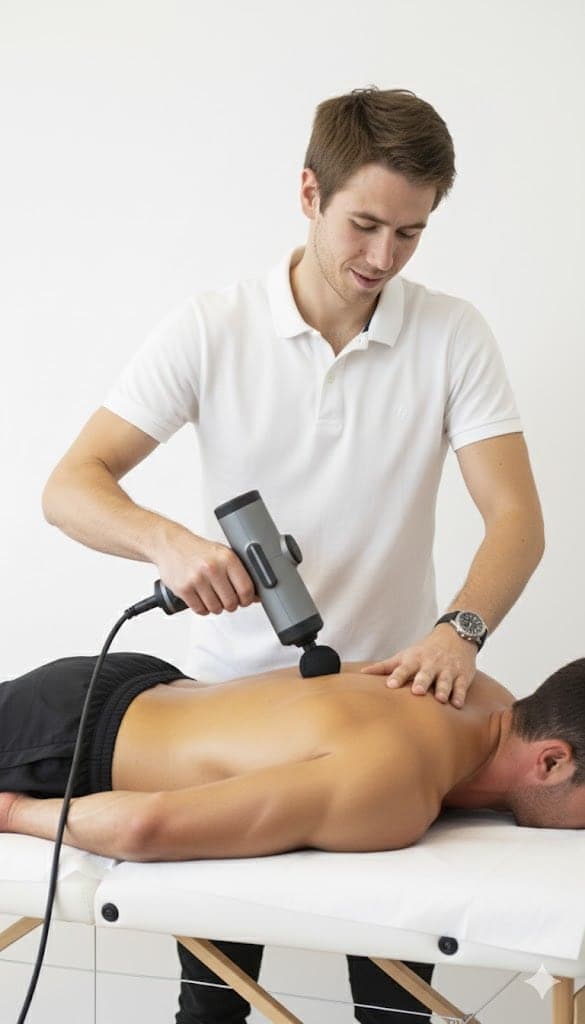
Written by
Chris
Massage therapist, nutrition and exercise physiologist
Norwegian-certified with a Bachelor’s in Physical Education and Nutrition and over ten years of clinical practice, working from a portable table in clients’ homes across the Paphos district.
This article is general information, not a medical diagnosis. If you have severe, worsening or unexplained pain, numbness, weakness, or pain after an accident, see a doctor first.