
Economical Massage Options Kato Paphos: The Truth About Value vs. Cost
In short
Discover the most economical massage options in Kato Paphos that deliver actual results. Learn why the cheapest option often costs you more in the long run, and what true value means when investing in pain relief.
When clients first contact me about economical massage options in Kato Paphos, they’re usually asking the wrong question. After ten years of treating chronic pain and mechanical dysfunction across Cyprus, I’ve learned that “economical” doesn’t mean “cheapest”—it means getting lasting results that eliminate the need for endless repeat visits. The most expensive massage is the one you have to keep booking month after month because it never actually fixes anything.
The massage industry in Kato Paphos operates on a comfortable fiction: that relaxation equals treatment. Walk into most establishments offering €35-50 sessions, and you’ll receive exactly what you pay for—temporary relief that feels pleasant but changes nothing structurally. I’m not criticizing relaxation massage. It serves a purpose. But if you’re seeking economical solutions to chronic shoulder tension, lower back dysfunction, or athletic performance limitations, you’re literally throwing money away on approaches that treat symptoms while ignoring mechanical causes.
My approach challenges this entire paradigm. With a Bachelor’s degree in Physical Education and Nutrition from Norway and a decade specializing exclusively in advanced mechanical deep-tissue work, I’ve built my practice around a singular principle: treat the cause, achieve lasting results, eliminate the cycle of dependency. This article examines what truly economical massage options look like in Kato Paphos, what they include, and why understanding tissue mechanics matters more than comparing price lists.
Understanding the Kato Paphos Massage Market: What You’re Actually Paying For
The Kato Paphos massage landscape ranges from hotel spa treatments at €80-120 per hour to small studios offering sessions from €35-60. On the surface, this appears straightforward: higher prices equal better quality. The reality is considerably more complex.
I’ve treated dozens of clients who’ve spent thousands of euros across multiple therapists before finding me. One particular case stays with me—a 42-year-old office worker who’d been receiving weekly €40 massages for eighteen months. She calculated she’d spent over €2,800 on sessions that provided 2-3 days of relief before her neck tension returned. When we began working together, I identified severe trapezius adhesions and scalene dysfunction that no amount of relaxation massage would ever address. After four sessions using my specialized mechanical approach, her chronic tension resolved completely. She hasn’t needed regular treatment since.
The Three-Tier Pricing Structure in Kato Paphos
| Price Tier | Typical Cost | What You Receive | Long-Term Value |
|---|---|---|---|
| Budget Studios | €35-45/hour | Basic Swedish/relaxation massage, minimal customization | Low—requires weekly maintenance |
| Mid-Range Establishments | €50-70/hour | More experienced therapists, some specialized techniques | Medium—may address surface tension |
| Premium Services | €75-120/hour | Luxury environment, varied quality of actual treatment | Variable—depends on therapist skill |
| Specialized Mechanical Therapy | €80-100/session | Advanced deep-tissue, machine-assisted precision work, targeted treatment plans | High—achieves lasting structural change |
The most economical option isn’t necessarily in any single tier. It depends entirely on your objective. Are you purchasing an experience, or are you investing in a solution?
What Budget Massage Options in Kato Paphos Actually Include
Let me be direct about what €35-50 massage sessions typically offer, because this clarity will save you considerable money and frustration.
Standard Inclusions at Lower Price Points
- 45-60 minutes of hands-on treatment time
- Basic Swedish massage techniques (effleurage, petrissage, light kneading)
- Aromatherapy oils (usually synthetic blends)
- Simple treatment room with basic amenities
- Limited consultation or assessment
- General full-body approach rather than targeted treatment
What these sessions categorically do NOT include is any form of advanced assessment, understanding of biomechanics, or ability to create structural change in dysfunctional tissue. The therapist’s hands, regardless of skill level, possess inherent limitations. Human thumbs and fingers fatigue. Pressure becomes inconsistent. Depth is restricted by the therapist’s own body mechanics. Most critically, hands cannot sustain the precise, controlled pressure necessary to release chronic adhesions in deep muscle layers.
I’ve experienced this limitation firsthand throughout my training. Even with optimal technique, my hands could only penetrate superficial and some intermediate muscle layers effectively. The deepest fibers—where chronic tension establishes its most stubborn patterns—remained largely inaccessible. This isn’t a criticism of manual therapy skill; it’s simple biomechanical reality.
The Hidden Costs of “Economical” Options
Here’s what the budget massage approach actually costs you:
Time Investment: If you require weekly sessions indefinitely to manage symptoms, you’re committing 50+ hours annually to treatments that never resolve the underlying problem. At €40 per session, that’s €2,080 yearly—every year.
Opportunity Cost: Every week spent managing symptoms is a week you’re not performing optimally in athletics, work, or daily activities. How much is reduced productivity costing you?
Progressive Deterioration: Untreated mechanical dysfunction doesn’t remain static. It creates compensatory patterns throughout the kinetic chain, multiplying problems over time. The shoulder issue you’re “managing” with monthly massages is simultaneously creating hip dysfunction you haven’t noticed yet.
I treated a 35-year-old runner last year who perfectly illustrated this progression. He’d been receiving regular sports massage for his chronically tight hamstrings—€45 sessions, twice monthly for three years. Total investment: €3,240. His hamstrings never improved because no one identified that his dysfunction originated in restricted hip flexors creating compensatory posterior chain tension. After proper assessment and targeted mechanical treatment, we resolved both the primary cause and secondary symptoms in six weeks.
My Specialized Mechanical Approach: Why It’s More Economical Than Cheap Massage
I work exclusively with a specialized machine that delivers three qualities impossible to achieve through manual therapy: precision, power, and consistency. This isn’t luxury equipment—it’s clinical necessity for producing actual structural change in dysfunctional tissue.
The DEEPER THAN HANDS Principle
Deep muscle layers—the multifidus along the spine, the rotator cuff complex, the deep hip stabilizers—require sustained, precisely controlled pressure to release chronic adhesions. Human hands simply cannot maintain the necessary force at the required depth without either fatiguing or causing surface tissue trauma.
My machine works differently. It penetrates to the exact depth required, sustains consistent pressure, and allows me to work layer by layer with complete control. I can address the root cause of tension where it actually exists, not just where it manifests as surface symptoms.
Consider a typical scenario: chronic lower back pain. A conventional massage therapist works the erector spinae muscles—the large, superficial back muscles they can easily access. You feel temporary relief because surface tension decreases. But the dysfunction actually originates in the deep multifidus or quadratus lumborum, which manual pressure barely touches. Within days, the superficial muscles tense again as compensatory patterns reassert themselves. You book another session. The cycle continues indefinitely.
With mechanical precision, I can access those deep stabilizers directly, release the actual adhesions causing dysfunction, and interrupt the compensation pattern durably. This is why clients typically need 4-6 sessions to resolve issues they’ve been “managing” for years with weekly conventional massage.
Complete Control: Customization That Manual Therapy Cannot Match
Every body presents unique requirements. The 28-year-old CrossFit athlete recovering from a snatch injury needs dramatically different treatment than the 55-year-old desk worker with cervicogenic headaches. My specialized equipment allows me to adjust intensity with precision—from light work on sensitized tissue to powerfully deep penetration for athletes who can tolerate and benefit from maximum depth.
This level of customization is biomechanically impossible with hands. Therapist fatigue, variable pressure application, and inability to sustain force create inherent inconsistency. With my machine, I deliver exactly the treatment each tissue requires, adjusted in real-time based on tissue response.
Consistent Results: Eliminating the “Off Day” Variable
Manual therapists have off days. They’re tired. Their hands hurt. They’re distracted. The quality of your treatment varies based on factors completely unrelated to your needs. This inconsistency undermines treatment outcomes, especially for chronic conditions requiring systematic progression.
My mechanical approach eliminates this variable entirely. Every session delivers identical precision and power. Your treatment plan progresses systematically because each session builds reliably on the previous one. This consistency is fundamental to achieving lasting results rather than temporary relief.
What My Service Actually Includes: The Complete Package
When clients invest in my specialized approach, they receive considerably more than a massage session. They receive a dedicated partnership focused on lasting resolution.
Comprehensive Initial Assessment
Every new client relationship begins with thorough evaluation:
- Detailed postural analysis identifying primary dysfunction and compensatory patterns
- Movement screening revealing restrictions and asymmetries
- Palpation assessment determining tissue quality, adhesion location, and sensitivity levels
- Discussion of activity patterns, injury history, and performance goals
- Clear explanation of mechanical causes underlying your symptoms
This assessment typically requires 30-45 minutes before hands-on treatment begins. Budget massage options skip this entirely, proceeding directly to generic technique application. Without understanding what’s actually dysfunctional, how can treatment possibly address it?
Customized Treatment Plans
I don’t offer one-off sessions designed to feel good temporarily. I create systematic programs targeting your specific mechanical dysfunction with clear progressions and measurable outcomes.
A typical treatment plan might look like this:
- Sessions 1-2: Address primary adhesions and most restricted tissue layers, establish tolerance baselines
- Sessions 3-4: Progress to deeper layers as superficial restrictions release, begin addressing compensatory patterns
- Sessions 5-6: Refine remaining restrictions, restore optimal movement patterns, establish maintenance protocols
- Follow-up: Periodic maintenance sessions (typically 2-4 times yearly) preventing recurrence
This systematic approach costs more per session than budget massage but requires dramatically fewer total sessions to achieve lasting results. The economics favor comprehensive treatment decisively.
Mobile Service: Professional Treatment at Your Location
I travel to your location with a professional treatment bench and all necessary equipment. This mobile approach provides several advantages:
Convenience: No travel time for you, no parking concerns, no schedule disruptions.
Comfort: Treatment in your familiar environment, with your preferred temperature, lighting, and privacy.
Efficiency: No rushed feeling, no waiting room anxiety, complete focus on your treatment.
Consistency: Same environment each session, eliminating variables that might affect tissue response.
The mobile model actually improves clinical outcomes while simultaneously providing superior convenience. You’re paying for results and efficiency, not overhead costs of maintaining a commercial space.
The Real Economical Calculation: Cost Per Problem Solved
Let’s examine actual economics using real client scenarios from my practice.
Case Study: Chronic Neck Tension
Budget Massage Approach:
- Weekly €40 sessions managing symptoms
- Average duration: indefinite (many clients continue for years)
- Annual cost: €2,080
- Five-year cost: €10,400
- Outcome: ongoing symptom management, no resolution
My Specialized Approach:
- Initial assessment: €100
- Five follow-up sessions: €450
- Total cost: €550
- Outcome: lasting resolution of mechanical cause
- Maintenance: 2-3 sessions annually (€200-300/year) preventing recurrence
Even adding three years of maintenance sessions, you’ve invested €1,450 total versus €6,240 for basic symptom management—and you’ve actually solved the problem rather than temporarily masking it.
Case Study: Athletic Performance Enhancement
A competitive cyclist came to me with plateau issues and chronic hip tightness. He’d been receiving regular sports massage (€55/session, twice monthly) for eighteen months without improvement.
His previous investment: €1,980 with zero performance gains.
My approach: comprehensive hip complex assessment revealed severe psoas and TFL restrictions with compensatory glute inhibition. Six sessions (€600 total) released the restrictions, restored optimal firing patterns, and improved his power output measurably. His subsequent season produced personal bests in three events.
Cost per problem solved: €600 versus effectively infinite with approaches that never resolve mechanical dysfunction.
What to Look for in Truly Economical Massage Options
If you’re seeking massage services in Kato Paphos with genuine economic value, evaluate based on these criteria rather than hourly rates:
Assessment Quality
Does the therapist conduct thorough evaluation before treatment? Do they explain what’s mechanically dysfunctional and why? Can they describe a clear treatment progression? If assessment consists of “where does it hurt?” followed by immediate hands-on work, you’re receiving symptom management, not problem-solving.
Results Orientation
Does the therapist discuss lasting resolution or ongoing management? Are they establishing dependency on regular sessions, or working systematically toward independence? Economical service solves problems; expensive service creates ongoing needs.
Technical Capability
Can they access deep tissue layers where chronic dysfunction actually resides? Manual therapy has inherent depth limitations. If the therapist relies exclusively on hands, they cannot address many common mechanical problems regardless of skill level.
Education and Specialization
What is the therapist’s educational background? A weekend certification course provides dramatically different expertise than a university degree in physical education, biomechanics, or related fields. Specialization in mechanical dysfunction indicates focused expertise rather than generalized technique application.
Treatment Philosophy
Does the approach target causes or symptoms? This distinction determines whether you’re investing in solutions or purchasing temporary relief. Ask directly: “Will this fix my problem durably, or will I need ongoing treatment indefinitely?”
Why My Approach Represents True Economy
I position my service explicitly as an investment in long-term health, not an expense managing symptoms. This framing matters because it reflects fundamentally different objectives and outcomes.
When you invest in mechanical deep-tissue treatment that addresses root causes, you’re purchasing:
- Freedom from ongoing treatment dependency: Solve the problem once rather than managing it forever
- Restored optimal function: Performance improvements in athletics, work, and daily activities
- Prevention of progressive deterioration: Untreated mechanical dysfunction compounds over time; resolution prevents future problems
- Enhanced quality of life: Pain-free movement, better sleep, improved mood, increased confidence
These outcomes possess enormous economic value extending far beyond the direct cost of treatment sessions.
The Partnership Model
I work with clients as dedicated partners pursuing clearly defined outcomes. This isn’t a transactional relationship where you purchase relaxation by the hour. It’s a collaborative process where my expertise in body mechanics combines with your commitment to achieving lasting improvement.
This partnership model includes education throughout treatment. I explain what I’m finding, why specific tissues are restricted, how compensatory patterns developed, and what you can do between sessions to support the process. You’re not a passive recipient of technique application—you’re an active participant in your own recovery.
Many clients tell me this educational component alone justifies the investment. Understanding why your body developed dysfunction and how to maintain optimal function afterward represents lasting value that continues benefiting you indefinitely.
Common Questions About Economical Massage in Kato Paphos
How much should I expect to pay for effective massage treatment?
Effective treatment addressing mechanical dysfunction typically costs €75-100 per session in Kato Paphos. This seems expensive compared to €35-50 relaxation massage, but requires dramatically fewer total sessions to achieve lasting results. Calculate cost per problem solved rather than cost per hour.
How many sessions will I need?
Most chronic mechanical problems require 4-6 sessions for complete resolution when addressed with advanced techniques and proper equipment. Ongoing symptom management with basic massage might continue indefinitely without ever solving the underlying issue.
Can budget massage work for some situations?
Absolutely. If your objective is relaxation, stress relief, or general wellness without specific mechanical problems, budget options serve perfectly well. If you’re dealing with chronic pain, restricted movement, or performance limitations, you need specialized treatment that most budget services cannot provide.
What’s the difference between deep tissue massage and mechanical deep tissue therapy?
“Deep tissue massage” is a widely misused term often describing firm pressure Swedish massage. True mechanical deep tissue therapy uses specialized equipment to access muscle layers that hands cannot effectively reach, applying precisely controlled pressure to release chronic adhesions and restore optimal tissue quality.
Is more expensive always better?
No. Price often reflects overhead costs, location prestige, or luxury amenities rather than treatment effectiveness. Evaluate based on therapist education, specialized training, technical capability, and treatment philosophy rather than price alone.
How do I know if a therapist can actually help my specific problem?
Ask direct questions: What’s causing my dysfunction mechanically? What’s your treatment approach? How many sessions typically resolve this issue? What’s your relevant education and experience? Competent specialists answer clearly and confidently. Vague responses or immediate booking pressure indicate inadequate expertise.
Why should I choose mobile service?
Mobile service eliminates travel time, provides treatment in your comfortable environment, and often delivers superior focus and consistency. You’re paying for results and convenience rather than covering the therapist’s commercial space overhead. The clinical outcomes are typically better, not just the convenience.
What happens if treatment doesn’t work?
With proper assessment and appropriate technique application, mechanical dysfunction responds predictably. If you’re not experiencing measurable improvement within 2-3 sessions, something is wrong—either the assessment was incorrect, the technique insufficient, or the problem lies outside massage scope (requiring medical intervention). Quality practitioners identify these situations quickly rather than continuing ineffective treatment indefinitely.
Making the Economical Choice: A Decision Framework
When evaluating massage options in Kato Paphos, use this framework to identify truly economical choices:
Step 1: Define Your Objective Clearly
Are you seeking:
- Relaxation and stress relief
- Resolution of chronic pain or dysfunction
- Athletic performance enhancement
- Recovery from specific injury
- General wellness maintenance
Your objective determines what constitutes “economical.” Relaxation goals may be perfectly served by budget options. Mechanical problem resolution requires specialized expertise regardless of cost.
Step 2: Calculate True Cost
Don’t compare hourly rates. Calculate:
- Total cost to achieve your objective
- Time investment required
- Opportunity cost of continued dysfunction
- Long-term maintenance requirements
Six €90 sessions solving a problem durably is dramatically more economical than endless €40 sessions managing symptoms.
Step 3: Evaluate Expertise and Capability
Research the therapist’s education, specialization, and technical approach. University-level education in relevant fields indicates substantially deeper expertise than basic certification courses. Specialized equipment demonstrates commitment to optimal outcomes rather than minimal viable technique.
Step 4: Assess Treatment Philosophy
Does the approach target symptom management or problem resolution? Is the therapist establishing ongoing dependency or working toward your independence? This philosophical distinction matters more than any technical detail.
Step 5: Consider the Complete Value Proposition
What do you actually receive? Assessment quality, customization, equipment sophistication, education, follow-up support—these elements create enormous value differences not reflected in price alone.
The Kato Paphos Advantage: Why Location Matters
Kato Paphos presents unique opportunities for massage therapy clients. The compact area, lower overhead costs compared to major European cities, and competitive market create access to specialized services that might be prohibitively expensive elsewhere.
My mobile model leverages these advantages perfectly. Without commercial space costs, I can offer advanced mechanical deep-tissue therapy at rates comparable to mid-range conventional massage in larger markets, while delivering dramatically superior results.
The local client base—combining residents dealing with occupational dysfunction, athletes training year-round in Cyprus’s climate, and visitors seeking recovery from travel stress—creates demand for diverse expertise. This competition pushes providers toward either specialization or commodification. I’ve chosen specialization deliberately, focusing exclusively on mechanical problem-solving rather than competing on price for relaxation services.
Investment vs. Expense: Reframing the Economic Question
The most important distinction in evaluating massage options is understanding the difference between investment and expense.
Expense: Money spent on temporary relief that requires endless repetition. Budget massage managing chronic symptoms represents pure expense—ongoing cost with no accumulating value.
Investment: Money spent producing lasting value that continues benefiting you indefinitely. Specialized treatment resolving mechanical dysfunction is investment—higher upfront cost creating lasting improvement.
I’ve built my entire practice around this investment model. My clients aren’t purchasing massage sessions—they’re investing in lasting resolution of mechanical problems limiting their quality of life. This reframing changes everything about how you evaluate economic value.
Consider what lasting pain relief is actually worth. What would you pay to never again wake up with that chronic neck tension? To run without hip restriction? To work at your desk without progressive shoulder dysfunction? To lift your children without lower back concern?
These outcomes possess enormous intrinsic value extending far beyond the direct cost of treatment. When you frame the question properly—”What is this solution worth?” rather than “What does this session cost?”—the economics become immediately clear.
Why I Choose This Approach: Personal Philosophy
After a decade in this field, I’ve developed strong convictions about how massage therapy should function economically. The conventional model—endless sessions providing temporary relief while never addressing underlying causes—benefits the therapist financially while failing the client therapeutically. I find this model ethically problematic.
My educational background in Physical Education and Nutrition taught me to think systematically about body mechanics and long-term outcomes. When I entered massage therapy, I was immediately frustrated by the industry’s focus on symptom management rather than problem-solving. The techniques I learned, while pleasant for clients, rarely produced lasting structural change.
This frustration drove me toward mechanical approaches and specialized equipment. I wanted to actually fix problems, not just make people feel better temporarily. When I discovered the precision and power that advanced mechanical therapy could deliver, everything changed. Suddenly I could access tissue layers that hands couldn’t reach. I could maintain consistent pressure that manual work couldn’t sustain. I could create real, lasting change in dysfunctional tissue.
The economic model followed naturally from this technical capability. If I can solve chronic problems in 4-6 sessions that conventional approaches never resolve, I should price accordingly. Clients pay more per session but need dramatically fewer total sessions and achieve incomparably better outcomes. This represents genuine economic value.
I travel to clients because it improves both convenience and clinical results. Treatment in familiar environments produces better tissue response. Eliminating travel stress enhances recovery. The mobile model serves my clients optimally while allowing me to focus entirely on clinical excellence rather than maintaining commercial space.
This entire approach reflects my core belief: massage therapy should be results-driven, mechanically sophisticated, and economically structured around lasting problem resolution rather than indefinite symptom management.
Taking Action: How to Proceed
If you’re dealing with chronic pain, movement restriction, or performance limitations in Kato Paphos, here’s how to move forward economically:
First, abandon the assumption that cheaper equals more economical. Calculate based on outcomes, not hourly rates.
Second, seek specialists with relevant education and advanced technical capabilities. University-level training in biomechanics, physical education, or related fields indicates expertise far beyond basic certification.
Third, ask direct questions about treatment philosophy and expected outcomes. Therapists who discuss lasting resolution rather than ongoing management are working in your economic interest.
Fourth, evaluate the complete service offering. Assessment quality, equipment sophistication, customization capability, and educational support create value extending far beyond the hands-on treatment time.
Fifth, view the investment properly. You’re purchasing lasting improvement in quality of life, not paying for temporary symptom relief.
My specialized mechanical approach represents the most economical option in Kato Paphos for clients seeking actual resolution of mechanical dysfunction. The upfront investment is higher than budget alternatives, but the total cost to achieve lasting results is dramatically lower, and the improvement in quality of life is incomparable.
The choice is ultimately yours. You can continue managing symptoms indefinitely with approaches that feel pleasant but change nothing structurally, or you can invest in specialized treatment that addresses mechanical causes and produces lasting resolution. One path leads to endless expenses; the other leads to lasting freedom from dysfunction.
After ten years of treating bodies in crisis, I know with absolute certainty which approach serves clients’ interests—both therapeutically and economically. The question is whether you’re ready to stop managing symptoms and start solving problems durably.
Evidence and limits
Massage may help with some symptoms, but benefits and evidence vary by condition. It does not replace medical assessment or treatment. A page update is not evidence of an independent clinical review.
Further reading: Massage therapy: evidence, safety and limitations by US National Center for Complementary and Integrative Health. This is general background reading, not verification of every claim in this article.
How we describe evidence and updates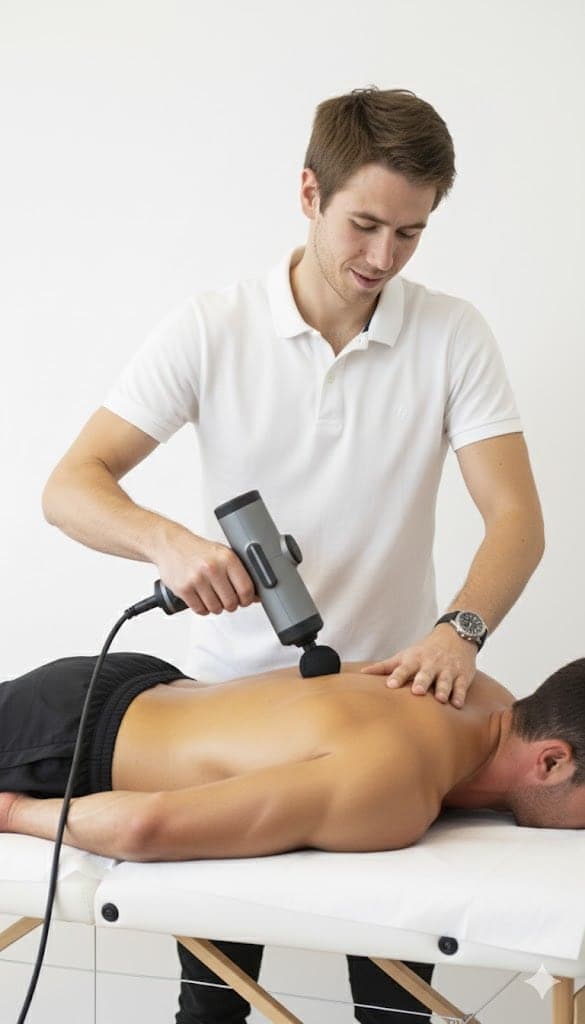
Written by
Chris
Massage therapist, nutrition and exercise physiologist
Norwegian-certified with a Bachelor’s in Physical Education and Nutrition and over ten years of clinical practice, working from a portable table in clients’ homes across the Paphos district.
This article is general information, not a medical diagnosis. If you have severe, worsening or unexplained pain, numbness, weakness, or pain after an accident, see a doctor first.