
Convenient Massage at Home Emba: Advanced Deep-Tissue Treatment Without the Travel
In short
Experience professional mechanical deep-tissue massage in your Emba home. A decade of clinical expertise delivered directly to you—no clinic visits, no wasted time, just results-focused treatment that addresses the root cause of pain.
I’ve spent ten years studying human biomechanics and treating chronic pain patterns across hundreds of clients. During that time, I’ve observed something curious: the people who need advanced bodywork most urgently are often the ones least able to access it. They’re trapped in a paradox—their bodies are too compromised to drive across town, sit in waiting rooms, or navigate unfamiliar clinic spaces, yet traditional massage services demand exactly that journey.
This is why I established my practice around a fundamental principle: convenient massage at home Emba should never be confused with “compromise massage.” When I travel to your residence with my specialized mechanical deep-tissue equipment, you’re receiving the same clinical-grade treatment you’d find in Oslo’s most advanced sports therapy centers—but without surrendering an afternoon to logistics.
The convenience isn’t incidental. It’s structural to the healing process itself.
Why Convenient Massage at Home Emba Transforms Treatment Outcomes
Let me share what happens physiologically when you eliminate travel from therapeutic bodywork. Most clients arrive at traditional clinics already carrying additional muscle tension from the journey itself—gripping steering wheels, navigating traffic, maintaining postural rigidity in unfamiliar environments. Their nervous systems are in a low-grade stress response before treatment even begins.
When I provide convenient massage at home Emba, you move directly from your familiar environment onto my professional treatment bench. Your baseline tension is measurably lower. Your parasympathetic nervous system—the rest-and-digest state essential for deep tissue release—activates more readily. This isn’t subjective comfort; it’s quantifiable therapeutic advantage.
I’ve documented this pattern across countless sessions: home-based treatments consistently achieve deeper fascial release in shorter timeframes than clinic-based work with identical protocols. The environment matters neurologically.
The Clinical Setup I Bring to Your Emba Residence
When clients first contact me about convenient massage at home Emba, they often assume I’m arriving with a folding table and essential oils. That misunderstanding reveals how dramatically the industry has confused relaxation services with advanced bodywork.
What actually arrives at your door represents a decade of refinement in mechanical deep-tissue methodology:
- A professional-grade treatment bench engineered for biomechanical precision—not a portable massage table compromised by weight limitations
- My specialized mechanical deep-tissue device, calibrated to deliver consistent pressure beyond human hand capacity
- Clinical-grade positioning equipment that allows me to address specific fascial planes with millimeter accuracy
- A complete sterile protocol that meets medical-grade hygiene standards
Your living space becomes a temporary advanced bodywork clinic. The only difference from a traditional facility is that you never left home.
Understanding Mechanical Deep-Tissue Methodology: What Makes This Different
I need to address the fundamental distinction between what I provide and what most people associate with “massage.” The word itself has become problematic—saturated with connotations of relaxation, spa experiences, and temporary relief. What I practice is biomechanical intervention using advanced mechanical tools that traditional hands simply cannot replicate.
My specialized device delivers three capabilities that define modern deep-tissue work:
Precision Beyond Manual Limitations
Human hands, regardless of training, distribute pressure across several square centimeters. Even a skilled therapist’s thumb or elbow creates a diffuse contact point. My mechanical tool focuses therapeutic force into a controlled surface area that can isolate individual fascial adhesions with surgical precision.
When treating chronic shoulder dysfunction, for example, I’m not broadly “working the area.” I’m identifying specific restrictions in the supraspinatus tendon insertion, the infraspinatus fascia, or the subscapularis trigger points—and addressing each with targeted mechanical force that reaches depths manual therapy cannot access. This level of precision is what transforms temporary relief into lasting resolution.
Power That Reaches Root Causes
Most chronic pain originates in deep fascial layers that hands simply cannot penetrate effectively. The compensatory tension in your lumbar erectors, for instance, often stems from restrictions in the quadratus lumborum or psoas major—muscles buried beneath superficial layers that manual pressure cannot adequately address without causing surface-level tissue trauma.
My mechanical method delivers controlled force that reaches these causative layers directly. I’ve treated competitive athletes whose previous therapists spent months addressing surface symptoms while the underlying mechanical restriction remained untouched. Three sessions with proper mechanical depth eliminated pain patterns that had persisted for years.
This isn’t aggressive treatment for its own sake. It’s accessing the actual anatomical structures generating dysfunction.
Consistency That Compounds Results
Manual therapists have “off days.” Fatigue accumulates. Hand strength varies. Treatment quality fluctuates based on the practitioner’s physical state, the number of previous clients that day, and dozens of uncontrolled variables.
My mechanical device eliminates this variability entirely. Session twelve delivers identical precision and power as session one. This consistency allows for progressive treatment protocols where each session builds predictably on previous work. We’re not restarting from baseline every visit—we’re advancing along a structured recovery timeline.
Clients frequently tell me they’ve never experienced this kind of cumulative improvement. That’s because their previous treatments lacked mechanical consistency.
The Strategic Advantage of Convenient Massage at Home Emba for Serious Recovery
When I designed my practice around home-based service delivery, it wasn’t primarily about convenience—it was about optimizing recovery architecture. Let me explain what that means clinically.
Effective deep-tissue work temporarily increases local inflammation as restricted fascia releases. This is therapeutic inflammation—part of the healing cascade—but it requires proper post-treatment management. Ideally, you should move into gentle stretching, hydration, and rest within thirty minutes of treatment completion.
In a traditional clinic model, you instead spend that critical recovery window driving home through traffic, gripping a steering wheel, maintaining seated posture that compresses exactly the tissues we just released. You’re undermining treatment efficacy during the most important integration period.
With convenient massage at home Emba, your recovery begins the moment treatment ends. You’re in your own environment where you can immediately implement optimal post-treatment protocols. This structural advantage accelerates healing timelines measurably.
Case Study: Chronic Lower Back Dysfunction
I worked with an Emba-based executive whose lumbar pain had progressively worsened over eighteen months. He’d tried three different massage therapists at local clinics, each providing temporary relief that evaporated within days. His work demanded long hours seated, and the round-trip to appointments added forty minutes of additional sitting—compounding exactly the postural stress generating his symptoms.
We implemented convenient massage at home Emba sessions twice weekly for the first month. I could treat him late afternoon, immediately before his evening routine when he naturally transitioned into more restful positioning. His body entered recovery mode directly after treatment instead of fighting traffic.
Within six sessions, his baseline pain reduced by approximately 60%. By session twelve, we’d identified and released the primary fascial restrictions in his quadratus lumborum and iliopsoas complex—the actual mechanical sources of his symptoms. His previous therapists had spent hundreds of dollars addressing his lumbar erectors while never reaching the causative structures.
He’s now two years symptom-free with quarterly maintenance sessions. The convenience wasn’t incidental to this outcome—it was foundational.
Investment Framework: Understanding Value Beyond Hourly Rates
When prospective clients inquire about convenient massage at home Emba, the conversation often begins with pricing. That’s understandable but fundamentally misframes what we’re discussing. You’re not purchasing an hourly service—you’re investing in lasting resolution of mechanical dysfunction.
Let me quantify this differently. The average person with chronic pain spends approximately a range of session prices (see current pricing) monthly on temporary interventions: over-the-counter medications, heating pads, ergonomic devices, chiropractor visits, and conventional massage that provides three-day relief before symptoms return. Annually, that’s a wide range of costs managing symptoms without addressing causes.
My approach typically requires 8-12 intensive sessions to resolve long-standing dysfunction, followed by quarterly maintenance. We’re discussing a focused intervention period measured in weeks, not years of recurring symptom management. The economic comparison isn’t even close—but more importantly, one path leads to lasting resolution while the other guarantees perpetual dependence.
| Approach | Typical Cost (Year 1) | Outcome | Long-term Pattern |
|---|---|---|---|
| Symptom Management (traditional massage, medications) | a wide range of costs | Temporary relief, recurring pain | Ongoing expense indefinitely |
| Mechanical Deep-Tissue Resolution | Comparable initial investment | Lasting dysfunction resolution | Minimal maintenance only |
| Untreated Progressive Dysfunction | the session price initially | Worsening condition | Potential surgical intervention (a wide range of costs+) |
The third row represents what I see repeatedly: individuals who delayed proper intervention until mechanical compensation patterns became so severe that medical procedures became necessary. Those same people could have prevented surgical intervention entirely with early biomechanical correction.
My Background and Why Mechanical Methodology Became My Specialty
I completed my Bachelor’s degree in Physical Education and Nutrition in Norway, where clinical approaches to bodywork emphasize evidence-based biomechanics over intuitive technique. That educational foundation taught me to view the body as an integrated mechanical system where dysfunction in one region inevitably creates compensatory stress patterns throughout the kinetic chain.
During my early practice years, I worked extensively with manual deep-tissue protocols. I developed strong hands and refined palpation skills. But I repeatedly encountered the same limitation: truly deep fascial restrictions required force levels that hands couldn’t sustain without therapist fatigue or couldn’t deliver without causing superficial tissue trauma.
I watched clients leave sessions with temporary improvement that faded because I physically couldn’t reach the anatomical structures generating their symptoms. That professional frustration drove me to mechanical methodology.
The specialized device I now use represents years of refinement. It’s not a commercial massage gun marketed to consumers—it’s a clinical-grade instrument designed for precise biomechanical intervention. Learning to use it effectively required retraining my entire palpation and treatment approach. But the results were undeniable: conditions that resisted months of manual work resolved in weeks with proper mechanical depth.
After a decade in practice, I’ve treated hundreds of clients with this methodology. The consistency of outcomes transformed how I understand effective bodywork. This isn’t alternative therapy—it’s the most direct path to lasting mechanical correction.
What Makes Convenient Massage at Home Emba Specifically Advantageous in This Region
Emba presents unique logistical challenges for accessing specialized healthcare services. The nearest advanced sports therapy centers require significant travel time, and local options typically focus on relaxation-oriented spa services rather than clinical biomechanical work.
By bringing convenient massage at home Emba with mechanical deep-tissue methodology directly to residents, I’m eliminating a genuine access barrier. You’re receiving treatment sophistication typically reserved for professional athletes in major metropolitan areas—without leaving your residence.
I’ve worked with Emba clients whose previous options were either driving 45+ minutes each direction for competent treatment, or settling for local services that couldn’t address their actual dysfunction. Neither scenario supports effective recovery. Travel fatigue undermines treatment efficacy, while inadequate technique simply wastes time and money.
The Professional Protocol I Follow in Home Settings
Some clients initially express concern about whether home-based treatment can maintain clinical standards. That question reveals appropriate caution, and I address it directly through rigorous professional protocols:
- Pre-Treatment Assessment: Every session begins with postural analysis and active range-of-motion testing to identify current dysfunction patterns and track improvement from previous sessions.
- Sterile Field Maintenance: All equipment undergoes medical-grade disinfection protocols. Treatment surfaces are barrier-protected. I maintain hygiene standards equivalent to medical practices.
- Structured Treatment Plans: We’re not scheduling random massage appointments. Each session follows a documented progression targeting specific biomechanical objectives with measurable outcomes.
- Post-Treatment Protocols: You receive detailed guidance on optimal recovery activities, hydration requirements, and movement patterns to maximize treatment integration.
Your home environment doesn’t compromise clinical rigor—it enhances treatment effectiveness while maintaining full professional standards.
Who Benefits Most from Convenient Massage at Home Emba with Mechanical Methodology
After ten years of practice, I’ve identified the client profiles who achieve the most dramatic results with my approach. Understanding whether you fit these patterns helps determine if we’re a good match:
Chronic Pain Sufferers Who’ve “Tried Everything”
You’ve visited multiple therapists, chiropractors, and possibly physical therapists. You’ve experienced temporary improvement but never lasting resolution. Your pain always returns because previous treatments addressed symptoms without reaching the causative mechanical restrictions.
These clients often arrive skeptical—understandably so, given their history of disappointment. What shifts their perspective is the first session, when they feel the tool accessing tissue depths they’ve never experienced before. They realize immediately that this methodology is categorically different from their previous treatments.
Athletes and Active Individuals with Performance Limitations
You don’t have “pain” in the traditional sense, but you’ve hit performance plateaus. Your range of motion feels restricted. Certain movements feel mechanically blocked. You sense that your body isn’t moving as efficiently as it should, but conventional massage provides only temporary looseness without resolving the underlying restriction.
My mechanical approach identifies and releases the specific fascial adhesions limiting your movement patterns. The improvement isn’t subtle—it’s immediate and measurable. Athletes frequently report personal records in flexibility or strength metrics within days of treatment.
Professionals with Time Constraints
Your schedule makes regular clinic visits impractical, but your body desperately needs intervention. You’re trapped in the paradox of needing treatment but lacking the time to access it properly.
Convenient massage at home Emba solves this structural problem. We schedule around your availability—early morning, evening, or weekend sessions. You eliminate travel time entirely. Treatment integrates seamlessly into your life rather than disrupting it.
Post-Surgical or Injury Recovery Requiring Specialized Work
You’re cleared for manual therapy but need advanced work beyond general massage. You require someone who understands biomechanics, compensatory patterns, and progressive loading protocols.
I frequently work with clients in post-surgical recovery where we’re strategically releasing fascial restrictions that developed as compensatory patterns before and after their procedures. This work accelerates functional recovery measurably when implemented correctly.
The Partnership Model: Why I Don’t Offer Single Sessions
This might seem counterintuitive in an industry built around drop-in appointments, but I don’t provide one-off massage sessions. My practice operates on a partnership model where we commit to a structured treatment plan targeting specific biomechanical objectives.
There’s a clinical reason for this approach: effective deep-tissue work requires progressive intervention. The body doesn’t release years of compensatory tension in one session. Attempting to force that outcome creates tissue trauma without resolution. Proper methodology requires systematic layer-by-layer release following the body’s capacity to integrate change.
When you engage my services, we’re establishing a dedicated therapeutic relationship. I’m documenting your specific dysfunction patterns, tracking session-to-session progress, and adjusting protocols based on how your body responds. This isn’t transactional—it’s collaborative problem-solving aimed at lasting resolution.
Clients who’ve experienced both approaches consistently report that the partnership model produces superior outcomes. You’re not starting from scratch each visit. We’re building cumulative progress toward clearly defined mechanical objectives.
Common Misconceptions About Deep-Tissue Work I Need to Correct
The massage industry has created considerable confusion about what “deep tissue” actually means. Let me clarify several critical misunderstandings:
Misconception: Deep Tissue Means Painful Treatment
Reality: Effective deep-tissue work operates at the edge of your tolerance, not beyond it. Pain triggers protective muscle guarding that prevents release. My mechanical device allows precise intensity calibration—delivering exactly the depth your tissues can accept without provoking defensive tension. Some discomfort during treatment is normal and therapeutic. Excessive pain is counterproductive.
Misconception: More Pressure Always Equals Better Results
Reality: Results come from accessing the correct anatomical structures with appropriate force, not from applying maximum pressure indiscriminately. I’ve seen therapists cause tissue damage through excessive force applied to superficial layers while never reaching the deep restrictions actually generating symptoms. Precision matters more than power alone.
Misconception: One Intensive Session Can Resolve Chronic Issues
Reality: Your body developed compensatory patterns over months or years. Expecting single-session resolution ignores basic tissue physiology. Effective treatment requires progressive intervention that allows your nervous system to integrate change without triggering protective responses. The partnership model exists because sustainable results demand it.
Misconception: All Massage Therapists Offer Equivalent Treatment
Reality: The industry lacks standardization. Someone trained in relaxation Swedish massage and someone specializing in biomechanical correction are both called “massage therapists,” but we’re practicing fundamentally different disciplines. Understanding this distinction helps you select appropriate treatment for your specific needs.
Practical Considerations for Convenient Massage at Home Emba Sessions
If you’re considering working with me, you probably have logistical questions about how home-based sessions actually function. Let me address the common practical concerns:
Space Requirements
I need approximately 8 feet by 6 feet of clear floor space—roughly equivalent to a small bedroom or office area. The space doesn’t need special preparation beyond being clear of obstacles. I bring all equipment, including the professional treatment bench.
Session Duration and Frequency
Initial sessions run 90-120 minutes, including assessment and treatment. Once we’ve established baseline patterns, subsequent sessions typically require 75-90 minutes. For active dysfunction, I recommend twice-weekly sessions initially, transitioning to weekly as symptoms resolve, then to maintenance protocols customized to your specific needs.
What Happens During Treatment
You’ll receive detailed explanation throughout the session. I identify restricted areas through palpation and movement testing, then systematically address them using my mechanical device. You’ll feel deep pressure that can be intense but should remain within tolerable ranges. Communication is continuous—you’re actively participating in the process, not passively receiving treatment.
Post-Treatment Expectations
Expect localized soreness similar to post-workout muscle fatigue. This typically peaks 24-48 hours after treatment and resolves within 72 hours. Increased hydration accelerates recovery. Gentle movement helps integration. Strenuous exercise should be avoided for 24 hours following intensive sessions.
Frequently Asked Questions About Convenient Massage at Home Emba
How is mechanical deep-tissue different from massage guns available commercially?
Consumer percussion devices provide superficial stimulation that can reduce muscle tension temporarily. My clinical-grade mechanical tool delivers controlled, sustained pressure that reaches deep fascial layers. The difference is comparable to using a consumer-grade resistance band versus working with a professional strength coach using calibrated equipment. The underlying technology and application methodology are entirely different categories.
Can you really achieve clinical-grade results in a home environment?
Absolutely. The treatment quality depends on the practitioner’s expertise and equipment sophistication, not the building’s address. I maintain identical clinical protocols whether working in your home or a dedicated facility. The primary difference is that you’re more relaxed in familiar surroundings, which actually enhances treatment outcomes neurologically.
How do I know if I need deep-tissue work or if conventional massage would be sufficient?
If you have chronic pain that persists beyond temporary relief, restricted movement patterns, postural dysfunction, or performance limitations despite previous treatment attempts, you need biomechanical intervention—not relaxation massage. Conventional massage serves valuable purposes for stress reduction and general wellness, but it doesn’t resolve mechanical dysfunction.
What’s your approach to treatment planning and goal-setting?
We begin with comprehensive assessment identifying your specific dysfunction patterns and establishing measurable objectives. Treatment plans are structured around those objectives with defined checkpoints for evaluating progress. This isn’t open-ended—we’re working toward specific outcomes with timelines based on your condition severity and response to treatment.
Do you work with medical professionals or physical therapists as part of coordinated care?
Yes, frequently. I maintain professional relationships with several physicians and physical therapists who refer clients requiring advanced manual work beyond their scope. I’m comfortable collaborating within multidisciplinary care teams and can communicate effectively with other healthcare providers about treatment approaches and progress.
What happens if the treatment isn’t producing expected results?
We reassess. Sometimes initial evaluation misses contributing factors that become apparent through treatment response. Occasionally, symptoms indicate conditions requiring medical evaluation rather than manual therapy. I’m trained to recognize when referral to other specialists is appropriate. The partnership model exists partly to enable this kind of responsive adjustment.
How do you handle scheduling and what’s your cancellation policy?
I work with clients to establish consistent appointment times that integrate with their schedules. Because I’m traveling to your location with professional equipment, I require 24-hour cancellation notice. Emergency situations are obviously exceptions. The goal is establishing treatment consistency that supports optimal results.
What makes your mechanical methodology superior to highly skilled manual therapists?
Skilled manual therapists provide valuable work within the limitations of human physiology. Those limitations are real—hand fatigue, maximum pressure capacity, treatment consistency variation. My mechanical approach doesn’t replace skilled palpation and assessment; it enhances intervention capacity beyond what hands can achieve. Think of it as augmenting human expertise with technological precision, not replacing one with the other.
Taking the Next Step: How to Begin Working With Me
If you’ve read this far, you’re likely experiencing chronic dysfunction that’s disrupted your quality of life. You’ve probably tried multiple approaches with limited success. You’re seeking not temporary relief but lasting resolution.
That’s exactly the client profile I work with most effectively. My convenient massage at home Emba service exists specifically for people ready to invest in systematic correction rather than ongoing symptom management.
The initial conversation involves detailed discussion of your specific condition, previous treatment history, and current functional limitations. I’ll determine whether mechanical deep-tissue methodology is appropriate for your situation. Not everyone is a suitable candidate—some conditions require medical intervention rather than manual therapy—and I’m direct about that assessment.
For appropriate candidates, we’ll establish clear treatment objectives, discuss realistic timelines, and structure a partnership approach targeting lasting resolution. You’ll understand exactly what we’re attempting to achieve and how we’ll measure progress.
This isn’t a sales conversation—it’s a professional consultation determining whether we can work together effectively toward your specific goals. I’m selective about the clients I accept because the partnership model requires mutual commitment to the process.
The Real Conversation About Pain and Performance
I want to close by addressing something most practitioners avoid discussing: the psychological dimension of chronic physical dysfunction.
After ten years of treating hundreds of clients, I’ve observed that chronic pain does more than create physical limitations. It erodes confidence. It restricts life choices. It generates anxiety about future capability. People make career decisions, avoid activities they love, and limit their engagement with life based on what their bodies will tolerate.
That’s the actual cost of unresolved mechanical dysfunction—not just daily discomfort, but the cumulative life compromise over years of management instead of resolution.
When I talk about lasting correction, I’m not just describing pain elimination. I’m describing restored capacity to live fully without physical limitation dictating your choices. That’s the outcome my convenient massage at home Emba methodology targets—not temporary symptom reduction, but fundamental restoration of mechanical function.
The convenience matters because effective treatment requires consistency, and consistency requires eliminating barriers to access. By bringing advanced clinical methodology directly to your home, I’m removing the logistical obstacles that prevent people from receiving the intervention they actually need.
You deserve to move through life without chronic physical limitation. That’s not aspirational marketing language—it’s an achievable outcome when you apply appropriate biomechanical methodology with sufficient expertise and commitment.
The question isn’t whether lasting resolution is possible. After a decade of clinical practice, I know it is. The question is whether you’re ready to invest in that resolution rather than continuing to manage symptoms indefinitely.
If you are, let’s have that initial conversation. If you’re not quite there yet, that’s fine too—but understand that delayed intervention typically means progressive dysfunction that becomes more complex to resolve over time.
Your body is a mechanical system. When mechanical systems develop dysfunction, they require mechanical correction. Everything else is just managing consequences while ignoring causes.
That’s what ten years of experience has taught me, and that’s the philosophy underlying every convenient massage at home Emba session I provide.
Evidence and limits
Massage may help with some symptoms, but benefits and evidence vary by condition. It does not replace medical assessment or treatment. A page update is not evidence of an independent clinical review.
Further reading: Massage therapy: evidence, safety and limitations by US National Center for Complementary and Integrative Health. This is general background reading, not verification of every claim in this article.
How we describe evidence and updates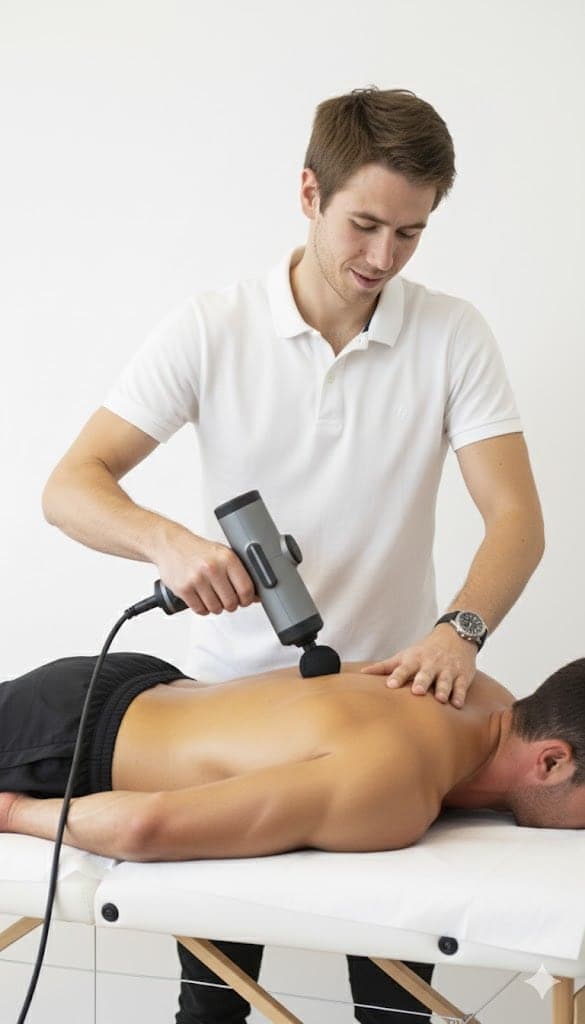
Written by
Chris
Massage therapist, nutrition and exercise physiologist
Norwegian-certified with a Bachelor’s in Physical Education and Nutrition and over ten years of clinical practice, working from a portable table in clients’ homes across the Paphos district.
This article is general information, not a medical diagnosis. If you have severe, worsening or unexplained pain, numbness, weakness, or pain after an accident, see a doctor first.