
How to choose a massage therapist: results over temporary relief
In short
Choose a massage therapist by training, specialisation and whether they can explain what they are treating and why. Ask what to expect and how progress is measured. Relaxation is fine, but lasting change needs a plan.
When people ask me how to choose a massage therapist, they usually expect a recommendation. What I give them is a short list of questions, because the answer depends on what you need. I am Chris, a one-person mobile practice across Paphos district — you can read more about me and my background before deciding whether I fit that list.
Most people looking for a therapist have already tried one or two. The pattern I hear most often is the same: the session felt good, the relief lasted a few days, and then the neck, back or hip went back to how it was. That is not a failure of massage. It is usually a mismatch between what was booked and what was needed.
What actually separates good therapists from the rest
The therapist you want is not necessarily the one with the nicest room or the longest menu of treatments. It is the one who can look at how you move, form a sensible idea of what is driving your discomfort, explain it in plain words, and then treat that rather than only the spot that hurts.
That sounds obvious, but it is rarer than it should be. A great deal of massage is delivered as a routine: the same sequence, the same pressure, whoever is on the table. That is fine for general relaxation. It is not much use if you have had the same tight upper trapezius for two years and want to know why.
Here is what I would weight most heavily:
- Formal training in anatomy and movement, not only a short massage certificate
- A clear specialism rather than a list of twenty different modalities
- Willingness to assess before treating, and to say what they found
- A plan with an expected number of sessions and a point where you stop
- Honesty about limits — what they can help with and what needs a doctor
None of these require a fancy setting. In my case, the training is a Norwegian massage certification and a BSc in Physical Education and Nutrition, and the specialism is mechanical deep-tissue work. That is not the only good combination, but it illustrates the shape of what to look for.
How I work and why I chose this method
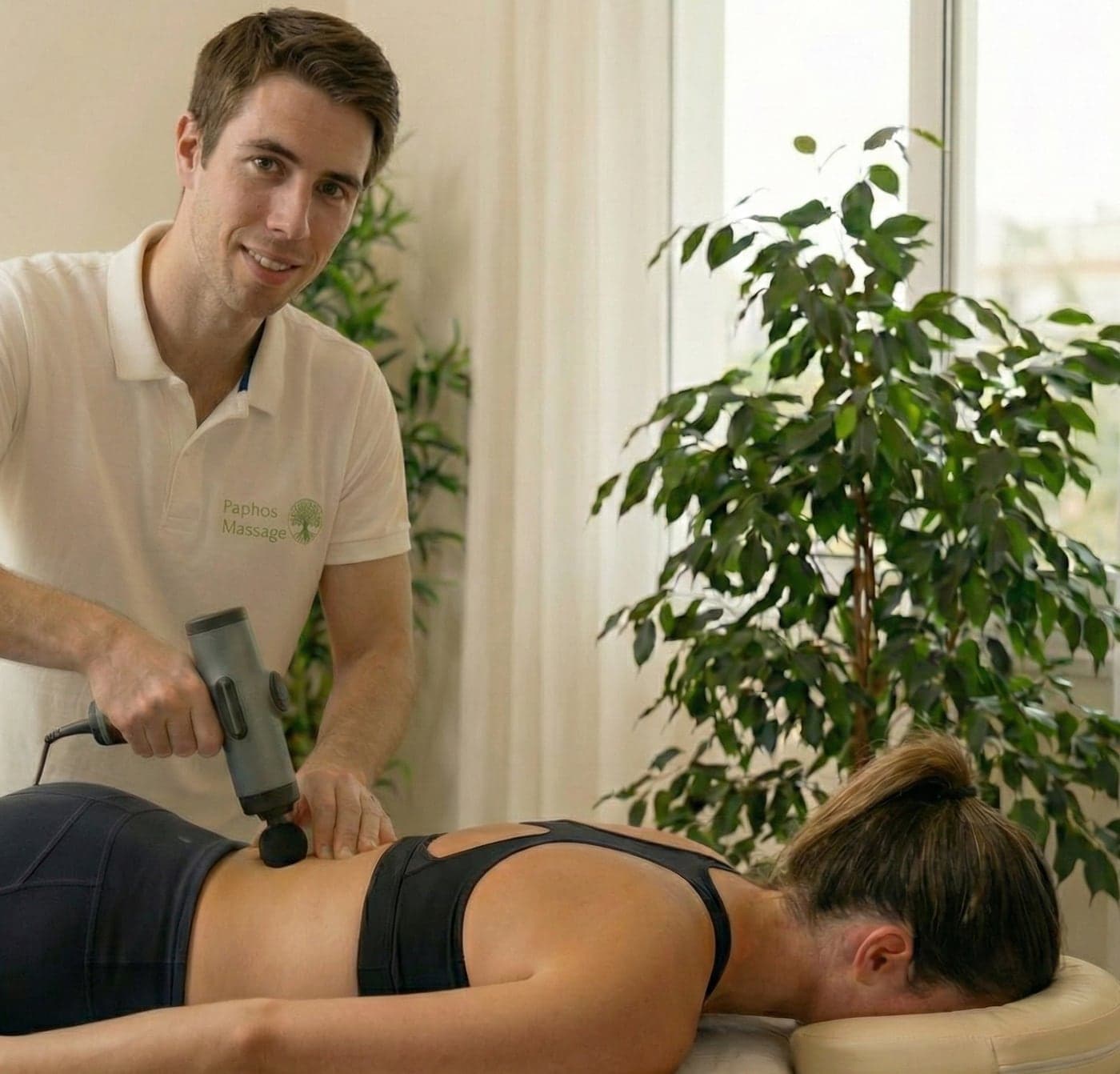
I should be transparent about my own approach, because it colours everything else in this article. After more than ten years of practice I work almost exclusively with mechanical deep-tissue massage: a handheld device that lets me apply steady, controllable pressure to deep postural muscles for as long as the tissue needs, without my hands tiring or the pressure drifting.
I did not start that way. Early on I noticed my own results varied from session to session, and the variation tracked my fatigue rather than the client's condition. Consistent pressure at real depth, for the time it takes to change stubborn tissue, is genuinely hard to sustain by hand. The device solved that problem for me. It does not replace assessment or judgement; it just makes the delivery reliable.
| What I look at | Manual deep tissue | Mechanical deep tissue (my method) |
|---|---|---|
| Depth reached | Depends on hand strength and stamina | Reaches deep hip flexors and lumbar muscles reliably |
| Pressure over a session | Tends to drift as the therapist tires | Stays where I set it |
| Adjustment | Skilled but variable | Dialled from light to firm, changed mid-stroke |
| Repeatability | Good day, bad day | Very similar from one visit to the next |
I mention this not to say hands-on work is inferior — plenty of excellent therapists work by hand — but because a good therapist should be able to tell you what they do and why, in about this much detail. If they cannot, that is information too.
How to choose a massage therapist — the questions I would ask
If I were the one booking, these are the questions I would put to any therapist before the first appointment. They are polite, quick, and very revealing.
Do they treat the cause or the sore spot?
The presentation I see most often across Paphos is shoulder or neck pain in someone who spends the day at a desk or a steering wheel. The painful area is often the place that is compensating, not the place that started it. A therapist who works only where you point, session after session, is managing a symptom. One who checks the neck, upper back and how the shoulder blade sits is looking for the reason.
Do they have an end point in mind?
Be cautious of anyone who proposes open-ended weekly sessions from the outset without saying what would change that. My own pattern is a short, focused run of sessions to change the tissue, then spacing them out as function improves. If a therapist is not trying to make themselves less necessary over time, ask why.
Can they explain their method plainly?
You do not need a lecture, but you should get an explanation you can follow: which muscles, what is tight or weak, what the treatment is meant to do. Vague language about toxins, energy or intuition tells you the therapist may not have a clinical model to work from. Plain anatomy is a good sign.
Do they tailor the session?
Ask what they would do differently for you compared with the last person they saw. A desk worker with a stiff neck and a cyclist with a tight hip flexor need very different sessions. If the answer is "the same routine, but I focus a bit more on the sore area", that is a relaxation service, which is fine if that is what you want.
Warning signs worth taking seriously
Most of these are not about dishonesty. They are about the business model behind the treatment, and it helps to see them clearly.
- The setting is the selling point. If everything is about ambience and escaping stress, expect a relaxation session, not clinical work.
- No assessment. You lie down, the routine starts, nothing is asked beyond "any areas to avoid?".
- No expected outcome. They cannot say what should improve, or by when, even roughly.
- Pressure to rebook before you leave. A decision about the next session should follow the results of this one.
- Every modality on the menu. Breadth is not the same as depth.
Price alone tells you little. Very cheap sessions often mean high volume and little assessment; very expensive ones sometimes pay for the building rather than the treatment. My own rates are on the pricing page: €90 for 60 minutes and €130 for 90, with one additional free session when you pre-book five sessions as a package, and I come to you rather than the other way round.
What a good first session looks like
Whoever you choose, the first visit should feel more like a conversation with a purpose than a set routine. This is roughly what happens when I arrive at a home in Chlorakas, Peyia or Kato Paphos with the table.
- A short history. What hurts, since when, what makes it better or worse, what you have tried, what you do all day.
- A look at how you move. Standing posture, a few simple movements, and hands on the tissue to feel where it is restricted.
- An explanation. What I think is going on and what I intend to work on today. You should understand it.
- Treatment. Progressive rather than maximal — I prepare the surface layers before going deep, especially on a first visit.
- A plan. What to expect over the next day or two, what to do between sessions, and whether a follow-up makes sense.
Depth is not the goal in itself. Going straight to full pressure on someone I have never treated is poor practice; it makes the next day worse and tells me less. Working through the layers is slower on day one and faster overall.
The homework matters as much as the session. Depending on the problem, I will suggest a couple of stretches, a change to how you sit or lift, or something about hydration and sleep. Clients who do the small things between visits get more out of every visit.
How to know whether treatment is working
Because massage feels good, it is easy to keep going without asking whether anything is changing. Here is how I judge it, and how you can too.
- Function, not just pain. Can you turn your head further, sleep through, sit for longer, run without the hip complaining? Those are better markers than a pain score alone.
- Relief that lasts longer each time. Improvement should build: a few days after the first session, then a week, then longer. If you arrive each time exactly as you left the previous one, the cause is not being reached.
- Fewer sessions needed over time. Good treatment makes itself gradually less necessary. Ongoing weekly appointments with no change in the interval are a sign to review the plan.
- You understand your own problem better. By the second or third session you should be able to say what is tight, why, and what you are doing about it.
Being clear about scope is part of choosing well, so here is mine. I can help with muscular tension, deep-tissue restriction, sports tightness and the stiff neck, back and hips that come from desk work and driving; I do not treat joint injuries, nerve compression or medical conditions, so see a doctor first if you have numbness, weakness, unexplained swelling, pain after a fall or accident, fever, or pain that wakes you at night and does not settle. If you want to see how the deep-tissue work applies to a specific area, my mechanical deep-tissue massage page goes into more detail.
Frequently asked questions
How can I tell if a massage therapist is properly qualified?
Ask directly about their training beyond a basic certificate — a degree in a movement or health science, a recognised national certification, or specific advanced courses. Then ask them to explain how they would approach your problem. Someone with a real clinical grounding will talk in plain anatomy, ask you questions back, and be comfortable saying what they do not treat.
Is deep tissue always better than a relaxation massage?
No. If your goal is to unwind, a relaxation massage is exactly right and there is nothing to apologise for. Deep tissue makes sense when there is a specific restriction or long-standing tightness you want changed. Choosing the wrong one is the most common reason people feel a session "did nothing" — the session was fine, it just was not the right tool.
How many sessions should I expect before I notice a difference?
Most people notice something after the first session, and a clearer pattern over a short run of visits. Long-standing problems take longer than recent ones. What matters more than a fixed number is the trend: each session should build on the last, and the relief should hold longer each time. If that is not happening after a few visits, the plan should change.
Does it matter whether the therapist comes to me or I go to them?
Clinically, no — the assessment and the treatment are the same. Practically, being treated at home means you arrive relaxed rather than parked and hurried, and you can rest afterwards instead of driving. It also frees you to choose on skill rather than on who happens to have premises nearby, which is one reason I built my practice around house calls across the Paphos district.
What should I do if I am not sure massage is the right thing for my problem?
Ask a doctor first if there is anything that concerns you: numbness, weakness, swelling, pain following an injury, or pain that does not settle at rest. Once anything medical has been ruled out, a good therapist will tell you honestly at the first visit whether your problem is something they expect to help with, or whether you would be better served elsewhere.
Evidence and limits
Massage may help with some symptoms, but benefits and evidence vary by condition. It does not replace medical assessment or treatment. A page update is not evidence of an independent clinical review.
Further reading: Massage therapy: evidence, safety and limitations by US National Center for Complementary and Integrative Health. This is general background reading, not verification of every claim in this article.
How we describe evidence and updates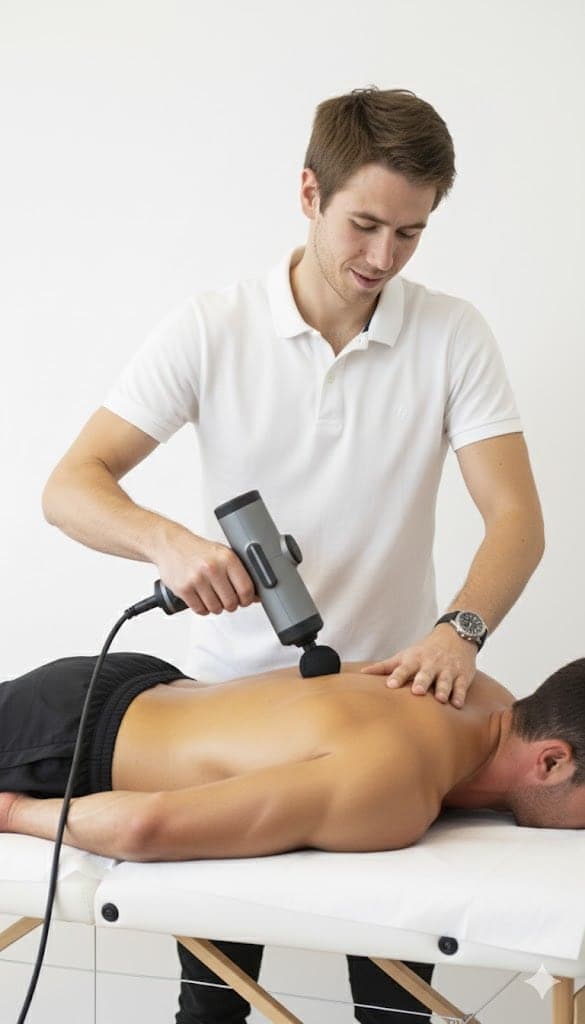
Written by
Chris
Massage therapist, nutrition and exercise physiologist
Norwegian-certified with a Bachelor’s in Physical Education and Nutrition and over ten years of clinical practice, working from a portable table in clients’ homes across the Paphos district.
- Norwegian-certified
- Nutrition & exercise physiologist
- 10+ years clinical practice
- Based in Chlorakas · all of Paphos district
- No call-out fee anywhere in Paphos district
Last updated
This article is general information, not a medical diagnosis. If you have severe, worsening or unexplained pain, numbness, weakness, or pain after an accident, see a doctor first.