Plantar fasciitis massage before surgery: what to try first
In short
Most heel pain settles without an operation. Plantar fasciitis massage that works the calf, the deep foot muscles and the fascia itself, combined with sensible loading, is what I would try before any surgical consultation in Paphos.
I get a lot of messages from people who have been told, or have concluded on their own, that surgery is the only thing left for their heel pain. In most of those cases the conservative work has not been done thoroughly. This is what I would try first, and where myofascial release in Paphos fits into it.
Why surgery is rarely the next step
Plantar fasciitis is a stubborn condition, but it is not usually a surgical one. The great majority of cases settle over months with a combination of load management, calf work and time. Surgery, in the form of a partial release of the fascia or a lengthening of the calf, is reserved for people whose pain has not shifted after a long, genuine attempt at everything else.
The problem is that "everything else" is often less than it sounds. The pattern I see most often in Paphos is someone who has bought insoles, done a few weeks of stretching, perhaps had an injection, and then stopped when the pain did not vanish. What has usually not happened is sustained work on the tissue that is actually overloading the heel.
Before anyone talks about an operation, I would want to know that the following have been given a fair run:
- Regular, deep work on the calf complex and the sole of the foot, not a one-off session
- A loading programme for the calf and foot that has been followed for at least three months
- A sensible look at footwear and daily walking volume, particularly on the hard tiled floors most homes here have
- Enough time — the fascia is slow tissue and it heals on its own schedule, not on ours
If those four have genuinely been done and the heel is still no better, that is a different conversation, and I return to it further down.
What is actually happening in the heel
The plantar fascia is a thick band of connective tissue running from the heel bone to the base of the toes. It acts as a tension cable that keeps the arch from collapsing each time you load the foot. When the load exceeds what the tissue can tolerate, the attachment at the heel becomes irritated, thickened and, over time, degenerative rather than inflamed. That is why anti-inflammatory approaches often do very little.
The fascia does not overload itself in isolation. It is at the bottom of a chain that includes the Achilles tendon, the calf muscles and the deep muscles of the sole. When the calf is short and stiff, the ankle cannot bend far enough during walking, and the fascia is asked to make up the difference. This is the mechanism I find in most of the heels I treat.
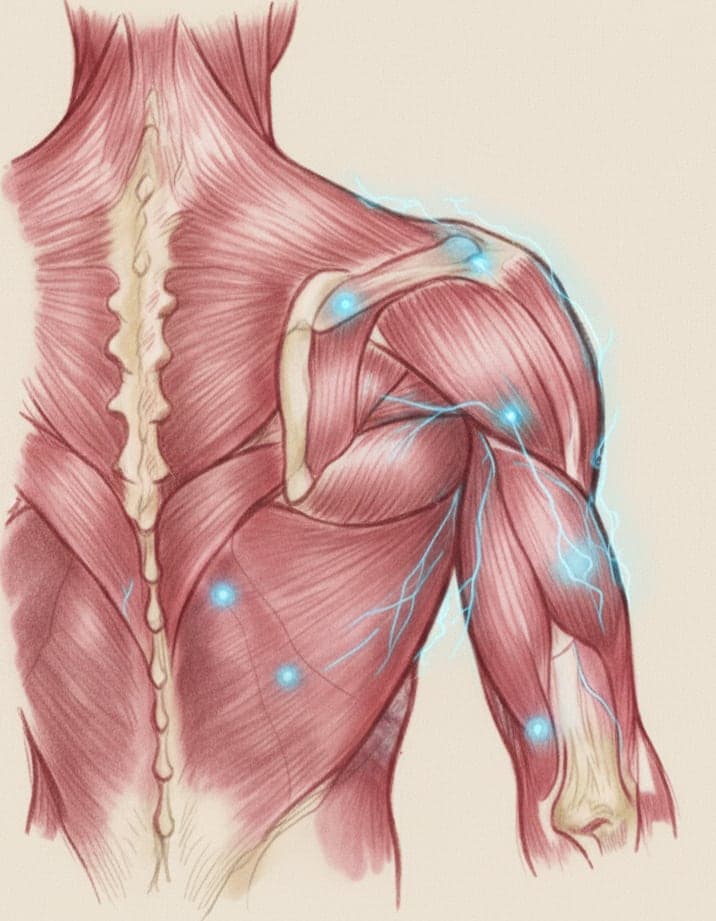
Because the fascia is the victim rather than the culprit, working only on the sore spot rarely gets far. Grinding a ball into the heel feels productive but tends to irritate an already irritated attachment. The useful work is mostly higher up.
What plantar fasciitis massage involves
When I treat a heel at someone's home in Paphos, the fascia itself gets perhaps a fifth of the session. The rest goes into the tissue that is loading it. My approach is mechanical and deep rather than soothing, and it follows roughly this order.
The calf comes first. I work through the gastrocnemius and soleus slowly, layer by layer, looking for the dense bands that restrict ankle bend. On most people the inner calf is worse than the outer, and the soleus, the deeper of the two, is where the real restriction sits. This part is uncomfortable but it should never be sharp. Then the Achilles and the tissue around it, particularly where the tendon meets the heel. From there I move to the sole: the deep muscles under the arch and along the inner border of the foot, worked with sustained pressure rather than fast strokes. Only at the end do I address the fascia and its attachment, and gently, because that tissue is already under strain.
| Area | Share of the session | What I am looking for |
|---|---|---|
| Calf (gastrocnemius and soleus) | About half | Dense bands limiting ankle bend |
| Achilles and lower leg | About a fifth | Thickening and adhesion near the heel |
| Deep sole muscles | About a fifth | Weak, tight arch support tissue |
| Plantar fascia and heel attachment | The remainder | Sensitivity, thickening, tolerance |
I also treat the other leg. A stiff hip or a tight hamstring changes the way the foot lands, and one heel rarely goes wrong without the rest of the chain being involved. If you would rather read about that side of things, my page on mechanical deep tissue massage in Paphos covers what the broader treatment looks like.
What a course of treatment looks like
One session will tell us both a lot but will not fix a heel that has been sore for months. Connective tissue adapts slowly, and the pattern that produced the pain will reassert itself unless the calf keeps being worked and the loading is changed. Realistically I would want to see someone every one to two weeks for the first month, then stretch the gaps out as the morning stiffness eases.
Between sessions, the work you do yourself matters as much as what I do. This is the part that is most often skipped.
The signal I watch for is the first few steps in the morning. When those start to soften before anything else changes, the tissue is turning a corner even if the rest of the day is unchanged. That usually happens before the pain in the evening does. Prices are on the pricing page: €90 for 60 minutes and €130 for 90 minutes, and I generally suggest 90 minutes for a first heel session because there is a lot of ground to cover from the hip down.
When conservative treatment really has failed
I am not against surgery, and there are heels that need it. What I am against is arriving at the surgical consultation with the conservative options only half tried. The following is a reasonable picture of a heel that has genuinely exhausted them:
- Pain that has been present for well over a year despite steady work on the calf and foot
- A loading programme followed properly for several months with no change in the morning symptoms
- Imaging that shows a substantial thickening or a tear in the fascia rather than simple irritation
- Compensation that has spread — a limp that is now producing knee, hip or back symptoms
Even then, the surgeon and your GP will make the call, not me. What I can do at that stage is keep the calf and foot as mobile and well-conditioned as possible before the operation, and help restore movement afterwards once the surgeon has cleared hands-on work. The chain that overloaded the fascia does not disappear because part of the fascia has been released, and people who go into surgery with a stiff calf tend to come out with a stiff calf.
What I can and can't help with
I can help with the mechanical side: a stiff calf, a foot that has stopped supporting itself, a heel that hurts because the chain above it is not doing its job. What I cannot do is diagnose the cause of your heel pain or tell you whether you need an operation. See a doctor first if the pain came on suddenly after a snap or a fall, if the heel is hot, swollen or red, if you have numbness or tingling in the foot, if the pain is there at rest and at night, or if you have a condition that affects your circulation or your nerves.
- Suitable: heel pain that is worst first thing in the morning and eases with walking, a tight calf, a foot that aches after long days on tile
- Ask a doctor first: sudden onset with a pop, swelling and heat, night pain, numbness, or a history of diabetes or vascular disease
- Also useful: post-operative mobility work once the surgeon has cleared hands-on treatment
Frequently asked questions
Can massage really replace surgery for plantar fasciitis?
For most people it never comes to that choice. Deep, regular work on the calf and the sole, combined with a proper loading programme and enough time, is what settles the majority of heels. Surgery is a last option for the small number of cases that do not respond after a long conservative effort. Massage is part of that conservative effort, not a rival to the operation.
How many sessions will my heel need?
I cannot promise a number, and I would be cautious of anyone who does. A useful pattern is a session every one to two weeks for the first month, then longer gaps as the morning stiffness eases. How quickly that happens depends on how long the heel has been sore, how much you walk, and how consistently the home exercises are done between visits.
Should the fascia itself be massaged hard?
No. The attachment at the heel is already irritated and grinding into it usually makes it worse for a day or two without any lasting benefit. The heavy work belongs in the calf and the deep muscles of the sole, which are what overload the fascia. The fascia gets gentler, sustained pressure at the end of the session, and I stop if it is sharp.
Is a home visit practical for a foot problem?
Yes, and it suits it well. I bring the table and everything else, and there is nothing about a heel treatment that needs a clinic. The advantage of being at your home is that we can look at the floors you walk on, the shoes you wear indoors and the stairs you climb, which are often part of the picture on the hard tiled surfaces common around Paphos.
What if I have already had the operation?
Once your surgeon has cleared hands-on work, the same approach applies: restore ankle bend, get the calf moving, and rebuild the deep foot muscles. Post-operative heels are often stiffer than before because of the period of protected walking. I stay well clear of the incision until it is fully healed and work within whatever limits your surgeon has set.
Do you treat the whole leg or just the foot?
The whole leg, and usually both. A stiff hip or hamstring changes how the foot lands, and I rarely find a sore heel on a leg where everything above it is moving well. A first heel session is normally 90 minutes for that reason. Later sessions can be shorter once we know where the restriction actually sits.
Evidence and limits
Massage may help with some symptoms, but benefits and evidence vary by condition. It does not replace medical assessment or treatment. A page update is not evidence of an independent clinical review.
Further reading: Massage therapy: evidence, safety and limitations by US National Center for Complementary and Integrative Health. This is general background reading, not verification of every claim in this article.
How we describe evidence and updates
Written by
Chris
Massage therapist, nutrition and exercise physiologist
Norwegian-certified with a Bachelor’s in Physical Education and Nutrition and over ten years of clinical practice, working from a portable table in clients’ homes across the Paphos district.
- Norwegian-certified
- Nutrition & exercise physiologist
- 10+ years clinical practice
- Based in Chlorakas · all of Paphos district
- No call-out fee anywhere in Paphos district
Last updated
This article is general information, not a medical diagnosis. If you have severe, worsening or unexplained pain, numbness, weakness, or pain after an accident, see a doctor first.